
Quick Answer

A contract of indemnity acts like a financial safety net and shifts the risk of monetary loss from one party to another. It delivers commercial certainty and lets businesses and individuals go with their activities fearlessly without the worries of potential catastrophic legal and/ or financial damages because of these events.
From what I have analyzed over the past few years, a contract of indemnity is much more than a boilerplate risk-allocation clause.
Rather, it is a complex statutory mechanism governed by Section 124 of the Indian Contract Act, 1872.
While standard textbooks limit their analysis to basic definitions, a rigorous legal evaluation reveals critical friction points. These include:
- Hidden jurisdictional divides.
- Evolving equitable rules on when liability triggers.
- Complex drafting nuances.
Understanding these advanced parameters is essential to truly get a hold of this primary commercial instrument.
What Is A Contract Of Indemnity?
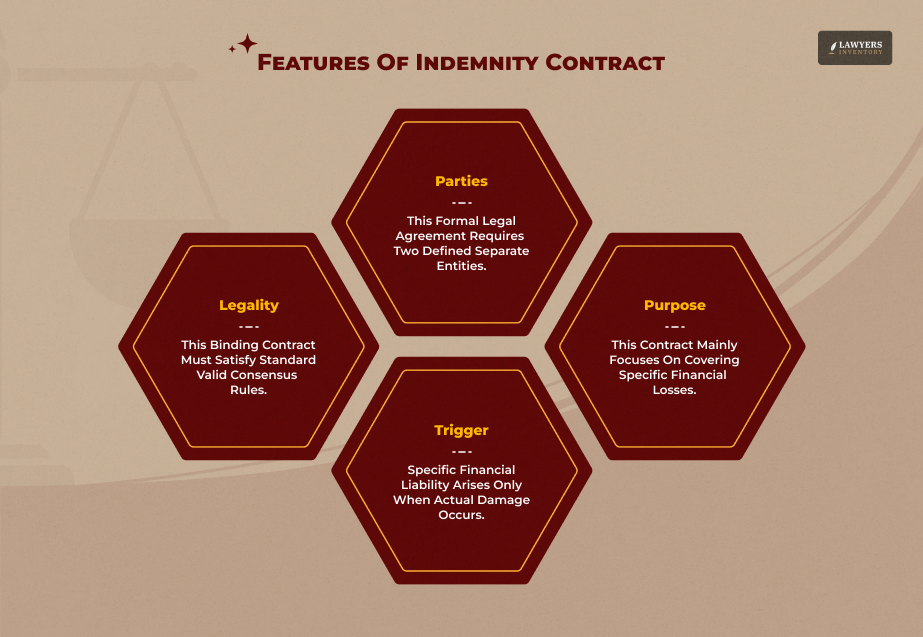
A contract of indemnity is a specialized legal agreement where one party promises to protect another party from financial losses caused by the actions of the promisor or a third party.
Derived from the Latin term indemnis – meaning “freedom from loss” – indemnity operates as a crucial risk-allocation mechanism in commercial leasing, mergers and acquisitions, supply chain logistics, and everyday insurance frameworks.
Statutorily, the framework is governed by Chapter VIII of the Indian Contract Act, 1872 (ICA). Section 124 of the Act explicitly defines it as:
“A contract by which one party promises to save the other from loss caused to him by the conduct of the promisor himself, or by the conduct of any other person.”
Example: If Party A enters into an agreement with Party B to construct its commercial premises and Party A assures that they will be solely responsible for the financial consequences of all code violation fines levied by the local municipality during the period of construction, they form an express contract of indemnity. At this point, Party A can be considered as the Indemnifier (promisor), and Party B, being the one to receive benefit from the contract, can be referred to as the Indemnity Holder (promisee or the party being indemnified).
Elements Of A Valid Indemnity Contract
To be legally enforceable in a court of law, an indemnity agreement must satisfy all core parameters of a standard contract under Section 10 of the ICA. These include:
- Free consent.
- Lawful object.
- Competent parties.
- Valid consideration.
Apart from these, there are the following mandatory attributes:
- Bipartite Arrangement: The contract must distinctly feature two parties: the Indemnifier, who accepts the financial risk, and the Indemnity Holder, who is protected from it.
- Promise of Protection: There must be an explicit or implied commitment to safeguard the promisee against an anticipated financial burden.
- Causation via Human Agency: Under the strict wording of Section 124, the anticipated loss must stem specifically from human conduct (either the promisor or any third party).
- Lawful Object: The indemnity cannot protect a party against legal consequences arising from committing an intentional crime or fraud.
Cross-Border Jurisdictional Comparison
A glaring content omission across major legal web portals is the massive operational difference between the Indian statutory framework and English Common Law.
| Legal Parameter | Indian Contract Act (Sec 124) | English Common Law |
| Scope of Trigger Events | Restricted purely to human conduct. | Broad; covers human actions, accidents, fires, and Acts of God. |
| Implied Indemnity | Not explicitly codified within Section 124. | Broadly recognized through the behavior or trade relationship of parties. |
| Status of General Insurance | Classified separately as “Contingent Contracts” under Section 31. | Marine and fire insurance are treated as default indemnity contracts. |
What Are The Key Rights Under Section 125?
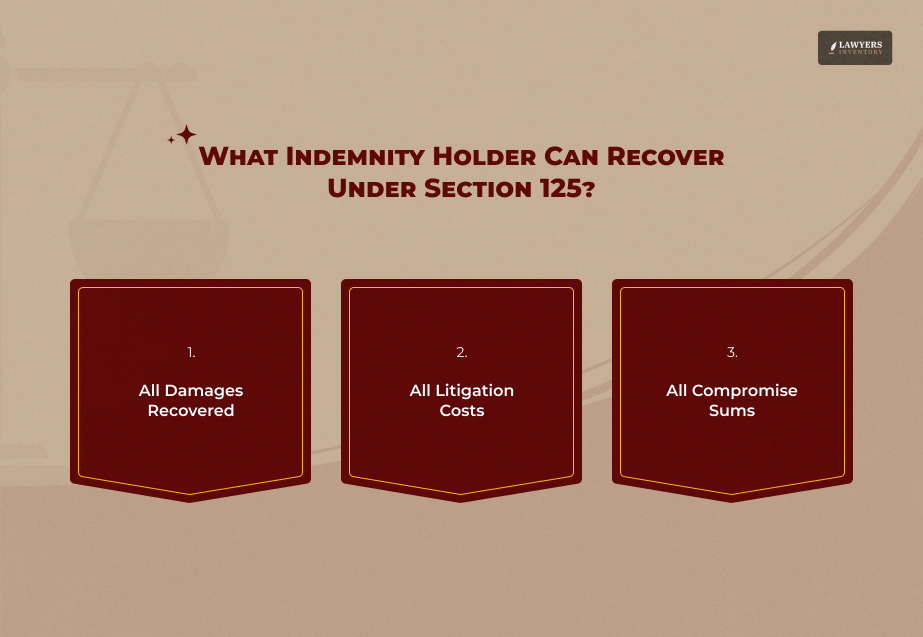
Section 125 of the ICA outlines the legal remedies available to an indemnity holder when sued by a third party.
Acting within their authority, the indemnity holder can legally recover three primary sets of financial sums from the indemnifier:
All Damages Recovered:
Firstly, all damages they are legally compelled to pay in any suit regarding matters covered by the indemnity agreement.
All Litigation Costs:
Secondly, all legal costs sustained while bringing or defending a suit, provided they acted prudently and followed the indemnifier’s instructions.
All Compromise Sums:
Finally, any financial settlements paid to resolve a lawsuit out of court, assuming the compromise was reasonable and not contrary to the explicit orders of the indemnifier.
Judicial Developments And The Commencement Of Liability In Contract Of Indemnity
Here’s where things can get a little tricky – the Indian Contract Law, 1872, does not explicitly state when the liability of the indemnifier truly begins under Sections 124 and 125.
The absolute turning point of indemnity application in India is rooted in judicial updates rather than raw statutory text.
Historically, under strict English law rules, an indemnifier was not liable until the indemnity holder suffered actual, physical pocket loss (“You must be damnified before you can claim to be indemnified”).
However, the landmark ruling of the Bombay High Court in Gajanan Moreshwar Parelkar v. Moreshwar Madan Mantri (1942) completely revolutionized this concept.
Justice Chagla clarified that the Indian Contract Act is not exhaustive regarding indemnity. The court held that equity steps in to relieve the holder as soon as their liability becomes absolute and clear, even if they have not yet paid out a single rupee to the third-party claimant.
Other historical landmarks include Adamson v. Jarvis (1827), which established that indemnity can be deduced from the auctioneer-client relationship.
Furthermore, Secretary of State v. Bank of India (1938) also decided that a bank must be indemnified for its actions when it deals in good faith at a client’s request in case the client presents a forged government promissory note to the bank. [Source: CaseMine]
Contract Of Indemnity vs. Contract Of Guarantee
Understanding the separation between Chapter VIII’s two primary risk-mitigation concepts – contract of indemnity and guarantee – is a foundational requirement for clean contract drafting.
| Operational Feature | Contract of Indemnity (Section 124) | Contract of Guarantee (Section 126) |
| Number of Parties | Two: Indemnifier and Indemnity Holder. | Three: Principal Debtor, Creditor, and Surety. |
| Primary vs. Secondary | The Indemnifier has primary, standalone liability. | The Surety’s liability is secondary; it triggers only upon debtor default. |
| Existing Privity | Only one contract exists between the core parties. | Three distinct, concurrent contracts are formed. |
| Subrogation Recoveries | The indemnifier cannot sue third parties in their own name without an assignment. | The surety automatically steps into the creditor’s shoes to sue the debtor. |
Step-by-Step Corporate Drafting Checklist Of Indemnity Contract
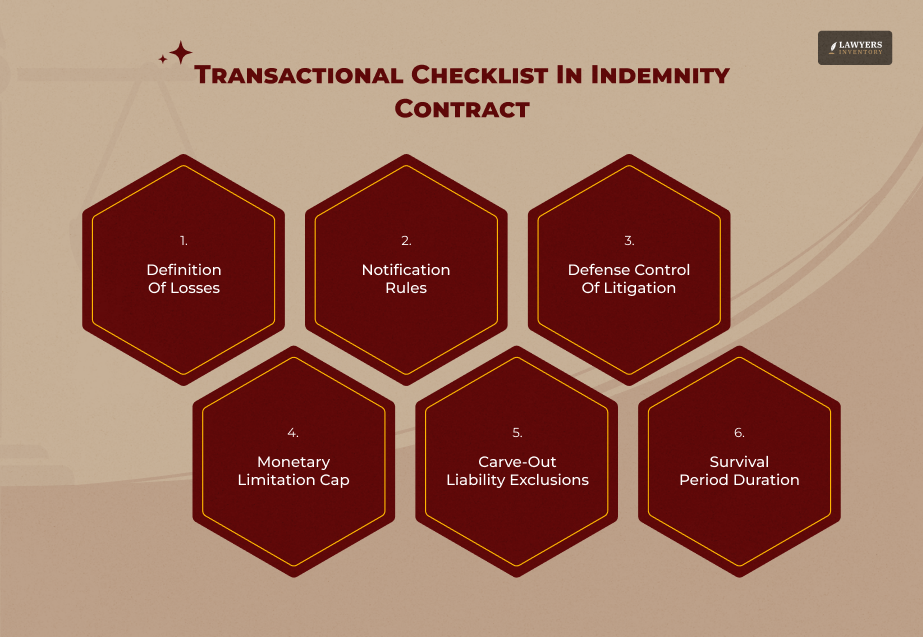
When drafting commercial contracts, generic descriptions fail. Reviewing attorneys should utilize this precise transactional checklist:
1. Definition Of Losses
Firstly, “losses” means any and all direct financial harms, liabilities, and damages. This scope explicitly includes the following:
- Reasonable out-of-pocket expenses.
- Attorney fees.
- Litigation costs.
It also covers court fees, expert witness fees, judgments, fines, penalties, and settlement amounts. The language is intentionally comprehensive.
This structure prevents any party from misrepresenting, narrowing, or excluding these expenses during a dispute.
2. Notification Rules
The Indemnified Party must report third-party claims quickly to preserve indemnity rights. If a third party notifies the Indemnified Party of a claim, a strict clock begins. The Indemnified Party has exactly 30 working days from that notice to act.
Within this window, they must send a formal written demand to the Indemnifier. This prompt timeline ensures the Indemnifier can mount an effective, early defense.
3. Defense Control Of Litigation
The Indemnifier holds full control over the litigation strategy. Under this provision, the Indemnifier exclusively picks the defense counsel. The Indemnified Party must approve this choice, but they cannot unreasonably withhold consent.
Furthermore, the Indemnifier retains the sole right to finalize and sign a settlement. However, a settlement cannot impose un-indemnified financial liability or admit guilt on behalf of the Indemnified Party without their written consent.
4. Monetary Limitation Cap
The Indemnifier’s total financial liability under this agreement has a strict maximum ceiling. The liability cap equals 100% of the total fees paid to the Indemnifier under this Agreement.
This calculation only counts the fees paid in the preceding 12 months before the specific claim arose. This calculation method reflects standard commercial market practice. [Source: Legistify]
5. Carve-Out Liability Exclusions
The monetary cap does not protect the Indemnifier from severe bad conduct. The liability limit is completely void for acts of fraud, gross negligence, or willful misconduct.
If the Indemnifier commits these specific actions, the financial cap is removed. The Indemnifier then faces unlimited financial liability for all resulting losses.
6. Survival Period Duration
The indemnity protection outlasts the expiration or termination of the core agreement. This specific indemnity clause remains active for a survival period of 3 years post-termination.
This exact timeframe matches the standard statutory limitation laws for contractual claims in the industry.
As a result, parties can still legally file indemnity claims during this post-termination window.
Disclaimer: The information provided in this article is for general informational purposes only. It does not, and is not intended to, constitute legal advice. Please consult an attorney for legal help.
Sources:
- The Indian Contract Act, 1872 (Act No. 9 of 1872), Chapter VIII, Sections 124 & 125.
- CaseMine – Gajanan Moreshwar Parelkar v. Moreshwar Madan Mantri, (1942) 44 BOMLR 703.
- iPleaders Blog – Adamson v. Jarvis (1827) 4 Bing 66; Secretary of State v. Bank of India (1938) 40 BOMLR 868.
- International Journal of Law Management and Humanities – The Evolution of Indemnity under the Indian Contract Act, 1872.
Leave A Reply






What Is An Operating Agreement? LLC Requirements, Key Provisions, And Why You Need One
Read More
Intentional Infliction Of Emotional Distress Explained: Elements, Evidence, And What Makes A Claim Win
Read More
What Is A Preliminary Hearing? Core Procedures, Timeline, And What To Expect
Read More
What Is Grand Larceny? Felony Thresholds, Penalties, And Your Legal Options
Read More
Larceny vs. Theft: What’s The Real Legal Difference?
Read More
0 Reply
No comments yet.