Quick Answer:

Absence from work, performance, grievance, disciplinary, redundancy, dismissal and workplace disputes are handled without a fair and documented procedure. This is the biggest risk to legal and HR compliance for UK employers. You can best reduce tribunal exposure by following the Acas Code of Practice and getting professional help early.
Operating a business involves handling a team, and handling a team comes down to risk management.
When I was asked to write this piece, my first step was to really dive into the Acas Code of Practice. That is not all; I also had to keep a close eye on the Employment Rights Act 2025 as it evolved.
One thing came up again and again: employers rarely set out to break the law. Small failures cause most of the damage. A grievance goes unanswered. A disciplinary meeting happens with no notes. An absence case drags on informally for months.
The rules are shifting fast, too.
From April 2026, Statutory Sick Pay started from an employee’s first day of sickness, and the lower earnings limit disappeared. From January 2027, staff will only need six months’ service to bring an unfair dismissal claim, down from two years.
Tribunals will also be able to award uncapped compensation. If you wait until a problem escalates before you check your procedures, you’re already exposed.
The HR Compliance Checklist For Every UK Employer
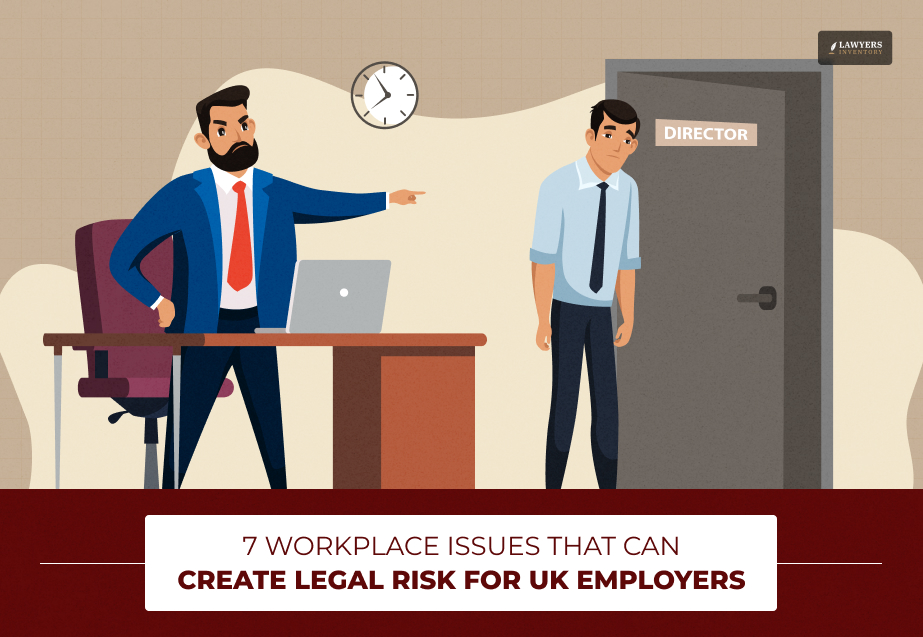
Below, I’ve set out seven workplace issues that keep coming up in employment tribunals, and why proper HR compliance and procedure matters at every stage.
Take a look at them:
1. Mishandling Employee Grievances
A grievance is a formal, written complaint. Employees usually raise grievances due to poor treatment. They might also raise them over bad behaviour. Poor working conditions are another common cause.
According to Indeed, you must address any grievances immediately. Treat every incoming complaint with absolute seriousness.
The Acas Code of Practice on Disciplinary and Grievance Procedures sets the benchmark. The Code outlines clear procedural expectations. [Source: Acas, Lex HR]
You must do the following:
- Conduct a timely investigation.
- Convene a formal meeting.
- Allow the employee to be accompanied.
- Inform the employee in writing of your decision.
Acas is currently reviewing a new version of the Code. According to Lexology, the public consultation period runs until 23 September 2026. This update heavily encourages non-formal resolution methods. Employers should resolve problems at the earliest stage. Do this before initiating formal procedures.
Ignoring a grievance doesn’t make it go away. It usually makes things worse. A tribunal can increase compensation by up to 25% if you unreasonably fail to follow the Code.
A consistent, documented process protects the employee raising the concern and the business responding to it.
2. Disciplinary Action And Employee Misconduct
Disciplinary cases carry the same risk. If you act on assumptions, skip the investigation, or dismiss someone on the spot, that decision rarely survives a challenge.
A fair process looks like this: investigate properly, put the allegations in writing, hold a hearing where the employee can respond, then reach a decision that fits what actually happened.
Don’t treat suspension as automatic.
Case law and Acas guidance both say it’s a serious step that needs justification, not a default reaction to every complaint.
Weak documentation causes most of the successful challenges I came across in my research. If you can’t show what you investigated and why you reached a particular outcome, your position weakens fast.
3. Managing Sickness And Long-Term Absence
Absence management sits right at the crossroads of employment law, disability law, and simply keeping the business running. You need to balance operational pressure against your legal duties to staff who are genuinely unwell.
Since 6 April 2026, the SSP rules changed significantly. The three unpaid waiting days are gone, so eligible employees can claim SSP from day one of sickness.
The lower earnings limit disappeared too, so employees who previously earned too little to qualify are now covered. If your absence policy still reflects the old rules, update it.
Long-term absence brings extra obligations. Where an employee’s condition could count as a disability, you must consider reasonable adjustments. Don’t treat disability-related absence as a straightforward conduct issue.
Rushing to dismiss on ill-health grounds, without proper medical evidence and consultation, is one of the most common triggers for tribunal claims I found in my research.
4. Performance Management Problems
Underperformance isn’t misconduct, but employers often blur the line between the two. Poor performance usually calls for a structured improvement process, not disciplinary sanctions from the outset.
Set clear expectations first. Employees should know exactly what standard you expect, ideally written into a job description, a set of objectives, or a probation review.
When performance slips, raise it early. Put the support you’re offering and the targets you’ve set in writing. Give a realistic chance to improve before you consider anything more serious.
Skip that process and jump straight to dismissal, especially for someone with two or more years’ service, and you significantly raise your risk of an unfair dismissal finding.
Contemporaneous records – emails, review notes, improvement plans – carry far more weight than a manager’s memory of events from months earlier.
5. Redundancy And Organisational Changes
Redundancy is a legitimate business decision. But the process around it is heavily regulated, and getting your reasoning right isn’t enough on its own.
If you’re proposing 20 or more redundancies at one site within 90 days, collective consultation obligations kick in. That includes minimum consultation periods and notifying the Secretary of State.
Even below that threshold, follow a fair selection process, use objective criteria, consult individually, and consider suitable alternative roles before you confirm any dismissal.
Watch for further reform here too.
The Employment Rights Act 2025 is bringing changes to collective consultation thresholds and tighter restrictions on “fire and rehire” practices, phased in through 2026 and 2027.
Restructuring without proper planning and consultation remains one of the most litigated areas of UK employment law.
6. Dismissal And Termination Decisions
Dismissal is often where earlier failures in process become expensive. A decision made in the heat of the moment, without following the right steps, can turn a manageable situation into a tribunal claim.
You need a fair reason for dismissal, and a fair process leading up to it, whatever the reason: conduct, capability, redundancy, or something else entirely.
From January 2027, the qualifying period for an ordinary unfair dismissal claim drops from two years to six months. The compensation cap is also due to disappear.
That brings far more employees within reach to challenge a dismissal, and it raises your financial exposure wherever the process fell short.
Difficult situations arrive with little warning. An allegation surfaces overnight. A resignation turns into a dispute. A conduct issue demands an immediate call. In moments like these, you often don’t have time to research the correct procedure from scratch.
That’s exactly the gap that professional HR guidance, such as Avensure’s 24-hour HR helpline, is built to fill, helping you understand your options before you act.
7. Workplace Disputes That Begin To Escalate
Not all workplace issues start as complaints. They do not start as disciplinary cases either. The reality is quite different. Most workplace issues begin with small things.
This includes a clash between colleagues. It includes a communication breakdown. Sometimes a complaint is never raised formally.
Management intervention is absolutely critical. A lack of intervention causes major problems. It can mean harassment complaints. It can lead to discrimination claims. An employee might leave the company.
They may then initiate a constructive dismissal claim. This often happens because they lack proper compensation. Experts all agree on one specific point.
UK employment law is changing direction. It now strongly encourages early resolution. It also prioritises informal resolution.
Acas recently held a consultation. This covered disciplinary and grievance procedures updates. The update explicitly encourages employers to act early.
Employers must deal with concerns quickly. Resolve them before they become formal. Use methods such as mediation. Try facilitated conversations as well.
Notice when a situation becomes tense. Respond proportional to the problem. Here are some of the things that you will be able to do with that:
- Avoid financial and legal damages.
- Protect your reputation.
Serious legal disputes go through courts. They also spread all over social media.
Never assume an issue disappears on its own. That is rarely a good risk. Use early and well-measured intervention instead. Get the help of a professional. Do this when you are not sure what to do. This approach tends to be the most effective solution.
The Common Thread In HR Compliance: Process Protects Everyone
Across all seven issues, the same pattern kept showing up in my research. Legal risk rarely comes from the underlying workplace problem itself.
It comes from how you handle it, or fail to. Investigate properly. Document your decisions. Communicate clearly. Follow a recognised procedure. Those four habits protect employees and employers alike.
UK employment law is moving fast, from the SSP reforms already in force to the unfair dismissal changes due in January 2027.
If you review your HR compliance policies against what’s actually required now, rather than assuming last year’s approach still holds, you’ll be in a far stronger position to manage risk.
Disclaimer: This article provides general information for UK employers and should not be treated as a substitute for advice on a specific workplace situation.
Sources:
- Acas, Code of Practice on Disciplinary and Grievance Procedures, and the 2026 draft Code consultation (acas.org.uk)
- Acas, Employment Rights Act 2025 implementation guidance (acas.org.uk)
- GOV.UK, Statutory Sick Pay eligibility and rates
- Employment Rights Act 2025 (legislation.gov.uk) and government commencement regulations, including SI 2026/559
Leave A Reply







When Spouses Interpret Stability Differently: Marital Conflict
Read More

What Key Evidence Helps Prove Fault In A Serious Car Crash Claim?
Read More
What Every Injury Victim Should Carefully Weigh Before Settling
Read More
How A Skilled Family Attorney Protects What Matters In Divorce
Read More
0 Reply
No comments yet.