Summarize using AI





Prompt copied. Paste it into Gemini.
Quick Answer:

Legal compliance refers to the process of implementing the regulations a company is subjected to, covering local, national, and international laws as well as regulations and moral standard requirements of an industry. This kind of compliance works as a tool that enables businesses to avoid financial fines, court procedures where the company will bear most, if not all, the losses, a possible shutdown of the business, etc.
When I hear the term legal compliance, I often see people reduce it to one idea: following the law. That definition is correct, but it is not enough to help someone make a real decision.
Legal compliance means following the laws. It applies to people, businesses, and transactions. Organizations must meet all relevant regulations.
No single checklist works for everyone. Requirements change based on your location and industry. Employee count and data types also matter.
Indian companies face unique domestic laws. They manage corporate tax and consumer privacy. Meanwhile, U.S. businesses face three regulatory tiers. They must follow federal, state, and local rules.
Global companies face the highest complexity. They must manage overlapping international jurisdictions.
Good compliance protects your business. It:
- Shields you from expensive lawsuits.
- Prevents heavy financial penalties.
- Protects your corporate reputation.
This ensures smooth daily operations.
The U.S. Department of Justice also takes a practical view of corporate compliance programs. Its guidance evaluates whether a program is well designed, adequately implemented, and effective in practice.
What Does Legal Compliance Mean?
In simple terms, I use legal compliance to describe the process of identifying and following the laws and regulatory requirements that apply to an organization or activity.
That process involves more than creating policies. A business must first identify its obligations. It then needs appropriate procedures and controls. It must train relevant people, maintain records, monitor changes, and address problems when they arise.
This distinction matters because having a compliance policy does not automatically mean that an organization is compliant. Regulators may look at what the organization actually does.
The DOJ’s corporate compliance guidance, for example, considers risk assessment, policies and procedures, training, reporting mechanisms, third-party management, management commitment, resources, testing, investigation, and remediation. [Source: US. Department of Justice]
Why Is Legal Compliance Important?
Non-compliance causes severe corporate damage. Organizations can face heavy financial fines. They may face regulatory enforcement actions.
Lawsuits and lost licenses are common risks. Violations disrupt daily business operations. They also cause lasting reputational damage. The exact penalties depend on applicable laws. The specific nature of the violation matters too.
Compliance helps organizations anticipate minor issues. It addresses small problems early. Left unattended, these problems escalate. They can turn into major legal disputes.
An efficient compliance system spots red flags. For instance, here are a few things that it does:
- Picks out missing approvals.
- Finds old policy documents.
- Flags missed reporting dates.
- Identifies conflicts of interest.
- Stops hazardous work practices.
- Prevents the mishandling of personal data.
However, I would avoid assuming that compliance eliminates legal risk. It does not. Laws can be unclear. Regulations can change. Employees and third parties can make mistakes. Regulators can also interpret requirements differently across jurisdictions.
The goal is therefore not to promise “zero legal risk.” The goal is to identify applicable obligations, reduce preventable violations, and respond appropriately when issues arise.
What Areas Does Legal Compliance Cover?
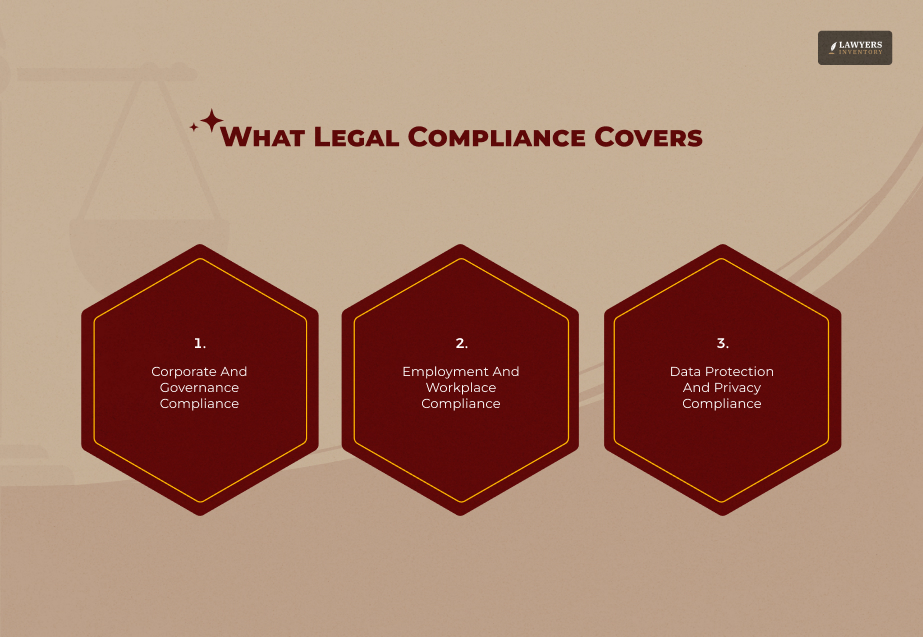
There is no single list that applies to every organization. I would start with the activities that create legal obligations for the particular business.
Corporate And Governance Compliance
Companies must manage key internal matters. These include incorporation, directors, and corporate records. Financial reporting and shareholder issues also require oversight. Finally, firms must handle filings and overall governance.
The Companies Act, 2013 is the central corporate law in India. It:
- Regulates all daily operations of companies.
- Covers incorporation, management, and administration.
- Dictates financial affairs and regulatory filings.
This Act remains an effective tool for corporate governance. Compliance requirements depend on your specific structure. Circumstances and business forms change these rules. [Source: India Code]
Therefore, a generic checklist is not effective.
Rather, it is better to review relevant statutes first. You must check specific rules, notifications, and regulator guidelines.
Employment And Workplace Compliance
Employers may need to comply with rules covering wages, working conditions, workplace safety, discrimination, leave, employee records, benefits, and termination.
The exact requirements vary by jurisdiction. In the U.S., for example, federal employment requirements can operate alongside state and local rules. In India, businesses must consider the applicable central and state-level employment framework.
This is one area where a business should avoid copying another company’s compliance policy. A policy designed for a different workforce or jurisdiction may not satisfy the rules that actually apply.
Data Protection And Privacy Compliance
Data compliance has become a major legal issue for organizations that collect or process personal information.
The European Union’s GDPR regulates the processing of personal data and gives individuals rights concerning their personal information.
India has also enacted the Digital Personal Data Protection Act, 2023. The Act establishes a legal framework concerning the processing of digital personal data, although its provisions come into force according to government notification.
For a global business, the important question is not simply “Do I follow GDPR?” I would first ask which people and data activities are covered, where the organization operates, and which laws apply to those activities.
Industry-Specific Legal Compliance

Some businesses face additional rules because of the services they provide.

Different industry sectors face highly specific demands. Each field has unique rules for legal conformity.

Because of this, similar companies have different needs. Two firms might have identical employee counts. They might share the exact same business statistics. Even so, their compliance requirements will differ widely.

Several key elements change the legal situation analysis. The specific type of industry matters greatly. The kind of business structure plays a massive role. This includes being a retailer, wholesaler, or distributor.

The type and profile of customers also shift the rules. Finally, the specific products and the regional reach of operations completely alter the compliance landscape.
How Do I Know Which Laws Apply To My Business?
This is where I would begin any compliance review.
First, I would identify where the business operates. That can include its incorporation jurisdiction, offices, employees, customers, facilities, and markets.
Next, I would identify what the business actually does. Selling products, processing personal data, employing staff, providing financial services, importing goods, or operating a healthcare facility can create different legal obligations.
I would then identify the regulators and laws connected to those activities.
For a business operating across borders, I would repeat this process for each relevant jurisdiction. A global company should not assume that compliance with the law in its home country automatically satisfies requirements elsewhere.
What Does An Effective Legal Compliance Program Look Like?
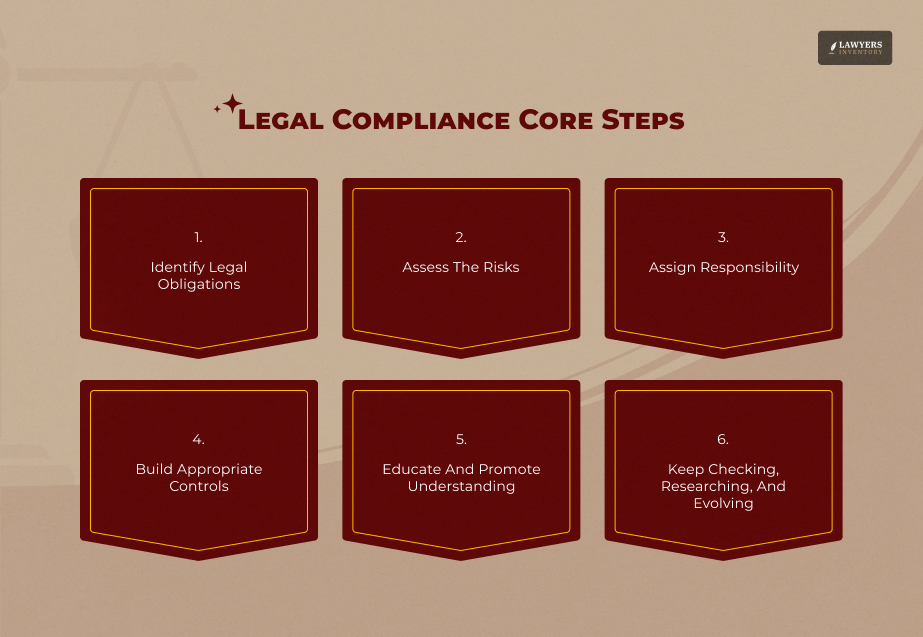
A useful compliance program should be practical enough for employees to follow and specific enough for management to monitor.
I would build it around six core steps.
1. Identify Legal Obligations
Prepare a list of the laws, regulations, licenses, permit filings, contractual obligations, and industry requirements to which you are subjected.
2. Assess The Risks
Compliance failure can bring different outcomes. I will evaluate the probability and seriousness of such failure.
3. Assign Responsibility
Each person who is A lot involved in the compliance of an obligation has to be the one who takes overall responsibility. According to the case of a business legal compliance, HR finance security, operations, or top management might be the responsible party.
4. Build Appropriate Controls
A written law or policy can give rise to actions required that are different from the literal wording. The various elements in a set of compliance controls could be approval procedures, restriction of access, maintenance of records audits complaint or reporting channels, and mandatory reviews.
5. Educate And Promote Understanding
Workplace compliance rules are not only for management. Workers must also know about the rules governing their jobs. Training can be much more meaningful if it is based on the reality and specific scenarios facing the workforce.
6. Keep Checking, Researching, And Evolving
Compliance activities do not happen just once; they have to run throughout the time you are subject to the regulation.
So, a company should keep watching the requirements, running the controls and, in cases of suspected infractions, conducting investigations, documenting remedies and enhancing their processes.
The DOJ’s compliance framework supports this risk-based approach. It emphasizes not only whether a program exists, but whether it is implemented effectively and works in practice.
What Happens If A Business Is Not Legally Compliant?
Consequence severity varies greatly. It depends heavily on the specific law broken. The geographic location also changes the outcome. Furthermore, the violation type and corporate behavior matter.
Factual scenarios lead to various negative outcomes. They:
- Trigger intense regulatory probe requests.
- Result in heavy financial penalties.
- Bring strict disciplinary measures.
Moreover, if warranted, criminal prosecution occurs. Businesses face civil lawsuits. They lose vital licenses and authorizations, pay high remediation costs, and they suffer massive damage to their corporate image.
Be skeptical of general penalty figures. Avoid generic “non-compliance cost” statistics. Only use figures tied to specific legislation. Laws differ completely between countries. Administrative enforcement procedures vary just as much.
The same reasoning applies to enforcement allegations. Compliance failures do not yield identical results everywhere. A specific mistake has different consequences in different jurisdictions.
Therefore, follow the most secure method. First, identify the exact requirement breached. Next, thoroughly research the law at issue. Review all corresponding regulations. Study the regulator’s official explanations. Finally, examine the applicable enforcement system.
When Should I Get Legal Help With Compliance?
Erroneous analysis can cause severe consequences. It can even lead to business loss. Furthermore, some laws leave no room for interpretation. In these specific cases, a lawyer is the best person to consult.
Legal counsel is a necessity in many situations. You need them when entering a new location. They are vital when releasing regulated products. They help when collecting confidential personal details. You should consult them when hiring staff abroad.
They must handle messages from regulators. They should oversee misconduct inquiries. Finally, they must respond to alleged violations.
Lawyers help identify key differences in rules. They separate legal requirements from industry practices. Industry practices are simply recommended guidelines.
Lawyers will emphasize one major point. Commonly accepted standards are not always laws. Doing what seems right is not always legally binding. The law is never just a piece of paper.
Large entities often combine two corporate functions. They make legal and compliance teams complement each other. Lawyers determine the exact legal obligations.
Moreover, they also assess potential risks. Meanwhile, compliance professionals put those obligations into effect. They use company tools like internal policies and controls.
How Should You Approach Legal Compliance?
I would not start with a massive checklist.
Rather, I would start with the business itself. Experts recommend that one should identify its:
- jurisdictions,
- activities,
- employees,
- customers,
- data,
- licenses,
- contracts,
- regulated relationships.
Then they should map those activities to the laws and regulatory requirements that actually apply. After that, rank the risks.
For example, I would assign responsibility for each major obligation. I would document the controls. Finally, I would create a process for monitoring legal changes and addressing gaps.
That approach is more useful than treating legal compliance as a one-time exercise.
Legal requirements change. Businesses change too. A company can enter a new market, launch a new product, collect new categories of data, hire employees in another state or country, or become subject to a new regulator.
For that reason, I view legal compliance as an ongoing legal and operational process, not a certificate that a business earns once and keeps forever.
Sources:
- U.S. Department of Justice, Evaluation of Corporate Compliance Programs. DOJ compliance resources
- U.S. Department of Justice, Corporate Compliance Program guidance and evaluation framework.
- India Code, The Companies Act, 2013.
- Ministry of Electronics and Information Technology, Digital Personal Data Protection Act, 2023. MeitY – Digital Personal Data Protection Act, 2023
- EUR-Lex, General Data Protection Regulation (GDPR). EUR-Lex – GDPR
- V-Comply, Legal Compliance definition and overview – reviewed as a competing SERP source rather than relied upon as the primary legal authority.
- greytHR, Legal Compliance – reviewed as a competing SERP source, particularly for the HR-compliance angle.
- PKP Consult, Understanding the Importance of Legal Compliance for Business – reviewed as a competing business-focused source.
Leave A Reply






Do You Pay Taxes On Lawsuit Settlements? IRC Section 104 Explained
Read More
Non-Disparagement Clause Explained: Requirements, Enforceability, And What Changed Recently
Read More
Best Practices For Successful Trademark Registration
Read More
Understanding Your Rights: A Guide To The Legal Process
Read More
How To Clear A Bench Warrant Without Going To Jail: A Legal Guide
Read More
0 Reply
No comments yet.