
Summarize using AI





Prompt copied. Paste it into Gemini.
Listen to this article
Quick Answer: How Much Is Law School?

On average, law school costs around $52,801 per year in tuition, with total three-year J.D. expenses averaging $215,105. Prices vary by school type, ranking, and location. However, it can be less than $100,000 at affordable public universities to over $380,000 for top private schools.
The cost of attending law school is not just the price that appears on the website of your university. When understanding how much is law school, you must look beyond.
On average, the total cost for someone graduating in 2026 will be $215,105 for a 3-year Juris Doctor (J.D.) course.
Unfortunately, the traditional financial guides will not provide the real compound costs that will ensnare you as a graduate. Therefore, to get into the legal sector, you must consider the financial aspects.
Your financial decisions will determine how free you are within your profession for decades. You must understand the hidden pitfalls of getting into debt as a graduate by analyzing data and loan structures.
How Much Is Law School? Understanding The Base Tuition Rates
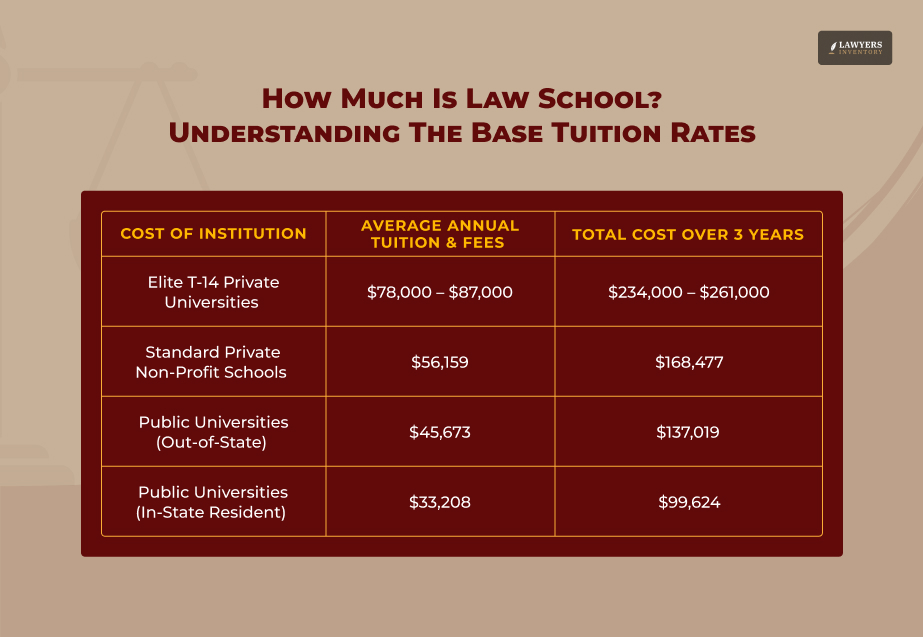
The starting point for your legal education will vary massively depending on your institution and whether you’re an in-state student.
According to the American Bar Association (ABA) Section of Legal Education, the average tuition fees at a private non-profit university are $56,159 per year in tuition alone.
Public institutions present a lower barrier for state residents, averaging $33,208. If you’re an out-of-state student at a public university, your fees will be very similar to those charged at private institutions.
Over the last three decades, these costs have been well above inflation thanks to reduced state funding and reduced student numbers per faculty.
At elite private universities, your annual tuition will often exceed $80,000. To work out your budget, you must categorize these costs.
| Cost of Institution | Average Annual Tuition & Fees | Total Cost Over 3 Years |
| Elite T-14 Private Universities | $78,000 – $87,000 | $234,000 – $261,000 |
| Standard Private Non-Profit Schools | $56,159 | $168,477 |
| Public Universities (Out-of-State) | $45,673 | $137,019 |
| Public Universities (In-State Resident) | $33,208 | $99,624 |
Pre-Law Admissions And Gatekeeper Expenses
The real costs of getting a law degree begin before you’ve even set foot in one lecture. You’ll be required to pay to sign up for the compulsory tests and apply using the application sites. Many candidates will spend thousands of dollars to obtain a letter of acceptance.
To manage this amount of money, you must be careful with your budget. If you rush into preparing for your tests, you’ll often perform worse and therefore incur extra costs for retaking the tests.
LSAT And Preparation Costs
To gain a place at a competitive university, you must perform well on your main entrance exam.
Prospective students must map out how to study for the LSAT by budgeting for the official prep books, question bank subscriptions, and logic courses. This process normally takes between 3-6 months.
The LSAT can be a very stressful and expensive exam to sit. The difficulty of the LSAT often causes debate amongst students. The exam focuses on logical reasoning and quick deduction rather than rote learning.
Recently, a new section was added to the exam – the argumentative writing section. This section is now compulsory.
Requirements For Top Universities
If you’re aiming to get into a top university, you’ll need to perform extremely well. Research exactly what LSAT score you need for Harvard.
To get into an elite university, your score will need to be almost perfect. The scores at these universities tend to be between 174-180.
Some candidates will aim for a law school that doesn’t require an LSAT score. Instead, they’ll use their GRE results.
The application process itself can be expensive.
Each school you apply to will have a baseline fee of $215 for its Credential Assembly Service (CAS), plus $45 to the Law School Admission Council (LSAC).
Typical university application fees will be $80. And applying to a strategic list of ten schools quickly eclipses $700.
How Much Is Law School With Hidden Financial Traps?

The actual cost of obtaining your legal education can often be higher than the university’s estimate. Most students will budget for their education based on the Cost of Attendance (COA) provided by the university.
However, there are hidden costs involved. These hidden costs are why many people leave law school with huge debts.
Living Costs
One of the biggest issues with traditional law school budgeting guides is the underestimation of living costs when living off campus in a city. The ABA reported the average living costs for students living off campus as $28,791.
However, these costs are based on the Fair Market Rent (FMR) set by the government. This means the average living costs for each county will be calculated.
This fails to account for the actual costs you’ll pay in cities such as New York, San Francisco, and Chicago.
Many landlords will charge a premium for living in areas surrounding elite law schools. This premium will be between 30%-50% more for either a 9- or 12-month graduate lease.
As the government loans for graduates are capped at the COA set by the university, students will be short on cash. They will often have to use high-interest private loans to cover this shortfall.
Interest Costs After Graduation
The second hidden cost is the interest charged on your federal loans after graduation. Unlike undergraduate loans, federal Direct Unsubsidized and Grad PLUS loans will start to accrue interest as soon as you receive them.
The current APR for federal PLUS loans is 8.94%.
The issue comes with the 6-month grace period you’re given after graduation. During this time, you’ll be studying for your bar exams over the summer.
You will not earn any money during this period, but your interest will still accrue. Once this period ends, the lender capitalizes the accumulated, unpaid interest by adding it directly to your principal balance.
For the average borrower, this will be $119,292 in debt. This single accounting event permanently swells the principal by over $12,000.
Scholarships And Academic Timelines

To reduce the steep costs of a J.D., you should aim to receive a scholarship. Receiving a competitive scholarship at law school will help to improve your ROI.
According to AccessLex, 80% of full-time law students receive some form of grant. However, you must be careful with your scholarships. If you’re receiving conditional scholarships, you may find yourself in a difficult position if you don’t perform well.
Duration Of Law Degrees
When considering funding offers, you must consider how long it takes to complete your law degree.
Traditionally, law degrees take 3 years to complete. This is 6 semesters. If you’re completing a part-time or evening course, it will take 4 or 5 years.
| J.D. Enrollment Pathway | Mandatory Academic Credit Minimum | Typical Completion Window | Summer Employment Availability |
| Accelerated Track | 83 – 88 Units | 24 Calendar Months | None (Mandatory Summer Classes) |
| Traditional Track | 83 – 88 Units | 36 Calendar Months | Full (Open for Law Firm Clerkships) |
| Part-Time Track | 83 – 88 Units | 48 – 60 Calendar Months | Full (Maintains Regular Employment) |
If you want to complete your law degree in 2 years, you’ll have to attend summer classes. While this will reduce the time you’re out of work, you’ll lose the opportunity to gain a summer associate role at a firm. Without being a clerk, you may struggle to gain employment after graduation.
Bar Exams And Career
Unfortunately, you will not be able to claim a professional salary once you graduate with your law diploma. You must pass strict regulations to become a practicing attorney. This will incur extra costs.
These final stages of your career will require months of revision. If you fail your first time, you’ll be out of work for an extra 6 months, costing you a lot of money.
Bar Exam Changes
During your final year, you’ll need to sign up for your licensing exam. For over 40 states, the UBE Bar exam was traditionally used.
This allowed your scores to be transferred between states. This exam consisted of strict multi-state multiple-choice questions and general common law essays.
However, many states are now moving towards the new NextGen Bar exam. This exam focuses less on rote learning obscure legal principles and more on practical skills needed on day 1 as a lawyer.
This includes:
- Client advising.
- Online research.
- Contract drafting.
Careers Outside Of Court
Once you’ve obtained your license, you must utilize your qualification to pay off your debt. Many candidates will ask: What can you do with a law degree?
Fortunately, there are many highly lucrative careers within corporate law. These include compliance, litigation financing, and legal tech.
- Litigation Finance: Assessing potential lawsuits as investments
- Legal Tech: Creating cutting-edge AI compliance systems and data automation systems
- Enterprise: Managing global compliance and risk management systems within Fortune 500 companies.
Many of these roles will offer competitive salaries.
Knowing the differences can help graduates use their specific skills in a variety of industries. Those interested in a public sector role often wonder: Do you have to have a law degree to be a judge in the United States?
While the U.S. Constitution sets no formal educational or licensing requirements to become a federal Article III judge, holding a J.D. and a law license is a strict practical requirement for modern appellate and high-level courts.
In reality, the President will not nominate, and the Senate will not confirm, a candidate to a federal bench or a state appellate court without extensive legal credentials.
However, the American judicial system still permits non-lawyers to serve on certain lower-level state courts, such as municipal courts or justices of the peace.
Disclaimer: The information provided in this article is for general informational purposes only. It does not, and is not intended to, constitute legal advice.
Sources:
- Education Data Initiative: educationdata.org
- 7Sage Admissions Index: 7sage.com
- LawHub Trends and Cost Analysis: lawhub.org
- BestColleges Research Database: bestcolleges.com
- Sallie Mae Graduate Planning Guides: sallie.com
- AccessLex Institute Legal Data Deck: accesslex.org
- National Conference of Bar Examiners: ncbex.org
Leave A Reply







Constitutional Requirements Vs. State Rules: How Laypersons Sit On The Bench
Read More
How To Use A Law Degree Outside The Courtroom [Top High Earning Alternatives]
Read More
How To Build A World-Class Law Firm Intake Engine: The Definitive Platform Guide
Read More
Legal Case Management Software Explained: How To Choose, What To Avoid, And The Best Tools In 2026
Read More
Logikcull Review 2026: The eDiscovery Tool 1,500+ Legal Teams Trust – But Should You?
Read More
0 Reply
No comments yet.