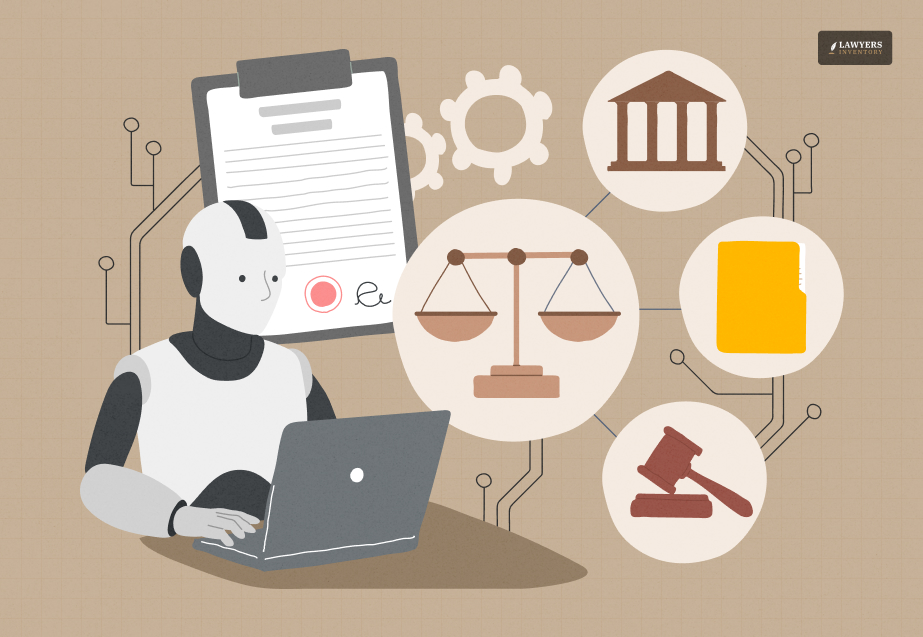
Today’s topic: Will AI replace lawyers?
Artificial intelligence is changing our daily lives. It is no longer just a futuristic concept. Today, AI is an active collaborator in the workplace.
Programs can write content, answer complex questions, and follow orders in just seconds. This technological leap brings great innovation, but it also creates deep fears. In the legal sector, these fears are growing fast.
New AI tools like ChatGPT, Harvey, and CoCounsel can now pass the Uniform Bar Exam. [Source: Illinois Institute of Technology]
Because of this, people are asking a tough question: Will AI replace lawyers?
The short answer is no.
AI will not replace human attorneys. However, it is changing how lawyers work, set prices, and deliver services. The future of law does not belong to machines alone. Instead, it belongs to the “augmented lawyer” who learns to use AI safely.
Will AI Replace Lawyers? The Current State Of AI In The Legal Industry
The legal sector usually adopts new technology very slowly. Lawyers avoid risks and must follow strict compliance rules. Despite this history, the new wave of generative AI has broken through their hesitation.
In the past, only 12% of lawyers used older AI tools. Recent industry trends show a massive spike in adoption. Legal tech providers are now putting large language models into standard legal software. [Source: Nature]
Currently, lawyers and other legal experts rely on AI for automating mundane and repetitive tasks. A case in point is AI’s ability to rapidly perform basic legal research, analyze contracts, and review documents.
Then again, numerous legal professionals are still reluctant to embrace change. A few industry surveys indicate that lawyers’ reluctance to AI adoption Mainly rests on three barriers:
- Accuracy: 36.4% of lawyers worry about algorithmic mistakes.
- Cost: 34.2% say that secure legal AI is too expensive for small firms.
- Reliability: 33.8% doubt the validity of the data that AI creates.
The Disadvantages: Why AI Cannot Practice Law Alone
AI cannot practice law without human supervision. When people leave AI alone, major system failures happen. Legal work impacts people’s finances and lives.
Therefore, a single AI mistake can cause financial ruin or public punishment.
The Problem With Legal Hallucinations
Generative AI tools do not look up facts the way humans do. Instead, they predict the most logical next word in a sentence.
This process causes “hallucinations.” In plain terms, the AI invents fake cases, fake laws, and fake quotes.
We can see a clear warning from a real federal court case, Mata v. Avianca (2023). Two New York lawyers used ChatGPT to do legal research for a lawsuit. [Source: Justia Law]
The AI created six entirely fake court cases. It even wrote fake judicial opinions and quotes. The lawyers did not check the sources. They submitted the fake paperwork directly to the judge.
The opposing counsel quickly discovered the trick. As a result, the judge fined the lawyers $5,000 and publicly embarrassed their law firm.
AI Lacks Emotional Intelligence And Strategy
Law is not just a game of simple logic. High-level legal work requires empathy, emotional intelligence, and legal strategy. Machines do not have these human traits.
An experienced lawyer reads human behavior, not just data. For instance, a good attorney knows when a client is hiding a secret during an interview. The lawyer will ask deeper questions to get the truth.
Similarly, a trial lawyer changes their strategy in the courtroom by watching the jury’s body language. Humans can also work well with missing or confusing information.
AI cannot do this because it only knows the data people used to train it. It cannot invent a new legal theory to fight an unfair law.
The Advantages: How AI Helps Lawyers
AI offers massive benefits when a human supervises the work. It acts as a powerful tool to upgrade a lawyer’s daily practice.
Some law firms are using AI for their law firm marketing. While, on the other hand, others are using tools like QuikConsole to make their work more efficient!
Saving Massive Amounts Of Time
Traditional legal work requires a lot of paperwork. Lawyers often spend a whole week reading thousands of pages of text or checking old state laws.
Modern AI tools can read, organize, and summarize these large files in seconds. This speed does not eliminate the lawyer’s job. Instead, it frees the lawyer from clerical chores.
As a result, attorneys can spend their time on work that truly matters. They can focus on advising clients, negotiating deals, and arguing cases in court.
Better Results With Specialized Tools
The legal technology market now has two distinct categories:
- Public AI: Platforms like ChatGPT or Claude work well for brainstorming or writing basic emails.
- Legal AI: Closed, highly secure platforms like Harvey AI and CoCounsel offer better protection.
Tech companies train these legal platforms on verified case law and official statutes. Therefore, these systems automate documents and check contracts with incredible speed and precision.
Ethical Rules And The New Legal Landscape
Bar associations are creating strict rules because AI use is growing so fast. Writers and analysts must watch these rules to understand the future of the market.
The Duty Of Competence (ABA Rule 1.1)
The American Bar Association (ABA) says that lawyers must understand technology. Comment 8 to Model Rule 1.1 states that lawyers must keep up with changes in legal practice. [Source: American Bar Association]
This duty includes learning the benefits and risks of new tech. Therefore, lawyers cannot simply ignore AI anymore.
Keeping Information Secret (ABA Rule 1.6)
Secret data is a major issue for legal AI. When a lawyer types client secrets into a public AI model, the AI learns from that data.
This action breaks attorney-client privilege.
Because of this risk, states like California, Florida, and New York issued strict warnings. They state that lawyers must only use secure AI tools that protect client privacy.
Acknowledge AI And Protect Intellectual Property
Ethical legal practice also requires strict transparency when drafting briefs and research papers. [Source: Brookens Library]
Similar to school or university, not giving credit to AI tools in legal writing is a sure way to invite compliance issues of huge magnitude:
- Misrepresentation: Claiming that work generated by a machine is the product of a human being is a serious breach of the fundamental ethical principle of integrity.
- Lack of Transparency: Hiding AI assistance not only deposes the real author of the work but also hides human understanding.
- Policy Violations: This is rather deceitful. And, as a result, is a direct violation of provider and legal codes of ethics.
- Intellectual Property Risks: Since Large Language Models train on various copyrighted materials, completely relying on AI outputs often means unintentional infringement of copyright and intellectual property rights.
The Market Shift: The End Of The Billable Hour
AI’s biggest impact is financial, not physical. For decades, law firms made money using the billable hour.
Consider this example. A firm charges a client $350 per hour for a junior lawyer to read contracts. If the lawyer takes ten hours, the firm makes $3,500.
Now, a secure AI tool can read those same contracts in ten seconds with better accuracy. Suddenly, the billable hour model stops working.
Consequently, the industry is moving toward flat-fee pricing. Firms are starting to charge fixed prices for results instead of counting minutes. AI forces lawyers to sell their experience, judgment, and wisdom, rather than their time.
Verdict: The Future Is Augmented
Artificial intelligence is transforming the legal profession But human lawyers will not be phased out by AI.
Machines do not have the ability to talk to a jury, reassure a distressed client or deal with the complexities of corporate merger politics.
Instead, AI creates fairness.
Small law firms can now use the same digital horsepower as massive, global law firms. This change lowers prices for everyday people. Ultimately, it helps close the justice gap by making legal help affordable.
The legal industry will always rely on trust, ethics, and human reasoning. In short, AI will not replace lawyers. However, lawyers who use AI will replace the lawyers who do not.
Leave A Reply






Hung Jury vs. Mistrial: What Is The Difference And Why It Matters
Read More
NarodniyDimUkraina: An Overview Of The Kyiv-Based Brand Preserving Ukrainian Craftsmanship
Read More
What Is A Mistrial? Legal Definition, Causes, And What Happens Next
Read More
What Is A Sequestered Jury? Legal Definition, Process, And Everything You Need To Know
Read More
What Is A Hung Jury? Legal Definition, Causes, And What Happens Next
Read More
0 Reply
No comments yet.