Summarize using AI





Prompt copied. Paste it into Gemini.
How long does a court hearing last is a common question asked by many people who find themselves involved in a legal matter. Whether you’re a defendant, a plaintiff, or simply a witness, knowing what to expect can ease a lot of stress.
A court hearing is a legal gathering where a judge (and sometimes a jury) is being informed about legal issues to solve them. It may include showing evidence, giving testimonies, or ending the legal disputes.
Whereas some hearings are just several minutes, others use all the time they have, some of them even throughout the day. The precise duration is the total of many factors, such as the degree of complexity of the case, the court’s schedule, and the nature of the hearing.
In this blog, we will talk about the following things:
- What happens in a court hearing?
- How long does a court hearing last?
- What is the average duration of a court hearing?
- When does the court start and end?
- Factors affecting the duration of a court hearing.
- The reality of Cattle Call hearing in courts.
Therefore, keep reading!
What Happens in a Court Hearing?
At a court hearing, a judge decides the outcome of the legal issue by listening to the arguments of both sides and by assessing the law and the evidence.
The majority of hearings are performed that way, where the two involved parties, being either individuals or representatives, have the chance to air their opinions.
After having finished speaking, they could still use facts, documents, or witnesses as a basis to back their statements.
Some hearings may be as basic as just reviewing some files or asking a few questions and nothing else, yet some may require thorough evidence evaluations, witness interrogations, and argumentations.
In case of criminal proceedings, the hearing could ask asking questions to the relevant authorities, the evidence available, or the charges. In civil matters, it may concern money, contracts, or property.
The judge listens carefully, follows the proceedings and might ask questions to get the matters clear.
After everything has been explained, the judge can decide right away or take some time to make the decision. Not every hearing leads to a final decision — some are only one step of several in a court case.
How Long Does a Court Hearing Last?
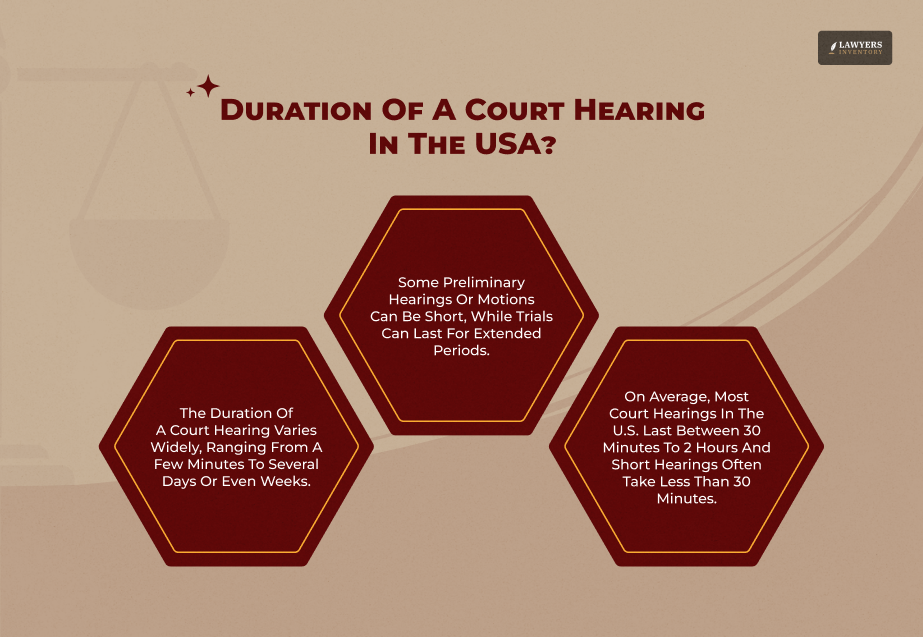
The duration of a court hearing can vary widely. Some last only 10 to 15 minutes, while others take hours or even several days.
There’s no fixed rule for how long a court hearing will be—it depends on the type and complexity of the case.
What is the Average Duration of Court Hearing?
On average, most court hearings in the U.S. last between 30 minutes to 2 hours. Short hearings like arraignments or status conferences often take less than 30 minutes. These are routine matters that don’t involve deep legal arguments or evidence.
However, longer hearings, such as preliminary hearings in criminal cases or motion hearings in civil cases, can stretch from 1 to 3 hours. If a hearing includes witness testimony or complex arguments, it might last the entire day or even carry over to another day.
Trial hearings are different. They can last for several days or even weeks, depending on how many witnesses are involved and how much evidence needs to be reviewed.
For example, a murder trial or a large business dispute can last weeks. But for most everyday legal matters, you can expect the hearing to be over in a couple of hours.
What Time Does the Court Start and End?
In the U.S., courts typically begin their business at between 8:30 a.m. and 9:00 a.m. Each court has an approximate ending time of 4:30 p.m. to 5:00 p.m. Most courts will schedule a one-hour lunch break (approx. noon to 1:00 p.m.) as well.
Even though your case may be scheduled as a morning case, courts often hear multiple cases each morning. This may cause delays in starting your hearing at the time listed on the docket.
When the court finishes hearing the previous cases, the court will then call your case. The same is true for afternoon hearings; it is likely that your case will be affected by delay from other hearings during the earlier time period.
Most courts are not open to conduct business during weekends and holidays unless the court is an emergency/specialty court (such as a night court in some larger cities).
Be sure to arrive early for your hearing; you should also plan to wait once you arrive. The courts are busy locations a lot of times. If you are a party to a case being heard, you will have to deal with the attorneys, judges, and clerks who have very active calendars.
Therefore, because of the busyness of the courts, it is often very common for there to be delays when you arrive.
Factors Affecting Duration of a Court Hearing
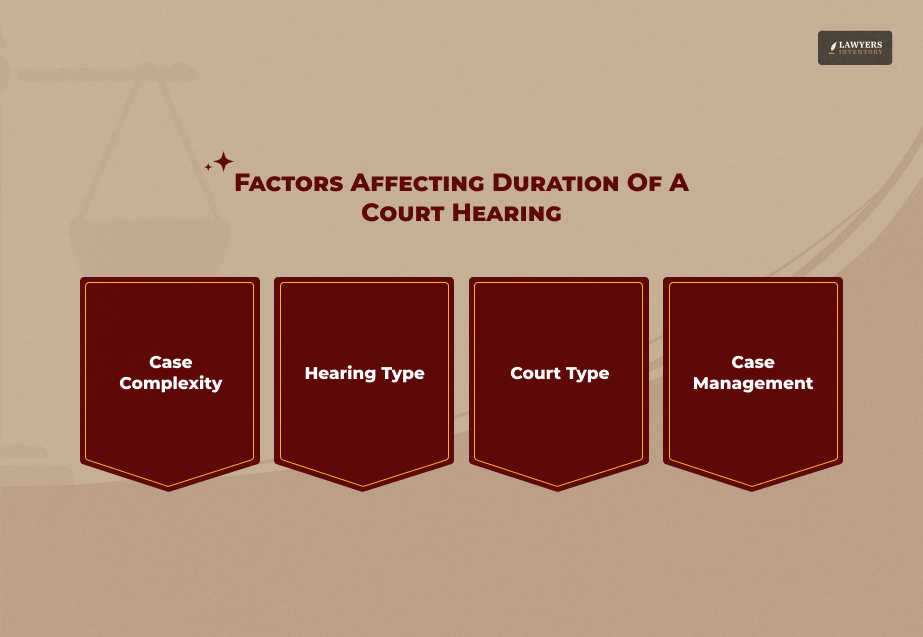
Several factors can influence how long your court hearing will last. It’s not just about the time on the clock—it’s also about what needs to be covered in the hearing.
Complexity of the Case
Normally, disputes like unpaid rent will resolve themselves quickly. But there are a few cases that take significantly longer to be resolved. These are complicated disputes involving:
- Multiple parties.
- Expert testimony from knowledgeable technical witnesses.
- Detailed document reviews.
Some of the most common examples of these cases include corporate fraud cases, and serious criminal offenses.
When lawyers are required to provide a detailed explanation and judges are required to make a decision based on conflicting evidence. It is easy for a hearing to last from a few hours to several days.
Type of Hearing
The procedural goal sets the pace. Arraignment moves fast – ten to fifteen minutes. Motion hearings handle issues like evidence rules, lasting less than an hour.
On the other hand, preliminary hearings stretch over days. Trials run for weeks. Witnesses testify that evidence unfolds slowly. The clock keeps ticking through every stage.
Type of Court
The location of your court is important. The Small Claims Court usually makes decisions quickly.
The Family Court and the Civil Court do not. They take a long time to resolve an issue due to serious emotional or financial impacts related to the matter.
Courts with Federal jurisdiction have timelines that are tighter and more formal when compared to the high volume State Courts.
The “Cattle Call” Reality: Why 9:00 AM Doesn’t Mean 9:00 AM
For first-time litigants, a common shock is arriving at the courthouse for a 9:00 a.m. hearing, only to find that they must wait in the gallery until noon. The phenomenon is referred to as a “Cattle Call” or Master Calendar System in the legal profession. (Source: US Legal)
Most courts have multiple busy courtrooms, so the judge does not assign cases to courtrooms back-to-back (like a doctor making appointments).
Instead, judges may have as many as 10–20 different matters scheduled for the same date and time.
When you arrive in the courtroom, you are not just there for your own case. You will be there for the “calendar call” for your attorney.
Additionally, other attorneys and litigants will be present so that the judge can identify the attorneys who have appeared and the matters that can proceed.
The judge will generally attempt to get through the low-hanging fruit first. These are basically those cases where the parties are only seeking to obtain a new date for a matter or are seeking a status update.
If you require a lengthy argument or witness testimony, your case will go to the end of the line.
Read Also:
Leave A Reply







Is It Legal To Use True People Search? What Are Its Restrictions?
Read More
Case Is Being Actively Reviewed By USCIS – Meaning And Timelines
Read More
Refund Risk Under Income Tax Demand Notice Section 143(1) Summary Adjustments [A Complete Legal Assessment]
Read More
2026 Rules For The Legal Age Of Marriage In India
Read More
What Is A Wet Signature? Legal Guide And 2026 Rules
Read More
0 Reply
No comments yet.