I have been analyzing and writing on legality for a long time. And time and again, I have seen how landlords use legal pressure to clear out properties. Through this, I notice one constant trend: an eviction notice paralyzes people with fear.
Most people instantly picture moving trucks and empty bank accounts. They view the paper as a final eviction order.
However, my analysis of housing data reveals a major systemic pattern.
Landlords weaponize the lack of legal literacy among renters. They count on your panic to force a quick, voluntary move.
What Is An Eviction Notice?
First, we must define this document clearly.
An eviction notice is a formal, written paper. As per Collins Dictionary, it is “an advance notice that someone must leave a property.”
A landlord sends this paper to a tenant. It states that the landlord intends to end the rental agreement.
Furthermore, property law requires a clear reason for this demand. Landlords cannot just throw you out without a cause. In most cases, these reasons fall into a few clear categories.
- Unpaid Rent: The tenant did not pay one or more rental installments.
- Lease Violations: The tenant committed. For instance, they had a pet without permission, or they damaged the property.
- Lease Expiration: The rental period is over, and the owner is not interested in renewing the lease.
- Owner’s Use: The landlord desires to take back the home for their own family.
To be completely clear, an eviction notice is not a court order. It is simply a formal warning shot. It states that a problem exists. Additionally, it gives you a set number of days to respond.
Do I Have To Move Out Immediately After An Eviction Notice?
The direct answer to this question is no. You absolutely do not have to pack your bags today. You do not have to leave the property the moment you get the paper.
In fact, forcing you out immediately violates the law in almost every country. According to an Investopedia Eviction Legal Rights Overview, landlords must follow strict legal steps to reclaim their property. They cannot just bypass the court system.
When a landlord serves an eviction notice letter, they merely start a legal timeline. Depending on your location, you have days, weeks, or months to respond. During this window, you hold the legal right to stay in your home.
Furthermore, you have the right to contest the landlord’s claims. You can present your side to a neutral judge. Ultimately, only a court can force you to move. Until a judge signs an official eviction warrant, you remain the lawful occupant.
I have also covered more about the eviction notice problems in the following articles:
- How long after the eviction court date do you have to move?
- How long does an eviction stay on your record?
Can I Pay Rent After Eviction Notice?

If you receive a non-payment eviction notice, you can typically pay the full balance during the notice window to stop the legal process.

In the US, this is called “curing” the notice. In India, clearing arrears generally eliminates the primary legal grounds for your removal.
Eviction Notice Timeline: The Universal Concept Of Due Process
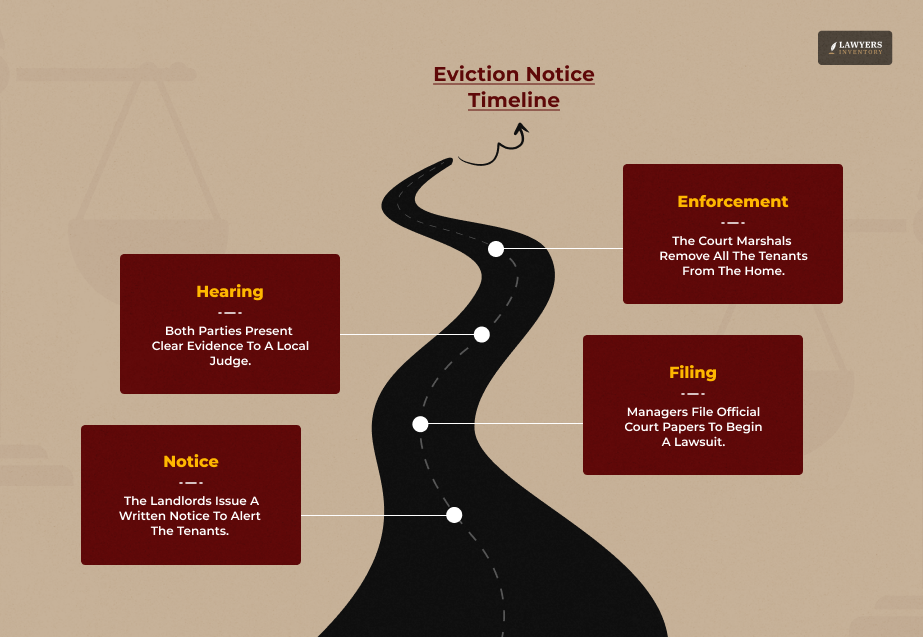
To understand your timeline, you must understand due process. My global research shows that tenancy laws heavily protect occupants. The system aims to prevent sudden homelessness.
Therefore, the legal timeline universally moves through four distinct phases:
- Notice Period: The landlord delivers the eviction notice and counts the days till the law allows.
- Legal Filing: After a failed attempt to fix the problem, the landlord initiates a court case.
- Hearing: The plaintiff and the defendant present their arguments and evidence to the deciding authority.
- Official Enforcement: The landlord who has obtained the judgment calls on a marshal to carry out the eviction physically.
Now, let us examine how this timeline operates in the world’s two largest democracies.
Navigating The Reality In The United States
For readers in the US, state and local laws govern the eviction process. However, certain universal protections apply across all fifty states.
State Timelines And Eviction Notice Types
Through my research into US landlord-tenant frameworks, I found that notice periods vary wildly. Your location and your specific lease violation dictate your timeline.
Legal documentation platforms like Loio’s US Landlord-Tenant Eviction Framework note that landlords must use specific notices. These documents establish your exact timeline:
- Pay or Quit Notices: Landlords use these for unpaid rent. They give tenants a very short window, typically 3 to 5 days, to pay or face a court filing.
- Cure or Quit Notices: Landlords use these for lease violations. They give you a set period, often 10 to 14 days, to fix the issue. For example, you might need to move an unauthorized pet.
- Unconditional Quit Notices: These are the most severe. They order the tenant to leave without a second chance. Landlords use them for repeated late rent or illegal activity.
The Illegality Of “Self-Help” Evictions
Now, American tenants must know that self-help evictions are strictly illegal. Landlords cannot take matters into their own hands.
For example, they cannot change your locks. They cannot shut off your electricity or water. They cannot throw your furniture onto the street.
If a landlord attempts these tactics, they break the law. In fact, US courts frequently award massive financial damages to tenants who face illegal lockouts. The landlord must wait for the court process to finish.
Navigating The Reality In India
For readers in India, the legal landscape offers unique, incredibly strong protections. The Indian legal system makes sudden, arbitrary evictions almost impossible for landlords.
The Model Tenancy Act And State Laws
Traditionally, rental disputes fell under the Transfer of Property Act, 1882. State-specific Rent Control Acts also managed these cases.
However, India is currently undergoing a massive structural shift. Many states are now aligning their local laws with the central government’s Model Tenancy Act.
Under standard Indian legal procedures, landlords must provide a valid, written eviction notice before taking legal action.
According to legal expert viewpoints, the eviction notice must specify the exact grounds for eviction. Furthermore, it typically requires a minimum 30 day eviction notice warning window. [Source: Bar and Bench]
Strong Protections For Indian Tenants
Moreover, Indian courts heavily favor the occupant. If you hold a valid, registered Rent Agreement, a landlord cannot evict you just to get a higher-paying tenant. They must prove specific, legally recognized grounds.
As highlighted in regional property insights from experts and agencies, these grounds usually include a failure to pay rent for two consecutive months. [Source: MagicBricks]
Landlords can also evict you if you cause major structural damage or use the residential premises for illegal commercial activities.
The Reality Of Indian Court Timelines
Finally, we must look at the timeline of Indian civil courts and Rent Control Tribunals. In India, litigation moves notoriously slowly.
Even if a landlord files an eviction suit, the case can take months or even years to reach a final verdict.
Consequently, an Indian tenant who receives an eviction notice has an extensive runway to mount a defense.
What To Do After Getting An Eviction Notice?
No matter where you live, your immediate actions will decide the future of your tenancy. So, it is best to check the eviction notice form.
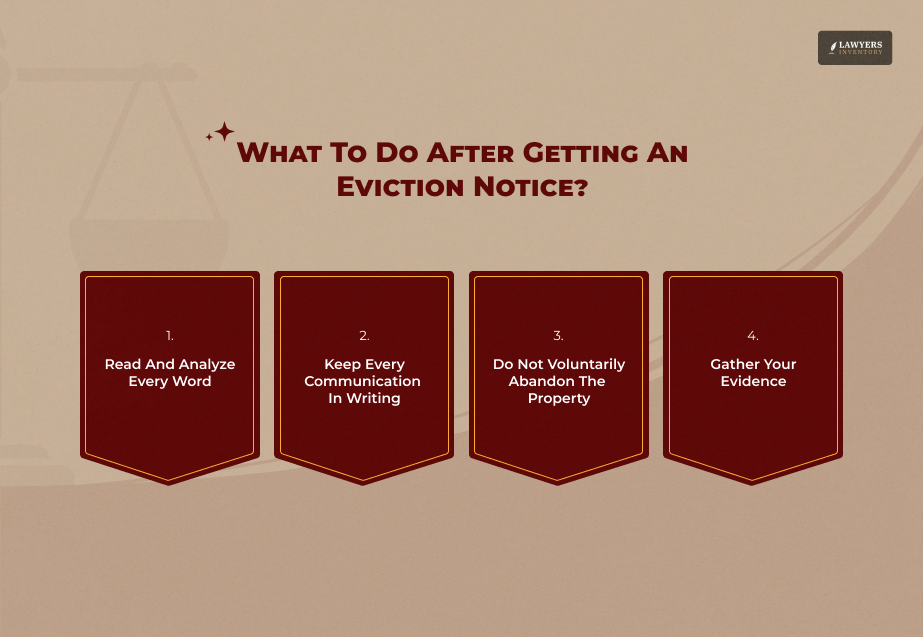
Based on my analysis of successful tenant defenses, I highly recommend following these strict steps:
1. Read And Analyze Every Word
First, do not ignore the document. Check the eviction notice for technical accuracy.
- Does it state your correct name?
- Is the address accurate?
- Is the amount of rent owed mathematically correct?
Landlords frequently make administrative errors. In many areas, a single mistake can invalidate the entire notice.
2. Keep Every Communication In Writing
Next, stop having casual phone calls with your landlord. Avoid face-to-face chats about the dispute. From this point forward, build a clear paper trail.
Send texts, emails, or certified letters. If your landlord promises to give you extra time to pay rent, ensure they put that promise in writing.
3. Do Not Voluntarily Abandon The Property
Sometimes, panicked tenants pack up and leave immediately. They assume they have already lost the battle.
Do not do this.
If you voluntarily move out, you forfeit your legal rights. Furthermore, you may still owe rent for the remainder of your lease. Stay in place while you evaluate your options.
4. Gather Your Evidence
Collect all proof of your tenancy immediately. Find your signed lease agreement and your rent receipts. Gather bank statements and any prior text messages.
For example, find texts where you complained about property maintenance issues. This evidence will be vital if your case goes to a judge.
Where To Find Expert Help
You do not have to fight an eviction notice completely alone. There are vast networks of professionals dedicated to keeping people in their homes.
In the United States:
Search immediately for your city’s local Legal Aid Society. You can also contact a tenant defense union. These non-profit organizations provide free or low-cost legal representation to tenants facing eviction.
In India:
Consult a local civil advocate who specializes in property disputes and rent control laws. Additionally, you can approach your local Rent Authority established under the new state tenancy laws to seek mediation.
Disclaimer: The information provided in this article is for general informational purposes only. It does not, and is not intended to, constitute legal advice. Please consult an attorney for legal help.
Leave A Reply






Hung Jury vs. Mistrial: What Is The Difference And Why It Matters
Read More
NarodniyDimUkraina: An Overview Of The Kyiv-Based Brand Preserving Ukrainian Craftsmanship
Read More
What Is A Mistrial? Legal Definition, Causes, And What Happens Next
Read More
What Is A Sequestered Jury? Legal Definition, Process, And Everything You Need To Know
Read More
What Is A Hung Jury? Legal Definition, Causes, And What Happens Next
Read More
0 Reply
No comments yet.