
Usually, nobody plans for this part. Two parents separate, and within days someone has to answer a question even if they are under tremendous psychological and emotional pressure: who’s got the kids tonight?
Sorting out parenting arrangements after separation is usually the first real task facing the family, and often the hardest. That’s because it has to happen while the wound of separation is still raw.
This guide walks through how New Zealand law treats these arrangements. We will also see what parents can decide between themselves, and when the Family Court needs to get involved.
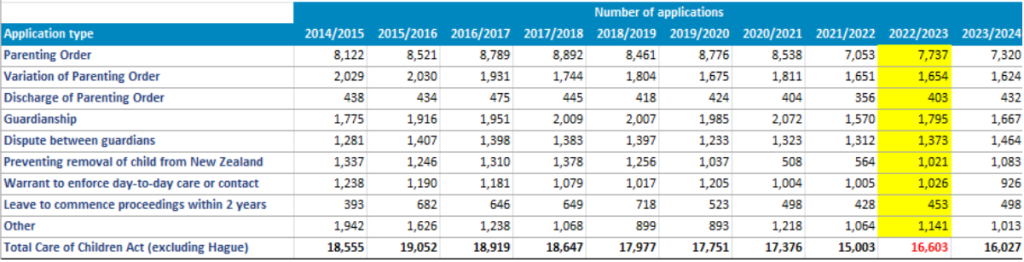
It’s more common than you’d think, in this part of the world. According to the latest data released, the Family Court received 16,603 applications under the Care of Children Act 2004 in the 2022/2023 year alone.
So if you’re only just starting the conversation about who has the kids and when, you’re in a very large, very ordinary club.
The Guiding Principle: The Welfare Of The Child
New Zealand law doesn’t ask which parent should “win.” A child’s welfare and best interests come first, ahead of what either parent wants. Section 5 of the Care of Children Act 2004 sets out the factors that judges must weigh.
Notably, they have to differentiate safety from violence, an ongoing relationship with both parents, stability, and, where a child is old enough, their own views. You can read how to get full custody of a child as a mother or as a father online!
None of these automatically outrank each other. In Kacem v Bashir [2010] NZSC 112, the Supreme Court made that point directly: no single section 5 factor beats another as a rule.
Judges weigh the continuity of care against genuine reasons for change on the facts before them. It’s this same balancing act that shapes nearly every decision on parenting arrangements after separation. Down to something as small as which school a child ends up at.
Reaching An Agreement Without Court Involvement
Most parents never see the inside of a courtroom. They sit down, often with a mediator between them, and hammer out something workable.
That’s what Family Dispute Resolution (FDR) is for. In other words, a government-funded mediation service, free for eligible families since 1 July 2025. That’s how to get guardianship of a child without going to court.
Fair Way Resolution, the main FDR provider, reports that roughly 80% of families who go through it settle some or all of their issues without filing in court.
A mediator works through day-to-day care, contact time, and decision-making with both parents, keeping the child’s needs at the centre of the room rather than either parent’s grievances.
When Parents Cannot Agree
Sometimes mediation just doesn’t close the gap. Two decent parents can sit across a table for hours and still not reach parenting arrangements after separation that both can live with.
When that happens, either parent can apply to the Family Court for a parenting order. The court will usually want an FDR certificate on file first. Unless there’s an urgent or safety issue that can’t wait.
From there, a judge decides, using the same welfare principles that would have guided a voluntary agreement anyway. It’s slower, it costs more, and most family lawyers will tell you it’s a last resort, not a starting point.
Different Types Of Care Arrangements
There’s no single template for parenting arrangements after separation. What works for one family looks nothing like what works for the next.
It depends on:
- the children’s ages
- how far apart the two homes are
- work schedules, and
- what the kids themselves want once they’re old enough to have an opinion.
| Arrangement | What It Looks Like | Best Suited For |
| Shared care | Roughly equal time with both parents | Cooperative co-parents living close together |
| Primary care with contact | Child lives mainly with one parent, regular time with the other | School-age children who need a steady routine |
| Supervised contact | Time with a parent happens with a third party present | Situations involving safety or trust concerns |
| Guardianship-only split | One parent provides day-to-day care; both keep decision-making rights | High-conflict separations |
Most families land somewhere between the first two rows, and very few start there. Moreover, it often takes a few months of trial and error to get right.
Communication Between Co-Parents
Good communication keeps children out of the middle, and that’s not a throwaway line. In fact, it’s one of the biggest predictors of how well an arrangement holds up.
Many separated parents lean on shared calendars, co-parenting apps, or a plain written log. So small disagreements don’t spiral.
Steady parenting arrangements after separation almost always trace back to boring, factual communication. Rather than any clever clause in a court order.
Judges also note the opposite: using a child as a messenger tends to go down badly with the Family Court.
Relocation And Changing Circumstances
Life doesn’t stand still. Jobs change, new partners show up, and sometimes one parent wants to shift cities or leave New Zealand altogether.
Because both parents usually hold guardianship. Now, a move that affects the child needs agreement from both sides. Or a court order if agreement isn’t happening.
Kacem v Bashir remains the leading authority on this: no automatic right to relocate, and no automatic right to block a relocation either.
The court weighs the real reasons behind the move against the extent to which it would disrupt the child’s relationships, school, and routine.
Supporting Children Through The Transition
Even a carefully planned separation is hard on kids. In fact, it is harder than most parents expect. Predictable routines help.
So does keeping conflict away from where children can see or hear it, and telling them, more than once, that both parents still love them.
The Ministry of Justice funds free Parenting Through Separation courses that teach exactly this. And many parents complete one before starting FDR.
Formalizing An Arrangement
Once parents agree on parenting arrangements after separation, write it down. Remember that a private agreement isn’t automatically enforceable.
But a consent order filed with the Family Court is. That one extra step gives both parents something solid to point back to the next time a birthday or a school holiday turns into an argument.
Seeking The Right Guidance
Every family’s situation is a little different, and the law leaves room for interpretation. Talking to a family lawyer in Auckland early can help you in many ways.
To sum up, it helps you understand where you stand, avoid mistakes other parents have already made, and settle arrangements that hold up in real life, not just on paper.
Good advice at the start is usually cheaper, in every sense. Than a dispute that ends up in court. So choose an experienced legal representative.
Involving Children In The Conversation
Since August 2023, children have to be given the chance to take part in Family Dispute Resolution whenever a decision will actually affect them. Their views don’t get the final say.
But the law now requires those views to be heard and genuinely weighed against the child’s age and maturity. Not just noted and set aside.
Parenting arrangements after separation tend to hold up better once the child’s own voice has helped build them, rather than being handed down after the fact.
What’s The Best Approach?
Nothing here is set in stone. Parenting arrangements after separation almost never stay exactly as they were first written. For instance, kids grow, schools change, jobs move, new relationships start.
Treat the first arrangement as a working draft, not a final answer. If you ensure that, most of that later friction never has to happen at all.
Disclaimer: This article is for general information only and doesn’t amount to legal advice. Outcomes in family law depend heavily on individual circumstances, and both the Care of Children Act 2004 and the case law around it can shift or be reinterpreted over time. Always talk to a licensed family lawyer about your own situation before making decisions about your children’s care.
Read Also:
- Soberlink Reviews: Separating Facts from Myths in Child Custody Cases
- Understanding The POCSO Act And Child Safety Laws In India
- What Happens When Parenting Arrangements Stop Working?
Leave A Reply








What Is A Business Entity? A Simple Guide For New Business Owners
Read More
When Should You Take A Criminal Charge Seriously?
Read More
Who Is Responsible For Pest Problems In Dallas Rental Properties
Read More
Considering A Sexual Abuse Claim? Know What Legal Support Offers
Read More
0 Reply
No comments yet.