Summarize using AI





Prompt copied. Paste it into Gemini.
Quick Answer

To relocate an out-of-state business to Texas without losing your EIN or business credit, you must execute a statutory Business Conversion. This legal process involves filing Form 645 (Certificate of Conversion) alongside Texas formation documents with the Texas Secretary of State. This method legally preserves your entity's uninterrupted corporate history, existing contracts, and operational assets.
Relocation to Texas for your business has numerous benefits, such as better taxation policies and stronger economies. Further, there is also the added advantage of having a low barrier in the market.
One way to enact this transfer is through a statutory Business Conversion, which is a legal procedure that allows you to transfer your LLC, LLP, or corporation seamlessly without setting up a completely new entity
This also allows you to keep your EIN and business credit and continue the operations as is.
Texas Business Conversion: Understanding Business Relocation To Texas
Statutory conversion (frequently called redomestication or redomiciling) is the formal process of moving an entity’s jurisdiction of incorporation from State A to State B under the Texas Business Organizations Code (TBOC).
Redomestication is quite unique compared to other methods of relocating as it allows for contracts, legal existence, and corporate history to be maintained. Additionally, this makes the transition simple and easy.
Relocation to Texas: Merits of Redomestication
Move your business to Texas – It provides quite a number of benefits, among which are the following.
- Retainment of Business EIN and Credit: There will be very few changes with redomestication as your business will keep its existing EIN and credit. The only thing you will not have to do is establish new banking relationships or even reapply for credit lines.
- Maintained Identity: The business can be conducted under its preexisting name and, therefore, enjoys the benefits of brand recall and existing customer loyalty.
- Eased Regulatory Requirements: With nothing else to worry about except the administrative workload slog, Texas easily brings with it a no-state income tax policy as well as a more flexible regulatory framework.
- Elimination of Multiple State Compliance: Redomestication makes it easier than foreign registration as the compliance obligations that go with your previous state are no longer necessary, allowing firms to focus on regulatory processes within America.
A corporate conversion can often be structured as a tax-free reorganization under Internal Revenue Code Section 368(a)(1)(F) (a ‘Type F Reorg’).
However, it is not automatically tax-neutral. If your business holds outstanding liabilities, exit-tax liabilities from states like California or New York, or built-in gains, a structured conversion must be analyzed by a professional to prevent triggering accidental liquidation taxes.
Redomestication vs. Foreign Registration vs. Strat Merging
With the relocation of a registered business to Texas, it’s very important to know the differences between redomestimation, foreign registration, and mergers.
Statutory Conversion:
- Process: Modifies the legal address of your present business entity and relocates it to Texas.
- Advantages: Preserves EIN, business credit, contracts, and corporate history while canceling obligations in the relocated state.
- Considerations: Must follow the legal process of the original state and abide by the Texas statutes on redomestication.
Foreign Registration:
- Process: Enables your out-of-state business entity to operate in Texas by registering it.
- Advantages: Permits operations in Texas without the need to change the state of incorporation.
- Considerations: Complies with the obligations and potential tax liabilities in both states, which increases the administrative costs.
Merger:
- Process: Involves the new Texas company absorbing the existing business entity.
- Advantages: The business is able to exist as a Texas-based entity.
- Considerations: Economically and financially burdensome; may change the established business credit, terminates existing business credit lines, requires entirely new EIN registration, requires formal manual contract re-assignments, and potentially triggers heavy asset-transfer tax liabilities.
The table attached below highlights the core distinctions between the methods mentioned above.
| Aspect | Redomestication | Foreign Registration | Merger |
| EIN Retention | Yes | Yes | No |
| Business Credit Retention | Yes | Yes | No |
| Compliance Obligations | Texas Only | Both States | Texas Only |
| Complexity | Moderate | Low | High |
| Cost | Moderate | Low | High |
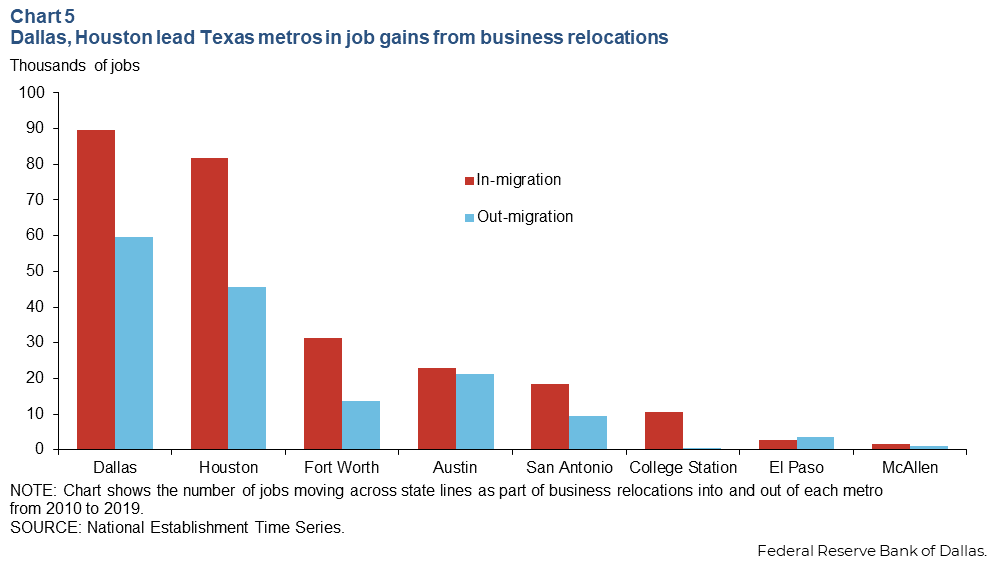
Job Relocations: Dallas and Houston Leading Texas Metros in Business Growth
The Federal Reserve Bank of Dallas has published a chart that portrays business migration due to relocation within the Texas metropolitan region between 2010 and 2019.
As demonstrated, job growth was most notable in both Dallas and Houston metros, with Dallas netting close to 90,000 jobs gained from internal migration and consistently reporting higher net gains as opposed to out-migration numbers.
Moreover, Houston also benefits from significant net positive job flows. Additionally, other metros such as Fort Worth, Austin, and San Antonio display net positive levels of job moves but at much lower ranges than the previous two.
In contrast, El Paso and McAllen have significantly fewer figures for internal migration as well as emigration.
The data indicates that business migration has significantly increased within Dallas and Houston regions, establishing them as impactful economic centers in Texas.
Additionally, this trend highlights the state’s benefits for companies, likely including tax benefits, cheaper business expenses, and excellent business conditions.
Relocation to Texas: Steps to Redomesticate Your Business to Texas
Business redomestication or relocation to Texas can be accomplished by following the steps below:
- Governing Documents Review: It is crucial to review the articles of incorporation or organization and the bylaws or operating agreement of your company to ascertain that redomestication is permissible and which consents are necessary.
- Required Approvals: Obtain approvals from shareholders, members, or partners as required by your state law and governing documents.
- File a Certificate of Conversion: Execute and file Form 645 (Certificate of Conversion) with the Texas Secretary of State, accompanied by the appropriate Texas forming document (such as Form 205 for an LLC or Form 201 for a Corporation) along with the requisite filing fees.
- Execute Inbound/Outbound Filings in the Origin State: Instead of filing a standard dissolution – which can accidentally terminate your continuous legal existence and void active vendor contracts – file specific outbound conversion or withdrawal documents required by your original home state’s corporate registrar.
- Licenses and Registrations Update: All business permits, licenses, and registrations should be updated to show the change of domicile to Texas.
- Inform Stakeholders: Notify customers, vendors, financial institutions, and any other parties involved in the business that the business has moved to Texas.

Why Cummings & Cummings Law for Redomestication of Your Business?
The legal firm Cummings & Cummings Law is well versed in redomestication Texas issues related to business and can assist clients incorporating Texas Incorporation.
Additionally, the attorney in charge, Texas Attorney and CPA Chad D. Cummings, provides:
- Competency: They have a complete grasp of business regulations as well as tax obligations in Texas.
- Productivity: Created new workflows to ensure an orderly and punctual relocation.
- Openness: There are no unforeseen expenses, just a flat rate fee.
- Guidance: Individualized help for each client during moving operations.
Their objective is to assist you in relocating your business to Texas without causing interruptions to your business activities.
Wrapping It Up!
In conclusion, redomestication or relocation to Texas for your business is a strategic move, offering several advantages, including an attractive tax environment, a thriving economy, and a favorable regulatory framework.
It is through an understanding of the redomestication process that you can easily work with professional people who would ensure that you have a seamless transition for the continued success of your business.
Read Also:
Leave A Reply







Power Stick Deodorant Recall FDA: Your Complete Safety Guide
Read More
Is It Legal To Use True People Search? What Are Its Restrictions?
Read More
Case Is Being Actively Reviewed By USCIS – Meaning And Timelines
Read More
Refund Risk Under Income Tax Demand Notice Section 143(1) Summary Adjustments [A Complete Legal Assessment]
Read More
2026 Rules For The Legal Age Of Marriage In India
Read More
0 Reply
No comments yet.