Summarize using AI





Prompt copied. Paste it into Gemini.
Quick Answer

Procurement contracts are binding contract which successfully manages business purchasing of goods or services from outside suppliers. It defines a transparent pricing structure, locks down enforceable performance parameters, eliminates commercial liabilities, and sustains the continuity of the enterprise buyer.
A procurement contract is a legally binding framework. It governs how an organization buys goods, services, or works from an external provider.
For enterprise buyers, corporate counsel, and supply chain executives, these documents are vital tools. They are not mere administrative formalities. They are powerful instruments to allocate risk, protect operations, and secure financial predictability.
Global supply chains face severe volatility. Regulatory landscapes shift quickly. Technological integration adds new vulnerabilities. In this climate, ambiguous terms introduce heavy liabilities.
Organizations must treat procurement contracts as strategic shields.
Procurement Contract Typologies And Risk Allocation
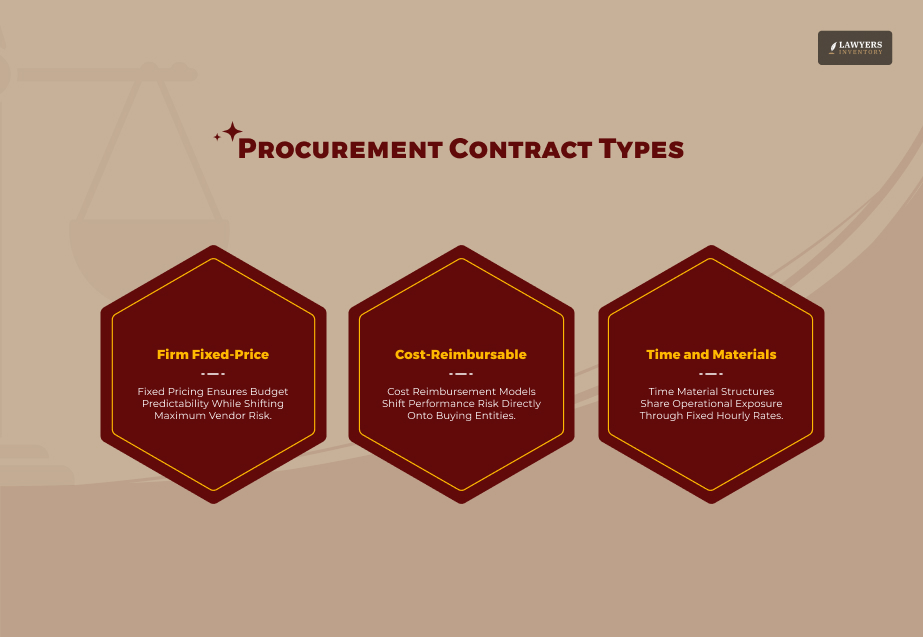
Selecting a contract structure is a critical initial decision. This choice dictates who bears the financial burden of market shifts. It handles raw material shortages and scope changes. Commercial transactions rely primarily on three foundational contract typologies.
Firm Fixed-Price (FFP) Contracts
An FFP contract sets a single, unalterable price for specified deliverables. The vendor bears maximum risk under this framework. If production expenses skyrocket, the supplier’s profit margins drop.
Buyers use FFP agreements when the scope of work is entirely clear. The project must be unlikely to change. This structure offers excellent budget predictability for the buyer.
However, it requires precise technical specs up front. This precision prevents downstream change-order disputes.
Cost-Reimbursable Contracts
Cost-reimbursable agreements work differently. The buyer pays the vendor’s actual performance expenses. They also add a fixed fee or percentage for vendor profit. This framework shifts financial risk directly to the purchasing entity.
Enterprises use this model for highly complex, long-term initiatives. These projects make it impossible to calculate precise costs at the outset.
Examples include bespoke software engineering or advanced infrastructure development. To limit buyer exposure, these agreements must include strict “not-to-exceed” price ceilings. They also require rigorous cost-auditing provisions.
Time and Materials (T&M) Contracts
T&M agreements compensate vendors based on fixed hourly labor rates. They also include the actual cost of materials consumed. This model represents a shared-risk profile. It works perfectly for agile, open-ended service engagements.
However, this structure provides no inherent incentive for supplier efficiency. Buyers must establish strict oversight parameters.
Savvy procurement teams routinely embed maximum labor caps and milestones within T&M documentation. This control keeps total expenditure from spiraling.
Enforceable Performance Safeguards: SLAs And KPIs
A robust procurement agreement must contain objective, quantitative metrics. These metrics measure vendor performance. Relying on vague promises of “reasonable effort” invites operational failure.
It also leaves the buyer with minimal legal recourse. Contracts must explicitly transform operational expectations into enforceable legal obligations.
Structuring Airtight Service Level Agreements (SLAs)
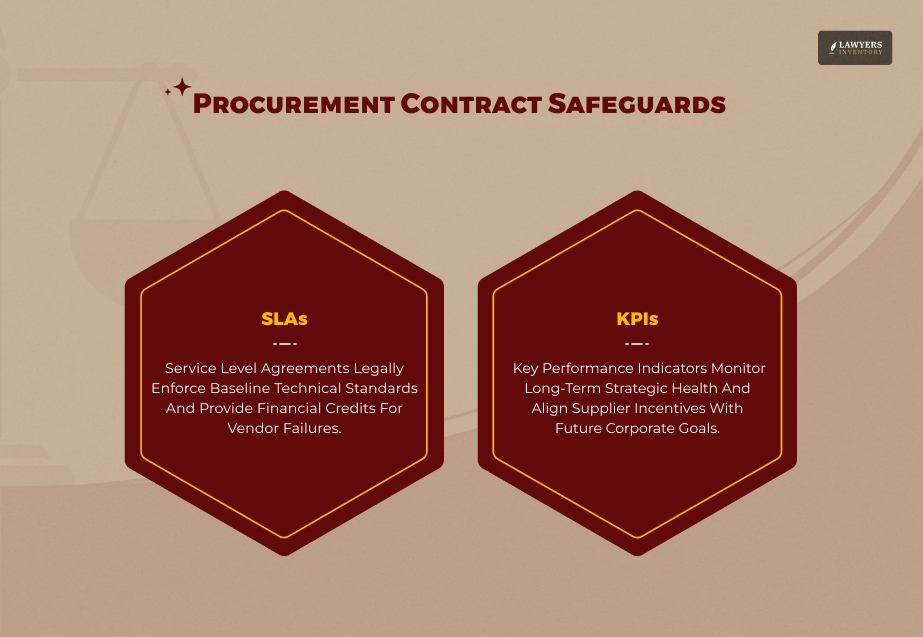
The SLA defines the precise technical standards the supplier must meet. For physical goods, this involves exact dimensional tolerances, defect rates, and strict delivery windows.
For services, it mandates specific uptime percentages, response times, and throughput volumes.
To ensure compliance, the contract should utilize an integrated enforcement matrix:
- Financial Service Credits: These are automated, non-punitive price reductions. They apply directly to the next billing cycle if an SLA metric falls below the threshold.
- Graduated Cure Periods: This is a mandatory, time-bound window. For example, the contract might allow five business days for the vendor to rectify a performance failure. This must happen before triggering a formal breach status.
- Chronic Failure Provisions: This clause protects the buyer from ongoing issues. It grants the right to terminate the contract immediately without penalty if the vendor repeatedly fails to meet critical SLAs.
Integrating Key Performance Indicators (KPIs)
SLAs focus on immediate, baseline requirements. KPIs track long-term strategic health instead. These metrics include:
- Supply chain innovation.
- Cost-reduction milestones.
- Sustainability compliance.
Linking KPIs to contract renewal options aligns supplier incentives directly with the buyer’s long-term corporate goals.
High-Stakes Boilerplate And Risk Allocation Clauses
When supply chains break down, the boilerplate sections of procurement contracts dictate corporate survival. Parties must carefully negotiate these high-stakes provisions. Never accept generic standard templates blindly.
Modern Force Majeure Boundaries
In the past, lawyers interpreted this as a customary jurisdiction. Currently, a force majeure term needs to be carefully amended to adapt to changes. This provision should establish a clear concept of excusable lateness. [Source: Thomson Reuters]
A contract must clearly outline the obligations of both parties when a major disruption occurs:
| Component | Strategic Contractual Requirement |
| Explicit Exclusions | Economic inflation, shifting currency values, predictable labor strikes, and general market downturns must be explicitly barred from protection. |
| Mitigation Duties | The affected party must be contractually obligated to provide immediate written notice. They must prove they took active steps to bypass the disruption. |
| Termination Rights | The buyer must retain the right to terminate the agreement without penalty if the disruption persists beyond a defined duration, such as 30 days. |
Indemnification And Liability Caps
Indemnification clauses mean the payment of damages resulting from third-party legal claims.
Buyers need to include a request for indemnification from the vendor for third-party intellectual property infringement. They need to include a provision to be indemnified by the vendor for data breaches and third-party property damage caused by third-party negligence.
Conversely, vendors will fight hard for a Limitation of Liability (LoL) cap. Corporate counsel should structure this cap as a multiplier of the annual contract value. For example, it could equal two or three times the fees paid. [Source: Lexology]
Crucially, certain claims must be carved out entirely from any liability limitations. These exceptions include gross negligence, intentional misconduct, and systemic data breaches.
Termination For Convenience vs. Cause
A sophisticated agreement outlines two distinct exit pathways. Termination for cause occurs when one party breaches a material term.
It applies if they fail to cure that breach within the designated window. This enables the non-breaching party to seek legal damages.
Termination for convenience allows the buyer to exit the relationship at any time. They can do this for strategic reasons without proving fault. To maintain operational agility, buyers should negotiate a convenience clause.
It should require a standard notification period, such as 60 days. It must also limit the vendor’s recovery strictly to work completed up to the termination date.
Lifecycle Automation And Contemporary Compliance
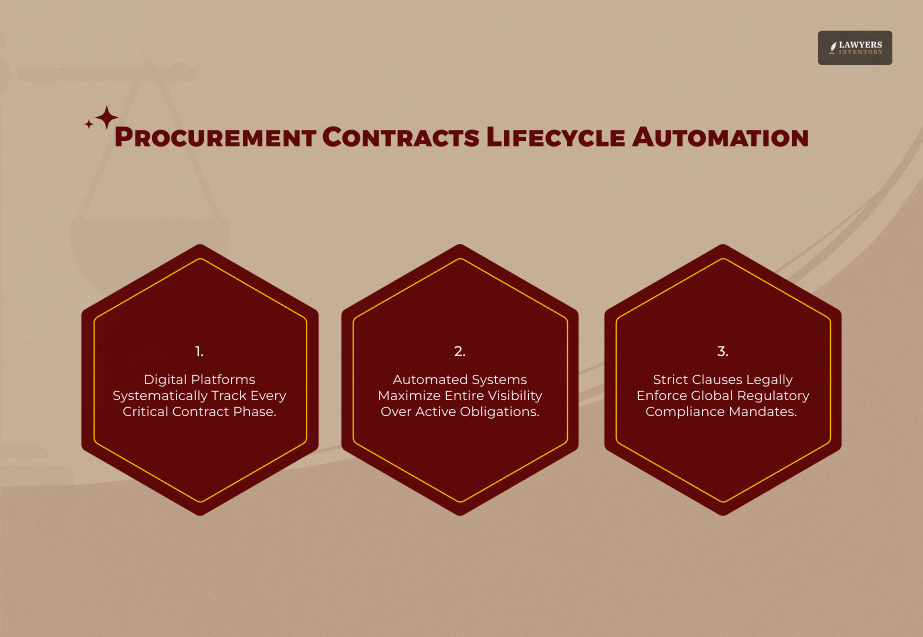
The legal power of procurement contracts depends on execution. An organization must be able to track its terms effectively.
Manual, disjointed management methods frequently cause problems. They result in missed renewal deadlines, uncollected service credits, and severe compliance gaps.
The Contract Lifecycle Flow
To maintain corporate efficiency, successful procurement contract management relies on a strict, sequential operational workflow:
- Sourcing and RFx: defining requirements, preparing RFxs, issuing RFxs, shortlisting suppliers, evaluating initial responses, and so on.
- Drafting and Authoring: Development of the baseline contract text based on standard legal precedents and provisional stipulations.
- Negotiation and Review: Redlining provisions, risk caps, and vendor legal protests.
- Sign-off and Implementation: Channeling the final document through top management for official approvals.
- Obligation Management: Monitored live vendor compliance, SLA metrics, and payment milestones.
- Renewal or Exit: A decision is to be made on renewing (continuing) the commercial relationship or switching to a different vendor.
Implementing Contract Lifecycle Management (CLM)
Modern enterprises deploy CLM software platforms to digitize the entire agreement lifecycle. These systems store agreements in a centralized repository. [Source: Ironclad]
They extract key dates using machine learning. They also trigger automated alerts before a contract auto-renews.
Digitization ensures absolute visibility over active obligations. Legal and procurement departments can easily track pricing tiers and liability exposures.
Regulatory And ESG Mandates
Procurement contracts are increasingly used as tools for corporate compliance. Global regulatory frameworks require enterprises to vet their supply chains thoroughly. Contracts must feature strict compliance warranties covering:
- Data Privacy and Security: The terms should require compliance with guidelines such as GDPR or CCPA. Under GDPR Article 28, including provisions for instantaneous breach alert mechanisms and compulsory data encrypting norms is essential.
- Environmental, Social and Governance (ESG): Pushes suppliers to work within prescribed limits of carbon emissions, covers labor legislation, and sets standards of ethical sourcing and handling. The buyer needs to have the right to have independent third-party audits.
Strategic Differentiation: Sourcing vs. Purchasing
Organizations often use corporate terminology loosely. This habit leads to internal governance confusion.
To optimize contract workflows, stakeholders must understand the functional divisions within the broader supply chain ecosystem.
Strategic Procurement
Procurement is a strategic, end-to-end process. It focuses on long-term vendor alignment and total cost of ownership (TCO) reduction.
It centers on proactive risk mitigation. Procurement contracts are the ultimate output of this phase. It serves as the master legal blueprint for the entire commercial relationship.
Transactional Purchasing And Management
Purchasing is a tactical, transactional subset of procurement. It involves executing individual purchase orders (POs).
It handles tracking shipments and processing invoices. These activities run against the parameters of the master procurement contract.
Contract management spans the remaining lifecycle. It ensures both parties strictly adhere to the negotiated SLAs, compliance mandates, and financial terms until the agreement expires or undergoes renewal.
Leave A Reply






An Understanding Of The Home Depot Damage Protection Class Action
Read More
No Demo Reno Lawsuit – What Homeowners Must Know Before a ‘No-Demo’ Renovation
Read More
23XI Racing NASCAR Lawsuit: Charter Victory, Legal Facts, And 2026 Updates
Read More
Implied Contract Law: What is It and When Should You Use It?
Read More
Types Of Employment Contracts: What Each One Actually Means Legally
Read More
0 Reply
No comments yet.