Summarize using AI





Prompt copied. Paste it into Gemini.
Today’s topic: USAA late fee class action settlement.
The USAA late fee class action settlement lawsuit has recently reached a significant milestone in the case, as it settled for $5 million.
This lawsuit arose from a legal battle for the insurance company’s failure to return the interest on the previously ordered refunds for late fees.
As of March 2026, the lawsuit, also known as Black v. USAA General Indemnity Co., is in its final stages in the U.S. District Court for the District of Maryland.
If you are a Maryland citizen and a previous auto insurance policyholder with USAA from 2011 to 2019, the USAA late fee class action settlement lawsuit is currently affecting your wallet.
The most important date in the timeline for this case is April 28, 2026. This is when the court will hold a final hearing to approve the release of the funds.
Afterward, USAA class action settlement checks for former members will be mailed out, and for current members, the funds will be automatically deposited.
In this article, we will elaborate on the following:
- The legal background of the USAA class action lawsuit regarding Maryland insurance fees.
- Specific eligibility criteria for Maryland policyholders to receive a payout.
- The breakdown of the $5 million settlement fund and individual payment estimates.
- Federal and state laws governing insurance late fees and consumer protection.
What Is The USAA Late Fee Class Action Settlement?
The USAA Late Fee Class Action Settlement is a court-approved agreement that has been created to settle claims of “unjust enrichment” in the payment of insurance premiums.
The Core Allegations Against USAA
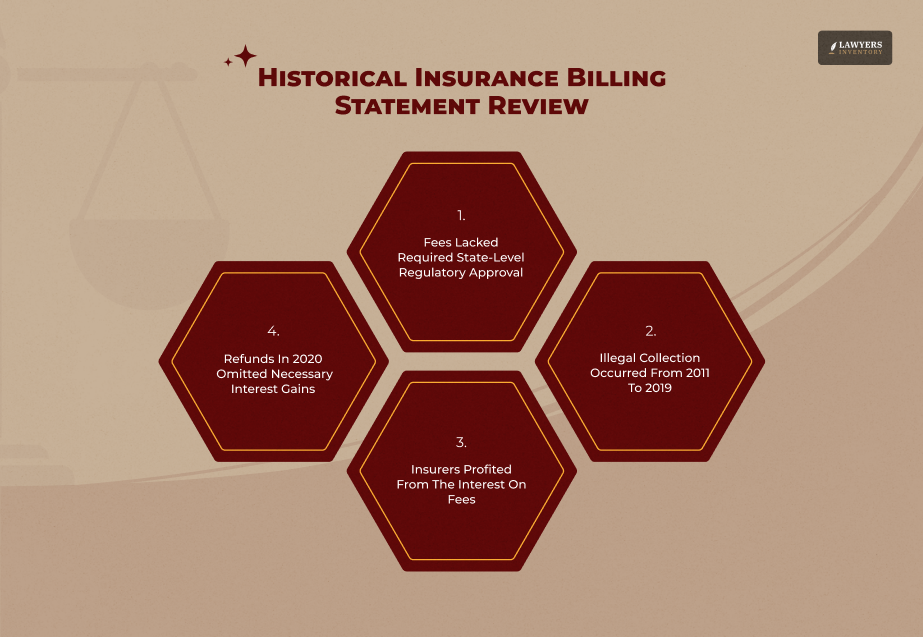
The plaintiffs in this case claim that USAA has been charging illegal late fees to more than 131,000 Maryland customers without the necessary approval from the State.
Even though USAA has returned the principal amount of the fees to its customers after a Consent Order in 2020, there are allegations that the company has been keeping the interest earned on this amount. (Source: TopClassAction)
This USAA late fee class action settlement was designed to specifically address the lack of interest and the timing of the funds.
The Maryland Insurance Administration Role
The Maryland Insurance Administration (MIA) was the body that first identified the fee practices during a market conduct exam.
The MIA had determined that USAA had imposed a $10 late fee that had not been properly filed and/or approved by the state.
Although the Maryland Insurance Administration had originally issued the refund orders for the USAA late fee, the class action settlement was necessary to obtain the additional interest for the consumers. (Source: Maryland Insurance Administration)
Let’s go through some Settlement Facts
- Resolves claims over withheld interest on fees.
- Follows a 2020 Maryland state consent order.
- Affects over 131,000 auto insurance customers.
- USAA denies wrongdoing but agreed to pay.
Background – Why The Lawsuit Was Filed
The history of the USAA class action lawsuit can be dated back to 2011 when the company began charging late fees on Maryland policies without the required authority. This section examines the activities that led to the multi-million dollar lawsuit.
Un-Authorized Fee Collection Practices
Maryland requires insurance firms to obtain approval for fees charged to a premium. The lawsuit claimed that USAA charged these fees for years without any legal filing to support the $10 fees.
Although the company made the required filing in 2019, it continued to overcharge some members with out-of-state addresses for their bills.
The “Time Value of Money” Case
One major aspect of the USAA late fee class action settlement case was the “time value of money.”
The plaintiffs claimed that by holding millions of dollars in illegal fees for almost a decade, USAA had an unfair advantage over its members. (Source: Justia)
Therefore, simply returning the original $10 was insufficient because it did not account for the profit USAA made while holding those funds.
Who Is Eligible For The Settlement?
The process of finding out if you qualify for the USAA late fee class action settlement is simple.
You just need to know your location and a little about the policies. The “Class” is a specific group of Maryland residents, which was strictly defined by the court.
Criteria For Maryland Policyholders
In order to qualify, you need to have been charged a late fee by USAA or any of its subsidiaries on a Maryland automobile policy prior to 2020.
You need to have received a refund on that fee from the 2020 Consent Order but have not been paid the accrued interest.
If you are a member of this group, you are automatically included in the USAA late fee class action settlement.
Automatic Inclusion And Notice
The interesting part about this settlement is that you don’t need to file a claim form. This is because USAA has a record of everyone who paid these fees. You should have received a notice via mail or email by early 2026 if you are a member of this settlement.
Let’s understand the Eligibility Criteria in a quick summary, shall we?
- Maryland automobile policyholders are primarily eligible.
- Must have received previous late fee refunds.
- Claim form not required for payment.
- Forensic record identifies all class members.
Key Settlement Terms And Payout Structure
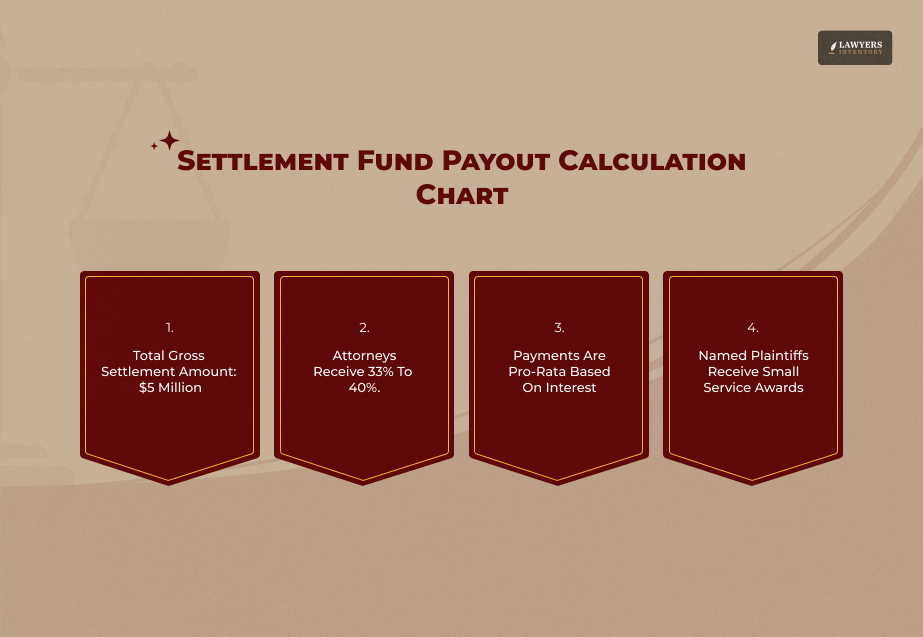
The $5 million fund for the USAA late fee class action settlement needs to cover various expenses before the money reaches the pockets of the policyholders. Knowing the “math” behind the deal can help manage the amount to be expected for the final check.
Breakdown of The $5 Million Fund
The $5,000,000 fund for the settlement does not entirely go to the consumers. About $2 million goes to the attorneys’ fees and expenses, and $18,000 goes to the plaintiffs as service awards for their role in the case.
The rest of the “Net Settlement Fund” goes to the class members of the USAA late fee class action settlement.
How Individual Payouts Are Calculated
The amount that an individual receives from the USAA late fee class action settlement depends on two factors:
- The number of late fees paid to USAA.
- The duration for which USAA held the funds.
If you are waiting for your USAA class action settlement checks, expect to receive a pro-rata portion of the available interest. (Source: USAA Late Fee Litigation Website)
Federal And State Laws Regarding Late Fees
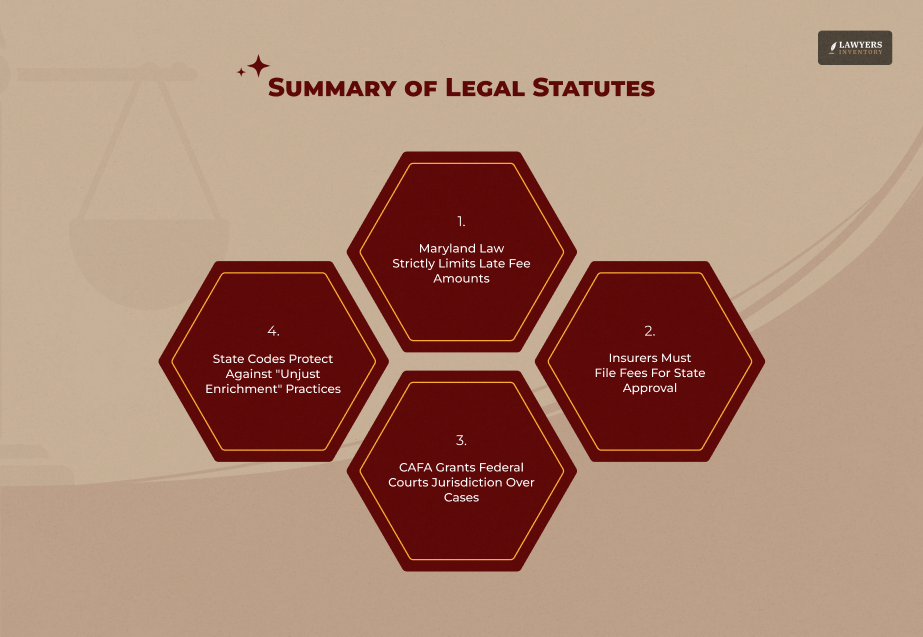
The USAA late fee class action settlement represents a complex interplay between state-based insurance regulations and federal-based consumer protection regulations.
Maryland has some of the most stringent regulations in the nation when it comes to the way in which insurance providers interact with customers.
Maryland Insurance Article § 27-216
The relevant law in this case appears to be Maryland Insurance Article 27-216, which states:
“No insurer may collect any charge which exceeds the rate filing approved by the Commissioner. Insurers may collect a charge for a late payment of a premium in an amount which is reasonable. This amount may not exceed $10.”
The USAA late fee class action settlement occurred as a result of USAA’s failure to comply with specific filing requirements.
Federal Diversity Jurisdiction And CAFA
While a state-based law, the case was filed in federal court based upon the Class Action Fairness Act (CAFA).
This federal law provides a federal forum for large class action cases in which the damages exceed $5 million and in which citizens from multiple states are involved.
This is the reason why the USAA late fee settlement class action lawsuit is being finalized by a federal judge in Maryland instead of a local state court.
How And When Settlement Payments Are Issued
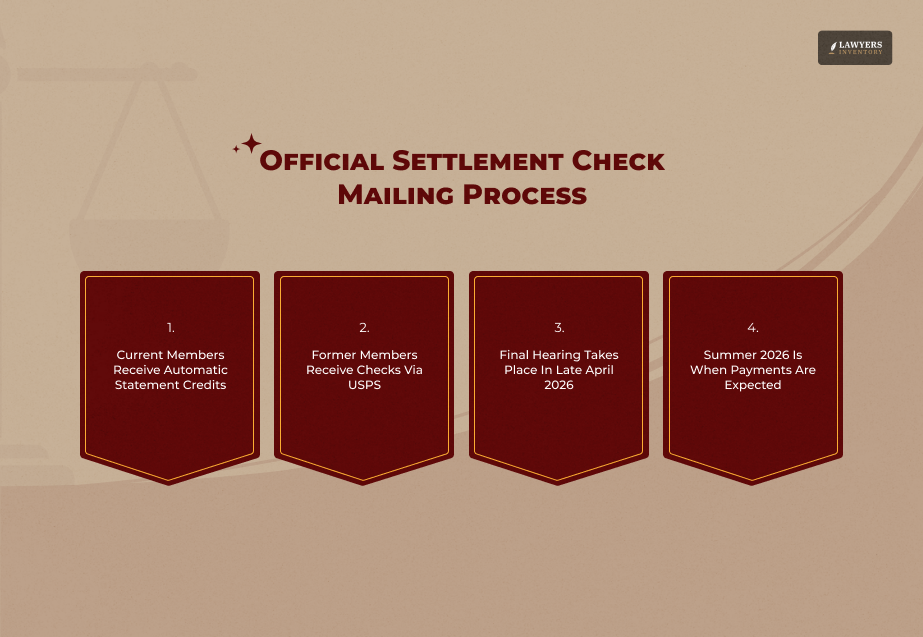
For those interested in the USAA late fee class action settlement, it is just as important to know “when” as it is to know “how much.” It is a very seamless process for the consumer.
Automatic Credits Vs. Mailed Checks
USAA members should receive their portion of the USAA late fee class action settlement as a credit on their insurance statement if they are current members of USAA.
Those who are no longer members of USAA should receive physical USAA class action settlement checks and mail them to their last known address.
It is very important to make sure your contact information is updated with the settlement administrator if you have moved in recent times.
The 2026 Distribution Timeline
The final approval hearing is slated for April 28, 2026. As long as a judge grants final approval and no appeals are made, payments should begin in mid-summer 2026.
This means that most people should receive their USAA late fee class action settlement by July or August 2026.
Frequently Asked Questions (FAQs):
The USAA late fee class action settlement may be confusing to those who do not read daily about legal settlements.
The following are the most common concerns regarding the USAA late fee class action settlement and payouts.
You are encouraged to contact the settlement administrator immediately at 877-206-2306. Although the USAA late fee class action settlement includes the interest, you are also entitled to the original principal amount if your check from 2020 never reached you or got lost in the mail.
The deadline to opt out of the USAA late fee class action settlement and sue USAA yourself was March 30, 2026. If you did not mail your request to opt out by then, you waived your right to sue USAA regarding these fees.
The amount of money each member receives also differs, depending on the actual interest USAA “made” off your money. For example, a member who paid five late fees in 2012 gets a bigger check than a member who paid one fee in 2019 because the money was tied up for a much longer time.
Leave A Reply







Capital One Class Action Lawsuit – Your Rights & What You Need To Know
Read More
The USAA Data Breach Settlement- Your Guide To Claims And Compensation
Read More
Credit One Bank TCPA Robocall Settlement- Everything You Need To Know
Read More
Credit One Bank Class Action Lawsuit- Eligibility And Claiming Your Share
Read More
Income Tax Notice Proposed Adjustment: Meaning, Reasons, & Response
Read More
0 Reply
No comments yet.