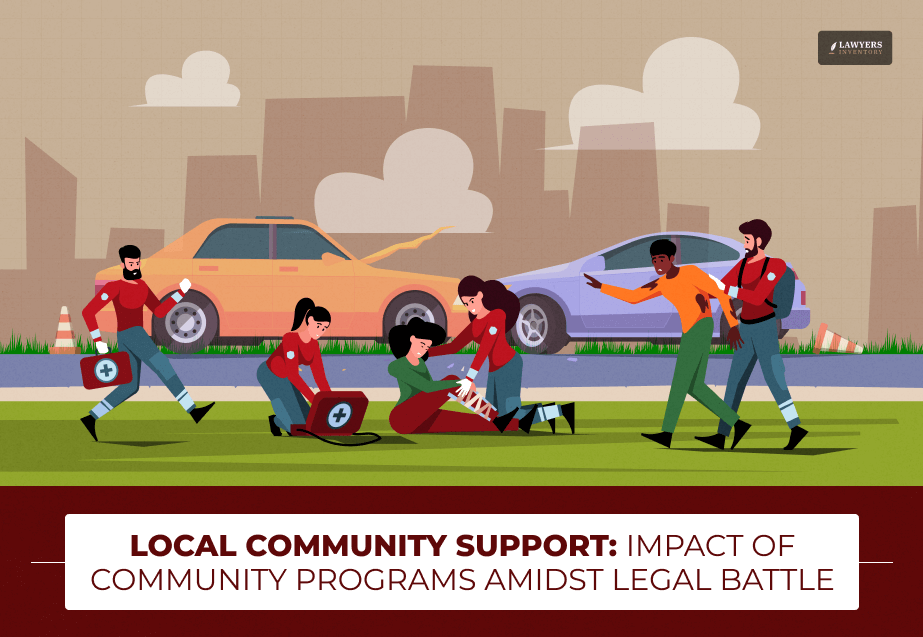
Today’s topic: Local community support.
Local community support at the grassroots level is a multiplier effect in legal battles. It shifts a private or systemic problem into a collective fight that has more chances of success.
This support is very important because it closes the access to justice gap for marginalized populations who often do not have the money to hire private lawyers.
And we all know that when a community gets involved, they are better able to watch over judicial decisions. Additionally, they can make sure those decisions are really put into action.
For instance, after winning a case against illegal land occupation, community vigilance is often necessary. This helps to ensure that the occupant actually leaves.
Community support amongst legal battles can be of several forms. For instance, there are legal professionals like Jeffcoat Injury and Car Accident Lawyers who partner with local community support groups to raise awareness among people and help them live the lives they deserve.
However, it is important to learn what local community support truly means and how itcan make life better legally. So, to have a better understandingof the same, keep reading till the end…
Local Community Support: Legal Empowerment Vs. Representation
Local community support for legal empowerment mainly targets closing the “justice gap” – the mismatch between the legal requirements of low-income people and the resources available to fulfill them.
Legal empowerment is different from traditional legal aid in that it is a community-led, bottom-up approach that restores power to the people.
Circumstances that mostly contribute to this are:
- Legal Aid Organizations: These are non-profit organizations that provide legal services for free in civil cases (housing, family law, public benefits) to people who are generally at or below 125% of the federal poverty line.
- Pro Bono Services: Private lawyers who donate their time to represent individuals or community groups for free.
- Community Paralegals/Justice Defenders: Locally based activists who receive law and mediation training and help community members understand the system and resolve problems together.
- Law School Clinics: Supervised students who provide legal assistance while receiving practical training.
Basically, unlike legal representation, legal empowerment ensures that people are aware of their rights and the resources they need to keep fighting their legal battle.
Here’s a table that would make it easier for you to understand:
| Feature | Legal Representation (Traditional) | Legal Empowerment (Grassroots) |
|---|---|---|
| The Role of the Lawyer | The primary expert and decision-maker. | A partner, coach, or facilitator. |
| The Process | Top-down: The client provides facts; the lawyer provides a solution. | Bottom-up: The community learns to navigate the system itself. |
| Primary Goal | Winning a specific case or avoiding a penalty. | Building long-term agency and systemic change. |
| Key Resource | Professional licensure and courtroom access. | Legal literacy and collective action. |
Core Impact Areas: How Does Local Community Support Work?
Local community support for legal empowerment works through a bottom-up approach that shifts power to marginalized groups by helping them know, use, and shape the law.
Unlike traditional legal aid, which often reacts to existing crises, legal empowerment builds community agency to proactively prevent injustices.
Core Impact Areas
When it comes to addressing systemic barriers in different sectors of society, community-led legal support becomes a powerful tool. Here’s how:
- Housing Stability: Through initiatives such as the Legal Services Corporation (LSC), tenants are educated on their rights and offered legal counsel, thereby preventing eviction and homelessness. In some cities, Right to Counsel laws have cut down default eviction rates by more than 40%.
- Civil Rights & Anti-Discrimination: Collaborations are made with organizations that deliver training sessions on fair housing and workplace rights, among other things. These help address problems such as racial harassment and/or discrimination against those with disabilities.
- Refugee & Migrant Support: Local communities facilitate access to asylum procedures, offer resistance to illegal detentions, enable employment without exploitation, etc., for displaced persons through grassroots initiatives.
- Worker Empowerment: The support is basically focused on informal or insecure forms of work, and workers are aided to win the fight for fair rules and therefore live in security.
- Land & Environmental Justice: Community paralegals not only help people in the area to secure their right to their land but also hold firms accountable for environmental damage.
How The Local Community Support Operates
Community-based lawyer programs are made up of front-line workers from the community who act as mediators and advocates between parties to help them find a resolution before a case goes to court.
Legal literacy programs provide materials, including interesting and engaging workshops and your rights, in order to help people to have a better understanding of the law.
It also helps people understand how it works through the use of easy-to-read materials. This is a great way to remove any mystery associated with law, as well as the complicated legal jargon.
Strategic legal action involves making decisions on which case or cases to use for new law in a strategic way so that the new legal precedent will be used for the entire community and not just for one person.
Additionally, there is collective activism. This includes bringing people from the community together to work towards changing/creating new and better laws.
Challenges And Institutional Barriers In Local Community Support
Communities in the United States are having a hard time accessing the resources necessary to empower them legally. So, when they try to seek local community support, they find themselves in a “justice gap.”
This is basically the gap between what people need for legal help to defend their rights and what they actually receive.
Currently, 86% of low-income Americans have civil legal issues and do not receive any legal assistance or only receive inadequate assistance.
These barriers stem from financial constraints, geography, and system obstacles. All of these combined make it difficult for people to protect their rights.
Here are the primary challenges that you need to know about:
1. Financial Constraints:
Firstly, the major issue is the high price of legal provider services. As a result of which, people with a lower income have to constantly choose between paying for rent, buying food, and the cost of hiring a lawyer.
2. Legal Deserts:
Secondly, 41% of counties in the United States lack available legal providers to provide legal services to individuals who reside.
This problem is particularly acute in rural areas where geographical isolation and a lack of legal infrastructure leave people to navigate complex systems alone.
3. Systemic Discrimination:
Black and other marginalized communities often face racial profiling, biased judgments, and disparities in representation within the legal system. These injustices undermine trust in institutional support.
4. The Digital Divide:
Due to the migration of law provider services and court systems to the internet, individuals who do not have access to TV, the internet, or the ability to use the internet to the extent they have been excluded.
5. Funding Instability:
There is little change in government funding for civil legal assistance. And, therefore, many of the organizations that provide free services to those in need rely upon the grant process, which is both unpredictable and difficult to obtain.
6. Complexity Of The Law:
Finally, there are strict deadlines and complicated rules and forms. All of these make it almost impossible to navigate through the legal system without having any training in the law.
Read Also:
- The Most Common Causes Of Car Accidents And How To Protect Your Rights
- Why Do Truck Accidents Cause More Severe Injuries Than Car Crashes?
- DUI-Related Car Accidents and Legal Accountability in Boca Raton
Leave A Reply








What Is A Business Entity? A Simple Guide For New Business Owners
Read More
When Should You Take A Criminal Charge Seriously?
Read More
Who Is Responsible For Pest Problems In Dallas Rental Properties
Read More
Considering A Sexual Abuse Claim? Know What Legal Support Offers
Read More
0 Reply
No comments yet.