Summarize using AI





Prompt copied. Paste it into Gemini.
Today’s topic: Criminology vs criminal justice.
The concepts of criminology versus criminal justice reflect two separate yet interrelated spheres in the American legal system.
Although many members of the general public confuse these terms, both of them perform their own distinct role when it comes to ensuring social security and protection against any form of crime.
To begin with, criminologists are the scientists who analyze behavioral trends and social inequalities. On the other hand, criminal justice becomes an instrument for enforcing the legislature’s rules and regulations.
As of April 2026, several major court cases concerning the American legal system continue to take place.
First, the current federal investigation of artificial intelligence-based law enforcement algorithms is one of them.
At present, courts decide whether these programs can be accused of violating civil rights because of their criminological biases.
In addition, some lawsuits related to prison reforms in such states as Alabama demonstrate tension between these two spheres.
In this article, we will elaborate on the following:
- The academic and practical definitions of both legal fields.
- Federal and state legislation governing enforcement and research.
- The impact of landmark Supreme Court cases on justice administration.
- How to choose between a criminal justice vs criminology degree.
The Theoretical Foundations Of Criminology And Justice

Contemporary legal scholars tend to argue the strengths of criminology and criminal justice for policy making.
While criminology studies the “whys,” taking into account the environmental and biological causes of criminal behavior, criminal justice addresses the “hows” through agency management.
The Scientific Study Of Criminal Behavior
Criminology is a subfield of sociology that deals with crime as a social issue.
Scholars examine statistical data to find out whether poverty and mental illnesses play a crucial role in high rates of crime.
Through studying criminology vs criminal justice, one understands how criminology helps shape the methods of criminal justice.
Criminological Theories Used In Contemporary Policy Making
There are two approaches to contemporary crime study – rational choice theory and social disorganization theory.
Such approaches help cities figure out what places need more parks and social workers to reduce the number of crimes.
Justice System And Its Working Structure
The justice system may be explained as an apparatus that ensures social stability through the application of the law.
The three main aspects involved include law enforcement, judiciary, and corrections.
From the comparison between criminology vs criminal justice, it is clear that criminal justice focuses on arrest and prosecution methods.
Operating Procedures In Law Enforcement
Law enforcement agencies have certain manuals that guarantee the protection of the rights of all citizens. Such procedures should be consistent with the state constitutions and civil rights at the federal level.
Laws Governing Legal Systems
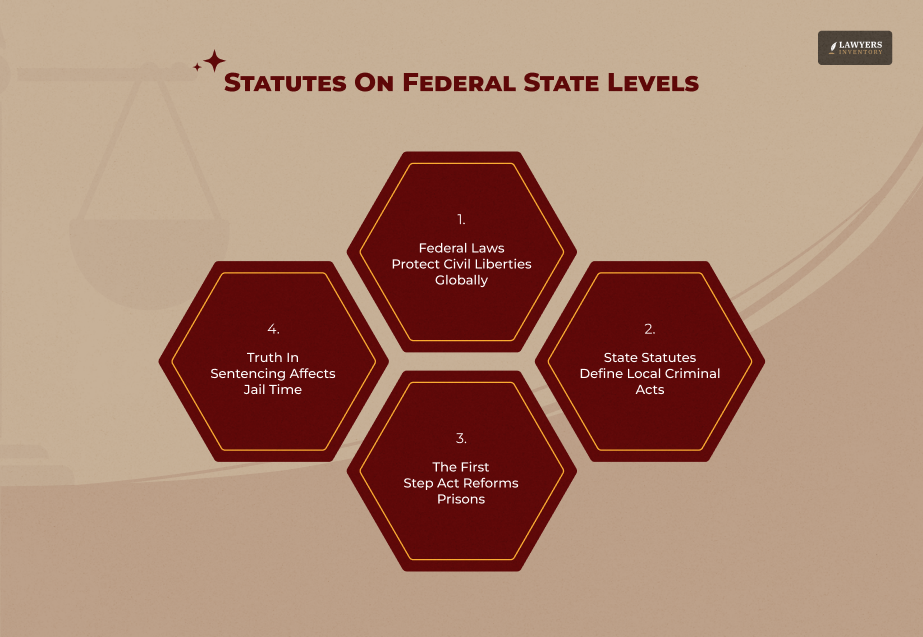
Understanding the differences between criminology vs criminal justice requires an understanding of the dual-court structure in America.
Federal law tends to focus on crimes committed across state lines and the constitutional rights of citizens throughout the country. State law deals with matters closer to home such as burglary or traffic offenses.
While federal programs like the First Step Act work to reform prisoners using criminological theories (Northeastern University), the state uses “truth in sentencing” programs to regulate the length of time individuals will be incarcerated.
Criminology vs criminal justice debates may be found in how each level of government budgets their police and social services organizations.
Federal Oversight Of Local Police Departments
The Justice Department can oversee a local police department if there are signs that they are engaging in consistent civil rights violations.
These situations are followed up with consent decrees which make departments implement new training programs, thus showing criminology vs criminal justice in practice.
The Civil Rights Act And Justice
The Civil Rights Act of 1964 is one of the key pieces of legislation that ensures equal access to the judicial process.
This act bars any form of discrimination in any program that gets funding from the federal government, which includes state-level judicial systems.
Sentencing Options In State-Level Judicial Processes
States are capable of creating alternative forms of justice through drug courts and other forms of justice, such as diversion based on criminological assessments.
Comparing criminology vs criminal justice, it is clear that states are the main labs for experimenting with different types of legislation.
Three Strikes Legislation In State-Level Courts
A lot of states adopted “Three Strikes” legislation in the 1990s to reduce crimes. However, criminologists would later examine these pieces of legislation and conclude that the laws increased prison expenditures without deterring criminals.
Landmark Case Law Shaping Both Disciplines
The decisions that define the relationship between criminology and criminal justice include those that set new rules for the use of evidence.
The decision of Gideon v. Wainwright (1963) was about providing legal counsel. The decision made ensured everyone in the justice system had an equal opportunity in court.
Another critical decision is Miranda v. Arizona (1966), in which the well-known Miranda rights were born. The ruling ensures suspects cannot be forced to incriminate themselves.
While analyzing criminal justice vs criminology, it is evident that such decisions make the justice system adapt to the ethical values of social research.
Terry Stop And Reasonable Suspicion
According to the decision made in Terry v. Ohio (1968), police officers are legally allowed to frisk suspects with reasonable suspicion of committing a crime.
The criminology discipline has spent years researching the effect of such a ruling on minorities.
It is one of the crucial arguments in the debate on criminology vs criminal justice.
Exclusionary Rule And Privacy
This rule bars the government from presenting any evidence that was obtained through an unlawful search. It aims to uphold the Fourth Amendment rights of American citizens in a criminal trial.
Juvenile Justice And Developmental Criminology Research
Roper v. Simmons (2005) led to the abolishment of capital punishment for minors.
The ruling cited developmental research to demonstrate that a minor’s mind is not fully developed.
This example highlights the relationship between criminology and criminal justice.
Miller v. Alabama And Life Sentences
Subsequently, the court deemed mandatory sentences of life imprisonment without parole unconstitutional for minors. The outcome of this decision required most states to conduct new trials for thousands of inmates.
What Is The Difference Between Criminology Vs Criminal Justice?
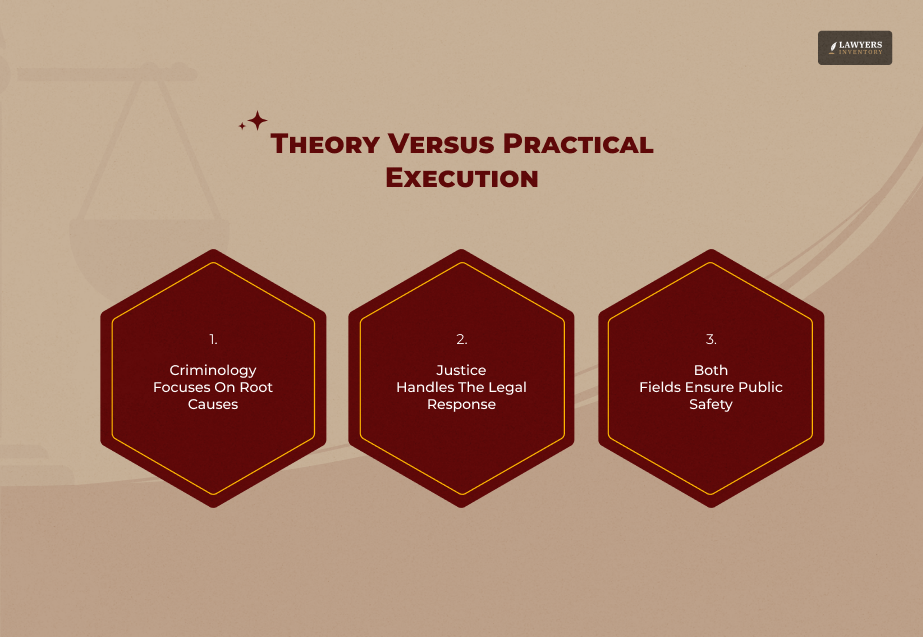
In choosing between criminology vs criminal justice, one must consider the different roles each serves in the legal process. Criminology is the brain that explains the motives behind all crimes. Criminal justice is the muscle that enforces the law and controls the effects of lawbreaking.
Criminology And Why Is It Important
Criminology is a science that studies crime as a social activity. Scientists analyze patterns within human behavior and social structures to figure out the motivations behind breaking the law.
Criminology vs criminal justice comparison shows that the former is more sociological and psychological in nature.
What Factors Do Criminologists Analyze?
The specialists study the impact of poverty, mental illness, and childhood experience on a person. They strive to find the driving force behind criminal behavior. The data collected is used to implement preventive measures by the government.
Victimology’s Role In Legal Reform
It is a branch of criminology that investigates the impact of a criminal act on its victim and family members.
It gives the law a clear understanding of the damage sustained from violent crimes. The research results lead to improvements in the provision of social services to crime victims.
What Is The Criminal Justice System And How Does It Work?
The criminal justice system refers to the physical set up of various agencies working together to deal with criminal offenses.
It entails police forces that apprehend criminals and the judiciary that tries the offenders and decides their culpability. From a comparison between criminology vs criminal justice, it is clear that criminal justice is the application of the law.
Law Enforcement And Public Safety
Law enforcement agencies include police officers who patrol and conduct investigations in ongoing crime scenes. These officers apply procedures to uphold citizens’ legal rights.
Role Of Courts And Corrections
Courts play a key role in carrying out criminal trials to safeguard accused persons’ interest. In case of a conviction, the corrections agency oversees prisons and paroles. Such an action helps in dispensing punishment fitting for the crimes according to the prevailing state’s statutes.
Which Degree – Criminology Vs Criminal Justice?
Differences can be observed in the approach to the legal issue. Criminology is a scholarly course aimed at preventing crime through social policies, while criminal justice involves punishing offenders to uphold law and order. A proper understanding of criminology vs criminal justice is critical for individuals pursuing legal careers.
Should I Go With Research Or Field Work?
The criminologist spends much time indoors working with data analysis. The criminal justice professional is involved in courtroom activities and patrolling areas.
These two careers are based on discovering something new or performing the actual activity.
Creating Legislation Play In Law Enforcement
As the outcome of criminology research, legislation is created in order to change or improve the situation within the criminal environment. The justice system takes the new rules into account and applies them to its activities. They work together to maintain the development of the American legal system.
What Are The Career Options For Criminology Vs Criminal Justice?
The decision about choosing a career in either field depends on one’s personal skills and preferences. Those who enjoy data analysis and solving puzzles will find themselves comfortable within criminology.
Those who prefer fast-paced work will feel confident working in the criminal justice area. Both of the chosen directions provide a safe and developing career path until 2026.
Criminal Justice
The following careers involve the application of laws and their enforcement and administration in society.
- Police Officer
- Federal Agent (FBI/DEA/U.S. Marshals)
- Detective/Criminal Investigator
- Probation/Parole Officer
- Correctional Officer
- Court Administrator
- Private Investigator
- TSA/Customs Officer
Occupations In Criminology
These occupations concentrate on research, psychology, and analysis to determine the reasons behind crime and develop prevention strategies.
- Criminologist
- Crime Analyst
- Forensic Psychologist
- Policy Analyst
- Victim Advocate
- Social Researcher
- Forensic Science Technician
- University Professor
Common Applications
Given the close relationship between the two areas, some careers integrate aspects of both.
- Intelligence Analyst (With work roles in organizations like the CIA or Department of Homeland Security.
- Rehabilitation Specialist who help in reintegrating past offenders.
- Security Manager
Questions Frequently Asked:
Members of the general population have several queries regarding the law’s influence on their life.
The following questions shed some light on how criminology vs criminal justice applies to your situation.
Yes, a majority of law enforcement agencies accept criminology graduates as fresh officers.
Such a professional can grasp the causes of crime in society. This knowledge facilitates their promotion to higher ranks.
Criminology has a stronger role when it comes to the creation of new laws. Law makers consider results of criminological research when deciding what policy will help to decrease crime. After that, the law enforcement agencies put it into action.
It would be helpful if students concentrate on history, sociology, and political science in high school.
In addition, volunteering at the county court and accompanying lawyers during trials will give an opportunity to see the whole process from the inside and decide which type suits you better.
They are great options for pre-law students. Criminology gives the reasons why there are certain laws. On the other hand, criminal justice gives more insight into the process of trial. Almost all colleges value diversity in opinions from these two branches of knowledge.
The latest development in technology involves the adoption of predictive policing software for crime mapping. These programs utilize past information to determine the location of future crimes.
However, many lawyers advise caution when using these records to ensure that the profiling of some regions does not occur unfairly.
Police officer positions typically offer annual pay ranging from $55,000 to $75,000. Researchers can expect salaries of up to $80,000.
Government analysts may earn upwards of $100,000 depending on whether they work at the federal level or as specialists in data analysis. Salaries will vary by state and government level.
Leave A Reply







What Is Reckless Driving In Texas: Legal Consequences You Need To Know!
Read More
How Can Criminal Identity Theft Occur And Your Legal Standing
Read More
Understanding What Is Criminal Justice And How It Functions
Read More
What Is The Difference Between Assault And Battery In Criminal Law?
Read More
Roblox Class Action Lawsuit: Who Can Help You & What To Do? [Complete Legal Guide]
Read More
0 Reply
No comments yet.