It is mid of 2026, and the California solar panel reimbursement legal battle remains volatile.
So, is the Sun shining brighter on California homeowners? Can’t say YES, though I wanted to.
The California homeowners were happy when the California Supreme Court ordered a lower court to further examine the drastic reduction in NEM 3.0 payments.
However, on 10th March 2026, the court ruling did not bring much relief for the solar homeowners.
The ruling mentioned that the low reimbursement rates will be there, following a tumultuous 80% drop in the market since the implementation of the policy in 2023.
Key Aspects Of The California Solar Panel Reimbursement Legal Battle
The core issue of the California solar panel reimbursement legal battle is the approval of NEM 3.0 by the California Public Utilities Commission (CPUC) in 2023.
Thanks to this, the rate utility companies pay for excess solar power went down by around 75%.
The volatility in this solar legal battle started with the intervention of the Supreme Court. However, before the intervention of the Supreme Court, you need to understand why the change was crucial.
1. Why Was The Change Needed For California Solar Panel Reimbursement?
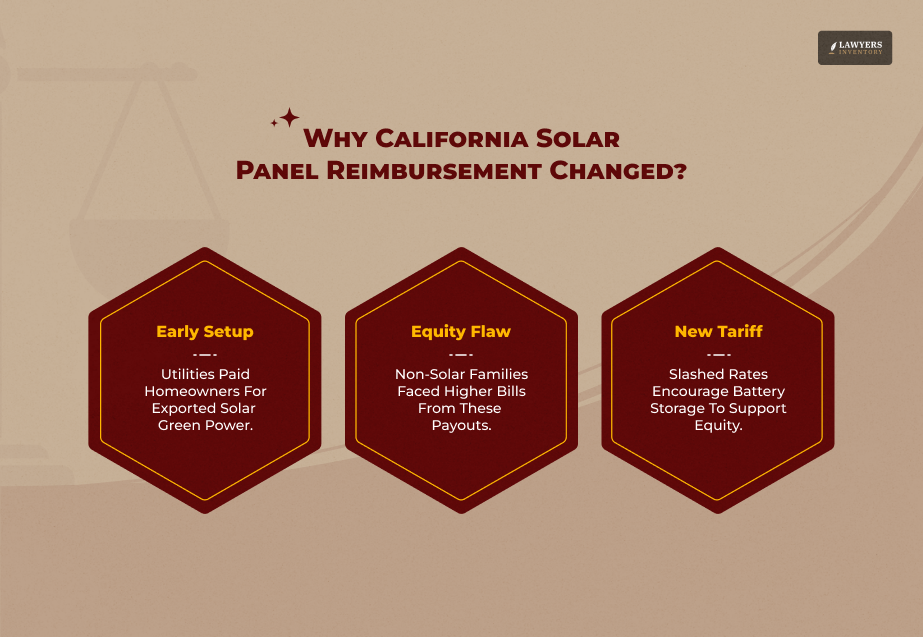
Now, since 1995, the legislature has been asking the utilities to pay for the solar energy that California homeowners export.
Utilities agreed to it, and they paid the homeowners the reimbursement. However, that raised another concern.
The reimbursement the utilities paid became a burden on the homeowners who did not have solar facilities.
So, by 2013, there was a need for a change, and by 2022, the commission slashed the amount of reimbursement to be paid to homeowners.
The California Public Utilities Commission (CPUC) issued a statement on the passing of NEM 3.0. It mentioned,
“We are launching the solar and storage industry into the future so that it can support the modern grid. The new tariff promotes solar systems and battery storage with a focus on equity.”
2. The Intervention Of The Center For Biological Diversity
However, the Center for Biological Diversity intervened, and it raised a concern before the California Supreme Court.
It is mentioned that due to a reduction of 80% in the reimbursement, the effort to expand the use of renewable energy will be hampered.
The Protect Our Communities Foundation and Environmental Working Group also showed similar concerns, and they said the commission should keep in mind the positive impact of renewable energy on society.
Moreover, they pointed out how the commission failed to ensure the sustainable growth of “customer-generated power.”
3. California Supreme Court Intervention
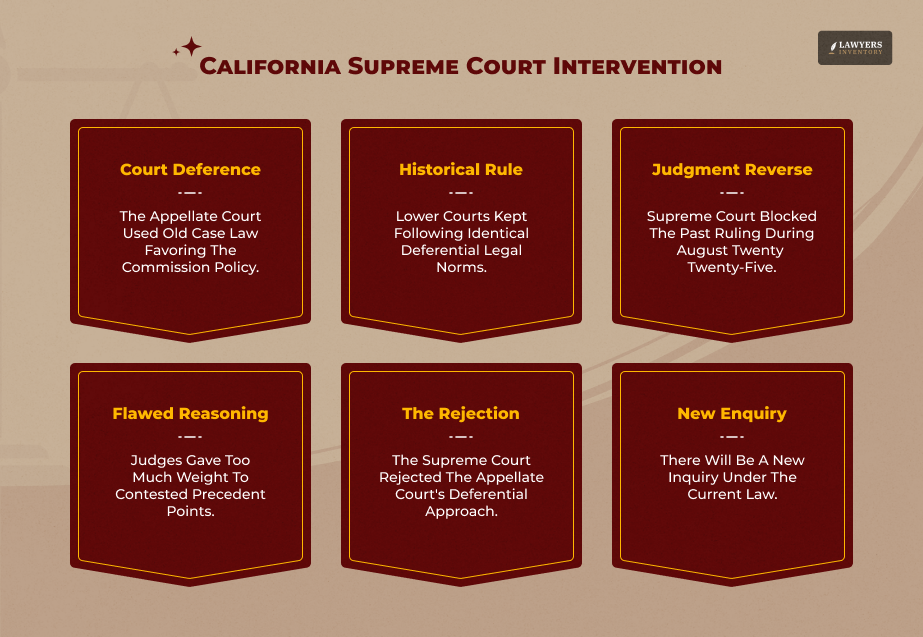
The First Appellate District agreed with the petition of the commission and showed the “Greyhound Lines, Inc. v. Public Utilities Commission” of 1968 as the point of deference (Source: Justia Law).
Furthermore, the High Court noted that though there have been changes in the 1990s, courts have been following the same deferential approach regarding any decision regarding the commission.
However, the Supreme Court opposed this judgment in August 2025, and Leondra Kruger, the Associate Justice, wrote,
“We reverse the judgment of the court of appeal in this matter … and remand for the court to conduct the appropriate inquiry under current law.”
The Supreme Court further mentioned that the lower courts and the CPUC have now given too much importance to the contested deferential point.
4. Continued Legal Uncertainty
There is legal uncertainty and volatility among solar installers and consumers. The Supreme Court ruling in March 2026 has maintained low reimbursements.
So, there is a significant drop in the solar installation rate in California.
5. Impact Of The California Solar Panel Reimbursement Changes On The Market
Thanks to the changes in 2023, the rooftop solar industry has experienced a sharp 80% decrease in installation activities.
This news from PV Magazine also indicates job loss by a significant number. The California Solar & Storage Association (CALSSA) mentions that in 2023, 17000 solar jobs were lost, and that was precisely 22% of all solar jobs in the industry.
So, Where Does The California Solar Panel Reimbursement Legal Battle Stand Now?
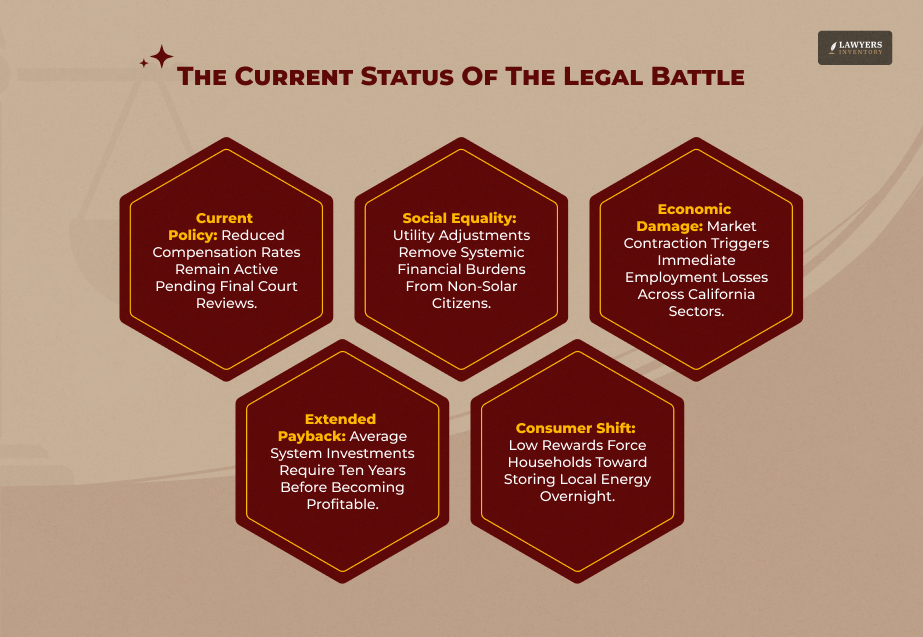
The California Supreme Court has yet to give any decisive ruling on the California solar panel reimbursement legal battle.
However, by asking the Appellate Court and High Court to reconsider their verdicts in line with the commission, it has also kept the possibilities of changes open. (As of 10th March 2026).
Nevertheless, for the time being, the reduced reimbursement rate remains in effect.
Also, with the reduction in the reimbursement rate, there have been some widespread impacts in the social, economic, and environmental sectors of the state.
The regulators defend that this will promote fair price distribution as it will remove the unnecessary burden of solar panel maintenance on the non-solar panel users.
While this is a matter of social equity, this decision has caused market contraction and significant job loss.
Moreover, this increases the span of a solar system repaying its cost. Earlier, it was 4 to 5 years, and now it will stretch up to 10 years.
So, it can be a challenge in the long-term planning of making California greener and sustainable in terms of energy use.
In addition, this has brought a paradigm shift in the way solar homes use energy. It indirectly incentivizes the use of stored power during high-demand hours instead of selling it to the corporation, which now offers a much lower reimbursement.
California Solar Panel Reimbursement Legal Battle: Frequently Asked Questions (FAQs):
Here are the frequently asked questions and answers about the California solar panel reimbursement legal battle.
The export rate or the credit rate a homeowner gets by sending excess power to the grid has gone down by 75-80 percent under NEM 3.0.
The earlier NEM 1.0 and 2.0 customers got near-retail rates of close to $0.30/kWh.
However, the new customers get a rate based on the “Avoided Cost Calculator.” So, the current reimbursement rate hovers between $0.05 and $0.08/kWh.
No, this new ruling does not affect homeowners who already have solar.
During this legal battle, one of the few protections for them is the 20-year-old grandfathering clause.
If your solar system has the “Permission to Operate” under NEM 1.0 and NEM 2.0, you will enjoy more favorable reimbursement rates for the next 20 years from your activation date.
Additionally, recent legislative updates (AB 942) ensure these grandfathered contracts stay with the home even if it is sold.
Yes, it is still worth having a rooftop solar in California.
However, the mathematics has changed, and there has been a shift from an export game to a consumer game.
Furthermore, if you are going for a solar-only model, the payback period under the reduced reimbursement rate will be around 9 to 10 years.
On the other hand, if you follow the recent standard recommendation of a solar+battery model, your payback period will be 4 to 5 hours.
In this current model, homeowners can now use the stored energy during the peak hours of energy consumption, from 4 PM to 9 PM.
This is also a cost-saving scenario, as in this way, you can reduce 85-100% of your electricity bill.
During the California solar panel reimbursement legal battle, there were proposals about adding a solar grid charge, which is also known as the solar tax.
There were expectations of a tax of roughly $8 per kilowatt of installed solar per month. This could have added $60 or more to a typical monthly bill.
However, the official rejection of the tax has offered some respite for the new solar panel adapters.
Leave A Reply






Hung Jury vs. Mistrial: What Is The Difference And Why It Matters
Read More
NarodniyDimUkraina: An Overview Of The Kyiv-Based Brand Preserving Ukrainian Craftsmanship
Read More
What Is A Mistrial? Legal Definition, Causes, And What Happens Next
Read More
What Is A Sequestered Jury? Legal Definition, Process, And Everything You Need To Know
Read More
What Is A Hung Jury? Legal Definition, Causes, And What Happens Next
Read More
0 Reply
No comments yet.