If you look at any high-stakes medical lawsuit today, you will notice that the rules of engagement have completely changed.
Attorneys are no longer just fighting over what happened in the operating room. Instead, the real battleground has quietly shifted to something far more complex: digital clinical metadata.
In my analysis of modern trial trends, I consistently see sharp attorneys run straight into a wall of data.
They are forced to sift through thousands of pages of Electronic Health Record (EHR) systems, trying to catch subtle, highly technical discrepancies that can make or break a multi-million dollar injury claim.
And let’s face it: if you don’t have a clinical background, you are going to miss the background metadata footprints that actually prove your case.
This is where a Legal Nurse Consultant (LNC) changes the game.
They act as the indispensable strategic link between the medical chart and the courtroom. They don’t just read records. Rather, they audit them to expose systemic errors that a lawyer would never notice.
If you are trying to understand the job role of a legal nurse consultant, keep reading!
What Is A Legal Nurse Consultant?
“A legal nurse consultant is a who works with attorneys and other legal professionals to provide expert opinions on medical cases, such as injury or medical malpractice,” according to Indeed.
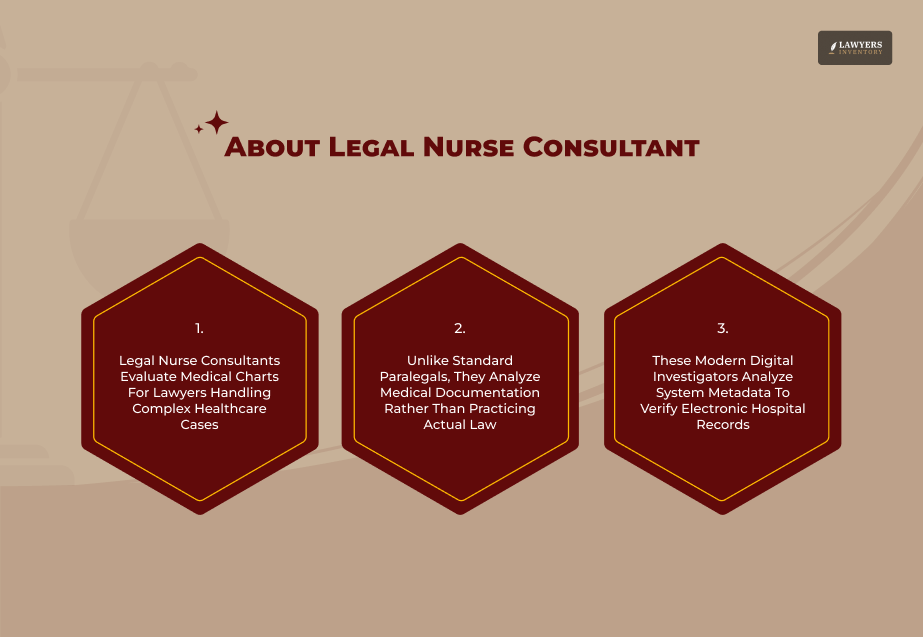
To define the role clearly, I categorize a Legal Nurse Consultant as a licensed Registered Nurse (RN) who applies their extensive clinical knowledge to legal cases involving healthcare issues.
However, we must distinguish them from traditional paralegals.
While paralegals focus on the administrative mechanics of a law firm, LNCs provide deep-dive expert analysis of medical documentation. They scrutinize records specifically to identify deviations from accepted standards of care.
Although they work intimately within the legal field, these professionals do not practice law. Instead, they interpret complex medical procedures, specialized charting patterns, and cryptic physician notes for the legal team.
Furthermore, I have tracked a significant evolution in this role. The modern LNC does not just summarize medical records anymore.
Today, the position requires the highly technical analysis of electronic audit trails and system metadata.
LNCs operate as digital detectives, verifying the exact timing, authenticity, and potential retrofitting of clinical entries within hospital computer networks.
What Is The Job Role Of A Legal Nurse Consultant?
Because legal teams frequently lack formal clinical training, I find that LNCs provide a vital clinical roadmap.
They make complex medical intricacies completely understandable for an attorney. In my daily research, I observe that their responsibilities are highly analytical and diverse:
- Medical record analysis.
- Case merit screening.
- Developing chronologies.
- Expert witness identification.
- Discovery support.
How To Become A Legal Nurse Consultant?
When we talk about career transitions of registered nurses, I discover that moving into the legal arena requires a deliberate, step-by-step professional path.
Here’s how you can become a legal nurse consultant:
Educational Foundation:
You must hold an active, unencumbered RN license. While an associate degree is the minimum requirement, my research shows that top-tier US firms heavily prefer a Bachelor of Science in Nursing (BSN). Furthermore, senior consulting roles now favor a Master’s degree.
Clinical Experience:
You need a minimum of 2 to 5 years of acute bedside experience in units like the ICU or ER. This time develops the diagnostic intuition required to audit complex care effectively.
Specialized Training:
I highly recommend completing a dedicated LNC training program. These programs cover the American civil litigation system, the federal rules of civil procedure, and legal report writing.
Board Certification:
The Legal Nurse Consultant Certified (LNCC) credential is the gold standard managed by the American Legal Nurse Consultant Certification Board. It strictly requires 2,000 hours of active LNC practice experience before you can sit for the comprehensive exam.
Essential Skills To Become A Legal Nurse Consultant
To thrive in this specialized legal niche, I have identified specific technical capabilities that are absolutely non-negotiable:
- Analytical rigor.
- Effective communication.
- Technological proficiency.
- Objectivity.
Is Legal Nurse Consultant A Good Career Path?
If you are a registered nurse looking for a major career pivot, I can tell you firsthand that this path delivers an incredible mix of professional independence and sharp mental challenges.
It is your ticket away from the brutal physical demands, constant burnout, and chaotic hours that come with traditional bedside shifts.
On top of that, it is a completely work-from-home friendly career.
So, basically, as an independent consultant, you get to run your own firm, call the shots on your billable hourly rates, and choose exactly which clients you want to work with.
Personally, I think that it is one of the most rewarding ways to use your clinical expertise to shift healthcare quality and legal justice on a truly systemic level.
What Is The Salary Of A Legal Nurse Consultant?
As the financial stakes of medical litigation increase, compensation has risen to reflect the specialized nature of the work. I have verified the current market rates using top industry databases:
- Annual Salary: Verified career indices on Glassdoor US show the national average base salary for an in-house LNC is approximately $124,578, with top earners in high-litigation states exceeding $150,715 per year.
- Hourly Rates: Independent, firm-owning LNCs operating in the US legal market routinely bill between $125 and $175+ per hour for specialized case reviews, medical summaries, and deposition preparation.
Specialization Tracks For Higher Salaries
To maximize earning potential and stand out in the competitive legal market, I recommend that consultants specialize in specific litigation niches:
- Toxic Torts.
- Forensic Nursing.
- Product Liability.
- In-House Risk Management.
How Long Does It Take To Become A Legal Nurse Consultant?
As a prospective legal nurse consultant, your timeline hinges entirely on your current clinical footprint.
If you already hold a Bachelor of Science in Nursing and work as a registered nurse, you can pivot surprisingly fast. In this case, you only need to master the legal side of the equation.
You can easily complete this specialized training through targeted certification programs within a few months. (Source: Coursera)
Conversely, if you are starting from scratch without a degree, you face a marathon rather than a sprint.
- First, you must earn your nursing degree and pass the NCLEX exam.
- Next, you need to clock several years of mandatory bedside experience.
Consequently, this foundational path demands a commitment of at least five to seven years before you can competently consult on complex medical-legal cases.
Legal Nurse Consultants vs. Expert Witnesses: Understanding The Difference
I believe it is critical to distinguish between these two roles, as they serve entirely different functions in the American civil justice system:
| Feature | Legal Nurse Consultant (Consultant) | Expert Witness (Testifying) |
| Primary Role | Behind-the-scenes strategic support and evidence screening. | Testifying under oath during depositions and trial. |
| Legal Visibility | Work is confidential, protected under the Attorney Work-Product Doctrine. | Work, notes, and correspondence are fully discoverable by opposing counsel. |
| Analytical Focus | Analyzing the entire nursing process and tracking documentation gaps. | Providing formal medical opinions on medical causation and liability. |
Legal Nurse Consultant Job Outlook 2026
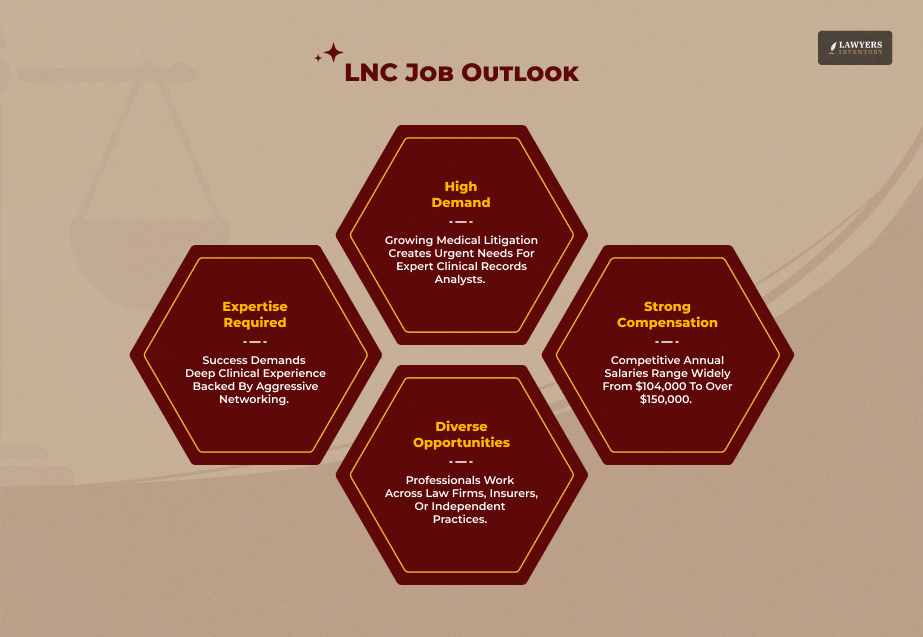
The US job market for Legal Nurse Consultants is absolutely booming right now
To put this into perspective, look at what the U.S. Bureau of Labor Statistics (BLS) is reporting: regular registered nursing employment is projected to grow 5 percent through 2034, which is already tracking faster than your average occupation.
However, when you look at the intersection of healthcare and law, the pace is moving even faster.
We can attribute this surge to two massive, colliding forces:
- The aging baby-boomer demographics requiring more intensive medical care.
- The constant influx of complex, changing federal medical regulations.
It is creating a perfect storm for litigation.
Because of this, civil litigation defense firms and plaintiff attorneys are shifting their strategies.
Instead of constantly outsourcing expensive third-party reviews, they are aggressively hiring in-house LNCs.
It is the smartest way for firms to manage a rising mountain of medical malpractice and personal injury claims without blowing through their clients’ budgets.
Can AI Replace Legal Nurse Consultant?
In my analysis of modern legal technology, AI tools serve as powerful efficiency assistants rather than human replacements.
Modern software platforms can scan thousands of pages of records in seconds, flagging specific data points like medication administration times.
However, AI software completely lacks clinical intuition. It cannot determine if those automated actions met the accepted standard of care within a chaotic, real-world clinical context.
Therefore, just like Legal Assistants, successful LNCs now use AI tools to speed up data extraction and indexing. This automation gives them more time to focus on high-level strategic analysis, case theme development, and human judgment.
Frequently Asked Questions (FAQs):
Here are some of the questions that people often ask about legal nurse consultants. Take a look at them before leaving:
No. You need active nursing credentials and clinical expertise, not formal legal degrees.
Independent LNCs build businesses by networking directly with local trial lawyers, attending bar association events, and marketing their specific clinical niches.
LNCs will be asked to testify in the courtroom only if they are specifically hired as an Expert Witness. “Consulting” experts typically work completely behind the scenes, helping attorneys build cases.
Leave A Reply






Hung Jury vs. Mistrial: What Is The Difference And Why It Matters
Read More
NarodniyDimUkraina: An Overview Of The Kyiv-Based Brand Preserving Ukrainian Craftsmanship
Read More
What Is A Mistrial? Legal Definition, Causes, And What Happens Next
Read More
What Is A Sequestered Jury? Legal Definition, Process, And Everything You Need To Know
Read More
What Is A Hung Jury? Legal Definition, Causes, And What Happens Next
Read More
0 Reply
No comments yet.