
Memorandum of association and articles of association are two preliminary documents that each and every organization has to prepare before they apply for the registration of the company in India.
But is it really that important? Yes.
Entrepreneurs can be preoccupied with product-market fit, pitch decks, and growth hacks. Yet, many of them dismiss the legal workings of starting a business as administrative formalities.
This is a critical mistake. Every global conglomerate and agile tech startup is built on a legal bedrock. And this bedrock consists of just two documents:
- Memorandum of Association (MOA).
- Articles of Association (AOA).
Together, these documents serve as the corporate constitution (Source: Legal Wiz). Therefore, understanding the structural dynamics between them is a strategic necessity.
Most experts look at the MOA as the company’s external charter. It defines the corporate boundaries with the outside world. Conversely, the AOA acts as the internal operational blueprint. It sets the rules for the people inside the machine.
If you want to understand what these are, keep reading!
What Is The Companies Act, 2013?
Before I start explaining the fundamental difference between Memorandum of Association and Articles of Association (or what they are), it is important that you have a clear knowledge of their origin.
And that is the Companies Act.
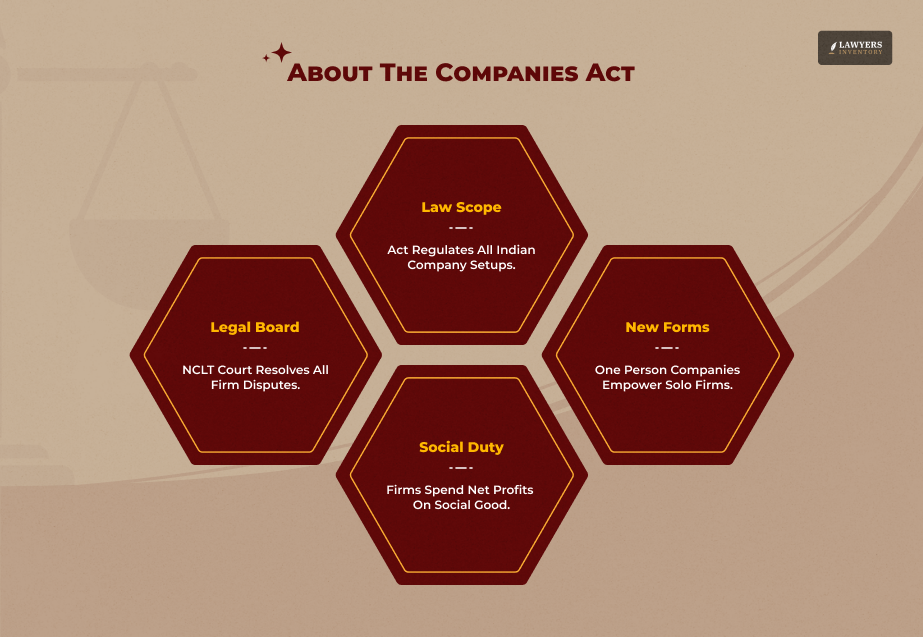
One of the major legislative reforms in India was the Companies Act, 2013. This replaced the old 1956 Act. The new law changed the landscape of corporate governance and the activities of companies in several ways.
The Act, besides strictly enforcing transparency, accountability, and corporate governance, also made the undertaking of Corporate Social Responsibility compulsory and introduced the concept of One Person Companies (OPCs).
According to the Companies Act – especially Sections 4 and 5 – a company can only be incorporated after the submission of the Memorandum of Association and the Articles of Association.
The Act established strict rules for these documents.
For instance, Section 10 explicitly states that once registered, the MOA and AOA bind the company and its members just like a signed contract. Furthermore, Section 6 declares that the Companies Act overrides both documents.
Additionally, any clause that contradicts the Act is legally void.
If a startup chooses not to draft a custom AOA, the Act provides a solution. Schedule I of the Act contains Table F, a standardized model roster of articles that automatically governs the company.
Consequently, founders must align their corporate charters with these statutory guidelines to ensure compliance and avoid regulatory penalties.
What Is Memorandum Of Association (MOA)?
When a company forms, stakeholders need to know its exact limits. The public, the government, and potential investors require clear boundaries.
This is where the Memorandum of Association (MOA) comes into play.
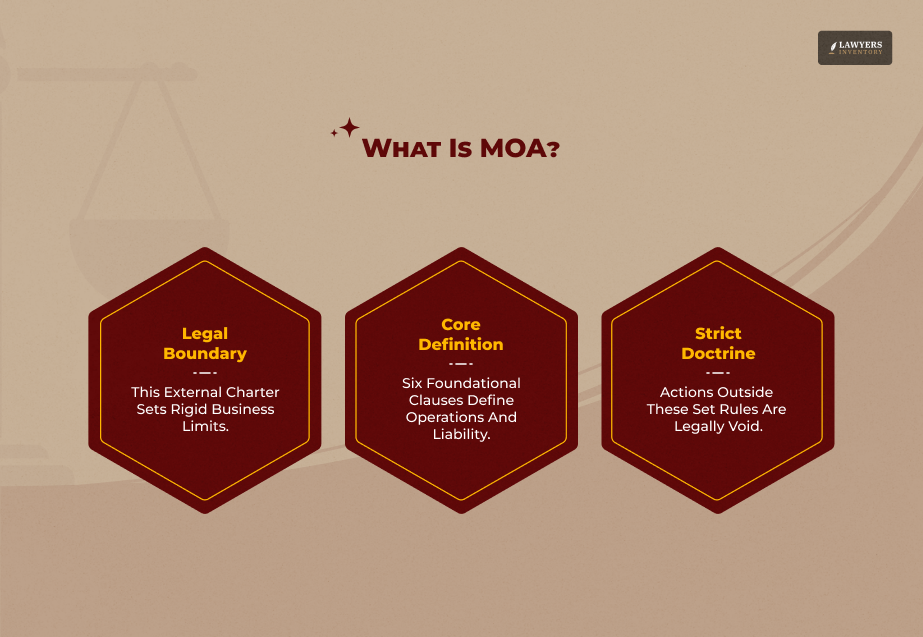
I define the MOA as the external face of the corporate constitution. It sets the absolute boundaries of the company’s existence.
Consequently, a company cannot take action outside the scope of its MOA. If a firm enters a contract beyond these limits, courts view that action as legally void.
In corporate law, professionals call this the doctrine of ultra vires (beyond the powers). Because the MOA defines the company’s legal perimeter, it remains highly rigid. For this reason, you need strict regulatory approvals to alter it.
Features Of MOA
The key features of MOA include:
- Mandatory for incorporation.
- Defines the scope of activities.
- Public document.
- Defines liability.
Elements/Contents Of MOA
Through my analysis of corporate frameworks, I find that almost every robust MOA relies on six core pillars:
- Name Clause: This establishes the official legal identity of the corporation. It protects existing trademarks and prevents public confusion.
- Registered Office Clause: This identifies the physical jurisdiction of the company’s legal domicile. It determines which courts and local laws hold authority.
- Objects Clause: This clause forms the absolute core of the document. It defines the specific purposes of the company and limits its industry operations.
- Liability Clause: This explicitly states the financial safety net for shareholders. It confirms that shares face value limits their personal liability.
- Capital Clause: This details the company’s authorized share capital. It maps out the maximum equity blueprint the company can issue.
- Association Clause: This final sign-off contains the formal pledge of the founding subscribers. They agree to form the corporation and take up their initial shares.
What Is Articles Of Association (AOA)?
While the MOA tells the world what the company can do, the Articles of Association (AOA) tell the team how to do it.
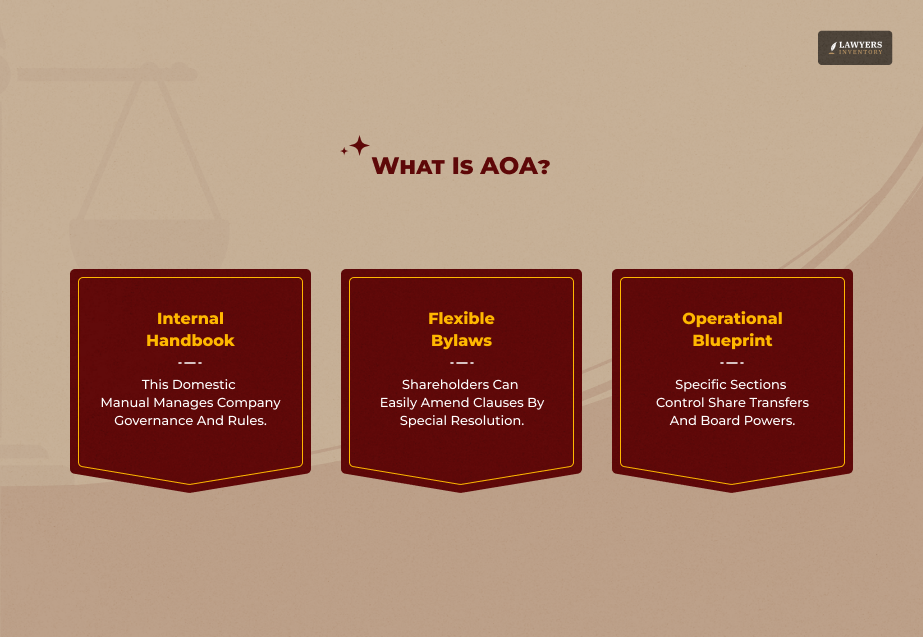
Specifically, I would say that the AOA is the domestic governance manual. It does not look outward at creditors or competitors. Instead, it manages the internal relationships between the company, its board of directors, and its shareholders.
Furthermore, the AOA operates as a living, flexible document. Because it contains the internal bylaws, shareholders can amend it relatively easily. They simply pass a special resolution to match the changing operational realities of the business.
Features Of MOA
The key features of MOA include:
- Internal governance.
- Management power.
- Shareholder rights.
- Financial management.
- Dispute and dissolution.
- Legal subordination.
Elements/Contents Of AOA
There are several critical operational elements that consistently stand out when it comes to AOA. These are as follows:
- Share Governance: These clauses establish precise rules for issuing new stock, transferring shares, and forfeiting shares.
- Voting and Meetings: This section outlines corporate democracy. It dictates how managers call annual general meetings (AGMs) and how shareholders use proxies.
- The Board Hierarchy: This detailed blueprint covers director appointments, executive powers, compensation, and removal protocols.
- Financial Stewardship: These internal guardrails control dividend declarations, financial reserves, and corporate account audits.
- The Exit Framework: This section provides a pre-negotiated legal roadmap for winding up the company or handling a corporate dissolution.
Differences Between Memorandum Of Association And Articles Of Association
To truly appreciate how these two legal pillars hold up a business, you must look at them side by side.
Based on my analysis of corporate law structures, here is how Memorandum of Association and Articles of Association differ across the most critical metrics:
| Scope | Memorandum of Association (MOA) | Articles of Association (AOA) |
| Legal Status | The supreme constitutional charter of the company. | The subordinate internal bylaws and rules. |
| Core Purpose | Defines the company’s scope, powers, and objects. | Establishes internal management and operational systems. |
| Target Relationship | Governs the link between the company and outsiders. | Governs the link between shareholders, directors, and the firm. |
| Supremacy | Subordinate only to national corporate statutes. | Completely subordinate to both the law and the MOA. |
| Ease of Alteration | Complex; requires special resolutions and government approval. | Simpler; usually requires just an internal special resolution. |
| Ultra Vires Impact | Acts outside the MOA are completely void. | Shareholders can ratify acts outside the AOA with consent. |
Legal Status And Core Purpose
First, the Memorandum of Association and Articles of Association hold entirely different positions within a firm’s legal hierarchy.
The Memorandum of Association operates as the supreme constitutional charter of the company. It serves as the bedrock foundation upon which the entire entity rests.
Conversely, the Articles of Association function as a subordinate set of internal bylaws. Which means that the AOA must always yield to the higher authority of the MOA. (Source: Clear Tax)
In terms of purpose, the MOA explicitly outlines the company’s broad powers, boundary limits, and fundamental objects. It identifies exactly what the business can legally achieve.
On the other hand, the AOA establishes the day-to-day internal management systems. It focuses on the specific processes required to keep the business running smoothly.
Operational Scope: Targeted Relationships And Supremacy
Secondly, the Memorandum of Association and Articles of Association address different corporate audiences.
For instance, the MOA mainly controls the company’s external relations with outside stakeholders like creditors, suppliers, and government regulators.
In contrast, the AOA regulates the internal dynamics of the firm. It manages the specific rights, duties, and ties between the shareholders, the board of directors, and the corporate entity itself.
When analyzing legal supremacy, national corporate statutes limit the MOA. However, it still stands above all other internal company paperwork.
The AOA occupies a much lower rung on the ladder. It remains completely subordinate to national laws and must never contradict any clause within the MOA.
Procedural Differences: Alteration And Ultra Vires Impact
Finally, the process for changing the Memorandum of Association and Articles of Association involves vastly different levels of difficulty.
Altering an MOA requires a complex legal journey. Founders must pass internal resolutions, notify the public, and secure formal government or regulatory approval.
Alternatively, amending an AOA is a much simpler procedure. Because it is an internal rulebook, shareholders can quickly update the clauses by voting through a standard special resolution.
This structural difference between the Memorandum of Association and Articles of Association becomes critical when a company breaches its own rules.
If a firm acts outside the boundaries of its MOA, the law treats that act as ultra vires and completely void. No amount of shareholder voting can fix or validate it.
However, if a company acts outside the rules of its AOA, the consequences are more forgiving. Shareholders can later ratify and legalize the action simply by giving their formal consent.
The Evolution Of Corporate Constitutions: Modern Business Trends
Recently, I have noticed a massive shift in corporate drafting. Founders no longer view documents like Memorandum of Association and Articles of Association as static templates. Instead, forward-thinking leaders use them as strategic tools.
Broadening The Objects Clause For Tech And AI Pivots
Historically, corporate attorneys wrote highly specific objects clauses. For example, if you ran a logistics firm, your MOA specified truck management.
However, the modern digital economy forces companies to pivot rapidly. If an AI software startup suddenly shifts to manufacturing proprietary robotics hardware, a restrictive objects clause freezes operation.
To solve this, elite corporate architects now write ultra-flexible, broad objects clauses. Founders deliberately build legal cushions into their MOAs. As a result, they execute massive strategic pivots without triggering a costly, time-consuming legal rewrite.
Embedding ESG And Sustainability Commitments
In addition to tech flexibility, legal analysts have united a profound shift toward Environmental, Social, and Governance (ESG) criteria.
Historically, corporate governance operated under strict “shareholder primacy.” This meant a director owed a sole legal duty to maximize profit for shareholders.
Now, a growing wave of sustainable brands rewrites their Articles of Association to mandate stakeholder governance.
By embedding ESG metrics directly into their AOA, these companies legally bind their board of directors.
Leaders must weigh environmental and community impact alongside profit margins. Ultimately, this protects the company’s mission from short-term financial pressures.
Practical Compliance And Amendments Of Memorandum Of Association And Articles Of Association
One of the questions that often arises about MOA and AOA is: Can you modify an MOA and AOA after your company starts running?
The shortest answer – yes, you can.
However, the legal friction varies wildly between the two. And that is mainly because the AOA functions as an internal rulebook. As a result, updating it requires a standard corporate procedure.
First, the company recognizes that it is necessary to change its regulations, e.g., sharing transfer restrictions on a new investor.
Then, shareholders adopt a special resolution, which usually needs 75% approval. Finally, the team submits the updated articles to the local corporate registry.
On the other hand, modifying an MOA is a far more complicated matter.
Changes in the capital structure or the objects of clause are among the changes that affect external creditors and government regulators, since they fundamentally change the company. That means you will be asked to complete significant regulatory changes.
Typically, you will need to submit written applications to the regional corporate regulatory authorities, publish creditors’ notices, and perform painstaking re-registration steps. This is the reason why experts advise founders to draft a well-designed MOA from the start.
Disclaimer: The information provided in this article is for general informational purposes only. It does not, and is not intended to, constitute legal advice. Please consult an attorney for legal help.
Leave A Reply







Hung Jury vs. Mistrial: What Is The Difference And Why It Matters
Read More
NarodniyDimUkraina: An Overview Of The Kyiv-Based Brand Preserving Ukrainian Craftsmanship
Read More
What Is A Mistrial? Legal Definition, Causes, And What Happens Next
Read More
What Is A Sequestered Jury? Legal Definition, Process, And Everything You Need To Know
Read More
What Is A Hung Jury? Legal Definition, Causes, And What Happens Next
Read More
0 Reply
No comments yet.