
Summarize using AI





Prompt copied. Paste it into Gemini.
Quick Answer

USCIS Citizenship Good Moral Character is a statutory requirement for those seeking naturalization in the United States. From August 2025, USCIS started using a very strict assessment overall rather than a checklist only. It has gone beyond just clean criminal records. For example, the officers now also look at what you are doing positively, like volunteering or helping the community, handling family duties, going to college, and paying taxes regularly, among other positive traits.
When researching about the USCIS Citizenship Good Moral Character and its requirement, I found something rather interesting.
While I was expecting a simple checklist, what I found was a standard that has undergone its most significant transformation in decades. One that has fundamentally changed what it means to qualify for U.S. citizenship.
On 15th August 2025, the USCIS (U.S. Citizenship and Immigration Services) issued their Policy Memorandum.
Their subject was simple: Restoring a rigorous, holistic, and comprehensive Good Moral Character evaluation standard for aliens applying for Naturalization. [Source: USCIS]
The August 2025 policy shift matters enormously.
The old approach asked a simple question: has the applicant committed any disqualifying acts? The new approach asks something far more expansive: is this person genuinely worthy of citizenship?
That shift affects every naturalization applicant currently in the pipeline – and it requires a completely different preparation strategy.
What Is USCIS Citizenship Good Moral Character?
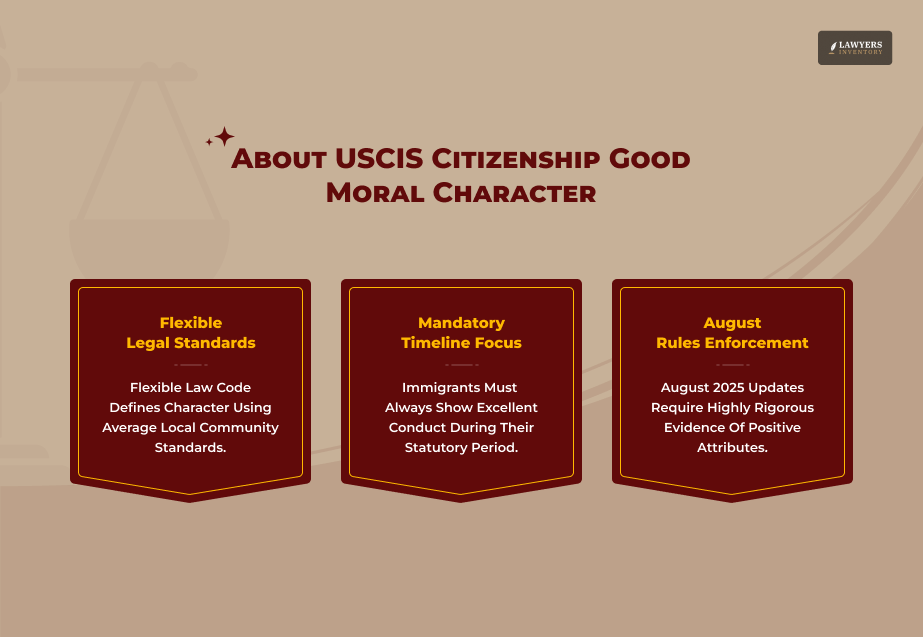
The good moral character requirement is rooted in the Immigration and Nationality Act (INA). It does not define the term precisely – intentionally so.
Congress left the definition flexible, allowing courts and USCIS to apply it in light of evolving community standards.
USCIS defines good moral character as character that measures up to the standards of an average citizen of the community in which the applicant resides.
Lawful Permanent Residents seeking to become naturalized U.S. citizens are required to establish good moral character for the required period – five years for most LPRs, and three years for certain spouses of U.S. citizens.
That five-year window is called the statutory period. USCIS reviews conduct during this period most intensively.
However, officers can – and under the 2025 policy now regularly do – consider conduct from before the statutory period if it is particularly serious or relevant to the overall character assessment.
The USCIS citizenship good moral character evaluation has always been central to the naturalization process.
What changed in August 2025 was how rigorously that evaluation is conducted – and what it now requires applicants to affirmatively prove.
The August 2025 Policy Shift: What Changed And Why It Matters
On August 15, 2025, USCIS released a new policy memorandum – PM-602-0188 – increasing the scrutiny of the good moral character determination.
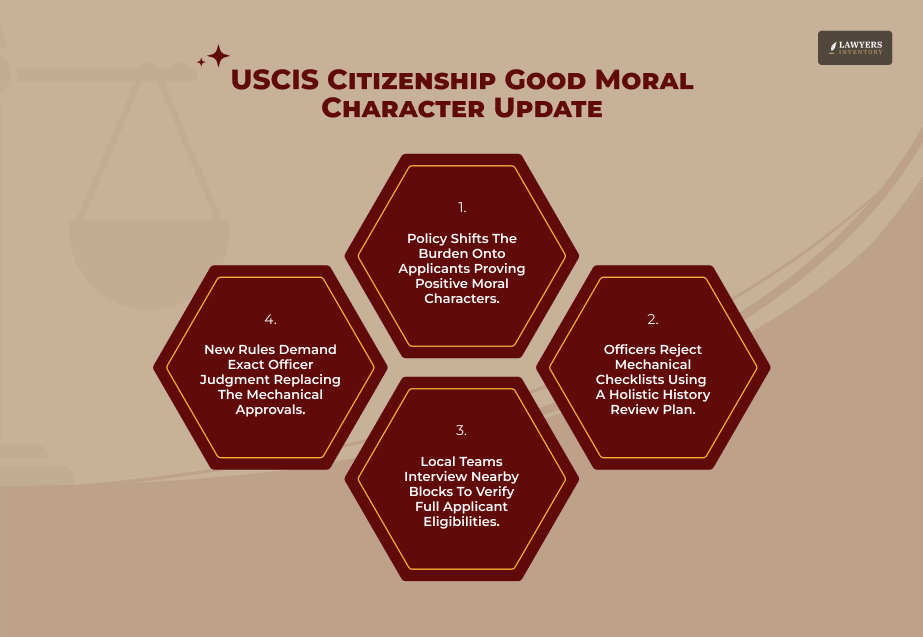
The new policy emphasizes that findings of good moral character must go beyond the absence of disqualifying acts. It must reflect a genuine positive assessment of who the applicant is and how they have lived in their community.
This is the most significant shift in USCIS citizenship good moral character evaluation in modern history.
Previously, the standard was largely negative: avoid disqualifying conduct, pass the background check, and citizenship follows.
Under the new framework, the burden is affirmatively positive. Applicants must demonstrate that they are genuinely worthy – not merely that they have avoided wrongdoing.
USCIS explained that the new directive moves away from a mechanical checklist approach to a totality of circumstances model.
Officers now have significantly broader discretion to approve or deny applications based on their holistic assessment of the applicant’s full history and current standing.
On August 22, 2025, USCIS also reintroduced neighborhood investigations of naturalization applicants to corroborate their eligibility for U.S. citizenship.
This means that what neighbors, employers, and community members say about an applicant can now directly affect the outcome of a citizenship application – a return to a practice that had been largely discontinued.
Legal precedent on good moral character has always evolved alongside shifting social standards.
The 2025 memorandum reflects the current administration’s view that prior adjudication practices were insufficiently rigorous – and that officers should exercise genuine judgment rather than mechanical approval.
Permanent Bars: Conduct That Permanently Disqualifies
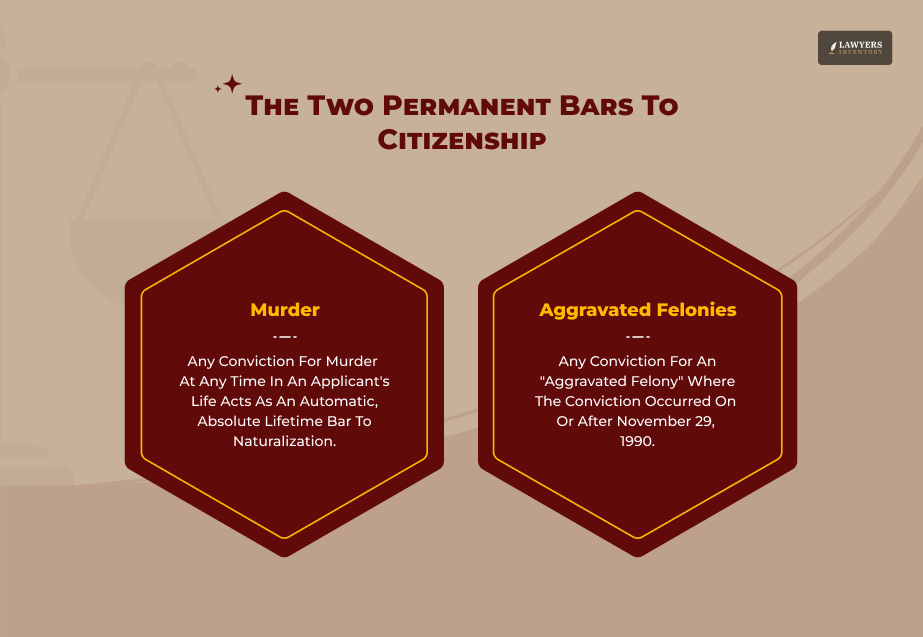
Some conduct permanently bars an applicant from establishing USCIS citizenship good moral character. These bars apply regardless of when the conduct occurred – they are not limited to the statutory period.
Permanent bars include murder, aggravated felonies, crimes of violence, persecution, genocide, torture, and severe violations of religious freedom.
Aggravated felonies deserve particular attention.
Under the INA, the term encompasses a broad range of offenses – including drug trafficking, sexual abuse of a minor, theft offenses resulting in imprisonment of at least one year, and crimes of violence.
A conviction for an aggravated felony at any point in an applicant’s history permanently forecloses naturalization.
There is no rehabilitation exception. There is no waiver.
The severity of the permanent bar framework is what makes early legal consultation so important.
An offense that an applicant believes was minor – or that has since been expunged under state law – may still constitute an aggravated felony under federal immigration law and permanently bar citizenship.
What Permanently Bars You From Establishing Good Moral Character?

Murder, aggravated felonies, crimes of violence, persecution, genocide, torture, and severe violations of religious freedom permanently bar good moral character. These bars apply regardless of when the conduct occurred.
Conditional Bars: Time-Limited Disqualifications
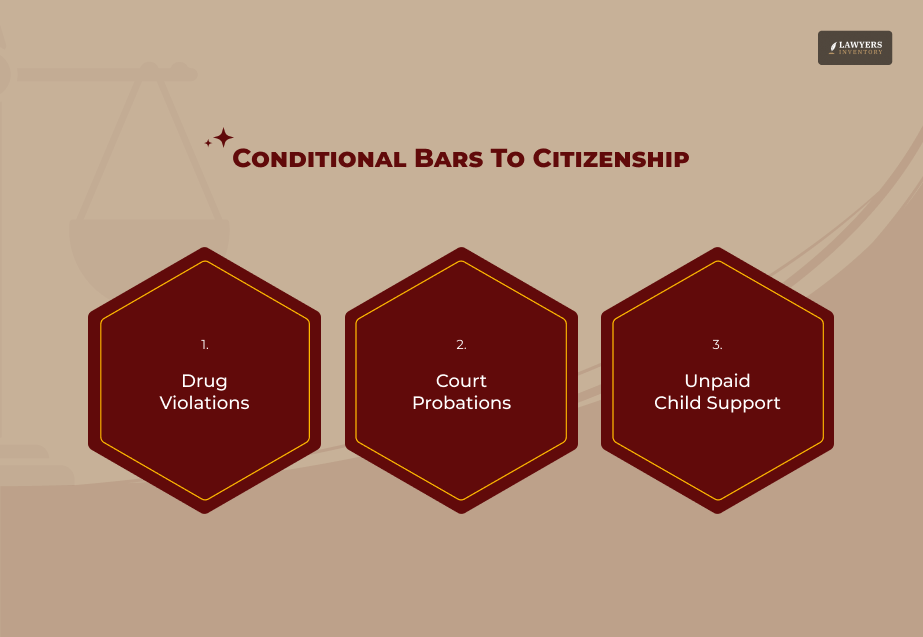
In addition to the permanent bars to good moral character, the Immigration and Nationality Act includes bars that are not permanent in nature.
USCIS refers to these as conditional bars. These bars are triggered by specific acts, offenses, activities, circumstances, or convictions within the statutory period for naturalization, including the period prior to filing and up to the time of the Oath of Allegiance. [Source: Chapter 9]
Conditional bars are the category where the 2025 policy shift matters most. Applicants may be disqualified from acquiring citizenship if they have committed or engaged in:
- Controlled substance violations.
- Multiple DUI convictions.
- False claims to citizenship.
- Unlawful voting.
Authorities can also disqualify them if they commit any other acts that are contrary to the average behavior of citizens in the jurisdiction where they reside.
Drug Violations
Drug violations are a particularly nuanced area. Violation of federal controlled substance law, including for marijuana, remains a conditional bar to establishing good moral character for naturalization even where that conduct would not be an offense under state law.
This is a critical point that many applicants in states with legalized marijuana miss entirely. State legality is irrelevant to federal immigration assessment.
Court Probations
Court probations add another layer of complexity. Acceptable evidence of rehabilitation includes compliance with probation or court-ordered conditions.
An applicant currently on probation – or who has violated the terms of court probation – faces significant additional scrutiny under the new holistic standard.
Unpaid Child Support
Child support non-compliance is also a factor. USCIS will look for proof that the applicant has paid overdue taxes or child support, completed probation or complied with all court orders, and repaid government overpayments or debts.
Unpaid child support obligations signal financial irresponsibility and a failure to meet legal duties – both of which weigh negatively under the totality of circumstances model.
Can You Still Apply If You Have A Conditional Bar On Your Record?

Conditional bars are not permanent. Applicants with conditional bar issues - including past drug violations, multiple DUIs, or court probation histories - may still qualify if they can demonstrate genuine rehabilitation and positive conduct since the disqualifying event.
What USCIS Now Examines Beyond Criminal Records
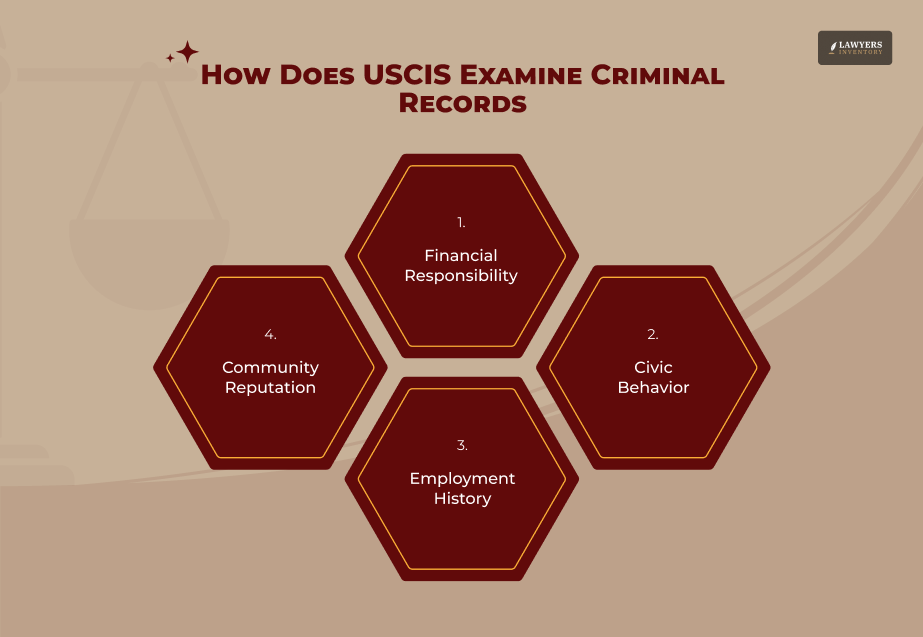
This is the section most applicants fail to address adequately. The 2025 policy expanded USCIS citizenship good moral character review well beyond the criminal record.
Beyond traditional criminal bars, officers are now directed to examine conduct that, while technically legal, may be inconsistent with civic responsibility. This would include things like:
- Repeated traffic violations.
- Harassment.
- Aggressive solicitation.
It could also include any behavior that does not align with the average behavior of citizens in the applicant’s community.
In practice, this means USCIS officers can now consider:
Financial Responsibility:
Tax compliance, unpaid debts, and financial obligations to government agencies are all relevant. An applicant with a history of tax evasion or unpaid government debts faces a meaningful hurdle even without a criminal record.
Civic Behavior:
Repeated minor infractions – even non-criminal ones – can aggregate into a pattern that undermines an applicant’s good moral character claim.
Employment History:
Stable and lawful employment history and achievements are now considered positive factors in the good moral character determination.
Community Reputation:
Under the reintroduced neighborhood investigation program, USCIS may contact employers, community organizations, and neighbors to corroborate or challenge an applicant’s self-presentation.
Background checks with True People Search and similar commercial background databases are sometimes used by applicants themselves to audit their own public records before filing.
For instance, from what I have seen, they do this to identify any records, liens, or public information that could surface during USCIS review.
While not an official part of the USCIS process, self-auditing before filing gives applicants the opportunity to address discrepancies proactively.
How Long Does USCIS Review Conduct For Good Moral Character?

USCIS primarily reviews the five-year statutory period immediately preceding the filing of Form N-400 - or three years for certain spouses of U.S. citizens. However, officers can consider earlier conduct, particularly if it was serious or constitutes a permanent bar.
Positive Evidence That Strengthens Your Application
The most significant practical change in the 2025 policy is the requirement to affirmatively present positive evidence – not merely the absence of disqualifying conduct.
USCIS officers must consider an individual’s positive attributes and contributions, such as community involvement, family responsibilities, educational attainment, and compliance with tax obligations, in good moral character determinations.
Documentation that could show good moral character includes:
- Tax records showing proper payment.
- Evidence of a long employment history.
- Proof of community involvement.
- Letters of recommendation.
- Evidence of compliance with court orders.
- Records showing financial and legal responsibility in the past five or more years.
The following categories of positive evidence carry the most weight under the current framework:
Community Service And Volunteerism:
Documented involvement with community organizations, religious institutions, or charitable causes demonstrates civic engagement beyond the minimum required by law.
Family Caregiving:
Evidence that the applicant serves as a primary caregiver – for children, elderly parents, or disabled family members – reflects the kind of personal responsibility USCIS now actively seeks.
Educational Attainment:
Degrees, certifications, professional licenses, and ongoing education all contribute positively to the holistic assessment.
Tax Compliance:
Clean tax records – including timely filing and payment – are among the clearest signals of law-abiding behavior available to USCIS officers.
Employment Stability:
A consistent, lawful employment history demonstrates reliability and civic contribution.
Letters Of Support:
Credible community testimony supporting the applicant’s character is specifically listed as acceptable evidence of rehabilitation and good character under the 2025 policy.
Rehabilitation: How To Overcome Past Conduct?
Past mistakes do not automatically end an applicant’s path to citizenship – unless they constitute a permanent bar. For conditional bars and other concerning conduct, genuine rehabilitation can make the difference between approval and denial.
The agency places greater weight on evidence of rehabilitation. Applicants who have engaged in past wrongdoing may still be approved for naturalization if they can show genuine reform, such as:
- Community service.
- Mentorship.
- Caregiving roles.
- Long-term ties to the U.S.
The rehabilitation inquiry is not perfunctory under the new framework. USCIS officers look for evidence of genuine change over time – not a single corrective action taken in anticipation of the citizenship application.
An applicant who committed drug violations five years ago but has since maintained clean compliance, steady employment, and community involvement is in a fundamentally different position than one who has simply waited out the statutory period.
Completing court probation successfully matters enormously in this context. Complying with every condition of court-ordered supervision – without violation, without delay – demonstrates exactly the law-abiding behavior the USCIS citizenship good moral character standard now requires.
The Neighborhood Investigation: What Applicants Should Know
On August 22, 2025, USCIS reintroduced neighborhood investigations of naturalization applicants to corroborate their eligibility for U.S. citizenship.
This is one of the most significant procedural changes accompanying the new good moral character framework – and one that very few guides address in detail.
Under this program, USCIS officers may contact community members, employers, landlords, or other individuals who can speak to an applicant’s character and conduct. What these contacts report can directly affect the outcome of the application.
This makes community reputation a tangible asset to cultivate – not an afterthought. Some of the applicants are positioned to benefit when neighborhood investigations confirm the portrait presented in their application.
They are the ones with:
- Strong ties to local organizations.
- Positive relationships with employers.
- Documented community engagement.
Applicants who have been involved in unusual legal proceedings.
It includes those that generated significant public attention, such as cases involving voyeurism charges or other conduct that became part of the public record – should consult with an immigration attorney before filing.
Public records are accessible. Officers conducting neighborhood investigations may encounter them. Proactive disclosure and contextualization are always preferable to undisclosed surprises.
The New Civics Test: What Changed In October 2025
The USCIS citizenship good moral character evaluation does not operate in isolation. It is one component of a broader naturalization process that has also undergone significant changes.
On September 17, 2025, USCIS announced the implementation of the 2025 Naturalization Civics Test.
The new test increases the number of questions from 10 to 20, randomly drawing from the same bank of 128 questions used for the 2020 test.
Officers will orally ask 20 questions until the applicant passes – correctly answering 12 questions – or fails – incorrectly answering nine questions.
The 2025 test assesses an alien’s understanding of U.S. history and government and is one of many steps in an ongoing effort to restore integrity to the naturalization process.
The combined effect of the expanded good moral character standard and the more demanding civics test means that the naturalization process in 2026 requires more thorough preparation than at any point in recent memory.
Working With A Legal Representative
The expanded discretion granted to USCIS officers under the 2025 policy makes professional legal guidance more important than ever.
The 2025 GMC memorandum offers flexibility for well-prepared applicants with strong community and family ties – but also grants officers wider discretion to deny applications for vague or subjective reasons.
Working with a qualified legal representative who understands the new holistic standard – and who can help build a complete, well-documented application – significantly reduces the risk of denial based on factors the applicant did not know were being considered.
A legal representative can also help applicants assess whether any past conduct – including conduct they believe was resolved – could surface during USCIS review.
The scope of what officers now consider means that applicants face meaningful risk from conduct they may have dismissed as irrelevant to a citizenship application.
Some applicants in this process also carry post-conviction histories that intersect with immigration law in complex ways.
Understanding what it means to commute a sentence – and whether any sentence modification in the applicant’s history affects their immigration record – is a question best answered with professional immigration counsel before filing.
A commuted sentence does not erase a conviction from the applicant’s record for immigration purposes.
Disclaimer: This article is for general informational and educational purposes only. It does not constitute legal or immigration advice. USCIS policies are subject to change. If you are preparing a naturalization application, consult a qualified immigration attorney who can evaluate your specific circumstances and help build the strongest possible case.
Sources:
- USCIS Policy Memorandum PM-602-0188 – Restoring a Rigorous, Holistic, and Comprehensive Good Moral Character Evaluation Standard for Aliens Applying for Naturalization (August 15, 2025) – uscis.gov
- USCIS Policy Manual, Volume 12, Part F – Good Moral Character – uscis.gov
- USCIS Policy Manual, Volume 12, Part F, Chapter 5 – Conditional Bars for Acts in Statutory Period – uscis.gov
- USCIS – 2025 Naturalization Civics Test Announcement (September 17, 2025) – uscis.gov
- Hunton Andrews Kurth – USCIS Expands Good Moral Character Standards for Naturalization (August 2025)
- Duane Morris LLP – Is Now the Right Time to Apply for U.S. Citizenship? (October 2025)
- Ogletree Deakins – USCIS Implements Holistic Good Moral Character Evaluation (August 2025)
- Boundless Immigration – Trump Admin Expands Good Moral Character Standard (April 2026)
- SG Legal Group – USCIS’s New Standard for Good Moral Character (October 2025)
- Law Offices of Robert P. Gaffney – New USCIS Policy Places Heavier Scrutiny on Good Moral Character (September 2025)
- Jackson Lewis – USCIS Updates Policy on Assessing Good Moral Character (August 2025)
- Manifest Law – How USCIS Determines Good Moral Character: A 2026 Guide (February 2026)
- Immigration and Nationality Act (INA) – 8 U.S.C. § 1101(f) – Definition of Good Moral Character
Leave A Reply






Do You Pay Taxes On Lawsuit Settlements? IRC Section 104 Explained
Read More
Non-Disparagement Clause Explained: Requirements, Enforceability, And What Changed Recently
Read More
Best Practices For Successful Trademark Registration
Read More
Understanding Your Rights: A Guide To The Legal Process
Read More
How To Clear A Bench Warrant Without Going To Jail: A Legal Guide
Read More
0 Reply
No comments yet.