
In the UK, voyeurism is considered a very serious crime. It is when someone secretly watches or records a person performing a private act without permission.
The law takes the offender to indulge in the act for sexual arousal to be criminally liable. This particular crime has been legislated in Section 67 of the Sexual Offences Act 2003.
British courts regard these breaches of personal privacy as a very grave matter. Those found guilty of such behavior can be punished by up to two years imprisonment. Apart from a jail sentence, offenders are normally also subjected to the Sex Offenders Register.
UK authorities strictly track down these crimes.
In fact, prosecutors win over 83% of these cases once they reach a court trial. Police use advanced digital forensics to find hidden videos on phones and cloud storage.
So, if you want to know what is voyeurism crime in the UK, keep reading!
Quick Answer

Voyeurism is a crime in the UK. It refers to watching or filming someone doing a private act, without their knowledge or permission, mainly for sexual arousal. If convicted, the highest punishment under Section 67 of the Sexual Offences Act 2003 is two years in prison.
What Is Voyeurism Crime: The Legal Definition Of Voyeurism In The UK
Section 67 of the Sexual Offences Act 2003 defines voyeurism as a crime. It is punishable by law.
The offense centers on observing or recording another person while they are engaged in a private act, without their knowledge or consent, and for the purpose of sexual gratification. [Source: McArthur Solicitors]
Three elements must typically be present for an act to constitute voyeurism under UK law:
- A private act took place.
- The defendant observed or recorded that act without consent.
- The behavior was carried out for the purpose of sexual gratification.
If the prosecution is unable to establish any of these elements, a conviction under Section 67 may not follow – though other offenses may still apply.
What Counts As A “Private Act”?
A private act includes situations where a person is naked or partially naked, using the toilet, or engaged in sexual activity not usually carried out in public.
What Is A “Reasonable Expectation Of Privacy”?
Legally, individuals have a right to privacy in specific circumstances.
This voyeurism law focuses on whether a victim reasonably expects privacy, rather than just evaluating the physical location of the act.
Consequently, offenders can victimize individuals in private homes, offices, hotels, changing rooms, public restrooms, or any other space where people generally expect privacy.
In other words, the location alone does not determine whether an act constitutes voyeurism. For example, an employee changing clothes in a workplace restroom still retains a full right to privacy.
The Four Ways One Can Commit Voyeurism
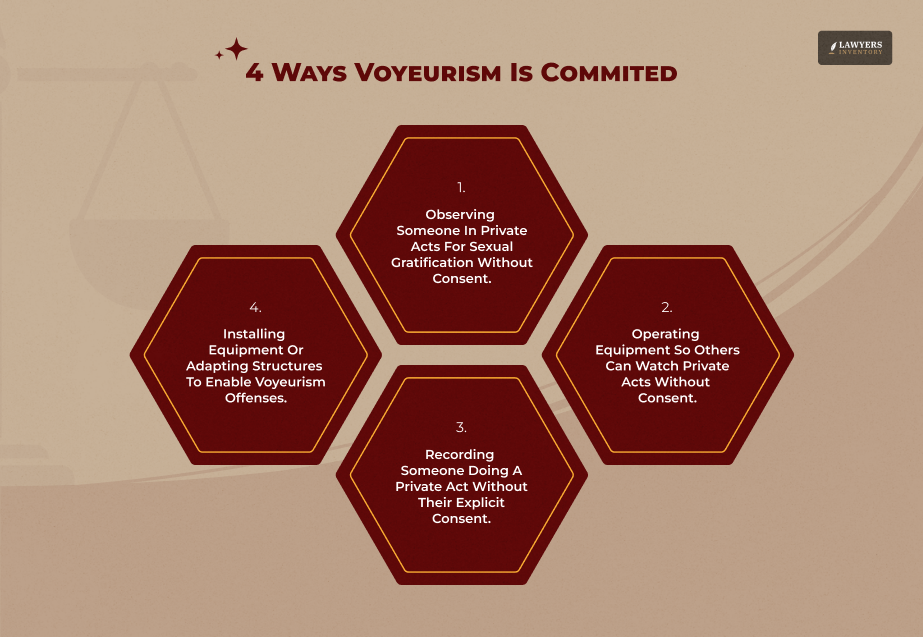
Now that you know what is voyeurism crime, let us talk about what constitutes it. And how does one commit this crime.
Under Section 67, a person commits an offense if they:
- Observe another person doing a private act for the purpose of sexual gratification, knowing that person does not consent to being observed.
- Operate equipment with the intention of enabling another person to observe, for sexual gratification, a third person doing a private act, knowing that the third person does not consent.
- Record another person doing a private act, with the intention that they or a third person will obtain sexual gratification from viewing it, knowing the person does not consent to being recorded.
- Install equipment, or construct or adapt a structure, with the intention of enabling themselves or another person to commit any of the above offenses. [Source: Points2Prove]
This means voyeurism is not limited to the person physically watching. Someone who installs a hidden camera on behalf of another, or enables another person to watch, can also be prosecuted.
Upskirting: A Related But Separate Offense
Upskirting is one of the new offenses that the Voyeurism (Offences) Act 2019 introduced and is punishable under Section 67A of the Sexual Offences Act 2003.
This section criminalizes the use of filming equipment under another person’s clothes to view their genitals, buttocks, or underwear without consent. To violate the law, the perpetrator must act either for sexual arousal or to cause embarrassment and distress.
According to Police.uk, it is an “informal term for a type of voyeurism when someone uses equipment like a camera or mobile phone to take photos or videos underneath a person’s clothes, without their permission.”
Although upskirting is a type of voyeurism, it is a separate crime.
Also, the offender’s intent does not have to be sexual satisfaction only. Humiliation or distress caused to the victim is enough for a person to face criminal charges under Section 67A.
Intimate Image Abuse: Recent Legal Developments
The law in this area has continued to evolve. The Crime and Policing Bill introduces new offenses for the taking of intimate images without consent and the installation of equipment with the intent to enable the taking of intimate images without consent. [Source: GOV.UK]
The law defines intimate image abuse as taking or sharing photographs or film that show, or appear to show, a victim in an intimate state without consent. This definition covers images of the following body parts:
- Breasts.
- Genitals.
- Buttocks.
It can be partially or fully exposed, engaged in sexual behavior, or toileting.
Refuge has reported that 1 in 14 adults in England and Wales have experienced threats to share intimate images or videos – equivalent to approximately 4.4 million people. In 71% of cases where people shared intimate images without consent, the victim was female.
Sentencing And Penalties
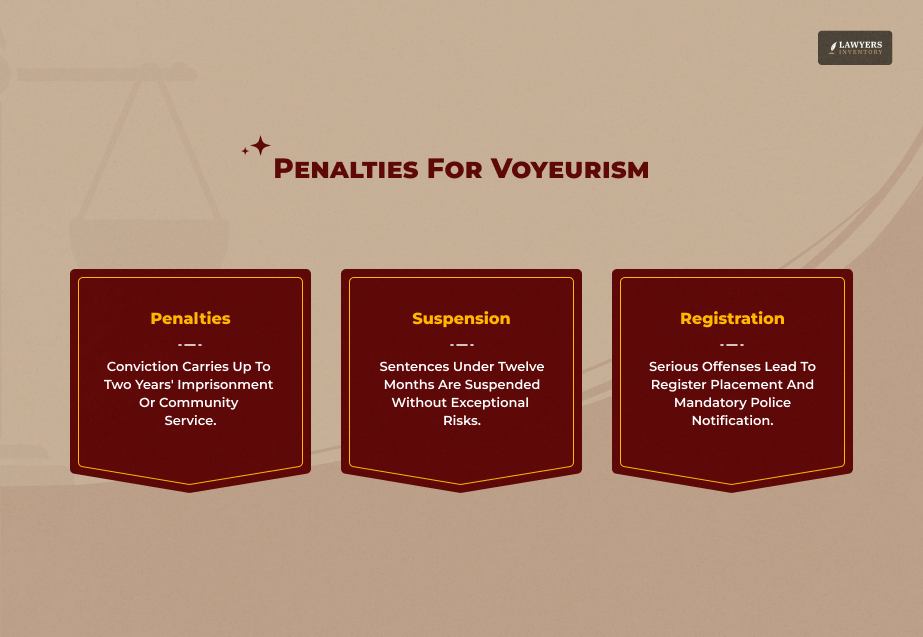
When a court convicts an offender of voyeurism under Section 67, the judge can impose a maximum prison sentence of two years.
Depending on the severity of the offense, the court chooses between several types of punishment. Judges order jail time, issue financial fines, mandate community orders, or combine these different options into a single penalty
For sentences on or after 22 March 2026, new statutory rules apply. When a court determines that the appropriate minimum sentence is 12 months or less, the law presumes a suspended sentence.
The court must automatically suspend the prison term unless exceptional circumstances exist. For example, a significant risk of harm to another person creates an exception and overrides this suspension rule.
More serious cases may also result in the offender being placed on the Sex Offenders Register.
Additionally, a relevant offender automatically becomes subject to notification requirements, obliging them to notify the police of specified information for a specified period. [Source: Sentencing Council]
Read Also: Sexual Assault Lawyer: Know How to Choose the Right One!
The Role Of Consent
Consensual observation or recording does not constitute a criminal offense when all participants agree to private sexual activity.
The act becomes criminal only when a person films secretly, operates without knowledge or agreement, and acts for sexual gratification.
Genuine and informed agreement defines valid consent. An individual cannot consent to filming if they do not know a camera is running.
How Does The Judiciary Investigate Voyeurism?
Voyeurism cases present the police with many complicated legal and technical issues. Police inquiries often invade privacy significantly, and police may seize and keep digital devices – mainly mobile phones – for several months.
But, evidence in such cases often includes analyzes of:
- Phones.
- Laptops.
- Hidden cameras.
- Cloud storage accounts.
The prosecution, in most cases of voyeurism, has to prove sexual gratification. However, in almost all cases, the motive of sexual gratification is proven by the circumstantial evidence that surrounds the act in question.
In the absence of sexual gratification as the primary purpose, you can present other factors as evidence for establishing intent.
These could be:
- Nature of the images.
- Repetition of the behavior.
- Storage of recordings.
- Defendant’s efforts to conceal the activity.
Read Also: Reality Of Federal Sex Crimes: Understanding Transportation To Engage In Prostitution Charges
Does Voyeurism Apply Across The Whole Of The UK?
This is an important distinction.
Only in England and Wales are criminal laws controlled by the Sexual Offences Act 2003. The corresponding statutes in Scotland and Northern Ireland respectively are the Sexual Offences Act 2009 and the Sexual Offences Order 2008.
Although all three jurisdictions punish these acts, Scotland and Northern Ireland use completely different criminal procedures from England and Wales.
Source:
- Sexual Offenses Act 2003, Section 67 – legislation.gov.uk
- Voyeurism (Offenses) Act 2019, Section 67A – legislation.gov.uk
- Sentencing Council – Voyeurism Sentencing Guidelines (updated March 2026) – sentencingcouncil.org.uk
- UK Government – Crime and Policing Bill Justice Factsheet – gov.uk
- Sexual Offenses (Scotland) Act 2009
- Sexual Offenses (Northern Ireland) Order 2008
Disclaimer: The information provided in this article is for general informational purposes only. It does not, and is not intended to, constitute legal advice. Please consult an attorney for legal help.
Leave A Reply







What Happens In A Mistrial? And What Every Defendant Needs To Know Immediately After
Read More
What Happens If A Jury Is Hung Twice? The Legal Answer Explained
Read More
What Is Wanton Endangerment? Is The Breonna Taylor Case Related To It?
Read More
How Can Criminal Identity Theft Occur And Your Legal Standing
Read More
Understanding The Core Differences Between Criminology Vs Criminal Justice
Read More
0 Reply
No comments yet.