
Summarize using AI





Prompt copied. Paste it into Gemini.
Quick Answer: What Happens If A Jury Is Hung Twice?

If a jury is hung twice, there is no legal barrier preventing the prosecution from pursuing a third trial. Double jeopardy does not apply after a hung jury because no verdict - guilty or not guilty - has been entered. In practice, however, a second consecutive hung jury significantly weakens the prosecution's position and often prompts case dismissal, plea negotiations, or a reassessment of the evidence. There is no constitutional limit on the number of retrials following hung jury deadlocks.
When I first started researching this question, I expected a clean legal answer. What I found instead was something far more interesting – a constitutional grey area that the Supreme Court has repeatedly visited, never fully resolved, and that real-world cases like the Karen Read murder trial have brought into sharp public focus.
What happens if a jury is hung twice?
The short answer is: the prosecution can keep going. But the full answer involves constitutional law, prosecutorial discretion, practical realities, and some of the most consequential legal decisions a district attorney ever makes.
Here is everything I found.
What Does It Actually Mean When A Jury Hangs?
Before addressing what happens if a jury is hung twice, it helps to understand what a hung jury actually is and why it matters legally.
Understanding what is a hung jury starts with the unanimity requirement in American criminal law. In federal court and most state courts, all twelve jurors must agree – unanimously – to convict or acquit a defendant.
When jurors deliberate extensively and cannot reach that agreement, the jury is declared “hung” or “deadlocked.” The judge then declares a mistrial.
A hung jury is not a verdict. No finding of guilt or innocence is entered into the record. The case is unresolved, the defendant remains charged, and the prosecution retains the full right to try again.
In my research, this was the first misconception I kept encountering: that a hung jury means the defendant walks free. It almost never does – at least not automatically.
The First Legal Answer: Double Jeopardy Does Not Apply
I began my investigation of the question “What Happens if a Jury Is Hung Twice?” And right away, the first thing that popped up was the Fifth Amendment’s Double Jeopardy Clause. Most people believe that facing two trials for the same crime is automatically unconstitutional.
However, the reality is more nuanced.
The Double Jeopardy Clause states: “No person shall be…subject for the same offence to be twice put in jeopardy of life or limb.” [Source: Amendment 5.3.1, U.S. Constitution]
The clause does apply to criminal cases, and it does protect against being retried after a formal acquittal or conviction. What it does not protect against is retrial after a hung jury.
The legal rationale is this: a hung jury does not terminate jeopardy. Courts treat the retrial not as a second, separate trial but as a continuation of the original proceeding that simply never reached a conclusion.
The United States Supreme Court established this principle in United States v. Perez (1824), holding that when a jury cannot agree, there is “manifest necessity” to discharge the jury and retry the defendant. That legal precedent has held for two centuries.
Understanding the difference between indicted vs charged is part of the same constitutional framework: both are mechanisms by which the state initiates formal prosecution.
Neither an indictment nor a charge triggers double jeopardy. Jeopardy attaches only when the jury is empaneled and sworn – and terminates only upon a final verdict or acquittal. A hung jury produces neither.
What Happens If A Jury Is Hung Twice?
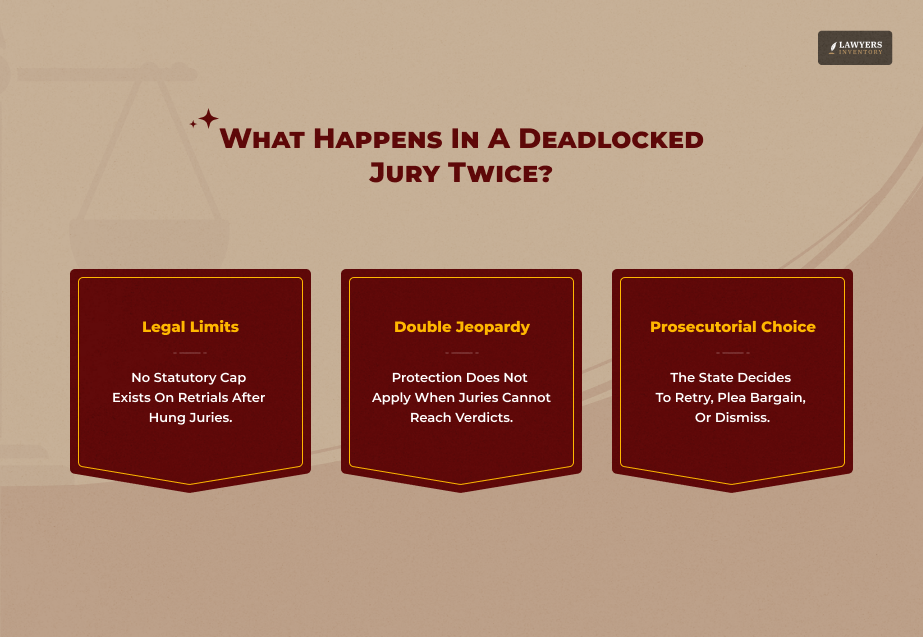
I spent considerable time looking for a statute or rule that caps the number of retrials after consecutive hung juries. I did not find one – because it does not exist.
For those facing hung jury retrials, it is as many times as the government pleases. As per GovFacts, double jeopardy prohibitions do not apply when juries fail to reach a verdict.
That is the legal reality.
Theoretically, a defendant could face three, four, or even five trials if the jury deadlocks each time. In practice, however, that almost never happens – because the decision to retry is not purely legal. It is also prosecutorial, political, financial, and ethical.
When a jury hangs for the second time, the prosecution faces a set of hard questions:
Is The Evidence Strong Enough?
A second hung jury is a powerful signal that at least some jurors – possibly many – have genuine reasonable doubt. If the jury split 6-6 twice, retrying for a third time with the same evidence is difficult to justify.
What Does The Split Tell Us?
A jury split 11-1 for conviction twice suggests a strong case that may succeed with a different panel. A jury split 7-5 for acquittal twice tells a very different story.
What Are The Costs?
Trials are expensive – financially for the court system and personally for everyone involved, including:
- Victims.
- Witnesses.
- Defendant.
Prosecutors weigh those costs against the probability of success.
What Does Justice Require?
This is the question that sits behind all the others. Some prosecutors conclude that a second hung jury signals that the case should not be pursued further. Others conclude that the public interest in a verdict justifies another attempt.
In my research, I found that most cases are dropped or resolved through plea negotiation after a second hung jury. A third trial following two deadlocks is rare enough to attract significant media attention when it does occur.
The Karen Read Case: Modern Real-World Example
The high-profile Karen Read murder trial illustrates the unpredictable nature of criminal proceedings and hung juries.
In the eyes of prosecuting officials, Read was guilty for ramming her partner, a Boston officer named John O’Keefe, with her SUV, leaving him lying there to freeze to death or get lost due to snow in January 2023.
She argued back, saying there was collusion among the police to set her up and falsely accuse her of something she had no intention of doing.
The first hearing at Norfolk County Superior Court ended in a stalemate in July of this year as the jury deadlocked and couldn’t come to an agreement. [Source: CBS News]
Read’s team of lawyers filed several appeals afterward and ultimately challenged the law before the Supreme Court.
They contended that under the double jeopardy clause, a person cannot be put on trial twice when the initial jury’s unverified, informal decision to discharge her on specific charges was considered. [Source: Yahoo!]
The appellate courts dismissed these and other issues, allowing the state to proceed with a renewed trial that formally opened in April of this year. Compared to the first prosecutor in charge, the second prosecutor, Alan Jackson, took the whole case in a different direction
What Is A Mistrial And How Does It Differ From A Hung Jury?
While researching this topic, I kept encountering the two terms used interchangeably. They are related – but not the same.
Understanding what is a mistrial requires recognizing that a hung jury is just one cause of a mistrial. A mistrial is a formal termination of a trial without a final verdict.
It may be the result of a hung jury. Or it may come from other things like:
- Misconduct of the jury.
- Misconduct of the lawyers.
- Death or incapacitation of a juror.
- Presentation of inadmissible evidence.
Additionally, it can also happen for any other procedural failure that completely destroys the fairness of the trial.
In the case of a hung jury vs. mistrial, we can say that it is cause and effect relationship: a verdict reached jointly by the jury leads to the situation called mistrial, while there may be mistrial situations not linked to a deadlocked jury.
Also, what happens at the stage of mistrial depends on which reason the court declared for the mistrial. This includes:
- what rights the accused will still have,
- what options the government will have,
- if a retrial is possible, etc.
Different sets of rules apply in cases where a mistrial is declared due to misconduct by the prosecutor, rather than a deadlock at the first trial.
For example, in a situation where the prosecution has deliberately caused the trial to end with a mistrial merely to get a new chance to convince a jury of the guilt of the defendant, a constitutional law known as the Double Jeopardy Clause might really stop a retrial in that situation, as was the case under Oregon v. Kennedy (1982) [Source: Justia]
This is an important distinction that any defendant facing retrial after a prosecutorial-misconduct mistrial should understand with the help of a qualified legal representative.
Practical Consequences Of A Second Hung Jury
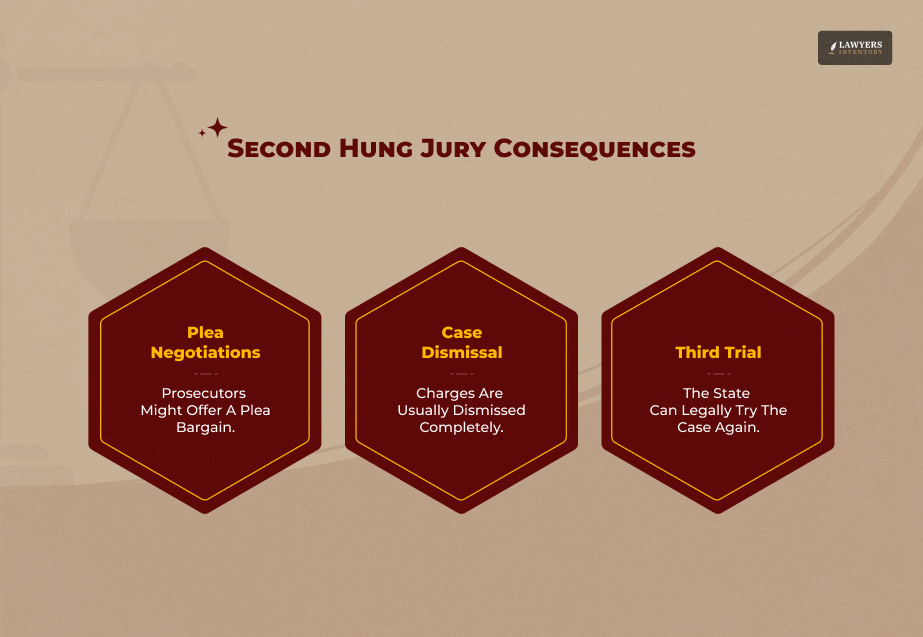
After going through my investigation into the situation where a jury is found to be deadlocked twice, I found out that the effects of such an event may largely depend upon the case type, jurisdiction, and the unique deadlock dynamics.
Plea Negotiations
A second hung jury leaves the defendant in a much stronger negotiating position. Because the prosecution failed twice to convince the jury, the defendant gains bargaining power in plea discussions.
Therefore, the prosecution must realize and consider that they can only attempt to convict the defendant one last time, in this third trial.
This shift in the defendant’s favor may prompt both sides to agree on a much milder charge or a significantly lighter sentence, sparing a defendant who originally faced a long prison stretch.
This is also the point at which post-conviction considerations begin to enter the picture – even though no conviction has occurred yet.
Defendants who understand concepts like what does it means to commute a sentence and the distinction between commute vs pardon are better equipped to evaluate whether a negotiated outcome serves their long-term interests better than a third trial.
Case Dismissal
Some prosecutors will dismiss charges after two consecutive hung juries, particularly if the evidence has not changed.
Filing charges and pursuing two full trials consumes enormous resources. A second deadlock is a strong signal that a conviction is not obtainable from a reasonable jury.
Third Trial
A third trial following the two hung juries is unusual, although not unheard of.
Generally, such a scenario takes place in criminal cases of severe violence, and the prosecution sees in them strong and overwhelming evidentiary support.
At the same time, they perceive the problem with deadlocks as arising from jury composition, not from weaknesses in the evidence.
Pursuing a final verdict becomes even more critical in cases where a death penalty is being considered; it is a major issue for the court and the parties concerned.
The Sequestered Jury Question
In high-profile cases that proceed to a second or third trial, the question of juror protection becomes increasingly significant.
Judges more commonly order a sequestered jury – one isolated from media and public contact throughout the trial – in retrials when the first proceeding attracted substantial publicity.
Extensive media coverage and documented concerns about juror privacy made this a live issue during the Karen Read retrial.
Sequestration is expensive and places a significant burden on jurors. But in cases where a first hung jury was potentially influenced by external pressures or media saturation, it can be the most reliable tool for ensuring the second trial is actually fair.
The Criminal Justice System’s Unanswered Question
The most striking thing I found while researching what happens if a jury is hung twice was not a rule or a statute – it was a gap.
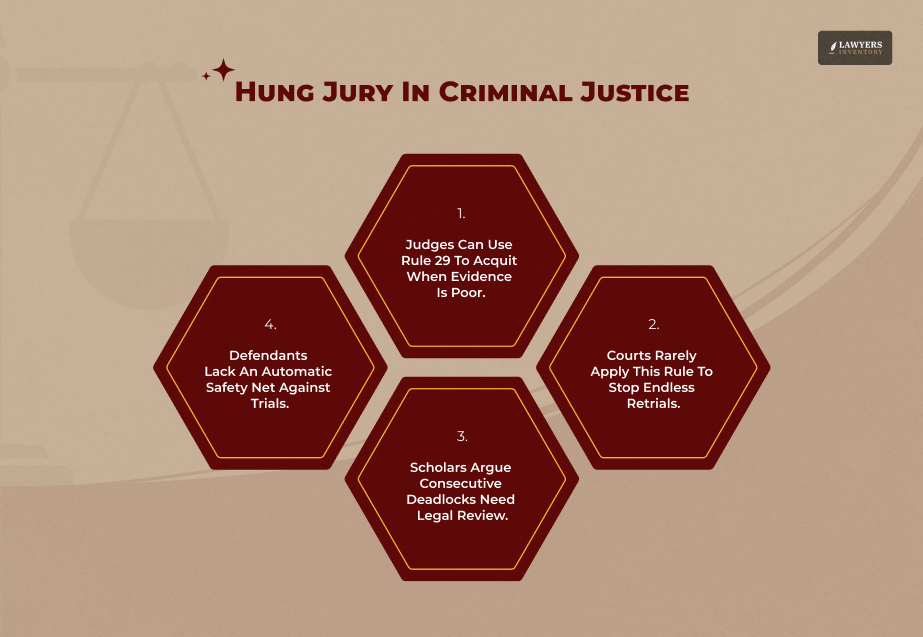
There is theoretically a built-in procedural solution to stop the government from endlessly retrying defendants. Rule 29 of the Federal Rules of Criminal Procedure allows judges to acquit defendants when the evidence is insufficient to sustain a conviction.
Considering that a hung jury indicates the jurors could not agree on the sufficiency of the evidence, defendants facing hung jury retrials are prime candidates for this rule’s application. Yet Rule 29 has not been applied to prevent hung jury retrials. [Source: GovFacts]
This gap – between what the rule technically permits and how courts have actually applied it – represents one of the most significant unresolved questions in criminal justice today.
Legal scholars have argued that two consecutive hung juries should trigger judicial scrutiny of whether the evidence is actually sufficient to support a conviction. Courts have not yet adopted that position.
For defendants navigating this gap, the most important thing to understand is that the legal system as it currently operates provides no automatic protection against repeated retrials.
The only meaningful constraints are prosecutorial discretion, judicial case management, and the practical reality that each retrial is another opportunity for acquittal.
Advantages And Disadvantages For The Defendant After A Second Hung Jury
Here are some of the positives and negatives of a second hung jury for the defendant:
Advantages:
- No conviction has been entered – the defendant remains legally innocent
- Strengthened plea negotiating position
- Prosecution may drop charges entirely
- Each retrial gives the defense another opportunity to refine arguments
- Jury composition may differ favorably in a third trial
Disadvantages:
- Legal limbo continues – charges remain active
- Ongoing legal costs and emotional strain
- No guarantee the prosecution will back down
- Evidence and strategy may improve for the prosecution in a retrial
- Continued reputational and professional consequences
The Broader Context: From Charge To Verdict and Beyond
Experts need to consider a criminal case entirely if they want to get a complete picture of double-hung juries. A charging document or indictment initiates the prosecution.
Arraignment and various pre-trial motions move the proceedings forward before the first trial.
The judge, upon realizing that the jury is unable to reach a verdict, declares a mistrial, so starting the legal procedure over, rather than abandoning the case.
The court treats each trial as a brand-new case. It selects a completely different jury for the new proceeding.
Attorneys present fresh opening statements to the new jurors. Prosecutors must show the evidence all over again. However, they must not hint to the new jurors about the previous deadlocks.
At the time the re-trial comes back with a guilty verdict, the case is moved to the area of deciding the penalty. The defendant may even apply for clemency. A commutation decreases penalties, while a pardon fully clears a person’s record.
The legal system must strike a balance. It weighs the state’s desire for an authoritative verdict against the defendant’s constitutional rights.
A judge may drop the charges after two mistrials. Legally, the prosecution can still seek a third trial against the defendant.
Sources:
- Legal Information Institute, Cornell Law School – Hung Jury (law.cornell.edu/wex/hung_jury)
- United States v. Perez, 22 U.S. 579 (1824)
- Renico v. Lett, 559 U.S. 766 (2010)
- Oregon v. Kennedy, 456 U.S. 667 (1982)
- Ramos v. Louisiana, 590 U.S. 83 (2020)
- FindLaw – When Does Double Jeopardy Apply? (August 2024)
- Justia – Double Jeopardy and Legal Protections for Criminal Defendants (October 2025)
- GovFacts – Double Jeopardy Loopholes: When the Government Can Try You Again (December 2025)
- Northwestern University Law Review – Hung Out to Try: A Rule 29 Revision to Stop Hung Jury Retrials, Elijah N. Gelman, 118 Nw. U. L. Rev. 1139 (2024)
- NPR – Karen Read Acquitted in 2nd Murder Trial (June 18, 2025)
- CBS Boston – Karen Read Trial: Full Timeline (June 2025)
- Koffel Law Firm – Hung Juries, Re-trials & Double Jeopardy (January 2026)
- Federal Rule of Criminal Procedure, Rule 29 – Motion for Judgment of Acquittal
U.S. Constitution, Fifth Amendment – Double Jeopardy Clause
Leave A Reply






What Is Reckless Driving In Texas: Legal Consequences You Need To Know!
Read More
How Can Criminal Identity Theft Occur And Your Legal Standing
Read More
Understanding What Is Criminal Justice And How It Functions
Read More
Understanding The Core Differences Between Criminology Vs Criminal Justice
Read More
What Is The Difference Between Assault And Battery In Criminal Law?
Read More
0 Reply
No comments yet.