Summarize using AI





Prompt copied. Paste it into Gemini.
Quick Answer: What Happens In A Mistrial?

A mistrial halts a trial before a verdict is reached, leaving the defendant neither convicted nor acquitted. A judge declares a mistrial when something goes so wrong that a fair outcome is no longer possible, or when the jury is hopelessly deadlocked. The case then reverts to its pre-trial status, and the prosecution decides whether to try the defendant again, negotiate a plea deal, or drop the charges entirely. A mistrial is a reset - not a resolution. The legal uncertainty that follows can persist for months.
A mistrial is not a verdict. It is not an acquittal. It’s not a win. It is a reset – and what happens after that reset depends on a sequence of decisions that most defendants, families, and even some legal observers do not fully understand until they are living through it.
Wondering what happens in a mistrial and the weeks that follow?
You have come to the right place! Here is everything I found about what happens in a mistrial – from the moment the judge speaks to the decisions that shape everything that follows.
What Happens In A Mistrial: Complete Timeline
In The Courtroom:
- Judge gives both parties opportunity to comment and suggest alternatives
- Judge declares mistrial in open court
- Jury is formally dismissed – no verdict is entered
- Charges remain fully active
Immediately After:
- Defendant’s custody or bail status continues unchanged
- Defense counsel files for bail review if defendant is incarcerated
- Both parties attempt to interview willing jurors
- Judge schedules status conference for next steps
Within 30-90 Days:
- Prosecution announces retrial, plea offer, or dismissal decision
- Defense files pre-retrial motions if retrial is announced
- Bail conditions are reviewed and potentially modified
- Speedy trial clock begins running – 70 days in federal court
Within 3-12 Months:
- Retrial scheduled and commenced, or
- Plea agreement reached and entered, or
- Charges dismissed with or without prejudice
At Retrial:
- Entire trial begins again – new jury selection, new opening statements
- All evidence presented from the beginning
- Prior trial proceedings are legally irrelevant to the new jury
- Defendant retains all constitutional rights as if the first trial never occurred
The Moment Court Declares A Mistrial: What Happens In The Courtroom
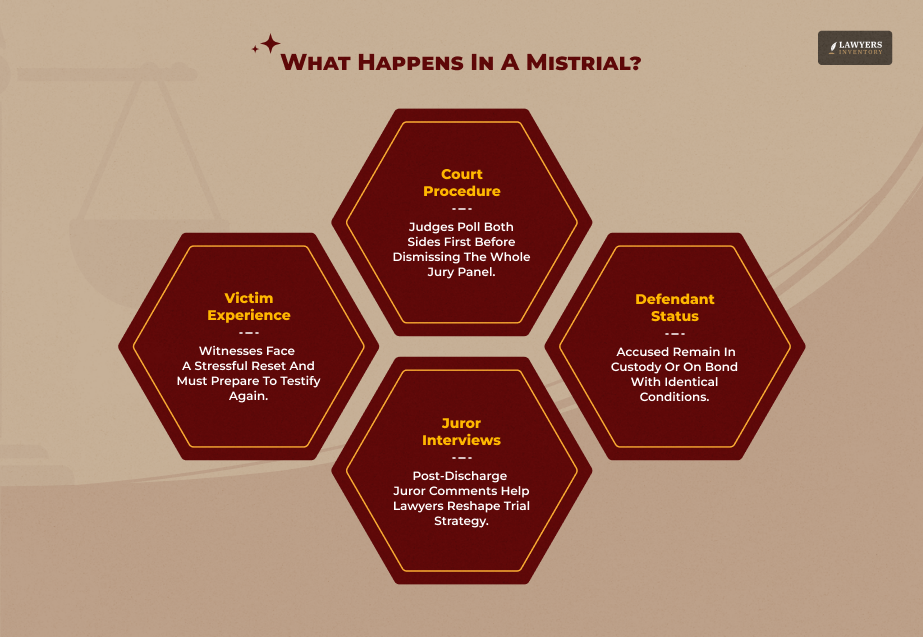
The courtroom reality is straightforward. The judge announces the mistrial in open court. Jurors are discharged. [Source: Legislation.gov.uk]
But those two sentences contain an enormous amount of procedural weight that most people do not fully appreciate until they are sitting in that courtroom.
Federal Rule of Criminal Procedure 26.3 sets a strict requirement before a judge declares a mistrial. The judge must give the prosecution and the defense an opportunity to comment first.
Both parties can state their official positions on the situation. They can also suggest alternative solutions to ending the trial.
The judge cannot simply declare what happens in a mistrial without first inviting that input. Both sides may argue against it. Both may propose remedies short of termination – new jury instructions, removal of a problem juror, a corrective statement to the panel.
If those alternatives fail, the judge declares a mistrial. The judge then formally dismisses the jury from their service. The court does not enter a verdict into the record. After that, the law treats all previous proceedings as void.
Then – and this is the part most coverage misses – the courtroom falls into an immediate procedural limbo. The charges do not disappear.
The defendant’s custody status continues unchanged. If the court released you on bond before trial, your conditions remain in effect.
If you were in custody, you will typically return to jail unless your attorney successfully argues for bond modification.
The judge will schedule a hearing to address next steps, including setting deadlines for the prosecution’s retrial decision.
Understanding what is a hung jury helps clarify the most common path to this moment – but it is far from the only one.
What Happens To The Defendant Immediately After
From the defendant’s point of view, the mistrial period is not a vacation. Bail conditions may remain active. The defendant may still be in custody.
A mistrial does not automatically improve a defendant’s immediate situation.
If the authorities incarcerated the defendants before trial, they likely return them to that status. If they were on bail, those conditions – travel restrictions, check-ins, electronic monitoring – typically remain in place.
The defense can, however, use the mistrial as leverage in a bail review. The defense can argue that the prosecution’s inability to secure a conviction demonstrates weaker evidence, justifying a reduction in bail or release under monitoring conditions. [Source: GOV.UK]
This argument is strongest when the jury’s deliberation notes or post-discharge conversations suggest the panel was leaning toward acquittal.
The defendant’s right to legal counsel is immediate and non-negotiable. A skilled lawyer with extensive experience in criminal defense can provide valuable guidance and support throughout the legal process.
They have the knowledge to handle the challenges of retrials and can ensure the defendant’s rights are protected.
The indicted vs charged distinction – whether the original case began through a grand jury finding or a direct prosecutorial charge – can also affect how quickly the prosecution can move toward retrial. Either mechanism leaves the charges fully active after a mistrial.
What Happens To The Jurors After A Mistrial
Once dismissed, the court releases jurors from their service. Jurors no longer must follow the court’s instructions to avoid discussing the case.
They can speak publicly about their deliberations, their votes, and their reasoning – and in high-profile cases, they often do.
This post-discharge access to jurors is strategically significant. The prosecution’s decision is influenced by factors such as jury polls and juror interviews. [Source: GOV.UK]
Both sides typically attempt to speak with willing jurors as quickly as possible after a mistrial. Defense counsel wants to know which arguments resonated. Prosecutors want to understand where the case broke down.
In cases where the court orders a sequestered jury – particularly in high-profile trials – lifting these restrictions can trigger immediate and extensive public comment from jurors.
That commentary shapes public perception, influences plea negotiations, and sometimes affects the prosecution’s retrial calculation more than any formal legal analysis does.
What Happens To The Victims And Witnesses
For victims and witnesses, a mistrial can mean extended participation in the process and, in some cases, additional testimony or reconsideration of plea negotiations.
Victims who have already testified – often reliving traumatic events in front of a jury – must now prepare to do so again if the case is retried.
Witnesses who gave testimony must remain available for a future proceeding. The parties may need to renegotiate cooperation agreements. Expert witnesses may need to update their analysis.
The human cost of what happens in a mistrial extends well beyond the courtroom. For victims’ families in particular, a mistrial after weeks of trial can feel like a profound injustice – even when it is, legally speaking, simply a procedural reset with no finding for either side.
With Prejudice vs. Without Prejudice: The Distinction That Changes Everything
A dismissal with prejudice after a mistrial is rare.
It typically follows intentional prosecutorial misconduct under Oregon v. Kennedy, a proven speedy trial violation, or a court finding that the defendant’s constitutional rights were so severely damaged that no fair retrial is possible. [Source: Justia]
The phrase “with prejudice” in law always means permanently. The phrase “without prejudice” means the door is still open.
Defendants who hear “mistrial” in the courtroom should immediately ask their attorney whether any dismissal, if granted, was with or without prejudice.
A defendant must have this distinction immediately after the judge declares a mistrial, as it provides one of the most practically significant pieces of information.
A mistrial declared without prejudice leaves the prosecution free to retry. This is the standard outcome in the vast majority of cases.
A mistrial followed by a dismissal with prejudice ends the case permanently. The prosecution cannot refile the charges.
Consequently, the court effectively applies double jeopardy in this scenario. The prejudicial nature of what occurred triggers this protection, rather than a jury verdict.
The Karen Read case illustrated this dynamic with unusual clarity. After her first trial ended in a mistrial, her defense team mounted a serious double jeopardy argument – claiming the hung jury contained implicit partial acquittals that should bar retrial.
Courts rejected that argument. Her retrial proceeded, ultimately resulting in acquittal on the most serious charges in 2025.
It remains one of the clearest modern examples of what happens in a mistrial when the defense fights the retrial itself as aggressively as the underlying charges.
How The Defense Uses The Post-Mistrial Period
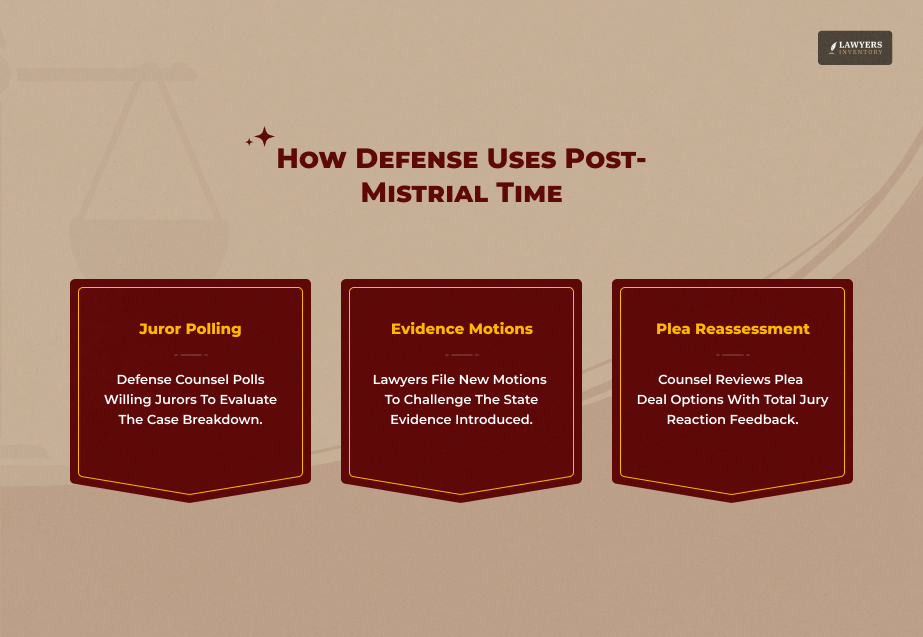
The period between a mistrial and a retrial decision is one of the most strategically important phases of any criminal case.
Defense counsel uses this period to accomplish several things simultaneously.
First, they poll and interview willing jurors to understand exactly where the case broke down. A 10-2 deadlock in favor of conviction requires a different strategic response than a 7-5 deadlock in favor of acquittal.
Second, they file pre-retrial motions challenging the admissibility of evidence that was allowed in the first trial. Favorable evidentiary orders continue to apply in a new trial, while unfavorable ones can often be litigated again.
A mistrial resets proceedings – and with that reset comes a fresh opportunity to relitigate evidentiary questions that were decided unfavorably the first time.
Third, they reassess plea options with full knowledge of how the prosecution’s case played in front of a real jury. A defendant whose case produced a near-acquittal is in a substantially stronger negotiating position than one whose jury was close to conviction.
This is precisely why working with a qualified legal representative in the immediate aftermath of a mistrial is not merely advisable – it is strategically essential.
The decisions made in the first 30 to 90 days after what happens in a mistrial often determine the ultimate outcome of the case more than the trial itself did.
Mistrial, Legal Precedent, And What the Courts Have Established
The legal framework governing what happens in a mistrial is well-established through decades of Supreme Court or legal precedent.
United States v. Perez (1824) established the foundational principle: when a jury cannot agree, manifest necessity justifies discharging it and retrying the defendant without triggering double jeopardy. That 200-year-old ruling remains the cornerstone of modern mistrial law.
Oregon v. Kennedy (1982) created the narrow prosecutorial misconduct exception: if the prosecution deliberately goads the defense into requesting a mistrial, double jeopardy bars retrial. This exception requires clear evidence of intentional manipulation – it is invoked rarely and succeeds even more rarely.
Ramos v. Louisiana (2020) confirmed that unanimous verdicts are constitutionally required in all criminal cases – reinforcing both why hung juries produce mistrials and why a single dissenting juror is exercising a constitutional right, not obstructing justice. [Source: Harvard Law Review, US Supreme Court]
These cases collectively define the commute vs pardon of mistrial law – the distinction between what resets the case and what ends it permanently.
Mistrial Across Different Case Types
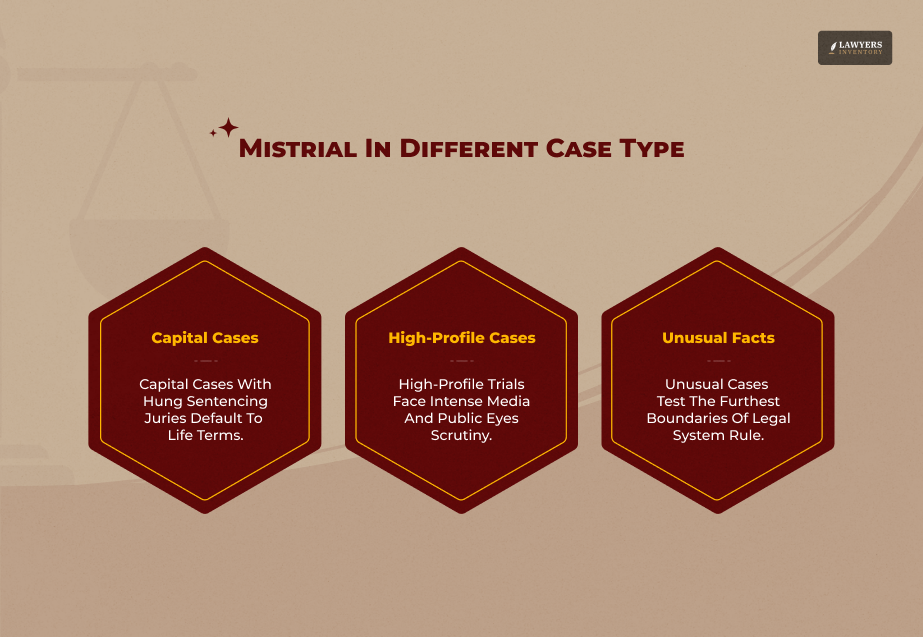
What happens in a mistrial looks different depending on the type of case involved.
Capital Cases:
In death penalty proceedings, a hung jury at the sentencing phase – even after a guilty verdict – results in a life sentence rather than execution in most jurisdictions. Federal law provides the same outcome. A mistrial at the guilt phase, however, simply resets to retrial.
High-Profile Cases:
Media saturation, public pressure, and political considerations all affect what happens in a mistrial when the case has attracted national attention.
The voyeurism of public interest – particularly in the social media era – shapes juror behavior, affects retrial jury selection. Additionally, it influences prosecutorial calculations in ways that routine criminal cases never experience.
Understanding how voyeurism laws intersect with public access to trial information is an increasingly relevant consideration as courts grapple with social media exposure during proceedings.
Cases Involving Unusual Facts:
Some of the weirdest lawsuits in legal history have produced mistrials.
These were cases where the grounds for termination were so unusual or unforeseen that they tested the outer edges of the doctrine.
What connects all of them is the same constitutional principle: a trial that cannot be fair should not continue.
Disclaimer: This article is for general informational and educational purposes only. It does not constitute legal advice. If you or someone you know is involved in a case where a mistrial has been declared, consult a qualified criminal defense attorney immediately to understand your rights and options in your specific jurisdiction.
Sources:
- Legal Information Institute, Cornell Law School – Mistrial (law.cornell.edu/wex/mistrial)
- Federal Rules of Criminal Procedure, Rule 26.3 – Mistrial
- Federal Rules of Criminal Procedure, Rule 31(b)(3) – Partial Verdicts
- 18 U.S.C. § 3161 – Speedy Trial Act: Time Limits and Exclusions
- United States v. Perez, 22 U.S. 579 (1824)
- Oregon v. Kennedy, 456 U.S. 667 (1982)
- Ramos v. Louisiana, 590 U.S. 83 (2020)
- LegalSynopsis – What Happens in a Mistrial: A 2026 Legal Breakdown Guide (May 2026)
- LegalClarity – What Does a Mistrial Do? Causes, Options, and Retrial (April 2026)
- Lorfing Law – What Happens After a Mistrial in Texas? (February 2026)
- Kraut Law Group – Mistrials in Los Angeles Criminal Cases (2026)
- Josh Johnson Law – What Happens in a Mistrial? Legal Process Explained (February 2026)
- JB Bassett Law – Is a Defendant Released After a Mistrial? (August 2025)
- NPR – Karen Read Acquitted in 2nd Murder Trial (June 18, 2025)
- Colorado Revised Statutes § 18-1-405 – Speedy Trial Rights After Mistrial
Leave A Reply







What Is Reckless Driving In Texas: Legal Consequences You Need To Know!
Read More
How Can Criminal Identity Theft Occur And Your Legal Standing
Read More
Understanding What Is Criminal Justice And How It Functions
Read More
Understanding The Core Differences Between Criminology Vs Criminal Justice
Read More
What Is The Difference Between Assault And Battery In Criminal Law?
Read More
0 Reply
No comments yet.