The law is not a static list of rules passed by legislatures. It is a living ecosystem shaped by real-world human conflict and judicial interpretation.
When a courtroom door closes, the decision reached inside does more than resolve a private argument. It leaves a footprint.
In common law legal systems, these footprints form what is known as legal precedent.
Legal precedent refers to a principle or rule established in a previous legal case that is either binding or persuasive when a subsequent case arises with identical or similar facts.
Rooted deeply in the doctrine of stare decisis, precedent requires courts to apply the law consistently to ensure individuals in similar situations are treated alike, rather than at the whim of a judge’s personal views.
Understanding how legal precedent is built, utilized, and challenged is essential for any legal professional, student, or citizen navigating the justice system.
What Is A Legal Precedent?
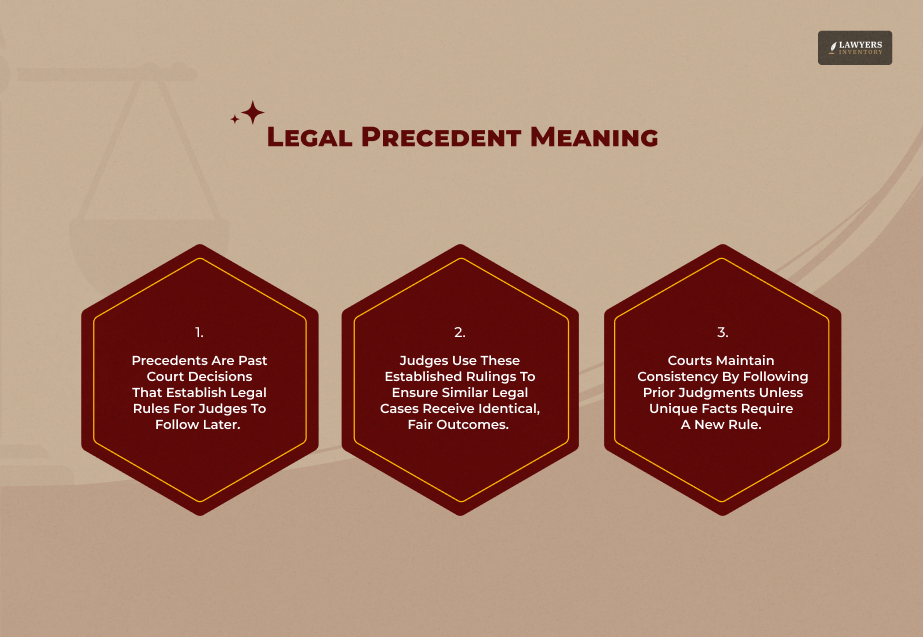
There are past judicial decisions that a higher court takes for a particular case. These decisions act as a framework for lower courts or courts at the same level. For instance, the lower courts follow these decisions for similar cases.
These are legal precedents.
As per Legal Information Institute, a legal precedent “is considered an authority for deciding subsequent cases involving identical or similar facts, or similar legal issues.”
These precedents become extremely important when it comes to decision-making for a similar case. With the help of such judicial precedents, courts can save time in delivering justice.
Inductive vs. Deductive Legal Systems
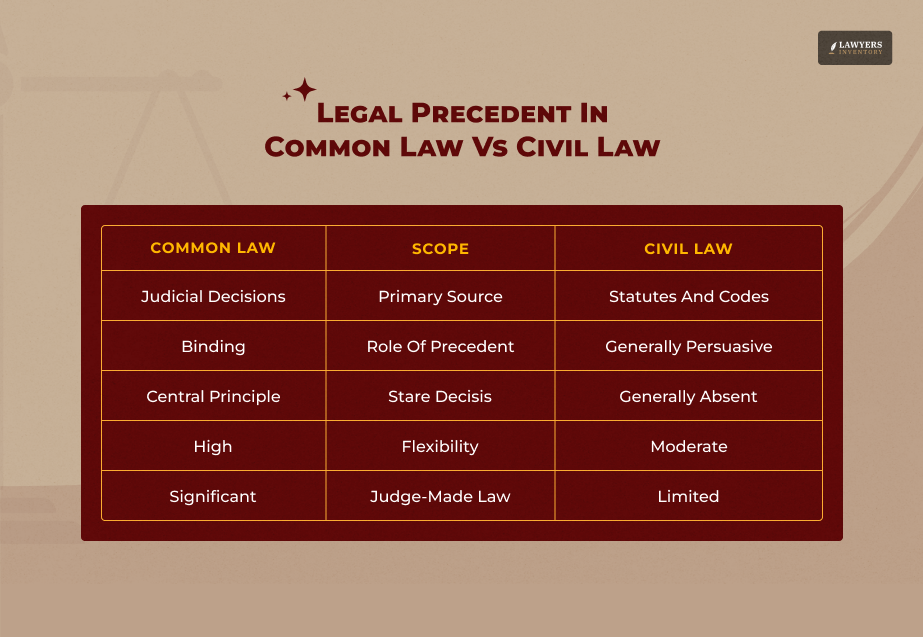
The weight and application of legal precedent depend entirely on the operational framework of a country’s legal tradition. The world’s legal systems generally split into two primary methods:
The Inductive Method (Common Law)
Common law systems, such as those in the United States, the United Kingdom, India, Canada, and Australia, rely heavily on judge-made law.
Under the inductive approach, judges look closely at previously decided cases of a similar nature.
From these specific, granular instances, they deduce generalized legal rules and apply them forward to the dispute at hand.
The Deductive Method (Civil Law)
Civil law systems, predominant in mainland Europe (like France and Germany) and Scotland, favor legislative codification.
Here, the legislature writes comprehensive statutory codes. Judges decide cases by applying these enactments directly to the facts.
In a pure civil law theory, past judicial decisions do not bind future courts, as a strict adherence to precedent is seen as interfering with the legislature’s right to make law.
The Doctrine Of Stare Decisis In Legal Precedent
In common law systems, courts maintain consistency through the doctrine of stare decisis, an abbreviation of the Latin maxim: Stare decisis et non quieta movere – “to stand by things decided.”
This doctrine is a structural requirement mandating that a court must follow the rules established by the courts above it.
| System Type | Core Principle | Operational Tool |
| Common Law | Stare Decisis | Lower courts are legally forced to follow higher court rulings. |
| Civil Law | Jurisprudence Constante | Judges are independent, but voluntarily rule predictably to avoid chaos. |
For stare decisis to function smoothly, three structural elements must exist: a universally accepted hierarchy of courts, an efficient system of comprehensive law reporting, and a careful balance between legal certainty and room for systemic growth.
Anatomy Of A Decision: Ratio Decidendi vs. Obiter Dictum
Not every word written in a judicial opinion carries the weight of law. Legal analysts divide a court decision into two distinct concepts:
Ratio Decidendi (The Reason For The Decision)
The ratio decidendi is the abstract core legal principle deduced from the material facts of a case. It is the explicit rationale that links a past decision to a contemporary dispute. Only the ratio decidendi has a binding effect as a precedent.
Obiter Dictum (Things Said By The Way)
Obiter dictum refers to statements made in an opinion that are answered based on the narrow circumstances of that specific case.
These observations do not lay down general legal principles. Dicta can be persuasive if well-reasoned, but they are never legally binding on subsequent courts.
THE “LURKING” RULE: As reiterated by the U.S. Supreme Court, questions that merely “lurk in the record,” neither explicitly brought to the attention of the court nor ruled upon by the bench, carry zero weight as legal precedent (Cooper Industries, Inc. v. Aviall Services, Inc.). (Source: Legal Information Institute)
Binding vs. Persuasive Authority In Legal Precedent
You can categorize legal precedents depending on their level of mandatory enforcement:
Binding Precedent
A binding (or mandatory) precedent is a legal decision made by a higher court that lower courts within the same jurisdiction must obey. For example, a ruling by a state supreme court binds all local trial courts in that state.
Persuasive Precedent
A persuasive precedent is a legal writing or decision that a court may consider but is not obligated to follow. Persuasive authority flows from several vectors:
- Horizontal Courts: Rulings from equal-rank parallel districts (e.g., a U.S. First Circuit Court analyzing a Ninth Circuit decision).
- Lower Courts: A superior court adopting a highly logical rationale written by a trial judge.
- Dissenting Judgments: The rationale of a minority panel judge, which a future court might choose to adopt to fix a failing law.
- Scholarly Treatises: Law reviews and restatements of law written by eminent legal scholars.
- Foreign Jurisdictions: Common law nations citing one another (e.g., English courts citing Canadian or Australian decisions).
Global Jurisdictional View Of Judicial Precedents
Different countries approach the management of case law through their own historical lenses:
The United States
In the U.S., stare decisis applies strictly to the definitive holding of a case. A case is vital primarily for what it decides (the precise legal consequence of a specific set of facts) rather than the broad text surrounding how it was reached.
Crucially, the U.S. Supreme Court treats stare decisis with maximum flexibility in constitutional cases.
Correcting a constitutional error via legislative amendment is nearly impossible. Consequently, the Court freely exercises its power to re-examine its own past decisions. Furthermore, it will completely overturn those rulings whenever it becomes convinced of a former error.
England And The Commonwealth
The doctrine of binding precedent is absolute within the English court hierarchy. Higher courts bind lower courts strictly.
However, the UK Supreme Court can break this rule. It took over the House of Lords in 2009. This court explicitly holds the power to depart from its own past decisions. This freedom prevents the law from stalling. It allows the legal system to grow naturally.
Anglo-American common law judges write very long opinions. They include deep factual details. This lengthy style serves a structural purpose. It completely explains the judicial outcome. It also helps future lawyers use the case as a clear blueprint.
India
The contemporary Indian legal system heavily derives its foundations from English common law. Moreover, the British Crown solidified this legal transition when it seized direct control via the Government of India Act of 1858.
Subsequently, constitutional framers synthesized legal frameworks from the UK, US, France, and Ireland to build the modern Indian state.
In India, stare decisis is strictly followed under a clear blueprint:
- Higher courts absolutely bind all lower courts beneath them with their decisions.
- One state’s High Court holds only persuasive value for a different state’s High Court.
- A multi-judge division bench binds a single-judge bench of the same court.
- The Supreme Court of India rejects binding restrictions from its own past decisions, allowing itself to self-correct.
Merits And Demerits Of Legal Precedent
Relying on past decisions to dictate future outcomes brings unique structural advantages and distinct systemic flaws:
The Merits
- Establishes predictability.
- Guarantees systemic certainty.
- Maximizes judicial efficiency.
- Reduces legal labor.
- Ensures real-world practicality.
- Promotes organic systemic growth.
- Maintains institutional flexibility.
The Demerits
- Creates a fog of authorities.
- Multiplies tracing obstacles.
- Forces accidental progression.
- Leaves incomplete structural frameworks.
- Entrenches fatal errors.
- Builds unfair financial barriers.
Reversal, Erosion, And Death Of A Precedent
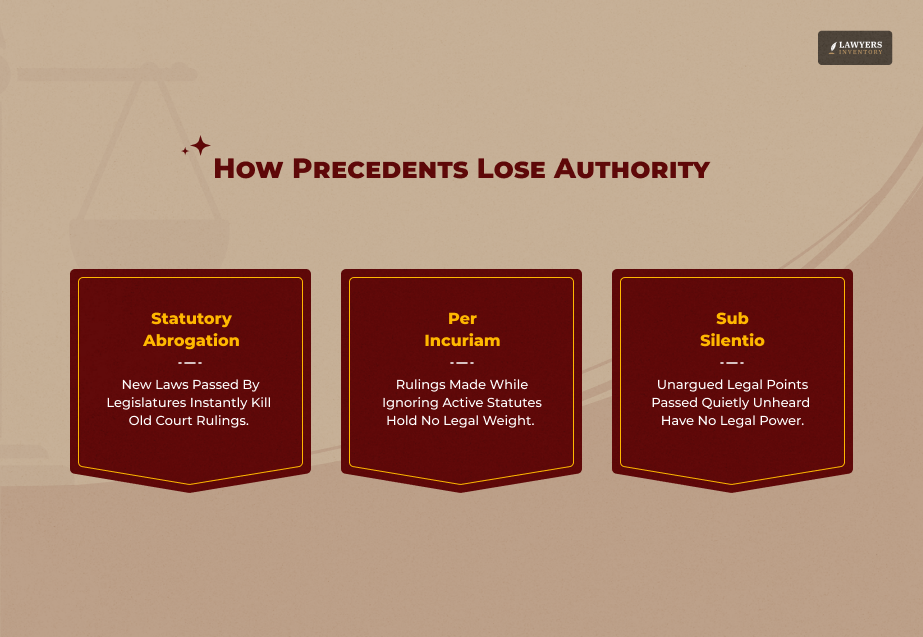
A precedent is a dynamic entity that can lose its legal authority through several subversion factors:
1. Statutory Abrogation:
Firstly, precedent is strictly constitutive (it can fill a vacuum) but never abrogative (it cannot alter an explicit act of parliament).
Therefore, if a legislature enacts a statute that contradicts a court decision, the precedent is instantly neutralized.
For example, India passed the 24th Constitutional Amendment specifically to nullify a restrictive Supreme Court decision in the Golaknath case [Source: Lawctopus].
2. Per Incuriam (Ignorance Of Statute):
Secondly, a precedent loses all binding power if it was rendered in total ignorance of an existing statute or higher court ruling. Even a lower court can refuse to follow a high court precedent if per incuriam can be proven.
3. Sub Silentio (Not Fully Argued):
A past case decision passes sub silentio and carries zero authority on an unargued legal point if counsel never noticed it and the bench never explicitly addressed it.
Read Also: Legal Assistant Career Guide: Salary, Skills, And The AI Revolution
Practical Application: Navigating Legal Precedent Via IRAC
Gone are the days of legal teams spending weeks manually looking through printed legal books.
Now, they use AI-enabled legal discovery tools – such as Westlaw, Practical Law, and CoCounsel.
With these, they locate identical matching facts and extract the relevant ratio decidendi quickly.
Once a favorable case is discovered, attorneys structure their legal reports using the standardized IRAC framework to persuade the court:
THE IRAC STANDARD

1. ISSUE: State the clear legal question at hand.

2. RULE: Cite the established legal precedent or statutory rule governing the issue.

3. ANALYSIS: Conduct a comparative study, analytically aligning the facts of the current dispute with the “ratio decidendi” of the cited case law.

4. CONCLUSION: Provide a definitive resolution based on that comparative analysis.
So, if an attorney faces an unfavorable binding precedent, their primary tool is distinguishing.
As a result, the attorney must meticulously demonstrate to the judge that the physical facts or legal requirements of the current dispute differ materially from the precedent-setting case. In this way, they can prove the old ruling should not apply.
Legal Precedent In International Law
At the global level, strict stare decisis does not exist. Under Article 38 of the Statute of the International Court of Justice (ICJ), past judicial decisions are categorized merely as a subsidiary means for the determination of rules of law.
Furthermore, Article 59 of the ICJ Statute explicitly establishes that a decision of the court has no binding force except between the specific state parties involved and in respect of that one particular case.
International tribunals look to their past work for persuasive guidance to maintain judicial predictability. However, they remain completely free to depart from their own rulings to meet the shifting needs of international society.
Leave A Reply





Hung Jury vs. Mistrial: What Is The Difference And Why It Matters
Read More
NarodniyDimUkraina: An Overview Of The Kyiv-Based Brand Preserving Ukrainian Craftsmanship
Read More
What Is A Mistrial? Legal Definition, Causes, And What Happens Next
Read More
What Is A Sequestered Jury? Legal Definition, Process, And Everything You Need To Know
Read More
What Is A Hung Jury? Legal Definition, Causes, And What Happens Next
Read More
0 Reply
No comments yet.