Summarize using AI





Prompt copied. Paste it into Gemini.
“Federal law prohibits businesses from repossessing service members’ vehicles without a court order.
The Department of Justice is proud to defend the rights of those who serve in our military and will continue to vigorously enforce the laws that protect them.”
– Harmeet K. Dhillon, Assistant Attorney General, Justice Department’s Civil Rights Division. (Source: The Office of Public Affairs)
This has been the basis of the CarMax lawsuit and the CarMax justice department settlement.
It all happened to resolve the allegations against the biggest retailer of used cars in the USA, CarMax.
The retailer company did not abide by the “Servicemembers Civil Relief Act (SCRA)” regulations for taking repossession of the cars used by members of the military service.
As a result, the Department of Justice had asked CarMax to pay at least $420,000 to the servicemembers who faced damages. Furthermore, it will have to pay a civil penalty of $79,380.
So, the overall CarMax justice department settlement value was at least $500,000. The United States Department of Justice (DOJ) entered into this settlement on 23rd February 2026.
However, around a month later, CarMax was served another settlement order where it had to pay at least $1.1M.
Hi, in today’s article, I will talk about the CarMax justice department settlement incidents in February and March 2026.
Quick Summary:

• The CarMax Justice Department Settlement Case of $500000

The U.S. Department of Justice (DOJ) entered a settlement with CarMax, Inc. over allegations of illegal vehicle repossessions from active-duty servicemembers, violating the Servicemembers Civil Relief Act (SCRA).

CarMax will pay $420,000 in restitution to 28 servicemembers, a $79,380 penalty, and must implement strict new DMDC search procedures for repossessions.

• The CarMax Settlement Case of 1.1 Million

The Sonoma County District Attorney and five other California DAs settled a consumer protection lawsuit against CarMax for $1.1 million.

The suit alleged that CarMax failed to timely transfer vehicle registrations and ownership documents to the DMV.

The settlement includes $900,000 in penalties and requires strict operational policies to ensure timely paperwork delivery for future used car buyers.
The CarMax Justice Department Settlement Case Of 23rd February 2026
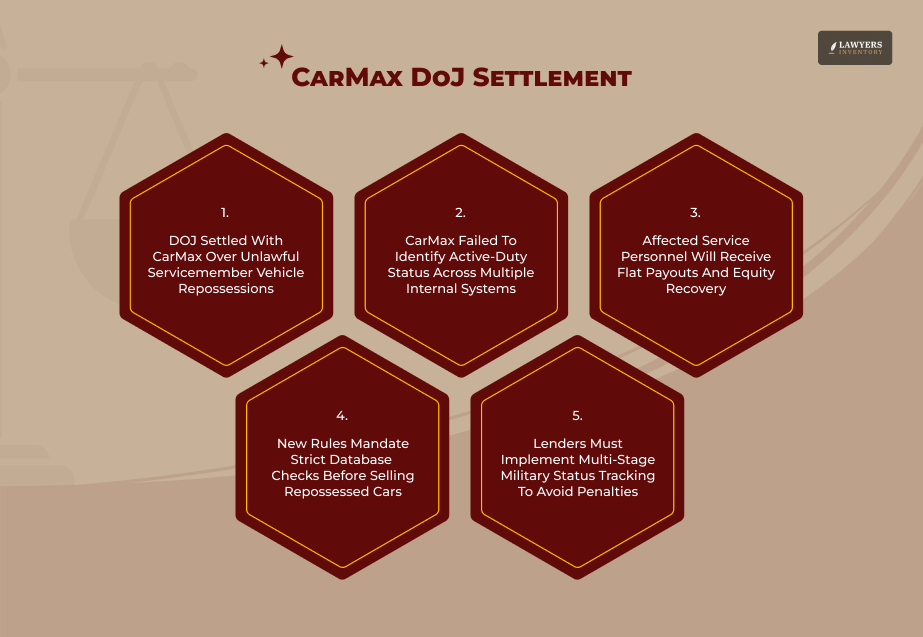
With the allegations of a pattern of non-compliance and the internal policy failures, the findings of the CarMax justice department settlement case were massive.
The Allegations: Where CarMax’s Systemic Gaps Failed Service Members
The investigation of the Department of Justice (DOJ) noticed a pattern of non-compliance.
As a result, there was unlawful repossession of vehicles belonging to at least 28 servicemembers between March 1, 2018, and October 24, 2023.
A Case Timeline Breakdown
| Time Span | Case Activities |
| March 1, 2018 – October 24, 2023 | The Violation Period |
| Late 2023 – Early 2026 | DOJ Investigation and Settlement Negotiations |
| February 23rd 2026 | The DOJ files a formal lawsuit against CarMax Auto Finance in federal court, and CarMax enters a settlement. |
The Core Safeguards Of The SCRA
Like the previous United States of America v. Bayport Credit Union case at the United States District Court for the Eastern District of Virginia, Norfolk Division, Section 3952(a) of the SCRA is the main safeguard here.
This section mentions that once someone enters active military service, an installment contract for the purchase of real or personal property, specifically including motor vehicles, cannot be terminated or rescinded due to a breach or non-payment.
Furthermore, no one can repossess the underlying collateral without a specific court order.
This is a crucial legal protection applying to a purchase agreement where the buyer made a deposit or at least one installment payment prior to entering active military duty.
A Breakdown Of Internal Policy Failures
CarMax’s violations were way beyond isolated clerical errors.
In fact, it was the direct byproduct of systematic deficiencies in the company’s internal controls.
Furthermore, the government highlighted three major structural blind spots, as we can see in the table below.
| Policy Feature | Description | Impacted Group/Loophole |
| The “Charge-Off” Blindspot | CarMax did not require staff to check the Defense Manpower Data Center (DMDC) database for accounts written off as uncollectible. | Service members with accounts in a “charge-off” status. |
| Neglecting the Reserve “Early Alert” Period | Internal rules failed to recognize the “call-to-date” window protected under SCRA Section 3917, which covers the time between receiving orders and reporting. | Pre-deployment reservists. |
| Ignoring Direct Customer Notifications | Repossessions proceeded even after borrowers explicitly told customer service agents about their active military status. | Service members who directly disclosed their active-duty status. |
The Cost Of Non-Compliance For CarMax: Financial And Credit Remediation
CarMax tried to enter the settlement without admitting or denying the allegations.
However, the DOJ imposed operational and financial remedies to reverse the economic impact on the service personnel.
Direct Financial Restitution Breakdown
For every identified case of unlawful repossession, CarMax has to execute a strict three-part remediation formula.
| Financial Restitution | Details |
| Flat Payout | A base payment of $15,000 per affected servicemember. The amount will be less if the company has made any prior litigation payments. |
| Equity Recovery | The restitution will be equal to any lost equity in the repossessed motor vehicle. |
| Accrued Interest | There will be compound interest on that lost vehicle equity. Also, the calculation of the equity will happen from the exact date of the repossession sale to the date of issuing the final settlement cheque. |
Credit And Debt Collection Requirements
The financial penalties are beyond the $420,000 baseline pool.
CarMax has to formally request all major credit bureaus to delete the negative credit tradelines related to these accounts.
Also, the company must stop all ongoing collection activities against these individuals. Moreover, the company has to refund deficiency balances previously collected after the vehicle sales.
The Post-Settlement Compliance Framework And New Operational Mandates
CarMax has to follow a highly regimented compliance infrastructure after entering the settlement.
Furthermore, the DOJ will supervise the implementation process. Also, the framework sets a clear roadmap for what federal regulators consider an acceptable SCRA compliance program.
Strict DMDC Search Windows
Simple manual or automated verification cannot be the single and static checkbox at the beginning of a collection cycle.
Also, the settlement has strict two-day verification windows. As a result, CarMax has to conduct independent DMDC database sweeps at three separate operational stages.
| Repossession Phase | Timeframe Constraint | Required Action |
| Pre-Referral | No more than two business days before officially referring any vehicle to a third-party repossession agent | Review the account and officially refer the vehicle to a third-party repossession agent. |
| Post-Recovery | No more than two business days after successfully securing physical possession of the vehicle. | Document the recovery and successfully secure physical possession of the vehicle. |
| Pre-Auction | Maximum two business days before the vehicle is put up for public or private auction. | Send required legal notices and put the vehicle up for public or private auction. |
Handling Post-Repossession Identifications
CarMax has to halt the sale immediately when a DMDC sweep reveals an active-duty or protected reserve status after a repossession has occurred but before the vehicle is liquidated.
Furthermore, the company has to contact the borrower within one business day to arrange a vehicle return or secure a legally sound, voluntary SCRA waiver.
Training And Governance Standards
The settlement mandates annual, comprehensive SCRA training for all corporate employees in the following areas.
- Customer Service
- Collections
- Vehicle Repossession Management
Also, suppose there is a new hire, promotion, or internal transfer between sensitive departments. The company has to complete its specialized training within 30 days of the placement.
Physical Return Requirement: The Most Challenging Part Of The CarMax Settlement
Suppose CarMax detects an unlawful repossession and cannot reach the borrower within the designated timeframe.
Then, CarMax has to return the vehicle physically to the exact location where the possession took place within three business days.
The Subjective Exceptions
The settlement, however, offers carve-outs in the following cases.
- When a Physical Return is Not Required
- There is a Major Risk of Vehicle Damage
- An Imminent Threat of Vehicle Impoundment
- Explicit Notification of Abandonment by the Borrower
Still, these significant risk factors are inherently subjective. So, CarMax and other auto lenders have to approach these exceptions with extreme caution.
They need ironclad documentation to justify the exception to avoid further regulatory scrutiny or claims of bad-faith non-compliance.
Hard Lessons For Auto Lenders And Dealers
The regulatory fallout from the CarMax settlement delivers critical, actionable lessons for compliance officers across the auto finance industry.
| Core Compliance Pillar | Operational Threat and Context | Mandatory Action Item |
| Non-Partisan Priority | DOJ and CFPB maintain aggressive enforcement regardless of broader regulatory rollbacks. Heightened geopolitical tensions mean oversight will intensify. | Maintain a highly aggressive baseline compliance posture for military consumer protections. |
| Multi-Stage DMDC Sweeps | Checking status only at delinquency leaves a 60- to 90-day vulnerability window where a servicemember may be deployed. | Implement a 3-part sweep. • Pre-Referral • Post-Recovery • Pre-Sale |
| Reservist Early Alert | Most software incorrectly flags protection based only on the active-duty start date, omitting the order phase. | Adjust automated system flags to protect reserve components the exact moment official activation orders are cut. |
| Direct Customer Disclosure | SCRA has a strict liability standard. DMDC database gaps do not clear a lender if a consumer gives direct notice. | Update front-end systems to log verbal/written claims instantly. Put declaration rules on notices; empower staff to freeze repossessions immediately. |
| Agile Remediation Playbook | Erroneous repossessions trigger broader regulatory audits if left unaddressed. Time is of the essence. | Deploy a rapid escalation playbook covering legal review, vehicle return logistics, fee reversals, and credit corrections. |
The CarMax Settlement Order Of $1.1 Million
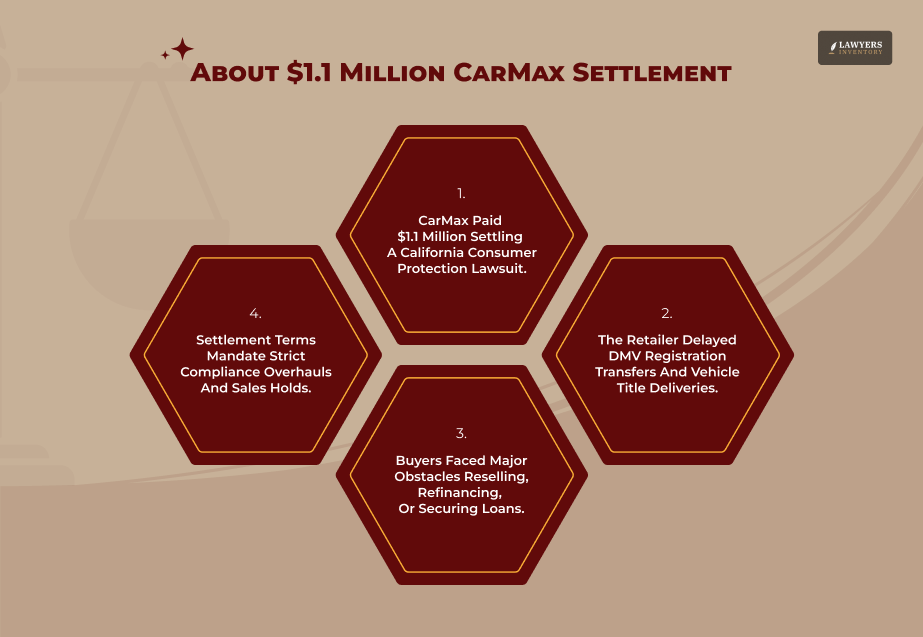
With the approval of the Santa Clara Superior Court, six California district attorneys, including Sonoma County’s Carla Rodriguez, announced a $1.1 million settlement with CarMax on 25th March 2026.
It was a consumer protection lawsuit. It said that CarMax has committed multiple violations of California law since 2019.
The retailer has failed to submit DMV registration transfers within the required 30-day deadline and has delayed the delivery of vehicle titles (pink slips).
As a result, the buyers could not use the car for reselling or refinancing, or as collateral for a loan.
In this context, the Sonoma County District Attorney, Carla Rodriguez, said,
“Used car buyers have the right to receive transfer of ownership on time.
Our Environmental and Consumer Law Division is working with other District Attorney’s Offices throughout California to hold companies accountable and enforce California’s consumer protection laws.”
According to this settlement, CarMax will have to pay the following amounts.
- $900,000 in Civil Penalties
- $150,000 for Investigative Costs
- $50000 in Restitution
CarMax also has to overhaul its compliance policies under strict injunctive terms.
Moreover, the company is now required to place a “hold” on selling used vehicles if the title is not in hand.
It also has to perform mandatory smog checks or VIN verifications prior to sale, train staff to prevent premature sales, and appoint a regional senior manager to oversee compliance.
Why Is The CarMax Justice Department Settlement More Than Just A Financial Impact?
Along with the financial restitution and penalty payments, the CarMax justice department settlement also included strict, court-monitored operational overhaul requirements spanning the next four years.
So, it was definitely more than a financial impact.
Furthermore, this enforcement action serves as an unmistakable warning to auto lenders, finance companies, and dealerships nationwide. It says that the SCRA enforcement remains an absolute priority for federal regulators.
Also, the CarMax justice department settlement emphasizes that relying on automated vendor tools or practical database checks will be inadequate to satisfy federal military lending protections.
Moreover, SCRA, as a strict liability law, does not leave any room for administrative oversight or policy blind spots.
So, every auto lender and dealer has to establish a proactive communication channel.
It also has to train frontline staff to prioritize military disclosures and execute multi-point database sweeps to fulfill their legal obligations to those in uniform.
Read Also:
Leave A Reply







Generational Equity Reviews- An Honest Guide (2025)
Read More
Your Ultimate Guide To The Amazon Prime Refund FTC Settlement
Read More
The Ultimate 2026 Guide To The Memorandum Of Association
Read More
Corporate Articles Of Association In 2026 [A Guide]
Read More
Yahoo Data Breach Settlement: Who Qualifies, How To Claim, What To Expect
Read More
0 Reply
No comments yet.