Quick Answer

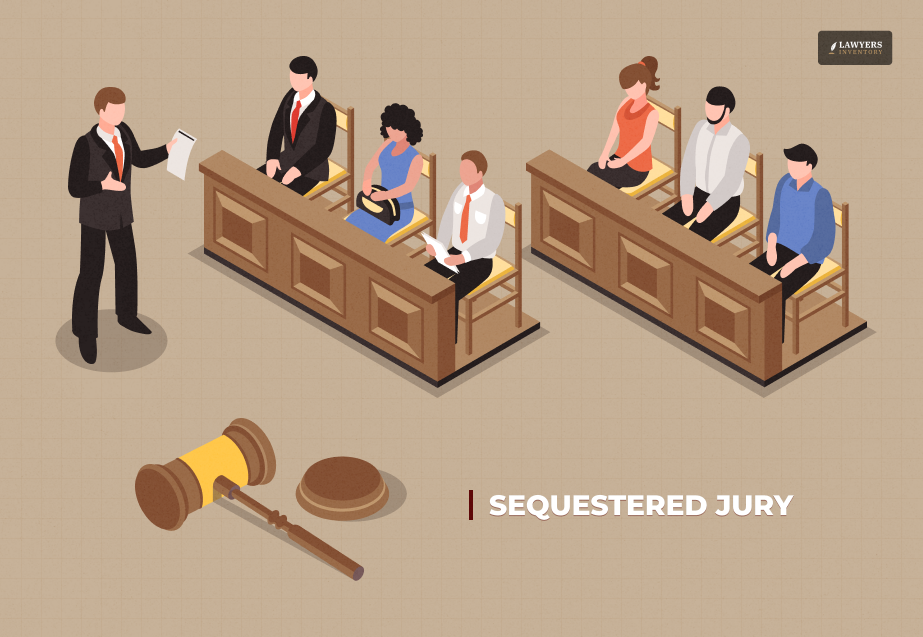
A sequestered jury is a group of jurors isolated from the public, media, and their normal lives for the duration of a trial or deliberation period. A judge sequesters a jury to stop outside influence. This process isolates jurors from the public. It removes them from the media and their normal lives. The court team finds hotels for the jurors. They cut off the jurors’ communication with the outside world. Security officers escort them from place to place. These strict measures prevent a compromised decision. They ensure the jury bases its final verdict solely on courtroom evidence.
Most people have encountered the phrase “the jury has been sequestered” during coverage of a high-profile trial. News anchors say it with gravity. Legal commentators nod. And most viewers quietly absorb the phrase without fully understanding what it means, what it requires, or why a judge would order it.
Jury sequestration is one of the most significant – and most misunderstood – procedural tools in American criminal law.
It is rare. It is expensive. Places an enormous burden on the people asked to serve. And it exists for a reason that goes to the heart of what the justice system is supposed to protect: the right to a fair trial decided solely on evidence, not on headlines.
This guide explains the sequestered jury in full – what it means legally, when judges order it, what it requires of jurors, what it costs, and how it fits into the broader architecture of a criminal trial.
What Is A Sequestered Jury?
A sequestered jury is a group of jurors placed under court supervision and separated from the general public during a trial or deliberations. They stay in a hotel, travel together, and have limited contact with the outside world. [Source: Cornell Law School]
To sequester is the act of isolating someone during trial proceedings. The jury, or witnesses, may be sequestered to preserve fairness during the trial.
Thus, when not fulfilling their roles at trial, sequestered persons may live in a hotel so that they are not influenced by the opinions of journalists, friends, and family. [Source: Uslegalforms]
The word itself comes from the Latin sequestrare, meaning to place in custody. In modern legal practice, sequestration refers to any official act of isolation or removal done to protect the integrity of a legal proceeding.
According to US Legal, jury sequestration is the isolation of a jury to avoid accidental or deliberate tainting of the jury by exposing them to outside influence or information that is not admissible in court.
Understanding what a sequestered jury is matters beyond legal trivia. In a criminal case, the sequestration decision shapes the experience of every juror involved – and can affect the outcome of the trial itself.
Why Judges Order Jury Sequestration
Sequestration is never a default. It is a last resort. Judges try less restrictive measures first – cautionary instructions telling jurors to avoid media coverage, limits on attorney statements to the press, and careful questioning during jury selection.
A sequestered jury order comes only when a judge concludes those lighter options are not sufficient to guarantee a fair trial.
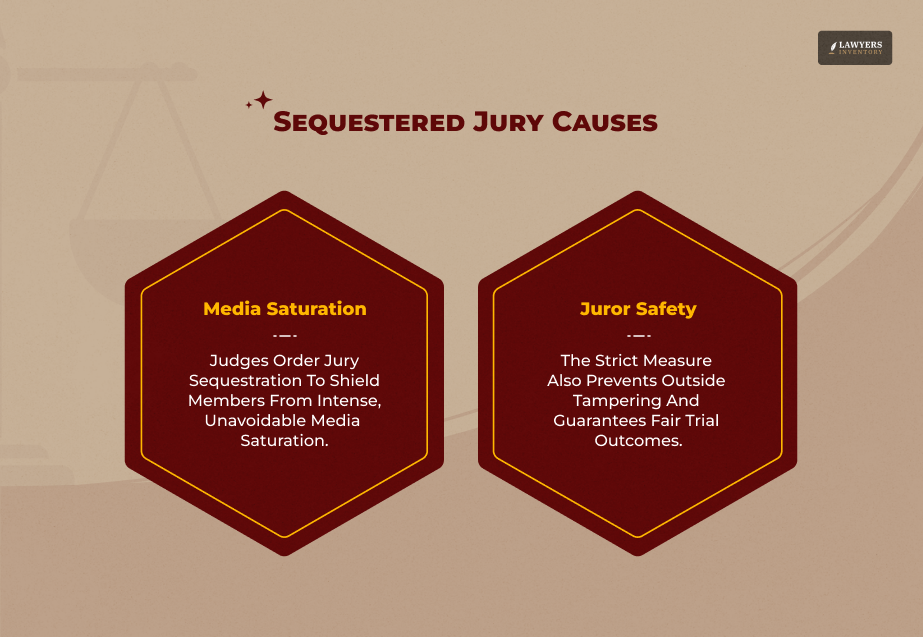
Two primary concerns drive almost every sequestration order.
Media Saturation
When wall-to-wall news coverage makes it nearly impossible for jurors to avoid hearing about a case outside the courtroom, a judge may conclude that no amount of cautionary instructions will keep the jury impartial.
This concern has only intensified in the social media era. A juror who goes home at night in 2026 does not need to seek out news coverage to encounter it – it finds them on every platform they use.
In cases of sufficient public interest, a judge may determine that the only reliable protection is physical separation.
Juror Safety And Tampering Prevention
Sequestration has often been used in syndicated-crime cases where a group, like the Mafia or the Hells Angels, may try to influence or intimidate a member of the jury. [Source: Versus Texas]
Courts view jury sequestration as a significant personal burden and financial expense, utilizing it only under specific conditions.
Judges generally implement this measure when the defense demonstrates community prejudice against the defendant. They also use it when news reports prevent juror impartiality [Source: Law definer].
The sequestration decision is entirely within the judge’s discretion. Even criminal defendants do not have an absolute right to a sequestered jury – though in some states, sequestration may be required by law in capital cases where a defendant could face the death penalty.
The Legal Authority Behind Sequestration
No single federal statute establishes jury sequestration as a standalone power. Rather, the authority stems from inherent judicial power to protect trial integrity, with federal law addressing related expenses for juries “ordered to be kept together.”
Landmark Supreme Court rulings, such as Sheppard v. Maxwell (1966) and Nebraska Press Association v. Stuart (1976), established sequestration as a constitutional safeguard for ensuring a fair trial. [Source: Justia]
These cases framed the measure as a necessary tool to counteract prejudicial publicity without infringing upon First Amendment press freedoms.
This legal precedent highlights sequestration as a vital, expected measure when trial integrity is at risk.
What Happens When A Jury Is Sequestered?
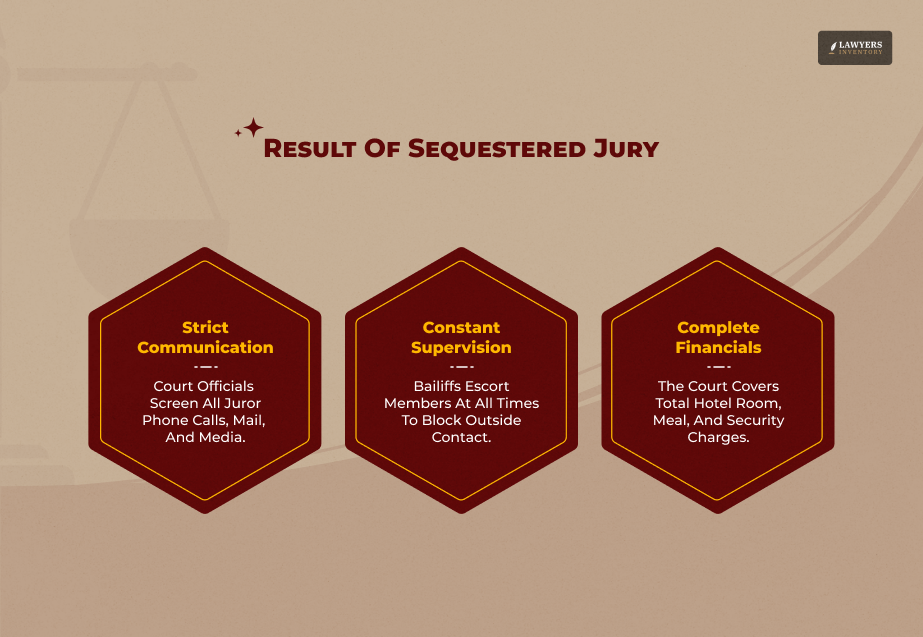
Once a judge orders sequestration, daily life changes dramatically for every juror involved. Jurors move into a hotel paid for by the court and travel only in court-supervised groups.
- Phone calls are monitored or restricted.
- Television access may be limited to non-news channels.
- Mail is screened before jurors receive it.
According to the Legal Information Institute, at the end of each day, jurors return to the hotel together rather than going home.
Once a judge sequesters a jury, the court imposes strict measures to ensure juror objectivity. For example, jurors cannot use a public restroom alone. A court bailiff or marshal must accompany them at all times.
As per Law Definer, sequestered jurors generally cannot make or receive telephone calls. A higher court will not reverse a verdict due to a juror’s phone call under specific conditions. A court officer must hear the entire conversation. Additionally, the caller must not discuss any case-related information.
The court covers hotel accommodation, meals, and security for the entire duration of sequestration. Jurors continue to receive their standard jury pay.
The conditions are managed to be as comfortable as possible – but comfort is a secondary concern. The primary concern is isolation from anything that could compromise the verdict.
When Does Sequestration Begin?
The timing of sequestration varies by case type and judicial determination.
In criminal trials, a judge may order sequestration at the outset – from the moment jury selection is complete – or only during the deliberation phase after all evidence has been heard.
In a civil trial, a judge does not sequester jurors until the jury hears all of the evidence. The judge must also deliver the final instructions before sequestration begins. [Source: Study.com]
Partial sequestration also takes place in some cases.
A judge holds complete discretion over jury sequestration. The judge decides when the sequestration begins. They also choose whether it covers the full trial or only the deliberations. Finally, the judge sets the specific conditions that jurors must follow.
The 2021 Derek Chauvin murder trial highlights this judicial power. The judge permitted jurors to go home overnight during the main trial.
However, the judge fully sequestered the jury during deliberations. Court staff parked the jurors in a secure location. Deputies then escorted the jurors between that location and a private courthouse entrance.
The Costs And Burdens Of Sequestration
Sequestration is expensive – financially and personally.
Sequestration is an expensive undertaking for a court system. For the sequestered jurors, it requires funding for the following things:
- Meals.
- Accommodations.
- Security details.
Jury sequestration inflicts major psychological distress, worry, and boredom on jurors. The process completely cuts them off from their families, work, and normal lives
An example is the 1995 O.J. Simpson trial, which was 265 days long and cost approximately $2 million. [Source: Los Angeles Times]
For these reasons, judges are reluctant to resort to this method mainly because of the huge financial cost and the risk of personal disputes arising among the sequestered jurors.
There is also a behavioral risk that sequestration itself creates. For instance, these jurors may be more likely to rush their deliberations in order to return to their normal lives.
Pressure to conclude a trial can stop a jury from deliberating thoroughly. This rushed process directly threatens fair trial integrity. Ironically, it destroys the very value that sequestration is meant to protect.
This paradox forces judges to use sequestration sparingly. The cure, applied too broadly, can compound the problem.
Sequestration And What Comes Next: Outcomes Of Deliberation
Understanding a sequestered jury requires understanding what deliberations are meant to produce – and what happens when they do not produce it.
The goal of sequestration is to protect deliberations so that jurors can reach a unanimous verdict based solely on the evidence. That unanimous verdict – guilty or not guilty – is the intended outcome of every criminal trial.
But deliberations do not always reach unanimity. When jurors fail to agree, they create a hung jury. This deadlocked jury cannot reach a unanimous decision, no matter how long they continue deliberations.
Hung Juries
Discussions cannot always make the members of the group completely agree. When the members of the jury are in deadlock for a decision and can’t even reach unanimity with a long discussion, we call it a hung jury.
In sequestered environments, the unbearable psychological pressure of isolation can do two things.
- Make a person’s mind decide quickly for an agreement even if it is a forced one.
- Make the divisions between the minds of the people who were disagreeing to the point that they find it extremely difficult to change their minds.
It is basically an either/or situation.
Mistrials And Retrials
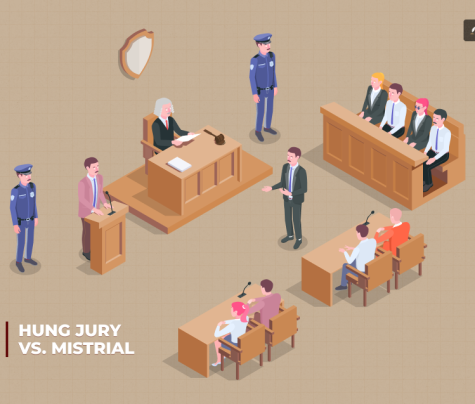
Generally, a hung jury would cause a mistrial that in fact puts an end to the case without a final verdict.
It is extremely important to keep apart a hung jury vs. a mistrial: the situation when the members of the jury cannot agree among themselves is only one of the factors that might cause a mistrial.
Things like the violation of the right of the defendant during the trial or the misconduct of the juror may be the causes, too.
The running of the case stops with the declaration of a mistrial. However, it leaves the issue open. The law officers usually decide to make the defendant stand trial over again before a new jury.
Otherwise, when a jury is hung twice, the court has to consider if it is still right to prosecute a defendant.
People being tried more than once for the same crime is possible, but there are some restrictions insightful of the law.
Notable Historical Examples Of Sequestered Juries
Jury sequestration has appeared across some of the most consequential criminal trials in American history.
Harry Thaw Trial (1907):
The Harry Thaw trial for the murder of Stanford White, known as “The Trial of the Century,” was the first to use a sequestered jury due to the excessive media attention and high-profile nature of the case.
O.J. Simpson Trial (1995):
The gold standard of sequestration cases. The jury was sequestered for 265 days – nearly nine months – at a cost of approximately $2 million. The sequestration itself became a story, with jurors reportedly requesting to be dismissed due to the psychological strain of extended isolation.
Charles Manson Trial (1970):
The Manson trial attracted extraordinary public attention and required sequestration to insulate jurors from the intense media and public sentiment surrounding the case.
John Gotti Federal Trial (1992):
During the 1992 federal racketeering trial of mob boss John Gotti, the jury was sequestered in part because Gotti had previously beaten charges in trials later proven to be tainted by jury tampering and witness intimidation.
Derek Chauvin Trial (2021):
The jury was partially sequestered during trial and fully sequestered during deliberations – a hybrid approach that balanced juror well-being with the court’s obligation to protect the integrity of the proceedings.
Advantages And Disadvantages Of Sequestering A Jury
Here are some of the positives and negatives of a sequestered jury that you should know about:
Advantages
- Protects impartiality: Sequestration ensures jurors base their verdict solely on evidence presented in court – not on news coverage, social media, or public opinion.
- Prevents tampering: Physical isolation makes it significantly harder for outside parties to influence, intimidate, or communicate with jurors during deliberations.
- Protects juror safety: In cases involving organized crime or defendants with loyal followers, sequestration can be a genuine personal protection measure for jurors.
- Produces legally defensible verdicts: A verdict reached by a sequestered jury is significantly harder to challenge on grounds of external influence or juror misconduct.
Disadvantages
- Significant financial cost: Hotel accommodation, meals, security, and court personnel costs can run into millions of dollars in extended cases.
- Personal burden on jurors: Extended separation from family, employment, and normal life creates psychological strain that can affect the quality of deliberations.
- Risk of rushed verdicts: Jurors under the pressure of sequestration may reach a quicker verdict than the evidence warrants in order to return to their normal lives.
- Declining necessity: Some legal scholars argue that careful jury selection and strong cautionary instructions can achieve adequate impartiality without the costs and burdens of full sequestration.
Sequestration In The Broader Criminal Justice Context
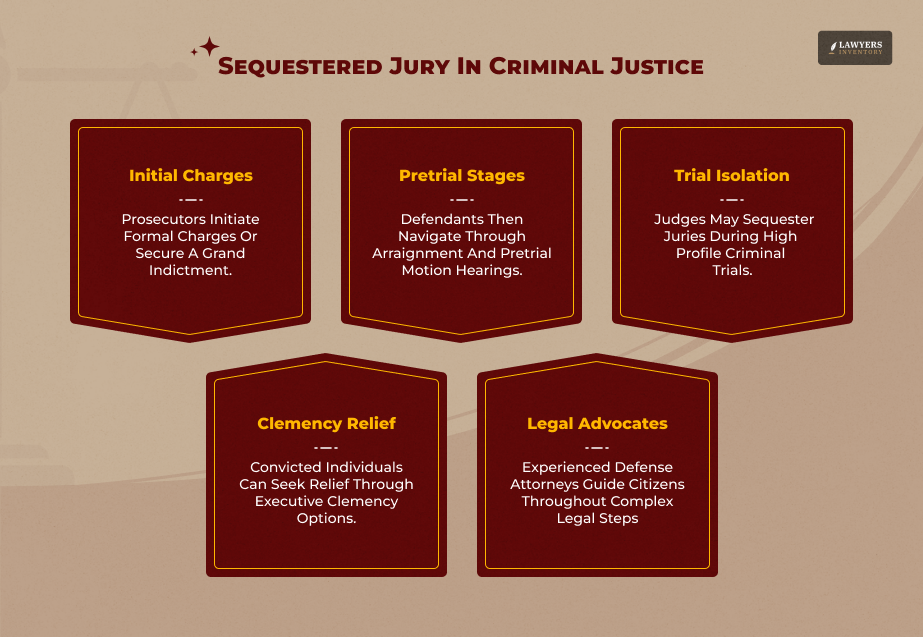
A criminal case follows a long legal journey. A sequestered jury sits at just one point in this process. The process starts before anyone selects a jury.
First, a defendant crosses a major legal threshold. The state either indicts or charges the defendant. A grand jury issues an indictment after finding probable cause.
Alternatively, a prosecutor directly files a charge. Both actions start the formal prosecution, but they use different legal mechanisms. After the filing, the case moves through arraignment and pre-trial motions.
Finally, the case goes to trial. At this stage, a judge might decide to sequester the jury. Judges usually reserve this step for high-profile or sensitive cases.
Sequestration does not stand alone. It is a procedural tool. The justice system uses it to protect fairness at every stage.
The legal process continues after a conviction and sentence. A defendant can seek relief through executive clemency.
For example, they can ask the executive to commute their sentence. A commutation reduces the punishment but does not overturn the conviction. My previous blog explains the difference between a commutation and a pardon. Please check out that post for details.
A person navigating post-conviction options needs a qualified legal representative. This advocate guides them through the complex rules.
One underlying principle connects all of these concepts. The legal system must maintain integrity at every step. This duty lasts from the first charge to the final sentence.
Leave A Reply





Hung Jury vs. Mistrial: What Is The Difference And Why It Matters
Read More
NarodniyDimUkraina: An Overview Of The Kyiv-Based Brand Preserving Ukrainian Craftsmanship
Read More
What Is A Mistrial? Legal Definition, Causes, And What Happens Next
Read More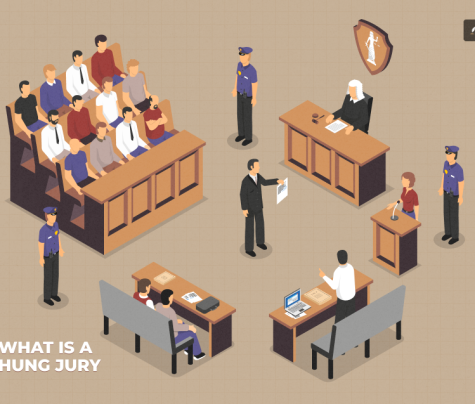
What Is A Hung Jury? Legal Definition, Causes, And What Happens Next
Read More
Commute Vs. Pardon: What Is The Difference And Which One Do You Need?
Read More
0 Reply
No comments yet.