Quick Answer

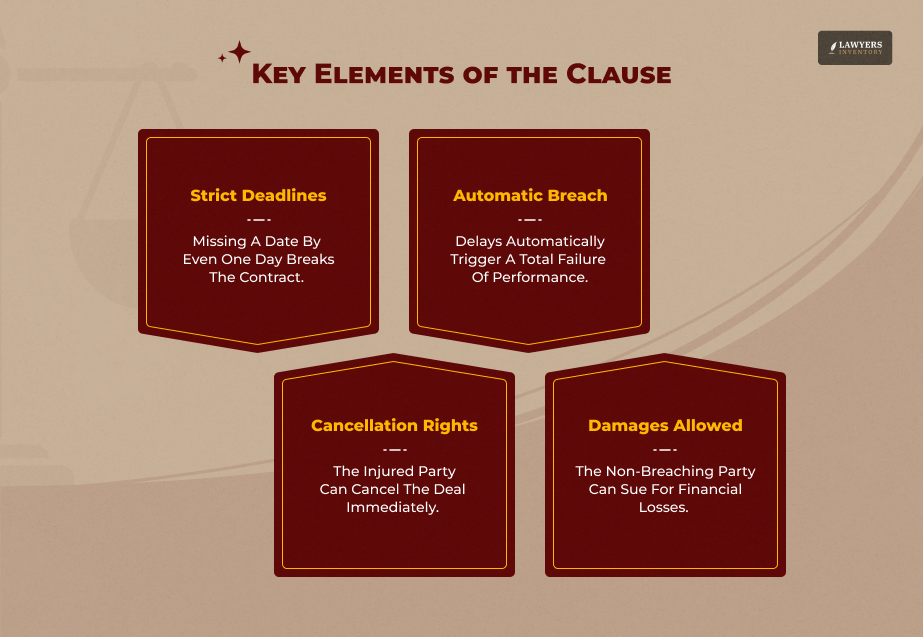
A “time is of the essence” (TIOE) clause is a critical legal provision stating that the specified deadlines in an agreement are absolute and mandatory. Under contract law, including this phrase elevates a standard deadline into a material term. Consequently, missing a deadline by even a few minutes does not constitute a minor delay; it is a material breach of contract, giving the non-breaching party the immediate legal right to terminate the contract, walk away, and sue for damages.
As a legal analyst researching contractual trends and studying expert opinions, I have observed that few legal phrases are as widely used – and as routinely misunderstood – as “time is of the essence.”
In corporate transactional drafting, businesses often assume that inserting this boilerplate phrase acts as a universal speed boost for their agreements.
Conversely, empirical data from modern contract litigation shows that corporate entities are frequently astonished to find that a delay of mere hours has cost them a multi-million-dollar deal or resulted in a massive breach-of-contract lawsuit.
In commercial transactions, time is more than just money. It defines the boundary between strict performance and a fatal, reputation-damaging default.
When parties sign a contract containing a Time is of the Essence (TIOE) provision, they are not merely expressing a desire for promptness. They are fundamentally altering the legal mechanics of how a court or arbitration panel will evaluate a delay.
What Is “Time Is Of The Essence” In Legal Contracts?
To fully comprehend the power of a TIOE clause, we must look at how courts evaluate contract deadlines when the phrase is absent.
Under standard common law principles, if a contract states a performance date but fails to specify that “time is of the essence,” the law treats that date as a target. A minor delay by one party is considered an immaterial breach. [Source: Legal Information Institute]
The non-breaching party is still required to perform their own obligations. Although they can later seek damages for any concrete financial losses caused by the delay.
However, when an explicit TIOE clause is inserted, a complete paradigm shift occurs:
- Standard Contract Pathway: Minor Delay – Immaterial Breach – Contract Stays Alive (Damages Only)
- TIOE Contract Pathway: Minor Delay – Material Breach – Contract Dies (Immediate Termination Right)
By explicitly making time of the essence, the drafting parties elevate a simple chronological metric into a core condition (or material term) of the agreement.
A failure to perform strictly on time behaves identically to a failure to deliver the core subject matter of the contract itself.
The Landmark Precedent: The 10-Minute Forfeiture
To illustrate just how uncompromising this doctrine is, legal researchers frequently point to the famous Privy Council decision in Union Eagle Ltd v Golden Achievement Ltd. [Source: CaseMine]
In this case, a buyer purchasing real estate was required to deliver a deposit by a strict deadline. The contract explicitly stated that time was of the essence. The buyer’s courier arrived precisely 10 minutes late.
The seller immediately rescinded the contract and kept the deposit. The court upheld the seller’s right to do so, ruling that when time is of the essence, a court has no equitable authority to excuse a late performance, no matter how brief or minor the delay.
A Side-by-Side Comparison: Time Is Of The Essence vs. Standard Deadlines
When analyzing or reviewing an agreement, it is vital to understand the structural differences in liability. The table below details how these two environments compare across critical legal metrics.
| Legal Dimension | Contract WITHOUT a TIOE Clause | Contract WITH a TIOE Clause |
| Legal Status of Deadline | Treated as a flexible target or baseline. | Treated as an absolute condition precedent. |
| Impact of a 24-Hour Delay | Immaterial Breach. The contract remains fully active. | Material/Repudiatory Breach. The contract can be dissolved. |
| Immediate Remedies | Continue performance; file for actual damages later. | Terminate contract instantly, reject performance, and sue. |
| Judicial Interpretation | Courts apply a flexible “Reasonable Time” standard. | Courts enforce Strict Compliance down to the minute. |
| Risk of Forfeiture | Low; the defaulting party is given a chance to cure. | High; minor slip-ups result in total loss of contractual rights. |
Industry-Specific Applications And Default Rules
A common mistake found in generic legal commentary is treating TIOE as a static rule across all industries. In truth, the presumption of whether time is essential varies dramatically based on the nature of the transaction.
1. Real Estate And Immovable Property
In the sale of real estate, the default rule across multiple jurisdictions – including US common law and Indian Jurisprudence under the landmark Supreme Court ruling in Chand Rani v. Kamal Rani – is that time is not naturally of the essence.
Courts presume that property values are relatively stable over a matter of days or weeks, meaning a short delay in closing will not structurally destroy the transaction. Therefore, if a seller wants a strict closing date, they must explicitly state that time is of the essence.
2. Mercantile And Commercial Supply Chains
In stark contrast, for mercantile transactions involving commercial goods, seasonal inventory, or commodities, courts naturally presume that time is of the essence, even if the clause is missing from the text.
If a logistics firm fails to deliver holiday merchandise until December 26th, the entire commercial utility of that contract has vanished.
3. Mergers & Acquisitions (M&A) And Financial Markets
In corporate acquisitions, “drop-dead dates” govern regulatory approvals, stock financing, and shareholder votes.
Because market valuations change rapidly, time is structurally essential. Failing to close on a specified date routinely allows one party to walk away without penalty or collect a pre-negotiated break-up fee.
How To Establish “Time Is Of The Essence” After Signing
What happens if parties have already signed an agreement that lacks a TIOE clause, and one party is continually delaying performance?
They are not entirely out of options.
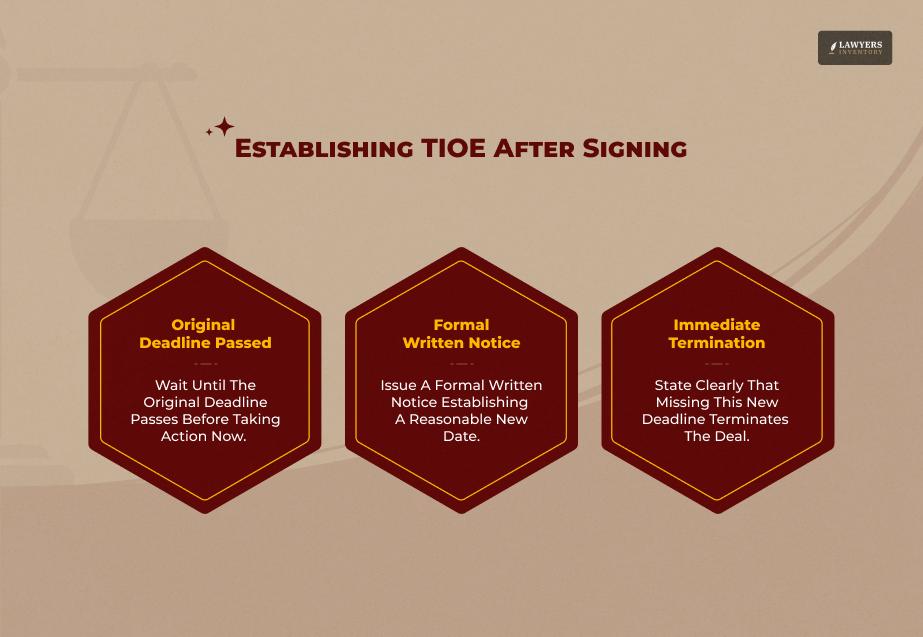
A party can unilaterally make time of the essence through a mechanism called a Notice to Perform (or a Notice to Complete).
To execute this strategy effectively, the non-breaching party must follow a precise process:
- Wait until the original contractual deadline has passed without performance.
- Issue a formal, written notice to the defaulting party.
- Fix an explicit, definitive new date for performance.
- Ensure the new timeline is commercially reasonable based on the complexity of the task.
- Explicitly state in the notice that “time is now of the essence regarding this new date,” and that failure to perform will result in immediate termination for material breach.
By serving this formal notice, a party effectively injects a TIOE clause into an active transaction, restoring leverage and setting up a clear path to exit if the delay continues.
Read Also: What Is A Non-Compete Agreement? Legal Definition, Enforceability, And Your Rights
Strategic Checklist: Evaluating The Need For A TIOE Clause
Before recommending a TIOE clause for an agreement, legal analysts look at the broader operational goals and risk profiles through this strategic checklist:
- Market Volatility: Does the financial value of the contract’s subject matter fluctuate dramatically from day to day (e.g., stocks, oil, commodities)? (If yes, include TIOE).
- Downstream Commitments: Does the client have a strict, binding obligation to a third party that depends entirely on this contract being completed on time? (If yes, include TIOE).
- Operational Performance Capabilities: If the other party makes time of the essence for all obligations, can the operational team realistically guarantee compliance down to the exact hour? (If no, negotiate an explicit cure period).
- Interdependent Milestones: Does the contract involve a complex, multi-stage project where a single delay breaks the entire development timeline? (If yes, apply TIOE strictly to those critical milestones).
- Financial Consequences: If a delay occurs, is it preferable to walk away entirely (TIOE), or keep the deal moving forward while collecting a daily penalty (Liquidated Damages)?
Things To Keep In Mind In Time Is Of The Essence Clause
Successful contract management requires addressing the advanced nuances and practical risks discovered through deep trend analysis.
Here are some of the most important things that you MUST keep in mind:
1. The “Waiver Trap” (Conduct vs. Contract Text)
This is the single most common reason TIOE clauses fail in court. Parties can write the most ironclad TIOE clause imaginable, but their subsequent conduct can completely invalidate it.
If a contract specifies that a monthly delivery must occur by the 1st of every month because “time is of the essence,” but the buyer routinely accepts deliveries on the 4th or 5th without issuing a formal, written objection, they have legally waived their right to strict enforcement.
If they suddenly try to terminate the contract on the 2nd day of a subsequent month, a court will rule that their history of tolerance created an estoppel. This would prevent them from invoking the TIOE clause.
2. The Structural Conflict With Force Majeure
What happens when an absolute, down-to-the-minute deadline collides with a global pandemic, a labor strike, or a catastrophic extreme weather event?
If a contract contains both a strict TIOE clause and a standard Force Majeure clause, an immediate ambiguity arises.
Expert opinions emphasize that a properly drafted agreement must clarify that a Force Majeure event temporarily pauses the TIOE clock, rather than allowing the non-delayed party to claim an immediate material breach.
3. The Danger Of Boilerplate “Liquidated Damages”
Many corporate agreements include both a TIOE clause and a liquidated damages clause (e.g., “$500 penalty per day of delay”).
Legal research reveals a major trap here: including a per-day financial penalty can completely undermine a TIOE clause in court.
A judge looking at a daily penalty may conclude that the parties did not actually consider time to be of the essence, because they explicitly calculated a financial remedy to keep the contract alive during a delay.If the true goal is the right to terminate immediately, a daily penalty clause can be highly counterproductive.
Leave A Reply







Intentional Infliction Of Emotional Distress Explained: Elements, Evidence, And What Makes A Claim Win
Read More
What Is A Preliminary Hearing? Core Procedures, Timeline, And What To Expect
Read More
What Is Grand Larceny? Felony Thresholds, Penalties, And Your Legal Options
Read More
Larceny vs. Theft: What’s The Real Legal Difference?
Read More
Is AI Ruining Your Legal Case? How To Detect And Correct Fabricated Law
Read More
0 Reply
No comments yet.