Quick Answer

Malicious compliance refers to obeying a directive precisely to the letter, knowing it is designed to fail, reveal a fault, or hurt your employer. Though no statute or dictionary recognizes it, the actual conduct can still potentially violate laws like insubordination, just cause, unfair dismissal, union rights and whistleblower laws, according to jurisdiction. Whether or not you find yourself being terminated, sued, or protected is determined almost wholly by the set of circumstances: what instructions were given to you, and why did you take it to that extreme and what happened afterwards.
Malicious compliance means following an instruction exactly as written while knowing the outcome will backfire, expose a flaw, or cause harm. No statute or court opinion defines this term.
Legally speaking, “malicious compliance” does not exist.
However, the behavior itself regularly triggers real legal consequences. When disputes escalate, courts and labor boards do not evaluate the phrase.
Instead, they classify the behavior into existing legal categories: insubordination, protected activity, breach of contract, or retaliation.
Malicious Compliance Definition: It’s Not A Legal Term – And That Matters
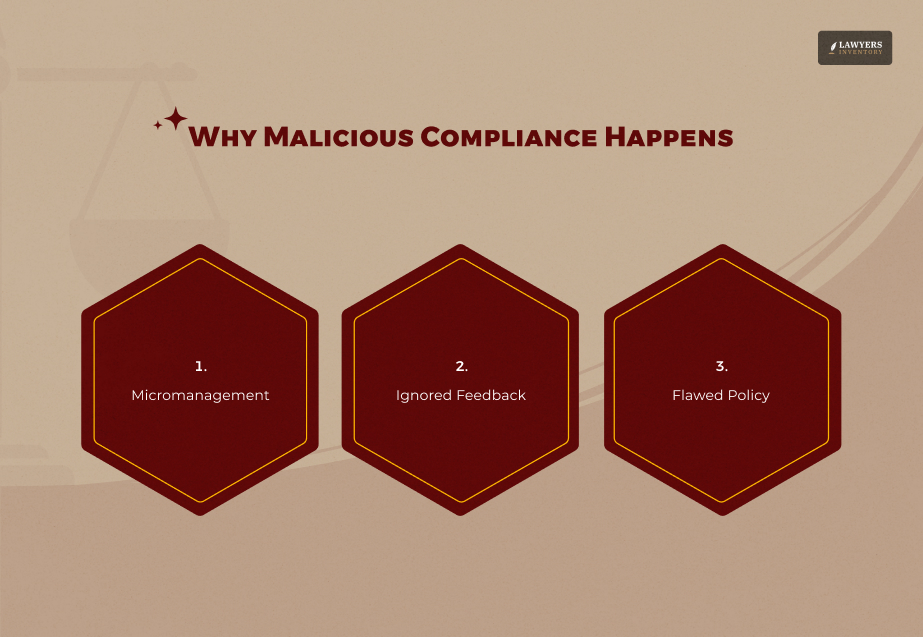
So, what is malicious compliance?
Search the term, and you’ll find a two-million-member subreddit, dozens of HR glossaries, and a handful of news stories using it to describe corporate lobbying tactics.
What you won’t find: a statute, a court opinion, or a regulatory definition. Legally speaking, “malicious compliance” doesn’t exist.
That doesn’t mean it’s legally irrelevant.
It just means the label itself carries no legal weight. Only the actual facts matter if a dispute ever gets serious. You must look closely at the exact instruction management gave you.
You must also examine the way you followed that instruction. Finally, you must evaluate the specific consequences that followed from your actions.
Courts and labor boards don’t ask “was this malicious compliance?” They ask whether the conduct fits into categories the law already recognizes:
- Insubordination.
- Protected activity.
- Breach of contract.
- Retaliation.
Everything below maps malicious compliance onto those categories.
Can Malicious Compliance Get You Fired?
Short answer: often, yes – but usually not for the reason your employer might claim.
Why “Insubordination” Rarely Applies
Employers sometimes label pushback as insubordination, but the legal definition doesn’t fit malicious compliance especially well.
Insubordination generally requires a deliberate refusal to follow a clear, lawful, reasonable instruction. Malicious compliance is the opposite move – you followed the instruction.
Exactly. To the letter.
That’s the entire point of the tactic, and it’s why disciplining someone for it under an “insubordination” label can be legally shaky, even in workplaces where insubordination is a fireable offense.
Why At-Will Employment Still Makes This Complicated
Here’s the catch: in most U.S. states, employment is at-will.
An employer can fire you for a good reason, a bad reason, or no reason at all, as long as the reason isn’t illegal – discrimination, retaliation for a protected activity, or a violation of an employment contract.
That means an employer doesn’t need to prove insubordination to let you go over an incident of malicious compliance. Employers only need a lawful reason to fire someone. In most jurisdictions, the phrase “this behavior damaged trust” easily clears that bar.
If you have a written employment contract, the calculus changes. Contracts often spell out specific grounds for termination and a process that has to be followed first.
Skipping that process can turn a termination into a breach-of-contract claim, regardless of what the employer calls the underlying conduct.
When Malicious Compliance Crosses Into Legally Protected Territory
This is the part most people talking about workplace culture skip entirely – and it’s the most important legal wrinkle in the whole topic.
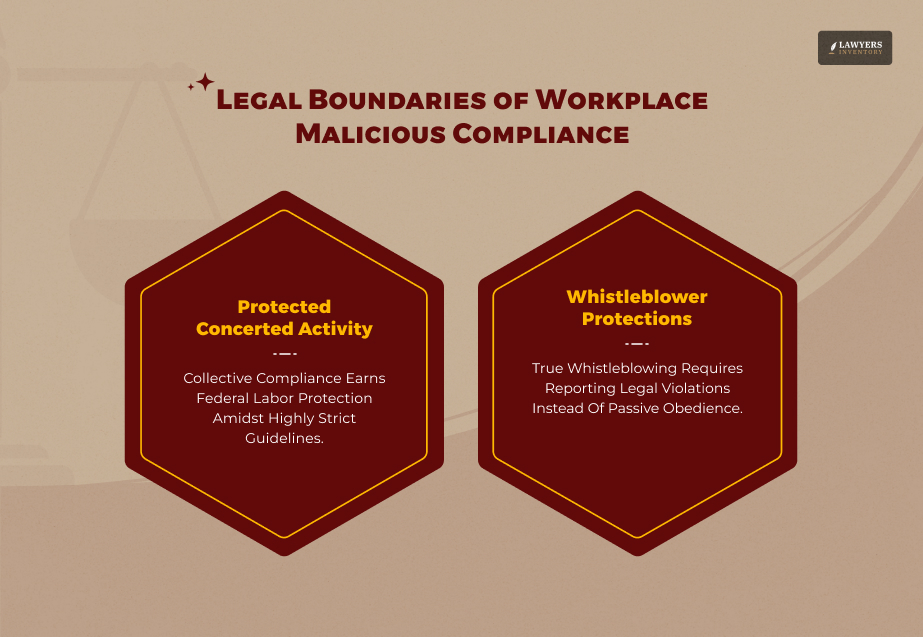
Protected Concerted Activity
Section 7 of the National Labor Relations Act protects employees, union and non-union alike, who act together to improve pay, hours, or working conditions. [Source: Labor Lab]
If malicious compliance happens as a group – several employees jointly following an unpopular policy to the letter to expose how unworkable it is – that can qualify as protected concerted activity. Employers generally can’t discipline or fire workers for engaging in it. [Source: Practical Law]
A single employee acting alone usually falls outside this protection, though there are exceptions when someone is speaking on behalf of a group’s shared concern.
This protection isn’t unlimited.
Conduct built on dishonesty, safety violations, or knowingly false statements can forfeit it. The line matters, and it’s exactly the kind of question an employment lawyer can answer on the facts of a specific case.
Whistleblower Protections
If the underlying policy you’re complying with is itself illegal – a wage-and-hour violation, a safety violation, a compliance failure a regulator cares about – following it precisely while documenting the fallout can shade into whistleblowing.
Federal whistleblower laws, including the programs OSHA administers across more than 20 statutes, protect employees from retaliation for reporting legal violations or refusing to participate in them. [Source: U.S. Department of Labor]
That protection generally depends on what you reported and to whom, not on how cleverly you followed a bad rule.
Reporting the problem – to a supervisor, a regulator, or an internal compliance channel – is usually what triggers the protection, not the compliance itself.
Can Malicious Compliance Get You Sued Or Disciplined For The Outcome?
Employees aren’t the only ones who can get burned here.
Employees sometimes follow rules exactly and cause real damage. According to Indeed, this damage might include:
- Missed regulatory deadline.
- Safety incident.
- Client contract breach.
The resulting fallout hurts the business itself, not just the employee who followed the letter of the policy.
For employees, personal legal liability from malicious compliance is uncommon, but not impossible.
If following an instruction to the letter caused harm to a third party, and a reasonable person would have known that outcome was likely, that can factor into a negligence claim against the employer, and occasionally against the employee directly, depending on their role and duties.
Executing a facially legal instruction rarely creates personal liability on its own. The bigger legal risk usually runs the other way: toward the employer, for writing a policy sloppy enough to be exploited that way in the first place.
Documenting Your Case In Malicious Compliance: What To Keep If Things Escalate
If you’re worried a disciplinary conversation, or worse, is coming, documentation is what turns a dispute into a defensible case.
- Keep the original instruction in writing wherever possible – an email, a memo, a message thread.
- Note exactly when you received it and from whom.
- Save the policy or procedure you were following, along with any prior version that shows how it changed.
- Record what happened as a result of your compliance, including any communications with your manager about it before or after.
- Keep clear evidence if you tied your compliance to a group effort.
- Save all records if you tied your actions to a reported legal concern.
This evidence separates a protected action from an unprotected one.
None of this guarantees an outcome. But a clear paper trail is consistently what employment lawyers say they need most. And it’s rarely something people think to build until it’s too late.
Should You Talk To An Employment Lawyer?
A few signals suggest it’s worth the conversation.
- You were disciplined or fired shortly after following a policy to the letter, especially if you’d raised concerns about that policy beforehand.
- You were acting alongside coworkers rather than alone.
- The policy you followed may itself have violated a law or regulation.
- Or you have a written employment contract and believe your employer didn’t follow its own termination process.
Most employment attorneys offer an initial consultation to assess whether a case has legal merit before any fees are involved. Bring the documentation described above, and be specific about the timeline – what was said, by whom, and when.
Malicious Compliance: What To Do Next?
Workplace conflicts can sometimes reveal cases of malicious compliance. If your situation is on the verge of this, you must protect yourself. Refrain from giving any informal explanations right away. Instead, wait until you have spoken with an expert who can clarify the legal aspects involved.
Perspective changes drastically during a dispute. What you see right now as a great, defensible decision can backfire. In a formal notice of termination, management can easily reframe your actions. They may present your choice as a willful act of insubordination instead.
To protect your career, you must act strategically. Put all of your facts in writing immediately. Identify exactly which categories your situation matches, and discuss the matter professionally. You must tell your side of the story before someone else tells it for you.
Sources:
- National Labor Relations Board (Section 7, National Labor Relations Act)
- U.S. Department of Labor, Occupational Safety and Health Administration Whistleblower Protection Program
- Employment law commentary on insubordination and at-will employment standards from licensed employment law practitioners.
Leave A Reply






What Is Litigation? A Complete Guide To The Legal Process, Costs, And When You Need It
Read More
What Does Pro Bono Mean – And Does It Actually Mean Free?
Read More
What Is A Holding Company, And When Does It Actually Protect You Legally?
Read More
Litigation Vs. Arbitration: Which One Actually Decides Your Case?
Read More
Mediation Vs. Arbitration: Costs, Process, Enforceability, And Key Differences
Read More
0 Reply
No comments yet.