Summarize using AI





Prompt copied. Paste it into Gemini.
Quick Answer: Litigation vs Arbitration

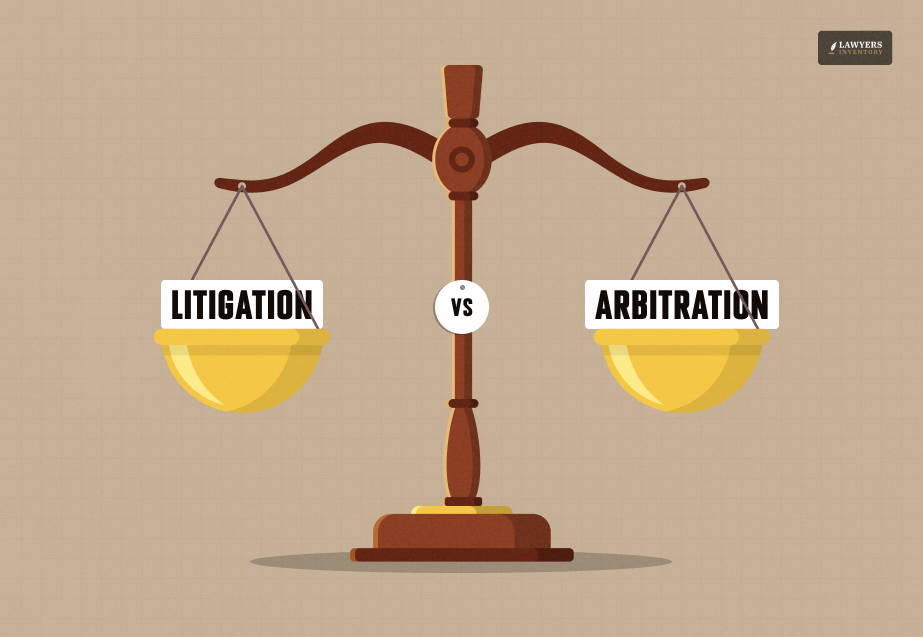
Litigation happens when two sides go to court. A judge or jury resolves their conflict. In contrast, arbitration refers to a private method. The disputing parties choose a neutral third party. This third party makes a binding decision. The entire process happens without court intervention.
Litigation and arbitration both resolve legal disputes. But they don’t work the same way. The core difference comes down to one question: who actually decides the outcome?
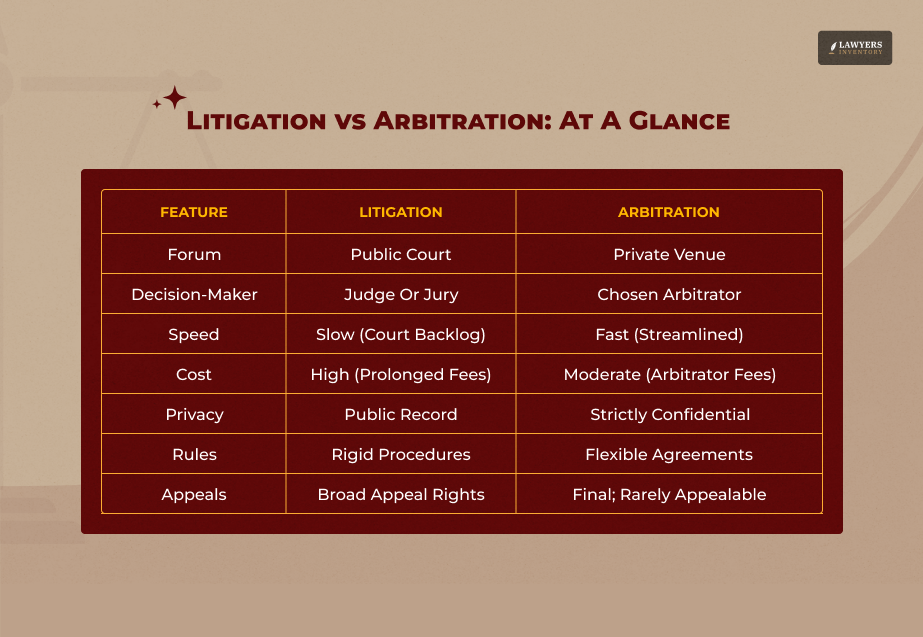
In litigation, a judge or jury decides. In arbitration, a private arbitrator does. That single distinction shapes everything else – discovery, appeals, cost, and how much control you keep over the process.
Litigation vs Arbitration: At A Glance
What Is Litigation?
Litigation is dispute resolution through the public court system. It runs under formal procedural rules – the Federal Rules of Civil Procedure at the federal level, and equivalent codes at the state level. Filings and judgments generally become part of the public record.
A judge presides. In many civil cases, either party can request a jury.
Discovery tends to be broad. Rule 26 of the Federal Rules of Civil Procedure governs the following:
- Depositions.
- Interrogatories.
- Document requests.
That breadth is a real strength when a case depends on evidence the other side controls.
What Is Arbitration?
Arbitration is a private process.
A neutral arbitrator, or a panel, hears the dispute and issues a binding decision called an award. Parties usually agree to arbitrate through a clause in their contract, well before any dispute exists.
The Federal Arbitration Act governs most U.S. arbitration agreements. It doesn’t set out detailed discovery rules the way the Federal Rules of Civil Procedure do. [Source: US Government]
Instead, discovery scope depends on the arbitration provider’s rules and the arbitrator’s own discretion. That’s a meaningful trade-off: less procedural weight, but also less certainty about what evidence you’ll actually get to see.
Litigation vs Arbitration: Difference In Discovery And Evidence
This is where litigation vs arbitration diverge most in practice, not just in theory.
Discovery Is Narrower In Arbitration By Design
Federal litigation gives you broad discovery tools under Rule 26.
Arbitration doesn’t come with that built in. Section 7 of the FAA lets an arbitrator summon a witness and demand relevant documents, but it says nothing about depositions or interrogatories the way court rules do.
Parties can negotiate broader “litigation-style” discovery into their arbitration clause, but absent that, an arbitrator’s default authority is narrower.
Formal Rules Of Evidence Usually Don’t Apply
In court, the Federal Rules of Evidence govern what a judge or jury can consider. In arbitration, those rules typically don’t apply unless the parties agree to import them.
Arbitrators can weigh evidence more flexibly – which speeds things up, but also removes a layer of procedural protection litigants take for granted in court.
Litigation vs Arbitration In Appeals: Why Arbitration Awards Are Nearly Final
Litigation gives you real appeal rights. A losing party can generally appeal to a circuit court, and legal rulings get reviewed de novo – meaning the appellate court looks at the legal question fresh, without deferring to the trial judge.
Arbitration doesn’t work that way.
Under 9 U.S.C. § 10, a federal court can only vacate an arbitration award for four narrow reasons:
- Arbitrator showed evident partiality or corruption
- The award was procured by corruption, fraud, or undue means
- Arbitrator committed misconduct, such as refusing to hear material evidence;
- Arbitrator exceeded their powers
The Supreme Court confirmed in Hall Street Associates v. Mattel (2008) that these four grounds are exclusive – parties can’t contract around them to get broader review. [Source: Justia Law]
Disagreeing with the arbitrator’s reasoning isn’t a valid ground to overturn the award. That finality cuts both ways: it’s efficient, but it also means a genuinely wrong decision can stand.
Litigation vs Arbitration: Cost, Timeline, And Confidentiality
Arbitration is often described as cheaper and faster than litigation. That’s frequently true, but not automatically.
A complex, multi-party arbitration with extensive expert testimony can cost as much as a moderate lawsuit. The better question isn’t “which is always cheaper” – it’s what the specific dispute actually requires.
Confidentiality is a more consistent advantage for arbitration. Court filings are typically public unless sealed. Arbitration proceedings, and often their existence entirely, stay private.
For a company protecting trade secrets or sensitive terms, that difference is often decisive on its own.
The Law That Changed Who Controls The Choice
Here’s the piece almost no comparison article covers, and it matters if you’ve ever signed an employment or consumer contract with a mandatory arbitration clause.
Congress passed a major law in March 2022. This law is the Ending Forced Arbitration of Sexual Assault and Sexual Harassment Act. It directly revised the Federal Arbitration Act (FAA). [Source: Cambridge University Press & Associates]
The Yale Law Journal assessed the change. They stated this is the first major amendment to the FAA. It comes after almost a hundred years since the original law.
The law lets a person bring a sexual assault or sexual harassment claim to court, even if they had signed a predispute arbitration agreement covering it. They can also pursue the claim as a class or collective action, even if they’d waived that right beforehand.
The choice belongs to the person raising the claim, not the company that drafted the contract, and it applies to agreements signed before the law’s enactment, so long as the claim itself arose afterward.
This doesn’t apply to every dispute – it’s specific to sexual assault and harassment claims. But it’s a real, current example of Congress actively limiting when arbitration can be forced on someone, which is exactly the kind of practical detail a reader evaluating their own contract needs to know.
Litigation vs Arbitration: Which One Fits Your Situation?
If your dispute is already governed by a signed arbitration clause, your choice may already be made. Courts generally enforce valid arbitration agreements under the FAA, and outside the narrow exception above, opting out isn’t simple.
If You’re Negotiating A New Contract:
Arbitration provides key benefits. It keeps your dispute confidential. It also offers a much faster and more predictable time frame.
Litigation offers different advantages. It gives a wider scope for investigation. It also gives you a real right to appeal if the court misapplies the law. [Source: Global Law Experts]
If You’re Dealing With A Cross-Border Dispute:
Arbitration is usually more advantageous here. The New York Convention provides a recognized enforcement mechanism. This system allows you to enforce arbitral awards in over 170 countries. [Source: ResearchGate]
Court judgments lack this advantage. They do not have a similarly recognized universal mechanism.
If Your Claim Involves Sexual Assault Or Harassment:
The 2022 law may let you choose court even under an existing arbitration agreement – worth raising directly with an employment attorney before assuming you’re bound to arbitrate.
If You’re Already In A Dispute:
Review the actual clause. Confirm which arbitration provider and rules it names, and check whether it expanded or restricted discovery from the FAA’s default. That single document usually answers the question before any legal strategy discussion needs to begin.
Sources:
- 9 U.S.C. §§ 7, 10 (Federal Arbitration Act): Cornell Law School’s Legal Information Institute
- Hall Street Associates, LLC v. Mattel, Inc., 552 U.S. 576 (2008)
- Ending Forced Arbitration of Sexual Assault and Sexual Harassment Act of 2021, Pub. L. 117-90
- Yale Law Journal’s analysis of the statute;
- American Bar Association’s litigation committee on discovery and confidentiality differences
New York Convention on the Recognition and Enforcement of Foreign Arbitral Awards.
Leave A Reply






Do You Pay Taxes On Lawsuit Settlements? IRC Section 104 Explained
Read More
Non-Disparagement Clause Explained: Requirements, Enforceability, And What Changed Recently
Read More
Best Practices For Successful Trademark Registration
Read More
Understanding Your Rights: A Guide To The Legal Process
Read More
How To Clear A Bench Warrant Without Going To Jail: A Legal Guide
Read More
1 Reply
Mediation Vs Arbitration: Costs, Process, And Differences
August 31, 2026 at 8:38 am
[…] Emergency Risks: If you need an immediate asset freeze, choose arbitration or litigation. Institutional rules provide emergency arbitrator mechanisms to issue binding interim injunctions. […]
Reply