Summarize using AI





Prompt copied. Paste it into Gemini.
Quick Answer: What Is Litigation?

Legal disputes are typically settled through litigation in the court system. This process starts when one party files a lawsuit. The case ends when a judge or jury rules on the matter, when the parties settle the dispute, or after an appeal. A lawsuit and litigation are slightly different terms. Filing a lawsuit refers specifically to one party initiating the action. In contrast, litigation refers to the entire legal process after the lawsuit is filed. This complete process includes pre-trial notices, discovery, the trial itself, and any subsequent appeals.
If you’re staring down a legal dispute right now, here’s what litigation actually involves: how the process works, what it tends to cost, how it stacks up against arbitration and mediation, and how to figure out whether court is even the right call.
What Is Litigation?
People mix up “lawsuit” and “litigation” constantly, but they’re not interchangeable. A lawsuit is a specific legal action – a party files a claim in court to enforce a right or recover damages.
Litigation is bigger than that: the whole arc, from the pre-suit notice through the final settlement, verdict, or appeal.
Cornell Law School’s Legal Information Institute frames litigation as the sequence a plaintiff moves through to get a court to rule in their favor, ending in trial, mutual agreement, or dismissal.
Merriam-Webster keeps it simpler: the settlement of a dispute in a court of law. Either way, the idea is the same – litigation is the rulebook for resolving conflict once informal efforts have run out.
Litigation touches individuals, private companies, and government bodies alike, and it shows up across a wide range of disputes – contract disagreements, property fights, personal injury claims, employment cases, and criminal charges brought by the state.
Where the case is filed determines how it proceeds. The Federal Rules of Civil Procedure (FRCP) govern civil proceedings in the United States, and the rules are designed to promote equity, speed, and economy. [Source: US Courts]
In other jurisdictions, civil procedure takes place in a manner that is largely dissimilar – the exact process varies by jurisdiction.
The deadlines differ, and so do the language and the order of proceedings. But, according to Super Lawyers, the general structure remains similar:
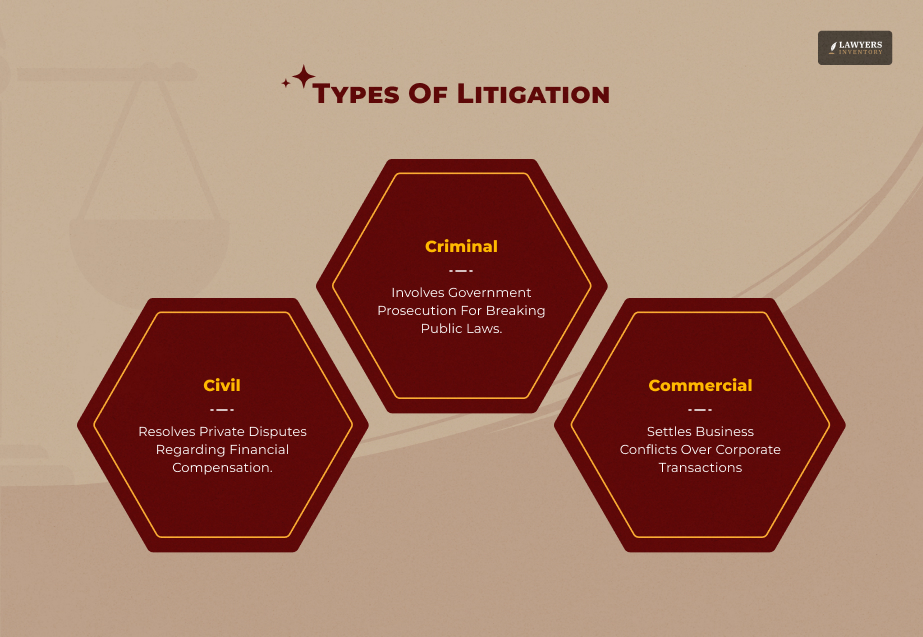
- A party files a claim.
- The other party responds.
- Each conducts discovery.
- A trial takes place if no settlement is reached.
- Either side can appeal the decision.
How The Litigation Process Unfolds
Litigation rarely opens with a courtroom scene. Most disputes start with a direct conversation, or an attempt at one, and only escalate to a formal notice or demand letter once that conversation goes nowhere.
Filing a case is usually the last resort, not the first move.
Before Anything Gets Filed
Attorneys typically start by digging into the facts – pulling together documents, timelines, and early evidence before anyone signs a complaint.
Then comes the demand letter, a formal warning that spells out the grievance and what happens if the other side doesn’t settle. A surprising number of disputes end right here.
Filing And Response
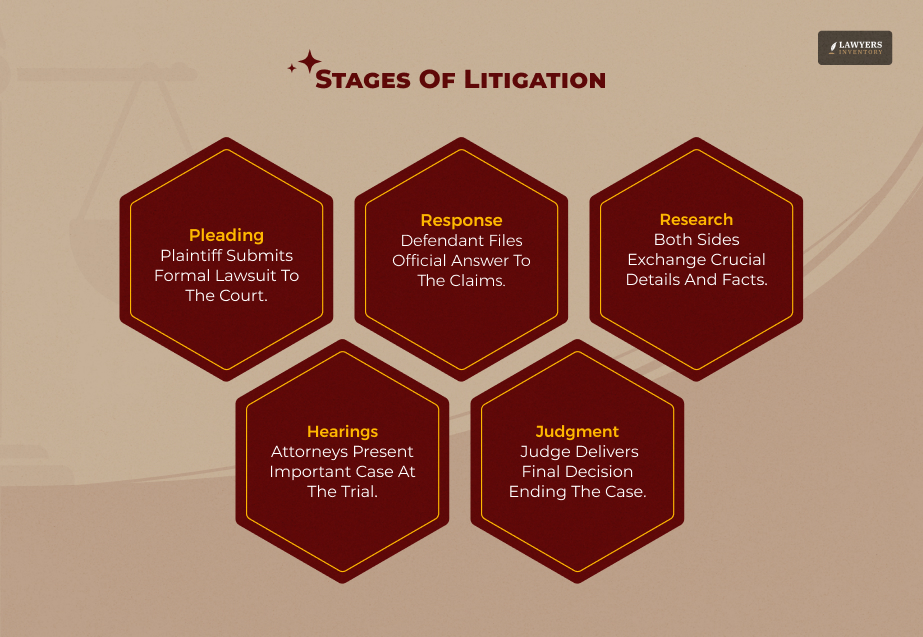
The first step is initiating the lawsuit by filing a complaint. You must file this document with a court that has the appropriate jurisdiction.
The complaint sets out the wrongful action the defendant supposedly committed. It also states the specific remedy the plaintiff seeks.
The next step is the delivery of the summons and complaint to the defendant. After receiving these documents, the defendant must submit a written response.
Under U.S. civil courts, this response is usually due within 20 to 30 days. However, this timeframe can vary depending on the jurisdiction.
In their official answer, the defendant can dispute or partly accept the allegations. They may also choose to raise new counterclaims against the plaintiff.
Discovery
Discovery is where most of the time in litigation actually goes. Both sides trade information using a handful of tools:
- depositions (lawyers questioning witnesses under oath outside the courtroom),
- interrogatories (written questions the other side must answer),
- document requests covering everything from emails to financial records.
The point is to keep either side from ambushing the other with surprise evidence once trial starts.
Motions And Pre-Trial Rulings
Somewhere in the middle of discovery, or right after it wraps, either party can ask the judge to settle a legal question before trial.
A motion to compel forces the other side to hand over evidence they’re withholding. A motion for summary judgment goes further – it argues the facts aren’t really in dispute and asks the judge to decide the case on the law alone, skipping trial entirely.
A lot of cases never get past this stage.
Trial
If no settlement is found and the case goes through its pretrial motions, then the case moves on to trial.
Both parties present evidence, call witnesses and cross-examine them, and a judge or jury are tasked with interpreting what they’ve seen in the context of the law to deliver a verdict.
In the US federal courts, that means Seventh Amendment rights generally require a jury trial for a civil claim seeking monetary damages.
But both parties can also waive their rights to have the case decided by a jury and allow the judge to make that decision in what’s known as a bench trial.
Judgment, Enforcement, And Appeal
Once a verdict is issued, the court issues a judgment. If the losing party does not pay, the winning party can take the matter back to court to enforce the judgment.
This can typically happen by:
- Deducting money from the loser’s wages.
- Placing a lien on his property.
- Taking possession of the assets.
- Selling them to the highest bidder.
Either side may appeal if they believe that the judge has erred in his judgment, although an appeal is not a retrial.
The matter is heard by a panel of judges who examine the record of the case and are not inclined to overturn a finding. Either way, the process can take months or even years, adding further pressure to the litigants.
What Litigation Costs – And Who Actually Pays
Now that you know what is litigation, let’s talk about the cost. Cost tends to be the first real question on anyone’s mind. Here’s a more honest breakdown.
How Attorneys Charge
Civil litigation attorneys generally bill one of four ways: hourly, flat fee, contingency, or a retainer drawn down against hourly work.
Hourly rates run roughly $150 to $500 or more, depending on experience, firm size, and local market – big-city firms tend to sit at the higher end.
Contingency arrangements, common in personal injury work, usually take 25% to 40% of whatever gets recovered, and the attorney only gets paid if the case wins.
Flat fees show up for narrowly defined tasks, and retainers require money up front that gets billed against as the case moves along.
What A Case Actually Costs
Attorney fees are the biggest line item, but not the only one. Court filing fees usually land between $100 and a few hundred dollars, depending on the court.
Discovery adds its own costs – depositions, document review – and expert witnesses can run several hundred dollars an hour when a case needs one.
Add it up, and a straightforward case that goes to trial can still cost tens of thousands of dollars; a complex commercial dispute with multiple experts can climb into six figures.
That math explains why so many cases settle before trial – the closer a case gets to a courtroom, the more expensive it gets.
Who Pays In Litigation?
In most U.S. jurisdictions, each side pays its own attorney regardless of who wins, unless a contract, statute, or court rule says otherwise.
Winning a case doesn’t automatically mean the other side reimburses your legal bills – a detail that catches a lot of first-time litigants off guard.
Litigation vs. Arbitration vs. Mediation: Key Differences
Court isn’t the only way to resolve a dispute, and it’s rarely the cheapest or the fastest. Weighing the alternatives before committing time and money to a lawsuit is worth the extra hour it takes.
| Scope | Litigation | Arbitration | Mediation |
| Decision-maker | Judge or jury | A neutral arbitrator | The parties themselves |
| Setting | Public court | Private tribunal | Private, informal |
| Outcome | Binding judgment | Binding award | Voluntary agreement |
| Right to appeal | Generally available | Very limited | Not applicable |
| Typical cost | Highest | Moderate | Lowest |
Arbitration shows up constantly in commercial contracts as a required first step. Its outcome is binding, much like a court judgment, but it happens in private with far less room to appeal.
Mediation is non-binding unless both sides sign off on whatever they agree to – a neutral third party just helps steer the conversation.
Litigation is the one that leaves a public record and can be appealed, which matters most when a legal principle, not just money, is at stake.
The Deadline You Can’t Afford To Miss: Statute Of Limitations
Every kind of civil claim comes with a filing deadline, known as the statute of limitations, and once that window shuts, courts will almost always dismiss the claim no matter how strong it is. This is arguably the single most consequential fact in any potential lawsuit.
The clock usually starts when the harm happened, though many jurisdictions apply a “discovery rule” that delays the start date until the harm was actually discovered or reasonably should have been.
Deadlines swing widely by claim type and location – a personal injury claim might allow two or three years in one state, while a breach-of-contract claim might allow considerably longer.
Since the real deadline depends on your specific claim and jurisdiction, confirming it with an attorney early is one of the few steps here where waiting genuinely costs you.
Should You Litigate? A Practical Decision Framework
Litigation is the right call in some situations and the wrong one in others. A handful of questions tend to sort out which side of that line your dispute falls on.
Is The Amount At Stake Actually Worth The Cost?
If potential damages clearly outweigh the projected legal fees, litigation is more likely to pay off. If the two numbers are close, winning might not feel much like winning once the bills are settled.
Has The Other Side Already Refused To Negotiate?
Litigation tends to make sense once demand letters have gone nowhere, or when the other party is acting in bad faith with no interest in resolving things directly.
Do You Need A Binding Legal Precedent Or A Public Record?
Some disputes – constitutional claims, injunctions, issues likely to recur – need a court order that arbitration or mediation can’t produce.
Does Your Contract Already Require Arbitration?
Many commercial and employment agreements lock in arbitration as a mandatory first step. Missing that clause can get a case dismissed on a technicality before anyone looks at the merits.
Is Your Filing Deadline Still Open?
None of the above matters if the statute of limitations has already run out.
What To Do Next
If your situation shows potential for a legal battle, you should meet with a qualified attorney in your area. A brief meeting will bring you much closer to the truth than any other step.
Most dispute lawyers offer a free initial consultation to review your situation. During this meeting, they will check if your matter has legal merit. They will also discuss approximate costs, how to preserve your evidence, and what documents they need.
You should gather every written letter, contract, and invoice related to the matter. Bring all other relevant records with you as well. Having your documents organized from the start will definitely help your case. It can also save you time and reduce stress during the legal discovery phase later.
Sources:
- Cornell Law School’s Legal Information Institute (Wex Legal Dictionary)
- Merriam-Webster Dictionary
- The Federal Rules of Civil Procedure (U.S. Courts)
- U.S. Chamber of Commerce Institute for Legal Reform
- Published attorney fee and civil litigation cost data from U.S. legal industry sources.
Leave A Reply






Do You Pay Taxes On Lawsuit Settlements? IRC Section 104 Explained
Read More
Non-Disparagement Clause Explained: Requirements, Enforceability, And What Changed Recently
Read More
Best Practices For Successful Trademark Registration
Read More
Understanding Your Rights: A Guide To The Legal Process
Read More
How To Clear A Bench Warrant Without Going To Jail: A Legal Guide
Read More
2 Reply
What Is an Operating Agreement? LLC Needs & Key Terms
September 28, 2026 at 11:01 am
[…] members disagree on a decision, or a dispute ends up in litigation, a judge will first check the operating agreement before falling back on the default statute of the […]
ReplyIllinois Birth Injury Statute Of Limitations Pitfalls
September 22, 2026 at 7:02 am
[…] useful overview of litigation deadlines explains why waiting can create problems even before the formal filing period runs […]
Reply