Quick Answer: How To Get A Public Defender

To get a public defender, you must be facing criminal charges that carry a possible jail or prison sentence and demonstrate to the court that you cannot afford to hire a private attorney. The process begins at your first court appearance - typically arraignment - where you request appointed counsel. The court then evaluates your financial situation through a formal indigency determination. If approved, the public defender's office assigns you an attorney. The process can begin before your court date in many jurisdictions by contacting the court clerk's office directly.
Facing criminal charges without legal representation is one of the most dangerous positions anyone can be in. The law recognizes this. The Sixth Amendment to the United States Constitution guarantees the right to counsel in criminal proceedings.
If you cannot afford an attorney, the government must provide one. That attorney is a public defender – a fully licensed, government-employed lawyer whose entire practice is criminal defense.
The Constitutional Foundation: What The Law Actually Guarantees
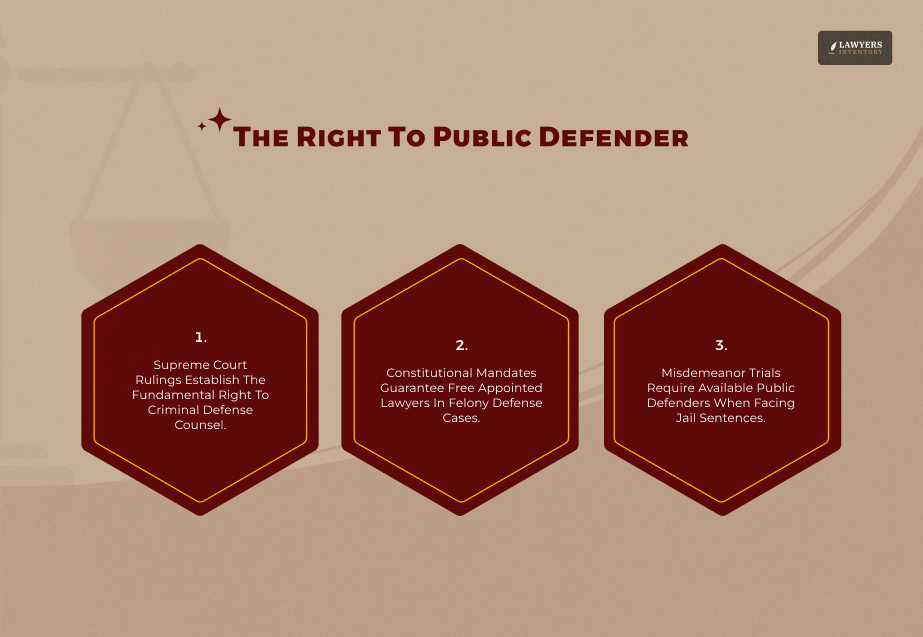
The right to a public defender does not come from court policy or a legislature. Instead, it is a core constitutional right.
This protection stems directly from landmark U.S. Supreme Court decisions. These rulings permanently changed the criminal justice system in the United States.
Initially, the Supreme Court addressed this issue in the 1932 case Powell v. Alabama (287 U.S. 45). Later, the Court expanded this view in the famous case Gideon v. Wainwright (1963). In Gideon, the Court interpreted the Constitution to protect everyday citizens. [Source: Justia]
The Justices decided that the Sixth Amendment’s right to counsel applies to state courts through the Fourteenth Amendment.
The Court reached a critical conclusion about fairness. It ruled that the state must provide a lawyer to any defendant who cannot afford one. Without this state assistance, poor defendants lose their right to due process.
Therefore, an unrepresented defendant creates an unequal justice system. This landmark finding guaranteed court-appointed lawyers for poor defendants in all felony criminal cases.
Subsequently, the Supreme Court expanded these rights to minor offenses. In Argersinger v. Hamlin (1972), the Court ruled on misdemeanor charges. [Source: EBSCO]
The Justices declared that no person can be imprisoned for any offense unless the state provides them the right to a lawyer at trial.
Ultimately, the rule depends on the penalty you face. If a criminal charge carries any risk of a jail sentence, a low-income defendant has a legal right to a lawyer. Under the Constitution, the court must appoint an attorney to represent them for free.
Who Qualifies: The Two Core Requirements
Eligibility for a public defender turns on two distinct requirements. Both must be satisfied. Meeting one without the other is not enough.
Facing Charges That Carry Possible Imprisonment
The right to appointed counsel attaches only when imprisonment is a possible outcome of the case. This is not the same as likely imprisonment or expected imprisonment – it means the charge carries the statutory possibility of a jail or prison sentence.
This requirement has significant practical implications for what is and is not covered. Felony charges always qualify. Misdemeanors that carry possible jail time qualify.
Infractions, traffic tickets that result only in fines, and civil proceedings – including divorce, child custody disputes, landlord-tenant cases, and small claims matters – do not qualify for appointed criminal defense counsel. [Source: United States Courts]
Immigration cases present a particularly important exclusion. Deportation and removal proceedings are classified as civil rather than criminal proceedings under federal law.
The Sixth Amendment right to appointed counsel does not apply. This means non-citizens facing deportation are not entitled to a government-provided attorney – a devastating reality for people who may be unaware that the constitutional guarantee does not extend to their situation.
Non-citizens facing immigration proceedings should contact nonprofit immigration legal services organizations immediately rather than waiting for a public defender that will not be appointed.
Financial Inability To Afford Private Counsel
The second requirement is financial. You must demonstrate to the court that you cannot afford to hire a private defense attorney without substantial hardship.
Courts call this being “indigent” – and the determination goes well beyond a simple income check. [Source: FindLaw]
Judges evaluate your full financial picture. Most jurisdictions measure household income against the Federal Poverty Guidelines published annually by the Department of Health and Human Services.
For 2026, the federal poverty guideline for a single person in the 48 contiguous states is approximately $15,960. Many jurisdictions set eligibility at 125% to 200% of that figure – meaning you can earn above the poverty line and still qualify. [Source: HHS Poverty Guidelines]
Beyond income, courts consider total assets, outstanding debts, monthly living expenses, the number and ages of dependents, and spousal income available to you. The seriousness of the charge also factors into the analysis. [Source: Avvo]
A judge may decide that an employed person charged with a minor offense can reasonably afford a private attorney for a relatively straightforward case, while the same person facing a serious felony clearly cannot afford the level of representation that charge requires.
Some states provide automatic presumptions of indigency for people already receiving public assistance. Minnesota, for example, presumes indigency for recipients of certain government benefits under Minn. Stat. § 611.17.
Florida defines indigency as the inability to pay for attorney services without substantial hardship to the person or their family under Fla. R. Crim. P. 3.111.
Texas requires courts to consider income, assets, property, outstanding obligations, necessary expenses, and the number and ages of dependents under Tex. Code Crim. P. art. 26.04.
How To Get A Public Defender: The Step-by-Step Process
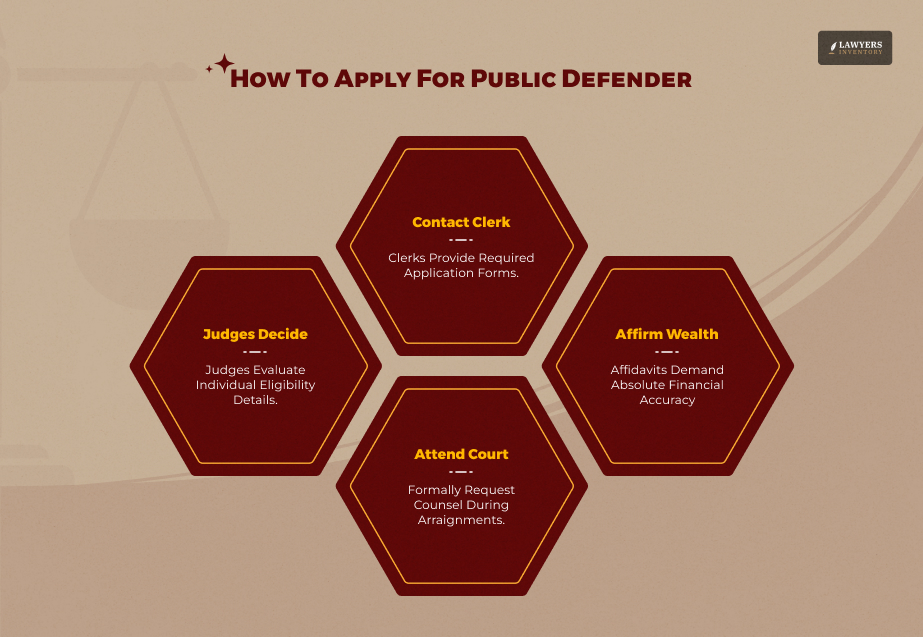
The application process varies by jurisdiction. But it follows a consistent general sequence across most states and counties.
Step One: Contact The Court Clerk Before Your Court Date
Most people assume they must wait until arraignment to request a public defender. In many jurisdictions, you can begin the process before your first court appearance. Start by calling the court clerk’s office as soon as charges are filed, or you receive notice to appear.
Clerks handle these requests routinely and can tell you exactly what forms are required locally, whether you can apply online or must appear in person, and what documentation to bring.
Acting before your court date has practical advantages. It gives the public defender’s office time to begin reviewing your case before arraignment.
It reduces the chance that you stand before a judge without counsel already assigned. And it demonstrates to the court that you are taking your case seriously.
Step Two: Complete The Financial Affidavit
The core application document is a financial affidavit – a sworn statement of your income, assets, expenses, debts, and household composition.
The form goes by different names in different jurisdictions. Maryland uses Form DC-099. Other states have equivalent forms available through the court clerk’s office or the court’s online portal.
The affidavit is a legal document signed under penalty of perjury. Every figure must be accurate. Courts verify the information you provide.
Judges or court employees may ask you questions about your finances at arraignment, request supporting documentation, or conduct independent verification through tax records, bank records, or public assistance databases.
Financial affidavits are generally confidential. Under federal court procedures and most state systems, they are filed under seal and do not become part of the public case record.
Gather the following before completing the affidavit: recent pay stubs or documentation of all income sources, bank account statements, documentation of monthly expenses including the following:
- Rent or mortgage.
- Utilities and childcare.
- Any public assistance award letters.
- Documentation of outstanding debts.
Step Three: Request Counsel At Arraignment
Whether or not you have already applied before your court date, you must formally request appointed counsel at your arraignment – your first court appearance.
State clearly and directly to the judge that you cannot afford an attorney and are requesting appointment of a public defender.
If you are in custody following arrest, request a public defender at your first opportunity. Detention facilities typically have procedures for inmates to submit written requests.
Do not wait for the arraignment if you are incarcerated – contact the jail staff about the application process immediately.
Step Four: The Court’s Indigency Determination
The judge evaluates your financial affidavit and any supporting information provided. The determination happens at or shortly after arraignment in most jurisdictions.
If approved, the court issues a formal order appointing the public defender’s office to represent you. The public defender’s office then conducts an intake interview and assigns a specific attorney to your case.
If you are denied – a decision the court can make if it finds you can afford private representation – the judge will inform you of that determination. Denial is not necessarily final.
What Happens If You Are Denied
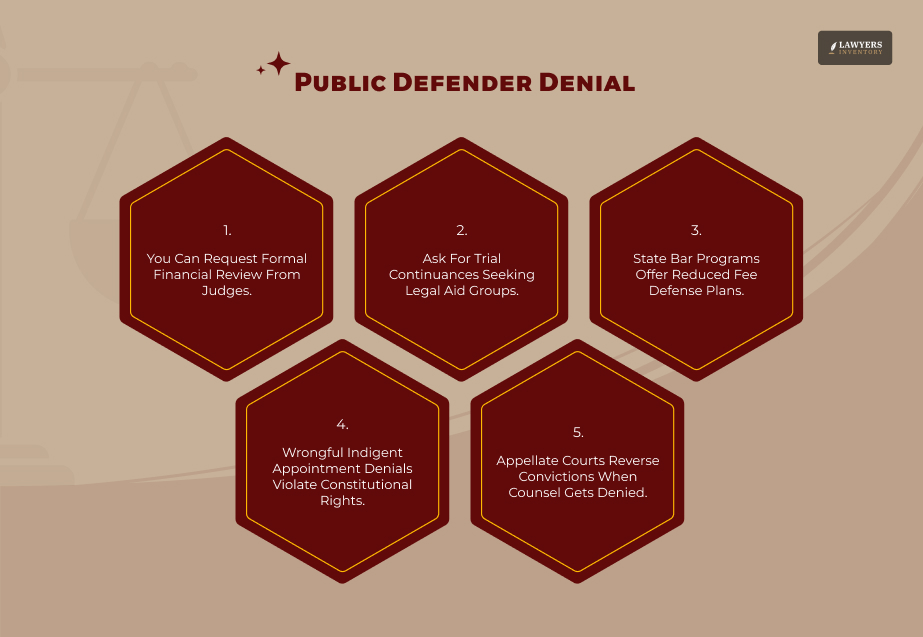
This is something that most people skip entirely. Denial of a public defender appointment does not mean you are without options – and understanding those options matters.
You can request reconsideration at the same hearing or at a subsequent appearance if your financial situation changes.
If your circumstances genuinely deteriorate between arraignment and trial – a job loss, a significant expense, a change in household income – report that change to the court and request a reassessment. Courts can revisit indigency determinations when circumstances change.
If you are denied and genuinely cannot afford a private attorney, you can also ask the court to continue your case while you apply for legal aid from nonprofit organizations in your area.
The Legal Services Corporation funds civil legal aid programs across every state and territory. Many state bar associations maintain lawyer referral services that include reduced-fee criminal defense options.
If you believe the denial was erroneous, you can raise the issue at subsequent hearings or – if ultimately convicted – challenge the denial on appeal as a violation of your Sixth Amendment rights.
A wrongful denial of appointed counsel that resulted in prejudice to your defense can constitute reversible error.
Protecting Your Appointment: What Can Revoke It
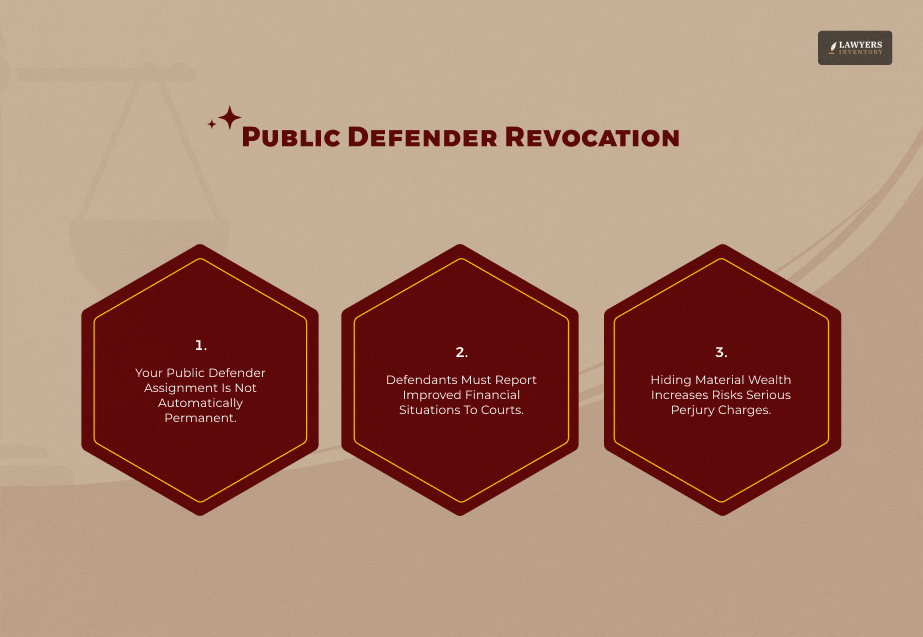
Just because you know how to get a public defender does not make things easy for you. That’s because once appointed, your public defender assignment is not automatically permanent.
Courts can revoke an appointment if they discover that your financial situation was materially different from what you disclosed, or if your finances improve significantly during the pendency of the case.
If your financial situation genuinely changes after appointment – you receive an inheritance, start a new job with significantly higher income, or otherwise acquire resources – you have an obligation to report that change to the court.
Staying silent about a material improvement in your finances risks perjury charges based on your original affidavit and revocation of your appointment at the worst possible moment – in the middle of active proceedings.
Honest disclosure protects both your right to counsel and your credibility before the judge managing your case. Courts treat proactive disclosure very differently from discovered concealment.
What To Realistically Expect From A Public Defender
Public defenders are licensed attorneys who have passed the bar exam. They have a massive amount of criminal courtroom experience.
In fact, they often handle more criminal cases than private attorneys who split their time across different practice areas. [Source: American Bar Association]
However, severe systemic underfunding hurts their offices. This lack of resources causes heavy workloads and leads to employee burnout.
Historically, traditional guidelines recommended capping annual workloads at 150 felonies or 400 misdemeanors. In reality, modern workloads frequently shatter these traditional limits. [Source: Reuters]
For example, some jurisdictions previously pushed these boundaries to 250 felonies and 500 minor offenses. This heavy case volume restricts the amount of time an attorney can spend investigating a crime scene. It also limits their ability to meet and communicate with their clients before trial.
Fortunately, you can still maximize your legal representation by taking an active role in your defense.
First, you must respond quickly to any legal request or message your lawyer sends you. Second, you should provide your attorney with a well-thought-out, written account of your case timeline.
Sometimes, the attorney-client relationship breaks down completely. If you and your lawyer cannot communicate at all, you hold the legal right to ask the court for a new public defender.
However, this change is never automatic. A judge must formally evaluate your situation and sanction the substitution during a special hearing.
Disclaimer: This article is for general informational and educational purposes only. It does not constitute legal advice. Public defender eligibility rules, financial thresholds, and application procedures vary significantly by state and county. If you are facing criminal charges, request appointed counsel at your first court appearance and contact your local court clerk's office immediately.
Sources:
- U.S. Constitution, Amendment VI – Right to Counsel
- Gideon v. Wainwright, 372 U.S. 335 (1963) – Right to appointed counsel in state criminal proceedings
- Argersinger v. Hamlin, 407 U.S. 25 (1972) – Right to appointed counsel for any offense carrying possible imprisonment
- FindLaw – How to Request a Public Defender in Your Criminal Case (updated July 7, 2026) – findlaw.com
- LegalClarity – How to Qualify for a Public Defender (May 2026) – legalclarity.org/how-to-qualify-for-a-public-defender
- LegalClarity – Public Defender System: How It Works and Who Qualifies (May 2026) – legalclarity.org
- Criminal Defense Lawyer – Getting a Free Public Defender in Criminal Cases – criminaldefenselawyer.com
- Scheuerman Law – How to Get a Public Defender (June 2026) – scheuermanlaw.com
- Maryland Courts – How to Apply for Eligibility for the Public Defender – mdcourts.gov/district/pdinfo
- Florida Rules of Criminal Procedure, Rule 3.111 – Indigency Definition – floridabar.org
- Texas Code of Criminal Procedure, Art. 26.04 – Indigency Factors – statutes.capitol.texas.gov
- Minnesota Statutes § 611.17 – Presumption of Indigency – revisor.mn.gov
- Department of Health and Human Services – 2026 Federal Poverty Guidelines – aspe.hhs.gov
- Congressional Research Service – U.S. Immigration Courts: Access to Counsel in Removal Proceedings – congress.gov
- American Bar Association – Workload Standards for Public Defenders – americanbar.org
- Legal Services Corporation – Find Legal Aid – lsc.gov
Leave A Reply







When Schaumburg Business Owners Should Hire Litigation Attorneys
Read More

Delayed Accident Symptoms: Protecting Your Health And Your Personal Injury Claim
Read More
Injured At Sea? The Essential Framework For Choosing A Qualified Maritime Attorney
Read More

0 Reply
No comments yet.