Summarize using AI





Prompt copied. Paste it into Gemini.
Quick Answer

A banking law firm provides critical legal counsel to financial institutions, corporate borrowers, and fintech companies. These specialized firms navigate complex federal regulations from the FDIC, OCC, and Federal Reserve. They actively manage corporate compliance, structure high-stakes commercial loans, orchestrate financial mergers and acquisitions (M&A), and defend institutions against regulatory enforcement actions.
The global financial system operates within a rigid grid. Federal statutes, international treaties, and aggressive oversight bodies dictate the rules. A banking law firm provides the vital operational framework for this system.
They ensure that financial institutions, commercial lenders, corporate borrowers, and fintech innovators operate securely. They protect these entities during high-stakes transactions.
For institutions managing massive capital, a banking law firm is not just a safety net. It serves as a core strategic partner.
These firms maintain compliance, structure complex debt instruments, and insulate corporate entities from regulatory exposure.
Core Practice Areas Of An Elite Banking Law Firm
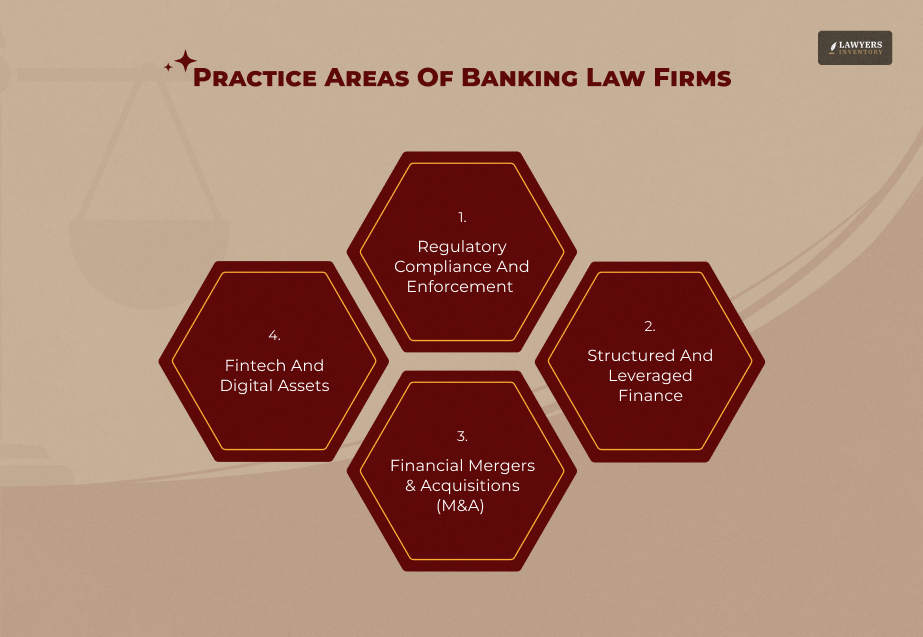
Banking and finance law has distinct layers. Top-tier law firms divide their banking practices into four critical operational pillars to manage institutional risk.
1. Regulatory Compliance And Enforcement
A complex web of agencies governs financial entities. These include the following:
- Federal Reserve Board (FRB).
- Office of the Comptroller of the Currency (OCC).
- Federal Deposit Insurance Corporation (FDIC).
- Consumer Financial Protection Bureau (CFPB).
Banking law firms advise clients on systemic structural mandates. These mandates include:
- Dodd-Frank Wall Street Reform Act structural compliance.
- Anti-Money Laundering (AML) and Bank Secrecy Act (BSA) protocols.
- Representation during federal audits, administrative subpoenas, and multi-agency enforcement actions.
Attorneys build internal compliance matrices for banks. They monitor everyday operations. They also defend institutions when regulators allege compliance violations.
2. Structured And Leveraged Finance
Corporations frequently require massive liquidity for capital expenditures, cross-border expansions, or corporate buyouts. A banking law firm structures the underlying financial vehicles to meet these needs.
Attorneys negotiate, draft, and close high-stakes agreements. These agreements involve:
- Syndicated loans.
- Asset-based lending (ABL).
- Asset-backed securitizations (ABS).
- High-yield debt offerings.
Lawyers balance the risk between the credit provider and the corporate borrower. They ensure the debt vehicle protects the client’s liquid assets.
3. Financial Mergers & Acquisitions (M&A)
Bank consolidations bring unique regulatory hurdles. Standard corporate acquisitions do not face these challenges. Elite firms orchestrate bank mergers from start to finish.
Lawyers handle both the corporate transaction mechanics and the necessary approvals. They secure these approvals from federal antitrust divisions and banking regulators.
Attorneys manage the due diligence process. They review loan portfolios and assess the target bank’s compliance history before execution.
Read Also: Top M&A Law Firms You MUST Know About!
4. Fintech And Digital Assets
Blockchain technology, decentralized finance (DeFi), and mobile payment architecture disrupt traditional banking. Specialized legal teams design modern operational frameworks to address these shifts.
They ensure digital transactions comply with evolving electronic fund transfer laws. They also protect clients from data privacy mandates and rigorous cybersecurity standards.
Fintech lawyers draft user agreements and structure peer-to-peer lending systems. They keep technology startups compliant with federal banking definitions.
The Premier Banking Law Firms In The United States
Multi-billion dollar transactions and systemic regulatory crises require elite representation. The financial sector relies on a select tier of law firms during these high-stakes moments.
Chambers & Partners and Legal 500 consistently recognize these institutions for their market-leading banking practices.
| Law Firm | Primary Strategic Strength | Notable Institutional Focus |
| Sullivan & Cromwell LLP | Bank Regulatory and Systemic Crises | Advises major central banks and global investment giants during market upheavals. |
| Davis Polk & Wardwell LLP | Capital Markets and Compliance | Guides tier-one financial institutions through continuous capital market transactions. |
| Wachtell, Lipton, Rosen & Katz | High-Stakes Financial M&A | Dominates complex corporate takeovers and bank consolidations. |
| Cleary Gottlieb Steen & Hamilton LLP | Cross-Border and Sovereign Finance | Leads international restructuring and cross-border regulatory compliance. |
| Skadden, Arps, Slate, Meagher & Flom LLP | Financial Litigation and Restructuring | Handles both massive leveraged finance and aggressive financial litigation. |
| Simpson Thacher & Bartlett LLP | Private Equity and Syndicated Lending | Counsels mega-cap private equity sponsors structuring massive debt financing. |
Macro-Regulatory Pressures Driving Banking Law
A modern banking law firm operates in a highly dynamic environment. The shifting regulatory landscape requires elite counsel to pivot rapidly. They must track every update from federal watchdogs.
The Corporate Transparency Act (CTA) Compliance Pivot
A massive operational shift recently changed reporting standards.
The U.S. Department of the Treasury’s Financial Crimes Enforcement Network – FinCEN finalized its rule permanently rolling back beneficial ownership information (BOI) reporting requirements under the Corporate Transparency Act (CTA).
The final rule permanently removes the requirement for U.S. companies and U.S. persons to report BOI database metrics.
Consequently, banking law firms are aggressively re-engineering Customer Due Diligence (CDD) workflows. Domestic federal registry cross-checks no longer exist.
However, banking lawyers must still ensure financial institutions independently satisfy core Know Your Customer (KYC) requirements.
They use legacy anti-money laundering (AML) laws to build these compliance structures. Lawyers protect banks from penalty exposure during this transition phase.
The Basel III Endgame Calibration
Capital adequacy guidelines are undergoing highly volatile changes. Federal banking agencies issued a revised Basel III Endgame package of proposed changes to regulatory capital requirements. This overhaul followed extensive industry pushback. [Source: Federal Reserve System]
The re-proposal drastically lightens the heaviest capital requirement burdens. It focuses primarily on Global Systemically Important Banks (G-SIBs) and Category I and II institutions. Regulatory counsel actively helps these institutions transition to a simplified, risk-based capital framework.
This framework preserves traditional commercial lending economics. Attorneys redesign stress-testing models for regional banks to lower their compliance costs.
Crisis Management And Bank Receiverships
Recent regional banking vulnerabilities turned crisis management into a permanent staple of tier-one banking practices. High-stakes restructuring and receivership advice protect financial assets during market downturns.
Top-tier firms act as primary emergency counsel during sudden liquidity crises, structured asset offloads, and FDIC receiverships. They ensure systemic isolation.
They minimize disruption to the broader capital markets. Lawyers draft emergency liquidity agreements and negotiate asset purchases under tight federal deadlines.
Selecting A Banking Law Firm: Institutional Considerations
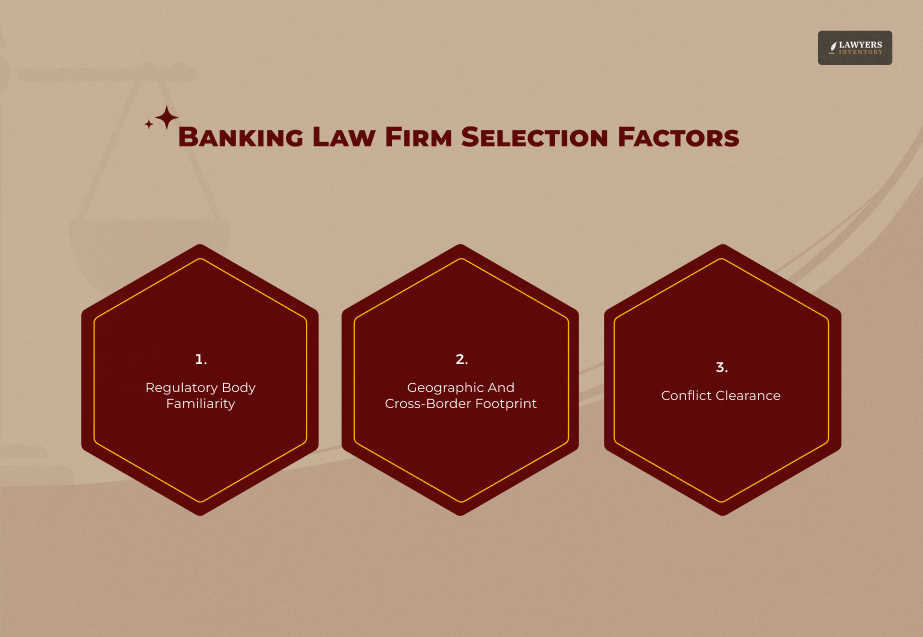
Scale and the specific legal mandate dictate your choice of counsel in the banking sector. Institutional clients must evaluate firms using specific parameters:
Regulatory Body Familiarity:
Confirm the firm possesses a deep, proven track record. They must negotiate directly with the specific regulators overseeing your immediate compliance matter. These regulators include the OCC, SEC, or FDIC.
Geographic And Cross-Border Footprint:
International transactions require global reach. Verify the firm has local law capabilities and established offices across critical global financial hubs. These hubs include New York, London, Frankfurt, and Hong Kong.
Conflict Clearance:
The banking sector features extreme concentration. Large financial institutions must verify that a prospective firm does not represent an adverse party. They check ongoing structured credit facilities and debt syndications for conflicts.
Leave A Reply







When, Why, And How To Hire A California Personal Injury Attorney?
Read More
Understanding Fee Structures: Do Personal Injury Lawyers Work On Contingency?
Read More
How To Choose A Product Liability Lawyer In NYC: A Defective Product Legal Guide
Read More
When To Hire A Civil Suit Lawyer: A Complete Guide To Non-Criminal Lawsuits
Read More
Delayed Accident Symptoms: Protecting Your Health And Your Personal Injury Claim
Read More
0 Reply
No comments yet.