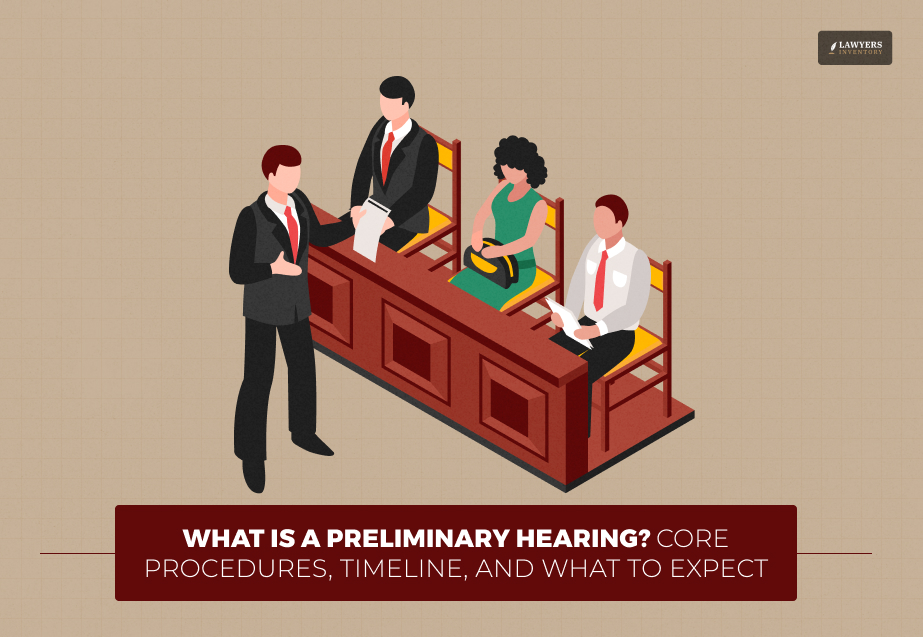
Quick Answer: What Is A Preliminary Hearing?

A preliminary hearing is the only court proceeding that occurs before a trial. A judge presides over this session alone. The judge decides if the evidence against the accused is sufficient. If it is, the prosecution can continue by filing formal charges. To proceed, the state must produce enough proof. This proof must establish probable cause. Specifically, it must show that a crime occurred and that the defendant committed it. However, outcomes depend entirely on the evidence. If the court is not satisfied, the judge will dismiss the matter immediately.
The legal system relies on filters to stop weak cases. Therefore, the preliminary hearing serves as a vital early filter in the judicial process.
Legal professionals often describe this proceeding as a “trial before the trial.” Essentially, it forces the initiating party to show a basic foundation in fact and law before moving forward.
Understanding this procedure helps individuals navigate the complex transition from an arrest to a final trial. However, the rules governing evidence, timelines, and outcomes vary significantly. This variance depends entirely on the specific courtroom context.
The Pre-Trial Criminal Progression
- Arraignment: First, the court reads the charges to the defendant. Then, the defense enters an initial plea.
- Preliminary Hearing: Next, the court evaluates the prosecution’s evidence. The goal is to determine if enough probable cause exists to advance the case.
- Criminal Trial: Finally, both sides present their full cases to a jury or judge. This stage determines ultimate guilt or innocence.
What Is A Preliminary Hearing: Criminal, Civil, And Family Courts
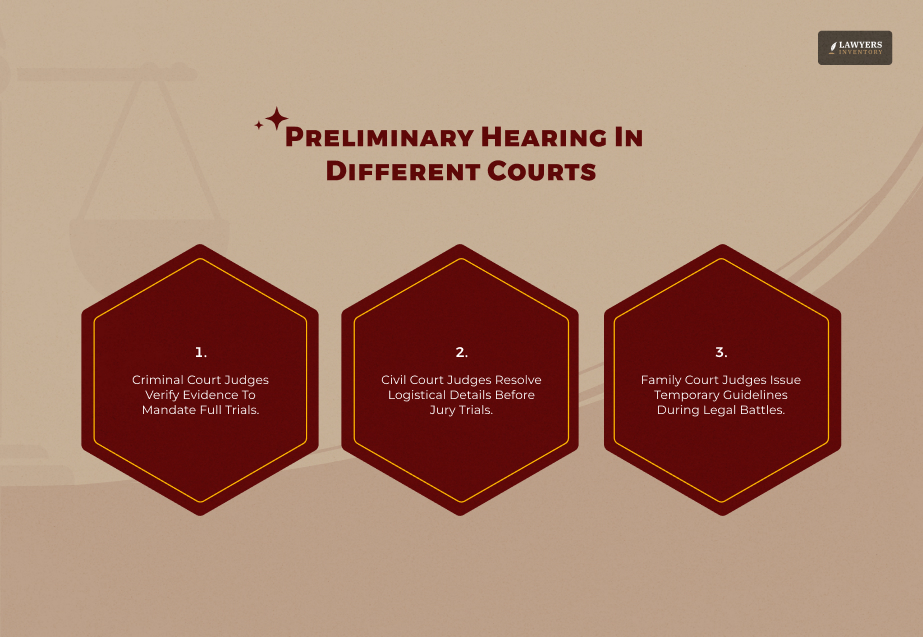
Different kinds of courts define a “preliminary hearing” differently. However, the major aim across all courts remains the same. The proceeding assesses whether a legal action is warranted before trial.
Criminal trials and civil lawsuits differ significantly. They use different standards of proof and case handling methods. Litigants must consider these factors before deciding on a course of action.
Understanding these procedural differences allows individuals to make effective legal moves. Clear planning saves both time and money.
Therefore, litigants should understand how these tools vary by situation. For example, constitutional rights to personal freedom require unique frameworks.
These frameworks differ from the rules governing property rights. They also differ from family court systems determining child custody disputes.
What Is A Preliminary Hearing In Criminal Court?
In criminal matters, this hearing is an adversarial proceeding. During the session, a judge decides if the prosecution has enough evidence to force a trial.
Specifically, the government must demonstrate probable cause. This means a reasonable belief exists that a crime occurred and that the defendant committed it.
According to the Legal Information Institute (LII) at Cornell Law School, the prosecution presents physical evidence, documents, and witness testimony to meet this standard.
The defense can cross-examine the witness and challenge the evidence. But in fact, they generally do not call their own witness or put their evidence here.
This decision to keep one’s cards in hand is usually a part of a defensive strategy to prevent the disclosure of defense methods to which the prosecution will be able to respond at a later date.
What Is A Preliminary Hearing In Civil Court?
In civil court, a preliminary hearing does not address crimes or prison sentences. Instead, it focuses on managing the logistics of a lawsuit before it reaches a jury. For example, judges use these conferences to establish strict deadlines for discovery.
Furthermore, these hearings settle disputes over document disclosures and narrow down specific legal issues. In some civil matters, a preliminary hearing addresses requests for immediate, temporary relief.
Thus, a judge might hold a hearing to decide whether to issue a temporary injunction. This action halts a specific behavior while the broader lawsuit winds through the system.
What Is A Preliminary Hearing In Family Court?
Family law structures use preliminary hearings to establish immediate boundaries during volatile transitions. These situations often involve divorce or child custody battles.
Because final trial dates can take months to secure, families require temporary rules to govern their daily lives in the interim.
Therefore, a family court judge reviews initial declarations during these sessions. Consequently, the judge issues temporary orders for child support, alimony, and visitation schedules.
These temporary orders remain legally binding until a final settlement is reached or a formal trial concludes.
Felonies, Jails, And Post-Hearing Realities
Apart from serving as a constitutional requirement, the criminal justice system also uses the preliminary hearing as a means to guarantee citizens’ rights
An accused person who appears in such a proceeding will have that moment as the first time a neutral judicial figure will be looking at the government’s case.
These hearings are such high-risk situations that they could be turned into completely different criminal cases in case of a wrong defense or a misrepresentation of the nature of the proceeding.
What Happens At A Preliminary Hearing For A Felony?
Felonies come with the harshest consequences for years afterward. That’s why the first phase before the court is such an important one.
If the charge is a felony, the judge will usually first hold a preliminary hearing, and the prosecutor will summarize the prosecution’s case and evidence in just a few minutes, mostly through the statement of the police officer who detained the defendant.
As documented by the Faber Law Firm, the rules of evidence are more relaxed during these proceedings. For example, the court permits hearsay evidence that would be strictly forbidden during a final trial.
Specifically, an investigator can testify about what an absent witness said at the scene. Because the burden of proof is low and the rules are permissive, courts bind over the vast majority of felony cases.
| Feature | Preliminary Hearing | Criminal Trial |
| Primary Purpose | Determine if probable cause exists to proceed. | Determine ultimate guilt or innocence. |
| Deciding Body | Presided over by a judge alone; no jury present. | Decided by a jury of peers or a bench judge. |
| Standard of Proof | Probable cause (a lower legal threshold). | Beyond a reasonable doubt (the highest standard). |
| Hearsay Rules | Often relaxed; hearsay is allowed in many areas. | Strictly prohibited, with very narrow exceptions. |
Can You Go To Jail At A Preliminary Hearing?
A defendant cannot receive a conviction or a prison sentence at a preliminary hearing. This is because the court is not deciding ultimate guilt. However, an individual can absolutely be taken into custody or sent back to jail during this proceeding.
For instance, if a defendant was released on bail after their initial arraignment, the judge reviews those bond conditions.
If the prosecution proves probable cause for a violent felony, or if the defendant violated release terms, the court can revoke bail. Consequently, the judge remands the defendant directly into custody to await trial.
What Happens After A Preliminary Hearing?
The next procedural step depends entirely on the judge’s ruling at the end of the hearing.
- If Probable Cause is Found: The judge binds the case over to the trial court division. Then, the prosecutor files an official charging document called an Information. This triggers a secondary arraignment where the defendant enters a formal trial plea.
- If Evidence is Insufficient: The judge dismisses the charges. Consequently, the court orders the immediate release of the defendant.
Crucially, a dismissal does not trigger double jeopardy protections.
As noted by Cox & Associates, PA, the prosecution can re-file the exact same charges later if they uncover better evidence. Alternatively, they can choose to bypass the hearing entirely by seeking a grand jury indictment.
Duration, Delays, And The Strategic Timeline In Preliminary Hearing
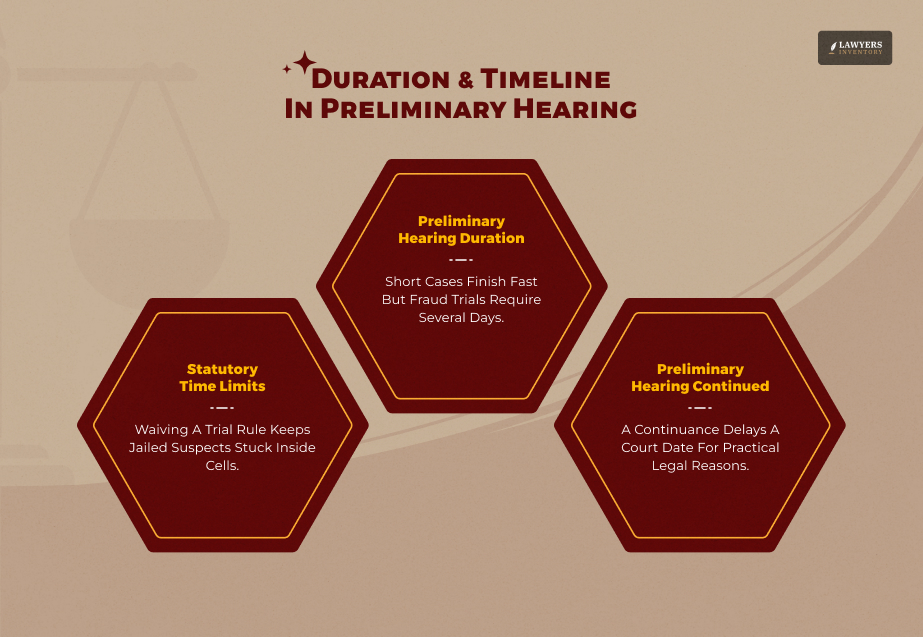
The timing of a preliminary hearing is closely tied to constitutional rights regarding a speedy trial. Therefore, legal strategies center on timeline manipulation.
Defense attorneys must decide whether to force a swift hearing to expose weak evidence or delay the proceeding to gain more time for discovery.
Ultimately, every choice regarding the courtroom timeline carries distinct advantages and long-term legal risks.
How Long Is A Preliminary Hearing?
Predicting the exact duration of a preliminary hearing is highly difficult. The absolute length of the proceeding depends entirely on the complexity of the criminal case and the volume of evidence involved.
For a straightforward case, such as a single-transaction drug felony, the entire hearing usually concludes within 30 to 45 minutes. In these simple scenarios, the prosecutor generally only needs to call one or two law enforcement witnesses to establish the charges.
Conversely, a complex case involving multi-defendant corporate fraud can easily last for several days. Ultimately, the prosecutor will produce only the minimum amount of evidence required to satisfy the judge that probable cause exists.
What Is A Preliminary Hearing Continued?
When a court record marks a case as a “continued preliminary hearing,” it signifies a formal postponement of the proceeding. A continuance simply reschedules the hearing date to a different time or location.
Courts grant these delay requests for several practical reasons. For example, a critical witness might fall ill, or a state forensic lab might fail to return drug sample analysis in time for the court date.
Furthermore, a newly hired defense attorney frequently requires a continuance to gain sufficient time to review the evidence files provided by the prosecutor.
Statutory Time Limits And Continuances
While continuances are very common, courts must balance them strictly against your statutory right to a speedy trial.
Under Missouri Supreme Court Rule 22.09, if a defendant cannot post bond and remains in jail, the court must hold a preliminary hearing within 30 days of their initial appearance. If the defendant is out of custody, the deadline extends to 60 days.
Crucially, if the defense requests a continuance to gather evidence or prepare their strategy, the defendant legally waives their strict 30-day statutory time limit.
As a direct result, a defendant who remains in custody can look forward to spending significantly more time in jail while waiting for their trial date. [Source: Avvo]
Leave A Reply







What Is Grand Larceny? Felony Thresholds, Penalties, And Your Legal Options
Read More
Larceny vs. Theft: What’s The Real Legal Difference?
Read More
Is AI Ruining Your Legal Case? How To Detect And Correct Fabricated Law
Read More
Can You Get A DUI On A Bike? How Vehicle Codes Impact Impaired Cycling
Read More
Reasonable Suspicion vs. Probable Cause Explained: The Fourth Amendment Standards That Determine Your Rights
Read More
0 Reply
No comments yet.