
Summarize using AI





Prompt copied. Paste it into Gemini.
Listen to this article
Quick Answer

A bench warrant is a judge's order that authorizes the arrest of a specific person. This happens if you miss court, fail to pay a fine, and/or ignore a formal summons. You can clear a warrant without going to jail. The safest method is hiring a criminal defense lawyer immediately. Your attorney can file a "Motion to Quash." They can schedule a voluntary court appearance. This allows you to resolve the matter quietly. You can handle it at your convenience.
Discovering an active arrest warrant is terrifying. Missing a court date by mistake causes this. Failing to pay court fines also causes this. You face a serious legal problem. A judge can issue a warrant instantly.
Many people falsely believe a bench warrant is a minor issue. In reality, it is a powerful legal document. It authorizes police officers to arrest you immediately. Officers can handcuff you anywhere. They can arrest you at a traffic stop, your workplace, or your home.
Navigating the legal system alone is overwhelming and stressful. Fortunately, you can take preventative steps. You can resolve this issue safely.
What Is A Bench Warrant?
A bench warrant is a legal order issued directly by a judge authorizing law enforcement officers to arrest an individual. It is typically issued when a person violates a court rule or fails to comply with a judicial order, such as:
- Failing to appear for a scheduled criminal court date or civil hearing.
- Failing to pay court-ordered fines, restitution, or child support.
- Ignoring a subpoena to testify as a witness in a legal proceeding.
Unlike a standard arrest warrant, which initiates new criminal charges based on police evidence, a bench warrant enforces compliance with an existing court process.
The term originates from the historical structure of legal systems. The “bench” refers to the physical desk where a judge sits in the courtroom. When a party skips a court appearance or violates a judicial order, the judge issues the arrest mandate directly from that bench.
The Legal Information Institute (LII) defines a bench warrant as a document issued by the court itself for the detainment or arrest of a person. This order can arise in either criminal or civil court proceedings. It applies heavily to cases involving contempt of court or when a criminal defendant violates their bail conditions.
Bench Warrant vs. Arrest Warrant: Key Differences
While both warrants grant police officers the authority to detain you, they serve entirely different legal purposes. Understanding these distinctions helps you take the correct legal actions.
1. Origin And Initiation
Police officers initiate standard arrest warrants. They present evidence to a judge to prove probable cause that you committed a crime outside the courtroom.
The judge signs the warrant based on this police report. A bench warrant originates from the judge alone. It requires no police investigation because the violation occurs against the court administration itself.
2. Type Of Crime Violation
An arrest warrant targets suspected criminal activity. Examples include:
- Theft.
- Assault.
- Fraud.
A judge issues a bench warrant for violating court rules. Examples include missing a trial, skipping community service, or neglecting child support payments.
3. Range Of Jurisdiction
Police actively track and capture individuals with arrest warrants. Detective units may even locate you at your home or frequent locations.
A bench warrant rarely triggers an active police search. This only changes if the underlying offense involves a violent felony.
Generally, the warrant sits quietly in the law enforcement database. Police usually discover it and arrest you during a routine traffic stop.
| Criteria | Bench Warrant | Arrest Warrant |
| Primary Purpose | Enforces compliance with court orders | Apprehends individuals suspected of new crimes |
| Issued By | A judge, directly during court proceedings | A judge, based on a law enforcement affidavit |
| Violation Type | Non-compliance (e.g., missed dates, unpaid fines) | Probable cause of criminal activity |
| System Focus | Judicial process management | Criminal justice system enforcement |
What Happens When A Judge Issues A Bench Warrant?
Once a judge signs a bench warrant, it remains active indefinitely. It does not have an expiration date. It stays open until you die, appear in court, or an attorney successfully quashes it. If you ignore it, the legal and personal consequences escalate rapidly.
Immediate Risk Of Arrest
The warrant enters the National Crime Information Center (NCIC) database. Any police officer in the country can see the active warrant during a routine interaction.
If an officer pulls you over for a broken taillight, they will run your driver’s license. The database flags the warrant, and the officer must place you in handcuffs immediately.
Suspension Of Driver’s License
In many jurisdictions, the Department of Motor Vehicles (DMV) automatically suspends your driving privileges. They take this administrative action once they learn about your active bench warrant.
Operating a motor vehicle with a suspended license constitutes a separate criminal offense. Consequently, this new charge complicates your legal situation significantly.
Additional Criminal Charges
Apart from triggering a warrant, your failure to attend court constitutes a standalone crime. A court classifies a Failure to Appear (FTA) charge as either a misdemeanor or a felony. State legislation and the severity of your original offense determine this classification.
Finally, the court attaches this new criminal accusation directly as an addendum to your existing case history.
Financial Penalties And Bail Adjustments
Judges view missing court as a flight risk. If you previously posted bail, the court may forfeit that money entirely. When you finally appear before the judge, they will likely raise your bail amount significantly or hold you without bond.
How Long Do You Stay In Jail For A Bench Warrant?
Three main factors determine the length of your jail sentence. These include:
- Your personal reaction.
- Your initial criminal charge.
- The judge’s final ruling.
For minor crimes like an unpaid traffic ticket, the jail holds you temporarily. The facility keeps you in custody only until the issuing judge returns to court. This custody period can range from a few short hours to an entire weekend. [Source: FindLaw]
For example, if police arrest you on a Friday night, they will keep you jailed until the judge holds a formal warrant hearing on Monday morning.
Serious misdemeanors or felony crimes result in much longer jail sentences. If you previously fled the court, the judge may deny your bail entirely. This means you must remain in jail until your actual criminal trial begins.
Proactive action completely transforms your legal scenario. Individuals who surrender peacefully alongside a defense lawyer secure much shorter jail stays. In many cases, they completely avoid spending any time in jail.
How To Clear A Bench Warrant Without Going To Jail
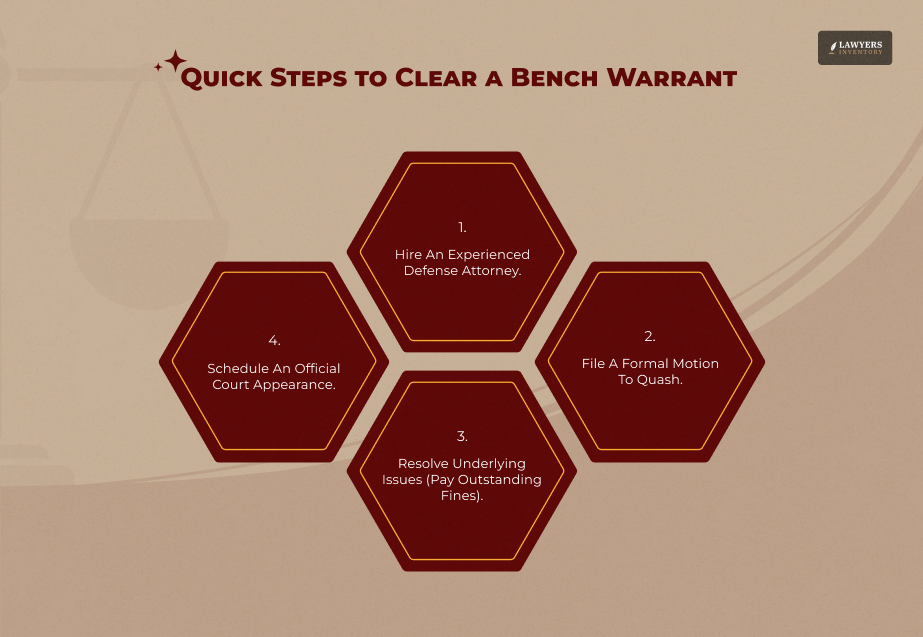
You can successfully remove a bench warrant without entering a jail cell. However, this requires strategic legal action. Ignoring the problem ensures an unpredictable arrest. Taking control of the situation allows you to resolve it on your own terms.
1. Get A Capable Attorney To Act On Your Behalf
Do not go to the courthouse alone. A knowledgeable criminal defense attorney acts as your primary shield. They contact the court clerk directly. They quickly master the details of your situation.
If necessary, they negotiate with the prosecutor or state attorney. This level of formal representation proves to the judge that you take the matter seriously. [Source: LawRato]
2. Prepare To File The Motion To Quash
Your attorney will file a Motion to Quash. This formal legal demand asks the judge to cancel, invalidate, or withdraw your open warrant.
For minor offenses or simple paperwork mistakes, the court may approve this motion immediately. The judge can completely eliminate the threat of jail without requiring your physical presence in court. [Source: Supreme Today AI]
3. Attend Court On Your Own
The court may still demand your physical appearance to dismiss the warrant.
If so, your attorney will arrange a specific date and time for your hearing. Walking into court voluntarily transforms your legal status.
You change from a wanted fugitive on the run into a responsible citizen obeying the law. Judges rarely penalise peaceful, self-surrendering individuals with immediate jail sentences.
4. Deal With The Root Cause Of The Warrant Early On
Address the core issue behind your warrant immediately. If the warrant stems from unpaid court fines or child support, pay as much as possible before your court date. [Source: Avvo]
If you cannot pay the full amount, your attorney will negotiate a legal payment plan. Presenting documented proof of financial responsibility or completed community service gives the judge less reason to hand down a harsh sentence.
Choosing The Right Attorney For Your Case
The specific nature of your underlying legal issue dictates the type of lawyer you need to hire. Aligning your case with the correct specialist ensures the best defense strategy.
Criminal Defense Attorneys:
Retain a defense lawyer if your warrant involves criminal charges, drug offenses, theft, or serious traffic violations like DUIs. They know local court procedures and specialize in reducing bond amounts.
Family Law Attorneys:
If your bench warrant stems from missed child support payments, child custody disputes, or violating domestic restraining orders, hire a family law practitioner. They understand the specific civil contempt laws governing family courts.
Tax Attorneys:
If you face a warrant for ignoring court subpoenas regarding unpaid state or federal taxes, consult a tax attorney. They negotiate directly with financial authorities to settle your debts.
Act Now To Protect Your Freedom
You cannot simply ignore or forget a bench warrant. It never expires automatically. Living under the constant threat of a surprise arrest creates extreme stress.
An unexpected arrest can cost you your job. It places a massive strain on your family. It also severely damages your personal and professional reputation.
Take control of the situation to ensure a positive outcome.
- First, hire a skilled criminal defense attorney.
- Next, have your lawyer file a Motion to Quash
- Finally, contact the judge to schedule a voluntary court appearance.
This proactive strategy significantly reduces your chances of going to jail. Do not leave this legal issue unresolved. Act today to change your life for the better.
Leave A Reply






Do You Pay Taxes On Lawsuit Settlements? IRC Section 104 Explained
Read More
Non-Disparagement Clause Explained: Requirements, Enforceability, And What Changed Recently
Read More
Best Practices For Successful Trademark Registration
Read More
Understanding Your Rights: A Guide To The Legal Process
Read More
Is It Negligence Or Malpractice? How Courts Define Carelessness And Professional Misconduct
Read More
0 Reply
No comments yet.