Summarize using AI





Prompt copied. Paste it into Gemini.
Imagine someone takes away an item that belongs to you. You wait a long time to ask for it back.
When you finally inquire, they say, “Sorry, it’s too late.” This simple scenario illustrates exactly how the statute of limitations operates under California civil law.
In a legal framework, the statute of limitations in California establishes a strict deadline for filing a lawsuit in court. If you miss this window, you lose your legal right to pursue financial recovery or justice.
That said, in modern litigation, knowing the written law is only half the battle. Today, plaintiffs must navigate severe, evolving California Court Backlogs. (Source: California Government)
Also, they must contend with rapidly purging digital evidence. Finally, strict institutional traps can destroy a case long before the official clock runs out.
What is a Statute of Limitations?
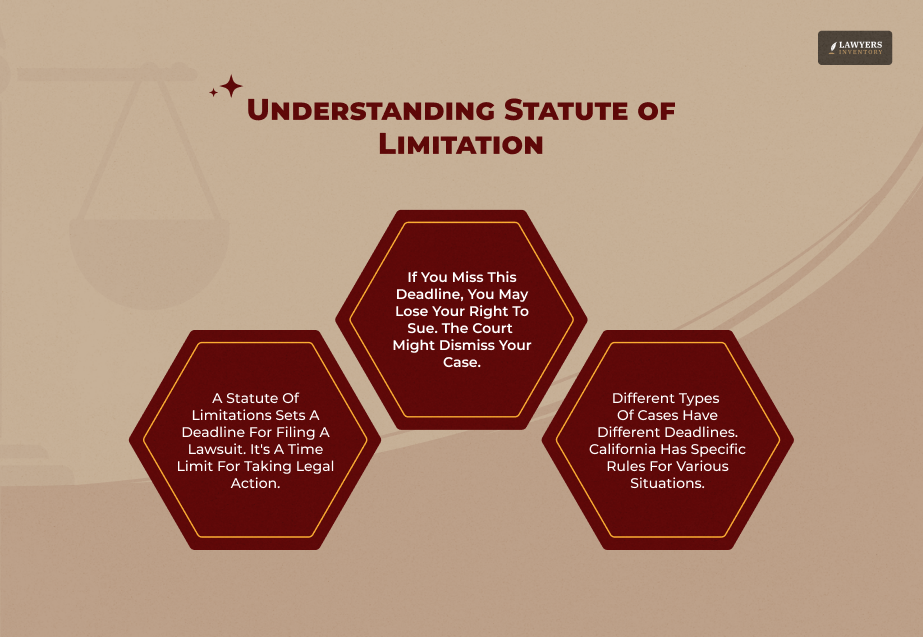
Before talking about the Statute of Limitations in California, let’s briefly mention what it is in the first place.
The statute of limitations functions as a statutory countdown timer for legal action. In many cases, ultimately, the rule maintains institutional fairness within the civil justice system.
Without it, plaintiffs could wait indefinitely to file a lawsuit. Because of this, critical evidence would disappear over time.
Similarly, physical assets would degrade, and witness memories would fade. As a result, enforcing strict limits ensures that parties resolve disputes while reliable evidence is still available. In addition, this rule actively protects defendants from indefinite legal threats.
Core Statute Of Limitations In California
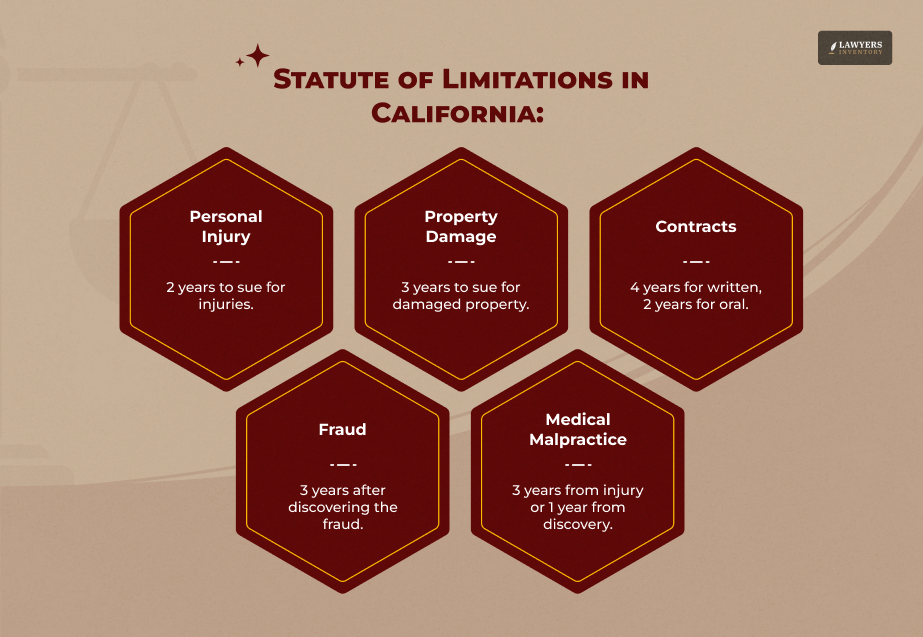
Under the California Code of Civil Procedure (CCP), the legislature assigns unique statutory deadlines to different categories of civil harm.
Because of this, if you miss these exact dates, the trial judge will likely dismiss your case permanently.
| Case Category | Statutory Deadline | Applicable Legal Code |
| Personal Injury | 2 Years from the date of the incident | CCP § 335.1 |
| Property Damage | 3 Years from the date the damage occurred | CCP § 338(b) |
| Breach of Written Contract | 4 Years from the date the contract was broken | CCP § 337 |
| Breach of Oral Contract | 2 Years from the date the agreement was breached | CCP § 339(1) |
| Fraud | 3 Years from the discovery of the fraudulent act | CCP § 338(d) |
| Medical Malpractice | 3 Years from injury OR 1 year from discovery | CCP § 340.5 |
| Debt Collection | 4 Years for accounts or contracts in writing | CCP § 337 |
Modern Legal Realities And Case Laws
The Statute of Limitations in California above dictates when you must file your case. That said, current judicial data shows a massive disconnect between filing a lawsuit and actually resolving it.
Recent California Judicial Branch Reports reveal that metropolitan hubs still grapple with severe, multi-year civil backlogs.
For example, courts in Los Angeles, San Diego, and Alameda counties handle thousands of delayed cases.
Because of this, even if you file a personal injury lawsuit within the legal two-year limit, the court may take an additional 18 to 36 months just to schedule a trial date.
Also, this systemic bottleneck has fundamentally altered corporate defense strategies. Because courts move so slowly, defense attorneys and insurance companies routinely use these delays as leverage.
They know that an injured plaintiff faces years of waiting alongside compounding medical bills. So, corporate insurers use the backlog to pressure victims into settling for a fraction of their claim’s true value.
As a result, waiting until the end of your statutory deadline to file places you at an extreme tactical disadvantage.
The Digital Evidentiary Window: Why The Clock Ticks Faster Online
In the modern era, parties no longer rely primarily on physical paper trails. On the other hand, they use digital assets to prove liability.
Crucial digital evidence includes GPS logs, rideshare app histories, text messages, Slack threads, dashcam footage, and smart-home metadata.
That said, a major trend analyzed by legal tech experts involves the aggressive data-retention policies of private corporations.
For instance, California law gives you two to three years to sue for an accident or property dispute.
Meanwhile, companies like telecom providers, private security firms, and rideshare networks routinely purge un-subpoenaed data after 30 to 90 days.
Because of this, if a plaintiff waits 18 months to initiate a lawsuit, corporate archiving policies may have already overwritten the digital evidence. In addition, recent court changes highlight this struggle.
Under the New California Court Rules, judges closely scrutinize data accuracy, AI integrations, and digital discovery integrity. (Source: Walsworth Law)
This reality creates a secondary, invisible deadline. You legally have years to sue, but you often have just a few weeks to preserve the evidence necessary to win.
Critical Exceptions Of The Statute Of Limitations In California
The statutory countdown does not always run continuously from the exact second an incident occurs.
Instead, California law allows for specific exceptions where courts pause or extend the timeline.
Legal professionals call this process “tolling.” That said, current judicial trends show that judges interpret these exceptions with extreme scrutiny.
1. The Burden Of Proof In Delayed Discovery
The “Discovery Rule” states that if an injury or fraud remains hidden, the clock does not begin until the victim discovers – or reasonably should have discovered – the harm.
For instance, if a medical device fails internally but causes no symptoms for a year, the court may pause the clock.
That said, defense attorneys aggressively fight this rule by filing motions to dismiss, called Demurrers.
Also, the law places a heavy burden of proof on the plaintiff to demonstrate “reasonable diligence.”
If the defense proves that you had even a slight suspicion of harm but failed to investigate, the judge will rule that you should have known. Similarly,. Because of this, the clock will retroactively run out and destroy your case.
2. Minority Status And Temporary Incapacity
If a victim is under the age of 18 when an incident occurs, the law pauses the statutory clock until their 18th birthday. So, the rule gives them until their 20th birthday to file a personal injury claim.
Similarly, courts may toll the timeline if the plaintiff suffers from a severe, legally documented mental illness.
In addition, tolling applies if the plaintiff serves a prison sentence or if the target defendant flees California to evade service.
The 6-Month Municipal Trap: Hidden Government Entities
Perhaps the most devastating trap for everyday consumers involves the California Government Claims Act.
If a civil claim involves a public entity, the standard multi-year deadlines completely vanish. Instead, plaintiffs must file a formal administrative claim within 6 months (180 days) of the incident under the California Government Claims Act.
What makes this a major journalistic concern is how easily public entities hide in plain sight. In many cases, consider these common, real-world scenarios:
- Getting struck by a regional transit bus, such as LA Metro or SFMTA/MUNI.
- Slipping on a cracked public city sidewalk.
- Tripping over hazardous debris in a poorly lit state park.
- Suffering an injury at a public school, county hospital, or community college.
A consumer might assume they have two years to seek legal recourse because they suffered a personal injury.
That said, because a government entity caused the harm, missing the 6-month administrative filing window acts as an absolute hard stop. Also, public agencies standardly reject these initial administrative claims.
After that rejection, the law gives the plaintiff only six months from the date of the rejection letter to file a formal lawsuit in court.
Proactive Steps To Take Before The Clock Runs Out
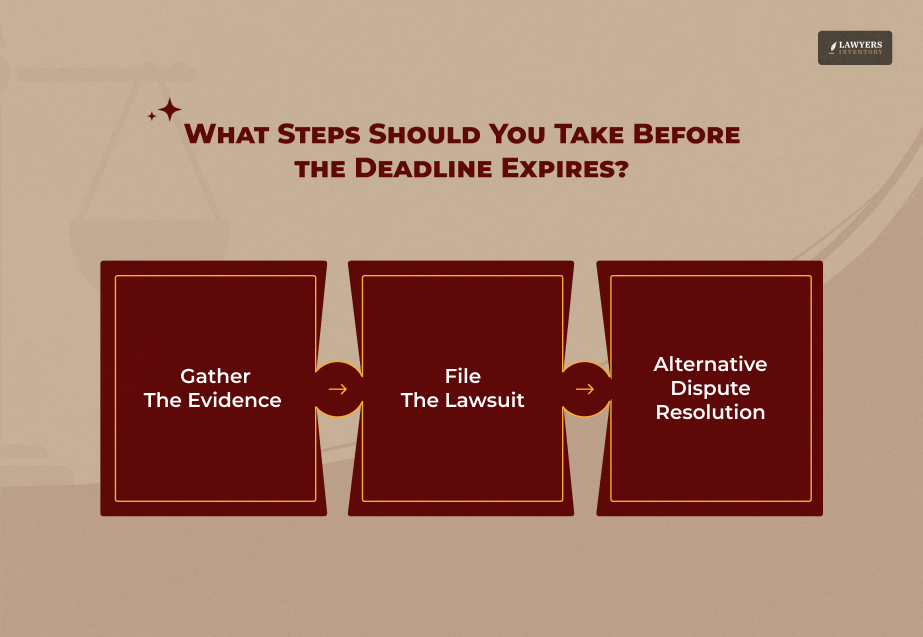
To counter judicial delays and evidence loss, you must build a viable legal case quickly. As a result, you should complete several crucial preparation phases well ahead of your filing deadline:
Issue Formal Spoliation Letters Immediately:
If you cannot file a lawsuit right away, your attorney can issue a formal “Spoliation of Evidence” letter to the opposing party.
This legally warns them that they must preserve all digital logs, video recordings, and internal communications. If they destroy data after this warning, they face severe court sanctions.
Navigate Procedural Filing Requirements:
Filing a civil complaint requires complex documentation. On the other hand, you must precisely draft the complaint, pay state-mandated administrative fees, and choose the correct geographic courthouse jurisdiction.
In addition, you must execute a legally compliant “service of process” to formally notify the defendant.
Evaluate Alternative Dispute Resolution (ADR):
Because of the multi-year backlog of trials in courts nowadays, a lot of modern plaintiffs skip the traditional court process entirely. They instead use structured mediation, where a neutral third party helps them negotiate a compromise.
Or they resort to binding arbitration, where the case is decided by a private arbitrator. In the end, both of these options lead to dispute resolution that is quicker, non-public, and much cheaper.
Missing The Deadline: The Ultimate Consequence
If, by any chance, you decide to bring up the case in court once the time limit set for the purpose has totally elapsed, the lawyer for the defendant is most likely to make a motion seeking the dismissal of the case.
Except in some unlikely circumstances when you manage to convince the court very well through a legal loophole like delayed discovery, your initial complaint will most probably be thrown out by the court with prejudice.
This action definitely prevents you from seeking damages. And you are left with no legal means to recover – no matter how seriously you have been injured.
Disclaimer: The information provided in this article is for general informational purposes only. It does not, and is not intended to, constitute legal advice. Please consult an attorney for legal help.
Read Also:
Leave A Reply






Power Stick Deodorant Recall FDA: Your Complete Safety Guide
Read More
Is It Legal To Use True People Search? What Are Its Restrictions?
Read More
Case Is Being Actively Reviewed By USCIS – Meaning And Timelines
Read More
Refund Risk Under Income Tax Demand Notice Section 143(1) Summary Adjustments [A Complete Legal Assessment]
Read More
2026 Rules For The Legal Age Of Marriage In India
Read More
0 Reply
No comments yet.