
Summarize using AI


Prompt copied. Paste it into Gemini.
Listen to this article
Quick Answer

A successful trademark registration under the Federal system protects brand identity nationwide by granting exclusive rights to a name, logo, or slogan. Securing USPTO approval requires selecting a unique mark, completing identity verification, choosing correct industry classes, and actively policing the market against infringement to maintain exclusivity.
Protecting your business in the long run is crucial! No matter what business you are up to, it’s better to protect your rights with products and properties through successful trademark registration.
What is a registered trademark?
Well, while doing business, you need legally established ownership of your brand name, design, logo, or business slogan. Some companies choose to rely on common law protection.
It is fine in a few cases, like doing business under your preferred name and brand assets. However, it cannot protect your rights further.
Many of your competitors may claim your product or advertisement deals to be their own for promotions in the future, and they might also file an infringement case against you if you are not protected with a trademark.
That’s where trademark registration comes in, because it helps you address competitors and infringement issues in the market.
If you are protected with a federal trademark, a trademark attorney can enter into litigation to defend your intellectual property rights. They can also file formal oppositions against competitors trying to register confusingly similar marks.
Important Elements To Consider For A Successful Trademark Registration
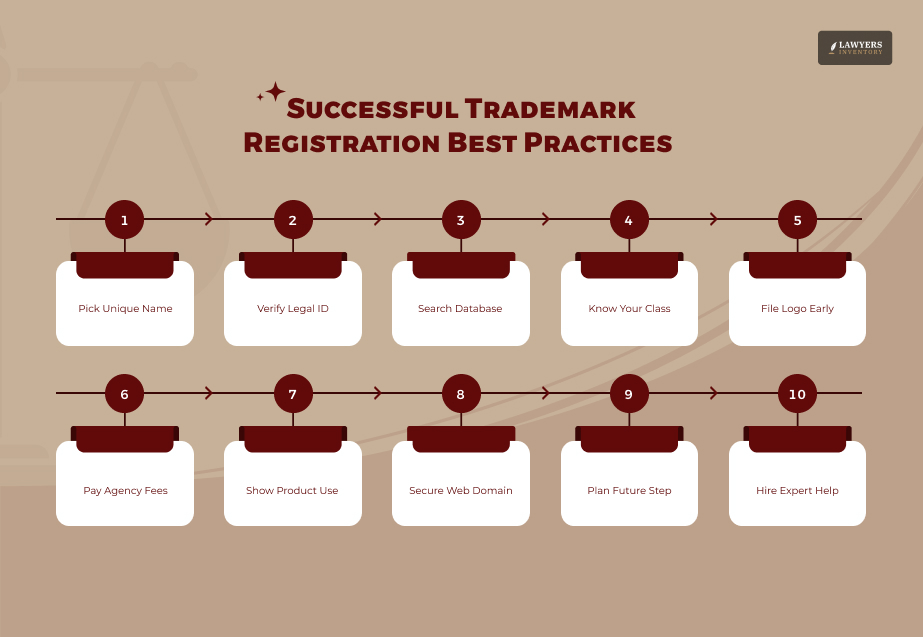
Successful trademark registration is a critical step in protecting your intellectual property rights.
The trademark registration process may take time and effort. However, following best practices during the application phase can help ensure a smooth registration and avoid potentially expensive legal battles.
Select A Unique Mark
Consider unique and strong marks that will help your business protect trade easily. If you have a strong mark, you will be less likely to get rejected by the market.
Trademarks are categorized into five distinct levels of legal strength:
- Fanciful / Arbitrary: Completely invented words (like Kodak) or common words used in unrelated ways (like Apple for computers). These are the easiest to protect.
- Suggestive: Marks that hint at the product’s function without explicitly stating it (like Netflix for streaming).
- Descriptive: Words that directly describe the product (like The Television Shop). These require proof of market recognition to qualify for protection.
- Generic: Common everyday names for goods (like Shoes for a shoe brand). These can never be registered as trademarks.
Provide A Clear “Specimen of Use”
If you apply for a trademark under an “In Commerce” status, you must submit a specimen – a real-world example showing how your brand name or logo is actively used in the marketplace.
For physical goods, this can be a photo of your product packaging or a label. For services, a screenshot of your active website offering the service is acceptable.
Understand Your Trademark Classes
Trademarks are divided into 45 international classes under the Nice Classification System. Your filing fee is calculated per class (currently a base fee of $350 per class digitally).
If your company sells both clothing (Class 25) and online retail services (Class 35), you must apply and pay for both classes separately to ensure complete legal protection. [Source: Trademark Engine]
Evaluate The Competitive Landscape
A crowded marketplace full of similar names, logos, or designs makes it incredibly difficult to defend your brand’s unique identity.
Conducting a thorough clearance search using the USPTO Trademark Search tool before you file is the best way to ensure a successful trademark registration.
Use Trademark Symbols Consistently
Taking measures to protect your business and intellectual property ensures your rights are safeguarded and helps build trust and confidence among customers and other businesses.
It shows that you take your business seriously and are committed to providing quality products and services.
Don’t Forget Domains And Social Media Handles
Securing your social media handles and domain names as early as possible is always a good idea.
Not only are social media accounts usually free to register, but domain names are also relatively cheap to obtain.
By reserving your handles and domains early, you can ensure that your brand is consistent across all platforms and that no one else can claim them. It’s a small investment that can pay off in the long run.
Work With An Experienced Trademark Attorney
Working with an experienced trademark attorney can greatly increase your chances of successful trademark registration. A trademark attorney can help you navigate the complex application process and ensure your mark is unique and does not infringe on anyone else’s rights.
They can also assist in enforcing your rights if someone else violates them. Don’t hesitate to seek professional help to protect your intellectual property and business identity.
File Logos As “Stat” Images
When registering a stylized logo with the USPTO, it is often best to submit it as a digital black-and-white drawing.
Filing without color or shading ensures your legal protection covers your logo layout across any color scheme your brand chooses to use in the future.
It also helps to ensure that the mark is easily recognizable and can be reproduced in any medium.
Think About The Future Of Your Business
While seeking registration of your mark, be thinking ahead about your company’s future.
Think about where you want to be in 5-10 years’ time and if the scope you have chosen will still be appropriate and useful.
Think about what possible entry into other markets or lines of business might look like. Will your mark still be appropriate if you expand the scope of your business?
Allowing the business to think about the future when registering a mark will help to do this, as it will make sure that your mark will be able to cover your business into the future.
Lock In Your Brand Early Via “Intent-to-Use”
You do not have to wait until your business is fully operational to file a trademark application.
If you have a solid business plan but haven’t launched yet, you can file under an Intent-to-Use (Section 1b) basis.
This acts as a legal placeholder, protecting your name from competitors while you finish your product development or website build.
Complete Mandatory Identity Verification First
Before you can submit any files, you must create a secure account and complete the mandatory USPTO Identity Verification process.
This is a one-time anti-fraud security step usually handled digitally via ID.me. You will need to upload a government-issued photo ID and pass a quick biometric check to unlock filing permissions.
Obtain Federal Registrations For Your Valuable Marks
Obtaining federal registration for your trademark is a crucial step in protecting your business identity and intellectual property. It provides nationwide protection and legal rights against any potential infringers.
Here are some important steps to follow when obtaining federal registration for your valuable marks.
- Conduct a thorough trademark search
- File your trademark application
- Respond to any office actions
- Monitor your trademark
By following these steps and working with an experienced trademark attorney, you can successfully register your business trademark and protect your valuable marks.
The Unified Electronic Base Fee
The USPTO has retired the old TEAS Plus and Standard models in favor of a single unified filing pathway.
The current base application fee is $350 per class, provided you select standard pre-approved goods descriptions straight from the official USPTO ID Manual. [Source: Teak IP Services]
If you write a completely custom description using the free-form text field, an additional surcharge will push your cost up to $550 per class.
Actively Police And Enforce Your Mark Against Infringement For Successful Trademark Registration
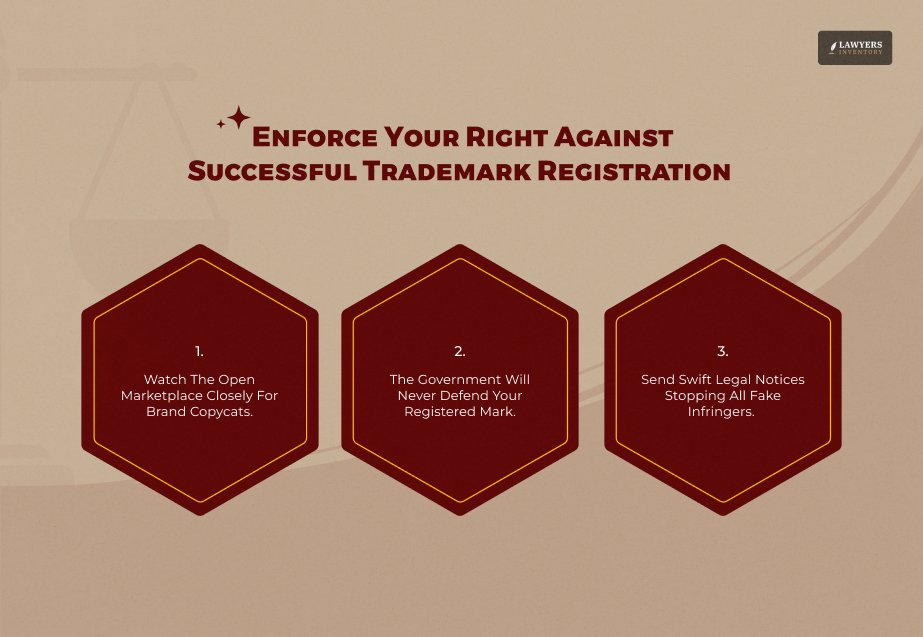
Securing a successful federal trademark registration is only half the battle; you must actively police the marketplace to defend it.
The USPTO does not monitor the market for copycats or send cease-and-desist letters for you.
It is your legal responsibility to monitor business filings, domain registrations, and competitor advertisements.
Leave A Reply






Do You Pay Taxes On Lawsuit Settlements? IRC Section 104 Explained
Read More
Non-Disparagement Clause Explained: Requirements, Enforceability, And What Changed Recently
Read More
Understanding Your Rights: A Guide To The Legal Process
Read More
How To Clear A Bench Warrant Without Going To Jail: A Legal Guide
Read More
Is It Negligence Or Malpractice? How Courts Define Carelessness And Professional Misconduct
Read More
0 Reply
No comments yet.