Summarize using AI





Prompt copied. Paste it into Gemini.
Today’s topic: What is a wet signature?
In today’s rapidly changing digital age, it’s common for most of us to sign documents with a mere click or touch of the screen.
But you may still find yourself in a situation where a bank or an attorney requests that you put your original, physical signature on a document.
This raises a question that many of us have asked before: What is a wet signature?
Although electronic signatures have become the norm in most business transactions, the traditional ink-on-paper signature has a special place in the legal world.
As of 2026, most large health organizations and government institutions are still requiring these physical signatures on high-security documents.
For instance, recent changes to real estate laws in several states still require “wet” ink signatures on deeds to avoid fraud.
Even in the midst of current legal changes, such as the 2025-2026 discussions on remote online notarization, the physical signature is still the ultimate fallback option for verification.
In this article, we will elaborate on the following:
- The core definition and history behind the term “wet signature.”
- Why certain industries like real estate and law still demand physical ink.
- The main differences between wet, electronic, and digital signatures.
- Best practices for providing a valid physical signature in a digital era.
Defining The Traditional Mark: What Is A Wet Signature?
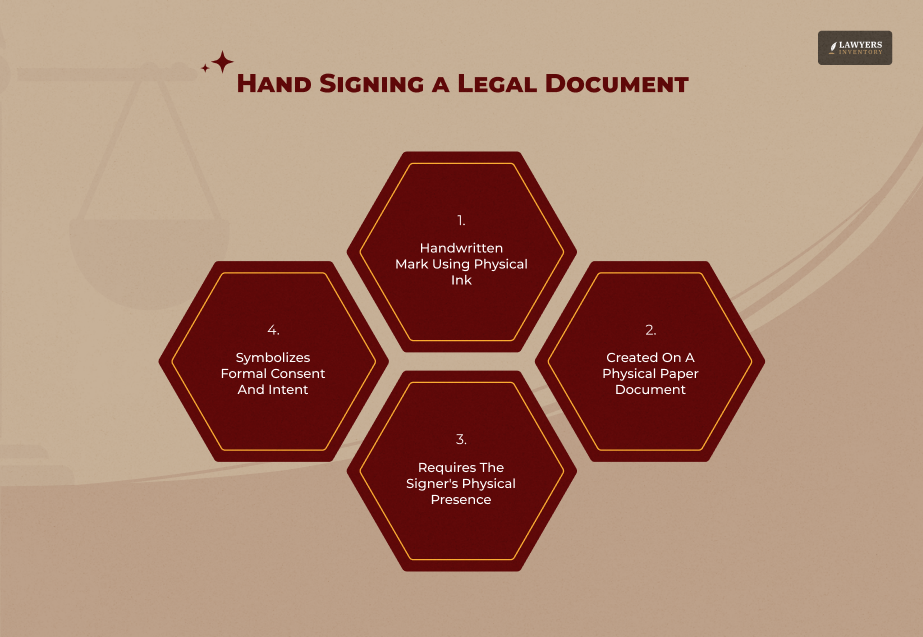
To grasp the concept of what is a wet signature, one only has to consider the pen and paper.
The term refers to a signature that is made by physically writing one’s mark on a document using a physical instrument, such as a pen.
“Wet” refers to the fact that the ink in the pen is literally wet when it first hits the paper. This was the only way to ensure that an individual actually viewed and agreed to a contract in the past.
The Origin And Evolution Of Physical Signing
Prior to the digital revolution, a signature was not merely an autograph but a seal. Individuals used wax, stamps, or even thumbprints, but the autograph became the universal standard.
Even in the modern era, the wet signature meaning is one of formality and finality that is sometimes not present with the digital “click” (Source: Adobe Acrobat).
Many individuals feel a greater psychological attachment when they actually sign their name.
Why The Term “Wet” Remains Relevant In Today’s World
It is only recently that we have adopted the term “wet signature” in response to the growing use of electronic signatures. We had to find a means to differentiate between the two.
When someone asks you what is wet signature in a business context, they are essentially asking you to sign a physical copy of a document using a pen. This ensures that there is a physical “original” copy of the document in existence.
Making Sense Of The Difference: What Does Wet Signature Mean Compared To Digital?
When someone asks you what does wet signature mean, they are essentially asking you to compare it to the “e-signatures” that they are using on a daily basis. An electronic signature is a generic term for any electronic sound, symbol, or process used to sign a record.
A digital signature is a specific type of encrypted electronic signature that is highly secure. In contrast, the wet signature is a purely physical process that does not involve any computer code in its initial creation.
Comparing Security And Verification Methods
The manner in which we verify a wet signature is quite different from how we verify a digital signature. In the case of a wet signature, we might look at the writing style or have a witness verify that the person signed it.
Digital signatures employ “Public Key Infrastructure” to monitor when and where the signature occurred (Source: DocuSign).
Both are recognized as legal under the ESIGN Act of 2000, but are used for different purposes.
Accessibility And Technological Requirements
One of the best things about the wet signature is that it doesn’t require any technology. You don’t need a smartphone, internet access, or software to sign a document.
This makes it the most accessible form of signing for someone who isn’t tech-savvy. However, it is also much slower because you have to mail the actual paper back and forth.
When A Wet Signature Is Legally Required In 2026
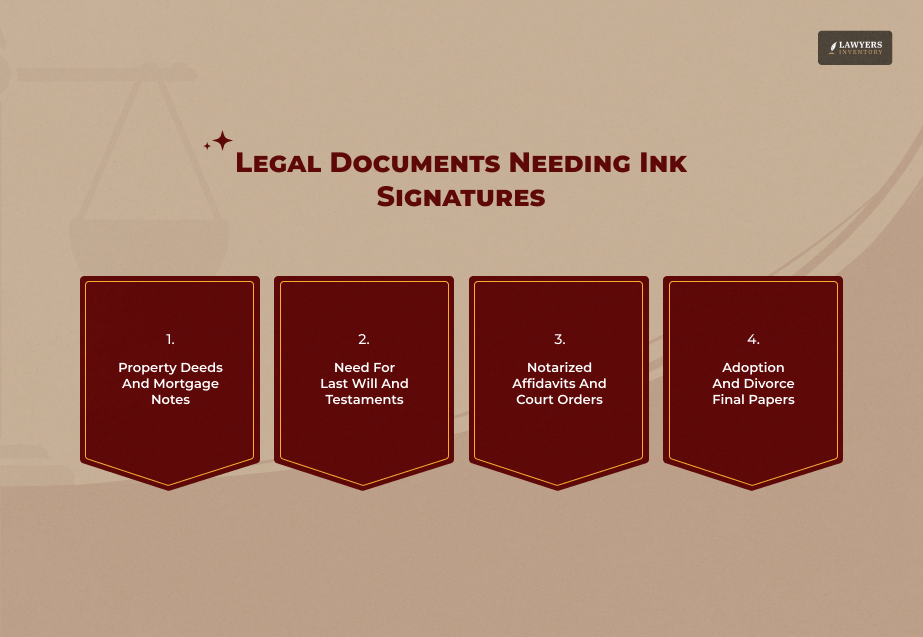
Despite the availability of amazing technology, you still cannot do without the pen. There are some high-stakes documents that still require a wet signature to make them official.
This is usually because the law requires that the signer of the document did not sign under duress or that the document is 100% authentic. In the year 2026, government offices and courts are still the largest users of wet signatures.
Real Estate And Financial Transactions
When you buy a house, you will need to give a wet signature for some documents. Deeds, mortgages, and promissory notes usually require a wet signature, which is an ink mark (Source: HyperStart CLM).
Most county recorders in the United States still require original paper documents with “wet” ink signatures for their archives. This is to ensure that hackers cannot easily forge property transfers.
Wills, Trusts, And Estate Planning
Family law is another field in which the wet signature reigns supreme. In most states, a person must sign their Will in the presence of physical witnesses who also sign their names in ink.
Although “Electronic Wills” are beginning to emerge in states such as Nevada and Florida, most of the country remains loyal to the traditional approach. This is to protect senior citizens from digital fraud or “undue influence” by other people.
The Pros And Cons Of Sticking To Paper
The use of a wet signature is a trade-off between tradition and convenience. Many traditional businesses favor the physical approach because it is more secure.
But most contemporary businesses believe that paper-based processes are costly and inefficient.
Knowledge of what a wet signature is also entails knowledge of why some businesses are attempting to abandon the practice.
Advantages – Trust And Simplicity
The major advantage of a wet signature is that it is accepted everywhere. No court in the world disputes the authenticity of a wet signature. You do not have to worry about software glitches and outdated digital certificates either.
It is a very simple, human-to-human transaction that has been in practice for centuries.
Disadvantages – Cost And Turnaround Time
On the other hand, wet signatures are very slow. You have to print out the document, look for a pen, sign it, and then mail or scan it back. This can turn a five-minute task into a three-day task.
Companies also spend thousands of dollars every year on paper, ink, and storage for these documents. In a world that is all about speed, the wet signature can be a bottleneck.
How To Properly Execute A Wet Signature
If a business asks you for a wet signature, you can follow a few easy steps to ensure that your signature is valid.
It is not just a matter of putting your John Hancock on a piece of paper; you have to make sure that the paper remains a “legal original.”
Most experts recommend using blue or black ink because it will photocopy well and will be easily distinguishable as “original” as opposed to a stamp.
Steps For A Valid Signature
First, print out the final copy of the document. Do not sign a copy that is a draft. Sign your name the same way it appears on your ID.
If there are multiple pages, some attorneys recommend placing your initials on the bottom of each page. This will ensure that you have read the entire document and that no pages have been switched out later.
Read Also: Understanding The Lady Bird Deed: What Is It & How Is It Better?
Processing Scanned Wet Signatures
One question that many people ask is: “Can I sign a document in ink and scan it?” In most business situations, a “scanned wet signature” is not a problem. You sign the document, scan it using a scanner app on your smartphone, and send the PDF via email.
However, you should always keep the original document in a secure location. If a dispute arises in the future, the court may ask to view the “wet” original to see if it has been tampered with.
Frequently Asked Questions About Physical Signatures
Although we have discussed a lot about what a wet signature is, there are still people who have questions. These questions usually come up during high-pressure situations, such as signing a house purchase or a court document.
No, a wet signature does not have to be in cursive to be considered a legal signature. The law typically considers any mark you make that you intend as a signature to be valid.
You could print your name, sign in cursive, or even use a special symbol. As long as it can be distinguished as you and indicates your agreement, it is a valid signature (Source: EM Law).
If you use an e-signature on a document that requires a wet signature, such as a Will or a deed to property, the document may not be accepted.
In some instances, the entire contract may be considered “invalid.” If you are unsure, it is always best to contact the receiving party to see if they accept an “original wet ink” signature.
Technically, a wet signature can be created with a pencil or a stamp, but this is a very poor practice.
A pencil can be erased, and a stamp can be used by anyone who finds it. Most banks and government institutions will require a pen with permanent ink strictly. A pen will ensure that the signature is permanent and much more difficult to change without leaving any trace.
Leave A Reply







Is It Legal To Use True People Search? What Are Its Restrictions?
Read More
Case Is Being Actively Reviewed By USCIS – Meaning And Timelines
Read More
Refund Risk Under Income Tax Demand Notice Section 143(1) Summary Adjustments [A Complete Legal Assessment]
Read More
2026 Rules For The Legal Age Of Marriage In India
Read More
What Is A Legal Precedent? Global Guide To Case Law, Stare Decisis, And Judicial Evolution
Read More
0 Reply
No comments yet.