Summarize using AI





Prompt copied. Paste it into Gemini.
Today’s topic: Legal age of marriage in India!
The legal age of marriage in India is a basic norm that helps ensure young people are physically and mentally prepared to take on the responsibilities of marriage.
This act is a Defense mechanism against the social problem of child marriages and also supports education and health for the youth.
As of 2026, the issue at hand is still very pertinent as the government weighs the possibility of a permanent change in gender-neutral age standards.
The current legal timeline is centered on the Supreme Court of India’s current examination of personal laws versus legal safeguards.
The Prohibition of Child Marriage (Amendment) Bill was proposed to increase the age limit for women.
However, it was postponed during the last parliamentary sessions. Nevertheless, the present laws are enforced very rigorously by the concerned authorities to safeguard children against early marriages.
The following points are explained in detail in this article:
- Currently existing statutory age limits for men and women under different Indian laws.
- The primary legislation of India dealing with child marriage, i.e., the Prohibition of Child Marriage Act, 2006.
- Social and health-related reasons for setting specific age limits.
- Legal consequences and penalties for the ones not follow the rules of marriage age.
What Is The Legal Age For Marriage In India?
The legal age of marriage in India is the minimum age that a person must attain before they can take part in a marriage.
This is not only a social rule but also a legal requirement that is followed in the country. The legal age of marriage in India considers the difference between legal maturity and biological maturity.
Current Statutory Age Limits
The current legal age of marriage in India is 18 years for women and 21 years for men. This has been the situation in the country for several decades, with the objective of ensuring that the person is socially mature enough.
Many people have been asking what is the legal age of marriage in India 2025 and 2026, and the truth of the matter is that the 18/21 rule is still applicable (Source: The Indian Express).
Protection Of Minor Rights
The legal age of marriage is a mechanism that the Indian government uses to ensure the rights of minors are not violated.
This is because the law in India governing the age of marriage ensures that children are not coerced into participating in any marriage while still young. This is in line with the human rights law internationally.
What Laws Regulate The Age Of Marriage In India?
There are various acts dealing with the age limit for marriage in India, varying based on religion or the type of marriage.
However, there are many personal laws, but the central government also frames broad acts, bringing all basic marriage acts under a broad standard for the protection of children.
Prohibition Of Child Marriage Act, 2006 (PCMA)
The PCMA is the most stringent legislation against child marriage. The act defines a “child” as a male below 21 years and a female below 18 years.
The legislation declares an offense to perform a marriage with a child. It also gives the government the right to prevent marriage from happening.
Hindu Marriage Act, 1955
In most circumstances, the Hindu Marriage Act is the law governing the legal age of marriage.
According to Section 5 of the Act, the minimum age of the couple must be 18 and 21, respectively. In any other case, the marriage can be challenged in court.
Specified Marriage Act & Indian Christian Marriage Act
The Special Marriage Act allows a couple to get married interfaith. The act has a minimum age requirement of 18 years for females and 21 years for males in the country. The act is secular in nature.
On the other hand, the ICMA deals with “the law relating to the solemnization in India of the marriages of Christians.” (Source: The Indian Christian Marriage Act, 1872)
Therefore, if everyone follows the same safety measures, they are safe from discrimination and can marry interfaith.
Why Is There a Legal Age of Marriage?
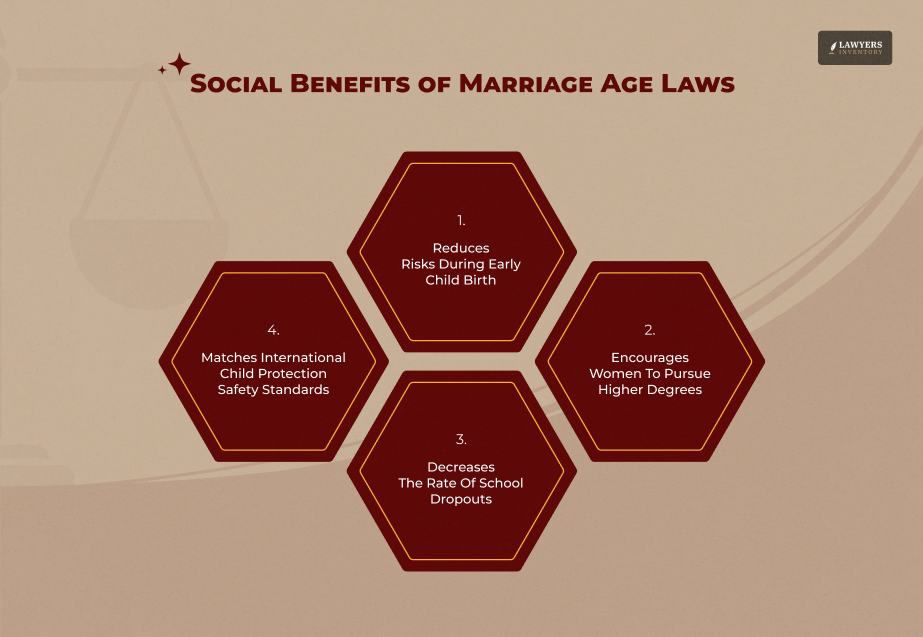
The problem of legal marriage age in India faces one of the greatest difficulties, which is the conflict with the particular laws of one’s religion.
Traditional customs, in some cases, allowed for a younger age of marriage based on puberty. However, modern Indian courts usually rule that child protection laws come first.
Hindu, Christian & Special Marriage Laws
These laws completely comply with the legal marriageable age in India, which does not allow any deviations to be drawn from any of the local customs. If a Hindu or Christian girl marries at 16, then she directly violates the law.
The Traditions Of Muslim Personal Law
The marriageable age in some Muslim interpretations of the law was traditionally linked to the onset of puberty. In that sense, it can get as low as 15 years in specific religious contexts.
On the other hand, many High Courts now say that PCMA 2006 is a “special law” whose provisions everybody must follow.
Other Personal Laws (Parsi, Jewish)
The Parsi Marriage and Divorce Act follows the standard legal age of marriage in India. The minimum requirements prescribed by the act are 18 and 21.
These minimum required age limits have been traditionally favored by these communities for the well-being of their future generations.
Legal Controversies & Debates Around Age Of Marriage
The debate about whether the legal age of marriage in India should be 21 for all genders is still on.
Several activists hold that if an 18-year-old can vote, then they can also marry- be it a male or a female.
Proposed Amendments To Raise Women’s Marriageable Age To 21 Years
The Government of India has very recently proposed increasing the legal age of marriage in India for female candidates to 21 years, with an aim to bring gender parity in the law.
The Bill was introduced in Parliament but has since faced several delays and is currently being studied by a standing committee.
Supreme Court Review Of Child Marriage Law
Currently, the Supreme Court is examining the relationship between the legal age of marriage and personal law.
The court wants to ensure that no individual uses their “freedom” under religious law to marry a child. This is the most important legal event of 2026 so far.
Conflicts & Court Interpretation (E.G., Delhi High Court)
Sometimes, different high courts offer different decisions on the legal age for matrimony in the country.
There have been cases in the Delhi High Court about a minor running away to get married. In these circumstances, the law is complex when questions of “consent” and “age” arise.
What Happens When Marriages Are Performed Under the Age?
The consequences for violating the legal age of marriage laws in India are severe. The legislature does not just prosecute a couple who violated this rule but also individuals who helped arrange this marriage.
This is intended to dissuade communities from supporting child marriage practices.
Voidable Vs Void Status
A marriage that has not taken into consideration the legal age of marriage in India is called “voidable.”
This means that the minor can apply for a cancellation of marriage at the age of 18. In some extreme cases, the marriage is considered to be “void” from the beginning.
Penalties Under PCMA
The punishment for the violation of the legal age of marriage is quite severe in India. Even adults can face rigorous imprisonment for a term of two years, coupled with a fine of one lakh rupees for the crime of marrying a child.
Parental & Facilitator Liability
The parents who permit the marriage will also be liable. The priest who performs the marriage ceremony will also be arrested. It is ensuring that no one is helping to violate the law on the legal age of marriage in India.
Court Marriage & Age Requirements
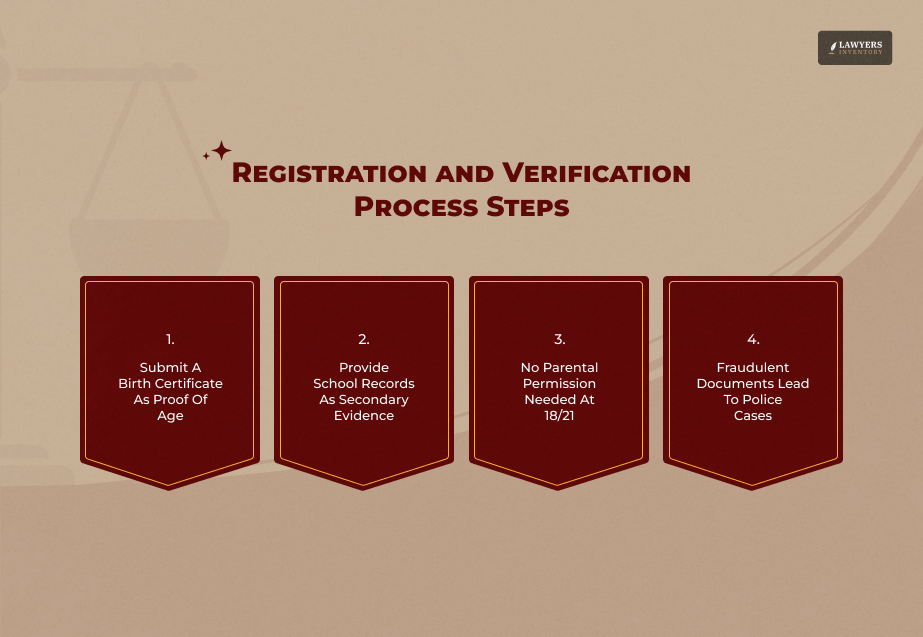
If you want to register a marriage officially, you are obliged to prove that you meet the legal age of marriage in India.
The registrar will ask you for several documents proving your date of birth. That’s where most of the underage marriages are caught and obstructed.
Age Factor Of Court Marriage
You need to be of the age of 18 years old for a female and 21 years old for a male to get a court marriage.
The registrar verifies school-leaving certificates or birth certificates. Without these, you are not able to verify the legal age of marriage in India (Law4u).
Consent, Documents & Validity
You do not need your parents’ consent legally if you have attained the legal age of marriage in India.
Many couples prefer a court marriage to avoid pressure from their families. If you are 18 or 21, then the law stands on your side.
Special Cases & Interpretations
People sometimes bypass the legal age of marriage in India using fake documents. It is a separate criminal offense in itself. Registrars are now trained to spot fraudulent birth records to avoid child marriage.
Lesser-Known Exceptions & Nuances
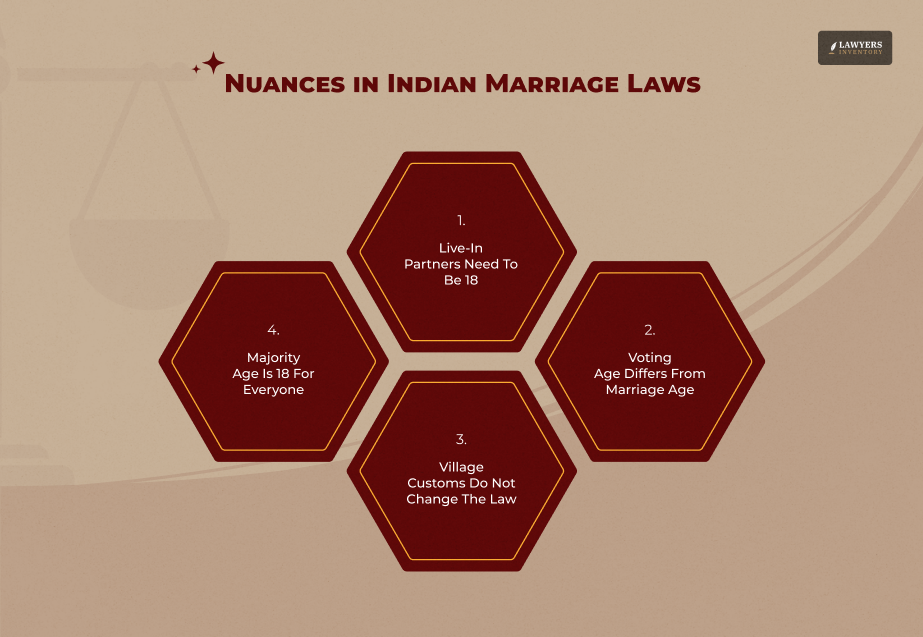
To understand the legal age for marriage in India, it is also necessary to understand the concept of “live-in” relationships.
Physical relationships and legal marriages are treated separately in law. This is an odd discrepancy in the lives of young people.
Live-In Relationships Vs. Legal Marriage Age
In India, if two consenting adults above 18 years want to live together, they can legally do so.
This is perfectly legal even if the man is below the legal age of 21 years to be married as a boy (The Hindu). Although they cannot marry, they cannot be arrested for cohabiting either.
Consent, Majority & Other Rights
The “age of majority” in India is 18. This is an age where a person can contract, vote, etc., but the legal age of marriage in India for males is more than this.
Hence, the PM of the nation can be selected by a 19-year-old male, but he cannot choose his wife legally.
Traditional Practices Vs Law
There are areas where the people live under the older customs that completely disregard the legal age for marriage in India.
Even if the ceremonies are important to society within that particular village or town, to the state, they are meaningless. The state will always choose to follow the law over any tradition.
Expert Tips & Best Practices for Compliance

Thus, in order to avoid any trouble related to the legal age of marriage in India, proper paperwork must always be ensured.
For instance, in a marriage, the age of the parties getting into the marriage should be checked so that there is no raid by the child protection officers.
Verify All Documents Early
In every case, the birth certificates of the bride and the groom should be verified. In the event of an error, the error should be corrected before the wedding date.
Following the legal age of marriage in India is the first step.
Register Your Marriage
The best evidence for proving that you complied with the legal age of marriage in India is by obtaining a marriage certificate.
This has various benefits, such as on visas, bank accounts, etc., as the government has verified the age of both parties in the certificate.
FAQs Regarding Marriage Age Laws
Find yourself still unsure about what the legal age of marriage in India is? Well, we will answer some of the most commonly asked questions on the matter.
No, not for all. The legal age of marriage in India is still 18 for women and 21 for men.
In a court marriage, the legal age of marriage in India for a female participant is 18 years. It is necessary that a Passport/Aadhaar Card be provided to the marriage registrar to prove that the participant has attained this age.
No, he cannot. Even if the girl has reached the legal age of girl marriage in India, the boy must be at least 21. If they marry before he is 21, the marriage is considered a violation of the Prohibition of Child Marriage Act.
Leave A Reply







Is It Legal To Use True People Search? What Are Its Restrictions?
Read More
Case Is Being Actively Reviewed By USCIS – Meaning And Timelines
Read More
Refund Risk Under Income Tax Demand Notice Section 143(1) Summary Adjustments [A Complete Legal Assessment]
Read More
What Is A Wet Signature? Legal Guide And 2026 Rules
Read More
What Is A Legal Precedent? Global Guide To Case Law, Stare Decisis, And Judicial Evolution
Read More
0 Reply
No comments yet.