Quick Answer

The most important sources of Muslim law are the Quran and the Sunnah, which consist of the Prophet's traditions. They are considered as the fundamental or primary sources together with Ijma (a scholarly consensus), and Qiyas (reasoning by analogy). Other secondary and modern sources of the law include customs, judicial cases and laws.
As someone who has been trying to decode legal jargon and ideas for years, I was particularly curious about the sources of Muslim Law after watching Haq.
The movie not only showed the struggles of Shayara Bano. Rather, it also highlighted the tone of the most prominent and significant cases related to Muslim law in India – one that led to the banning of triple talaq.
Muslim law (Shariat) is an expansive legal framework governing over a billion people globally, functioning as both a personal spiritual compass and a formal statutory regime.
Understanding the structural architecture of Islamic jurisprudence – known natively as Fiqh – requires a clear division between immutable divine revelations and dynamic human reasoning.
For modern legal practitioners, jurists, and law students, analyzing the interactions between these sources is essential. In this blog, I will break down and explain the following things:
- primary and secondary sources of Muslim law.
- key interpretative splits between Sunni and Shia jurisprudence.
- the contemporary socio-legal significance of Muslim Law and its sources.
So, keep reading!
Sources Of Muslim Law Core Summary
What Are The Primary Sources Of Muslim Law? (Ancient Sources)
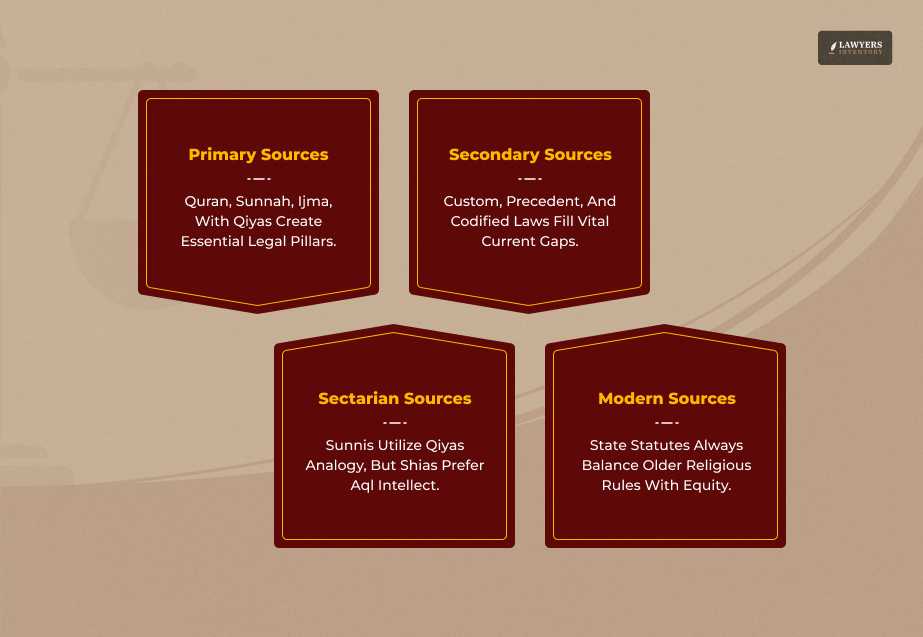
The primary sources of Muslim law are considered the baseline of Islamic jurisprudence (Usul al-fiqh).
They follow a strict hierarchical structure. If a legal issue cannot be explicitly resolved by the first source, jurists move systematically down to the next tier.
The Quran: The Supreme Divine Revelation
The Quran, as most of us are well aware of, is the absolute, unalterable, and ultimate source of all Islamic legal thought.
Derived from the Arabic root Quarra (meaning “to read”), Muslims recognize the text as the direct manifest word of God, transmitted to the Prophet Muhammad via the Angel Gabriel over approximately 23 years (610 – 632 A.D.).
- Structure: It contains 114 chapters (Suras) and 6,666 verses (Ayats).
- Legal Quantifiers: Out of these, roughly 200 verses directly formulate explicit legal codes regarding personal status, marriage, dower (Mahr), divorce, guardianship, and inheritance.
Because it represents divine communication, its core tenets are entirely immutable.
Sunnah Or Hadith: Traditions And Practices Of The Prophet
When the text of the Quran provides broad, generalized moral mandates, the Sunnah and Hadith supply the explicit structural mechanics.
Sunnah refers to the “trodden path” or the model behavior and lifestyle of the Prophet Muhammad, while Hadith denotes the explicit recorded narrations of his statements and actions.
These traditions are legally classified into three operational categories:
- Sunnat-ul-Qual: Definite spoken words and oral injunctions issued by the Prophet.
- Sunnat-ul-Fail: Actions, physical deeds, and everyday judicial practices performed by the Prophet.
- Sunnat-ul-Tuqrir: Silent approval or tacit consent given by the Prophet to conduct that occurred directly in his presence without his active objection.
Ijma: Consensus Of Islamic Jurists
Ijma represents the collective consensus of qualified Islamic legal scholars (Mujtahids) during a specific historical era regarding a novel point of law. It is invoked when both the Quran and the Sunnah are silent on an emerging legal issue.
The structural validity of Ijma originates from a celebrated prophetic tradition stating that “the Muslim community will never agree upon an error.”
It ensures that Islamic law can adjust collectively to shifting cultural contexts while preserving historical continuity.
Qiyas: Analogical Deductions
Qiyas is the final primary source and represents the application of human logic to divine mandates.
It involves extending an established law found in the Quran, Sunnah, or Ijma to a completely new problem based on an identical underlying cause or common feature (Illa).
For example, if the Quran explicitly bans the consumption of wine based on its intoxicating nature, Qiyas is the logical mechanism used by jurists to extend that prohibition to modern synthetic narcotics.
What Are The Secondary Sources Of Muslim Law? (Modern Sources)
As global legal landscapes shifted through industrialization, colonial rule, and constitutionalism, secondary sources developed to adapt, clarify, and modify traditional uncodified personal laws.
Urf Or Custom: Regional Usages
Customary practices had a predominant role in pre-Islamic Arabia and other territories that later adopted Islam. Islamic law is not adverse to the introduction of local customs (Urf) to the field of private law subject to rigorous legal criteria:
- The custom must be continuous, uniform, and ancient.
- It must perfectly align with public morality and reason.
- It must not conflict with any explicit mandate of the Quran or Sunnah.
Historically, local customs frequently governed complex inheritance schemes until statutory enactments intervened. [Source: The Submitters]
Judicial Precedents: Case Law
In modern court systems – particularly across common-law jurisdictions such as India, Bangladesh, and Pakistan – judicial precedents have become an active source of law.
Rulings handed down by superior appellate bodies like the Privy Council or State Supreme Courts interpret uncodified Sharia texts.
These interpretations establish binding legal precedents that guide subsequent court choices on matters of personal status.
Legislation: Codified Statutory Acts
While classic Islamic law is natively uncodified, modern sovereign states frequently introduce legislative enactments to streamline, regulate, and modify personal matters. Notable statutory markers include:
The Muslim Personal Law (Shariat) Application Act, 1937:
This baseline act explicitly struck down contrary local customs. It laid the foundation of the uniform law for Muslims as their personal law, i.e., marriage, maintenance, and succession with the Shariah.
The Dissolution Of Muslim Marriages Act, 1939:
This was a very important legal amendment which empowered Muslim women to file for divorce on grounds laid down clearly in the law. This benefited from a more liberal view of the Maliki school. [Source: The Maydan, India Code]
Equity, Justice, And Good Conscience
Known historically in Islamic jurisprudence as Istihsan (juristic preference) or Istislah (public interest), these principles empower jurists to bypass strict analogical reasoning if its application results in extreme hardship or public harm.
It allows modern judges to interpret personal law flexibly, ensuring outcomes align with universal standards of equity and fairness.
Sectarian Interpretations: The Sunni vs. Shia Split
A central point of distinction in Islamic jurisprudence involves how the two primary branches of Islam view the legitimacy of these legal sources.
While both sects agree on the supreme authority of the Quran, their methodologies diverge sharply regarding secondary verification and logical deduction.
Here’s a table that you need to take a look at:
| Source of Muslim Law | Sunni Interpretation (Hanafi/Maliki) | Shia Interpretation (Ja’fari/Usuli) |
| The Quran | Recognized as the supreme, unalterable word of God. | Recognized as the supreme, unalterable word of God. |
| Sunnah / Hadith | Validated through rigorous, independent historical chains of narrators (Isnad). | Accepts only those traditions transmitted through the household of the Prophet (Ahl al-Bayt) and the structural rulings of their recognized Imams. |
| Ijma (Consensus) | Validated as the independent consensus of any era’s qualified legal scholars (Mujtahids). | Rejected as an independent source; it is considered valid only if the consensus explicitly includes or reveals the view of a living or infallible Imam. |
| Logical Deductions | Relies heavily on Qiyas (analogical induction) to expand laws to new scenarios. | Fundamentally rejects Qiyas as speculative; it replaces it with Aql (pure human intellect/deductive reason) to establish absolute legal certainty. |
This methodological divergence explains why the largest Shia legal school, the Ja’fari/Usuli school, maintains an active tradition of Ijtihad (independent legal reasoning led by living jurists).
On the other hand, from what I have analyzed, Sunni schools lean more toward historic canonical precedents.
Why The Sources Of Muslim Law Are Significant Today
The sources of Muslim law form a cohesive, adaptive legal ecosystem.
While the Quran and Sunnah provide an immutable moral and legal baseline, the evolutionary mechanisms of Ijma, Qiyas, and modern legislation allow the system to address contemporary developments.
For legal professionals navigating this field, understanding the differences between these sources is essential. It helps in balancing ancient religious traditions with the requirements of modern constitutional law.
So, the ancient sources of Muslim law are not merely historical artifacts. Rather, they continue to exert structural influence over modern personal and international legal frameworks.
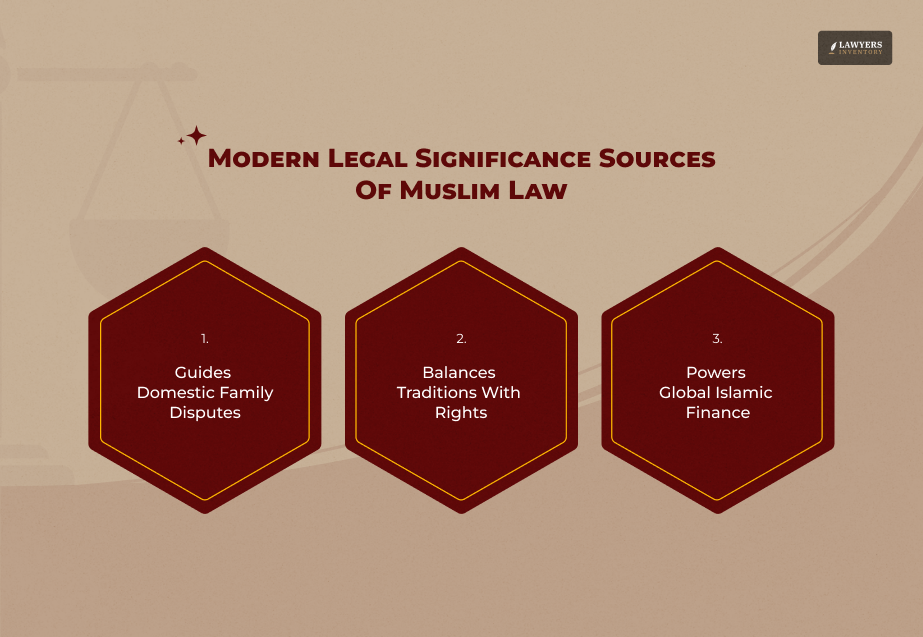
Resolving Domestic Personal Law Disputes:
In countries like India, uncodified traditional Muslim law continues to govern civil interactions among citizens regarding:
- Marriage (Nikah).
- Dower (Mahr).
- Divorce.
- The management of religious endowments (Wakf).
Family courts cannot rule on these matters using generic secular principles. Rather, they must directly analyze the classical hierarchies of Fiqh to resolve complex inheritance or matrimonial actions.
Interaction With Constitutional And Human Rights Mandates:
One of the most complex legal issues of the 21st century is the structural intersection between religious personal laws and modern constitutional rights.
Superior courts frequently evaluate ancient uncodified rules against constitutional principles like gender equality and the right to live with dignity.
Landmark cases include the abolition of instant triple talaq (Talaq-e-Biddat) in the Shayara Bano v. Union of India case.
This demonstrates how modern statutory law modifies traditional practices to safeguard fundamental human rights. [Source: Legal Information Institute, Supreme Court Observer]
Powering Global Islamic Finance:
The significance of these sources extends well beyond family law into international commercial transactions.
The global Islamic banking and finance sector operates under strict compliance with Sharia principles derived directly from the Quran and Sunnah.
Because the primary sources strictly forbid Riba (usury or interest), modern financial scholars use Ijma and Qiyas to construct complex, multi-billion-dollar commercial instruments.
Financial tools like Murabaha (cost-plus financing) and Sukuk (Islamic bonds) allow contemporary institutions to participate in global markets while remaining anchored in classical jurisprudence.
Source:
- iPleaders Legal Portal – History of Muslim Law
- RostrumLegal & Academic Journals
- International Journal of Law Management & Humanities [ISSN 2581-5369]
- Dhyeya Law: Sources of Muslim Law
- Testbook Education Platform – Sources Of Muslim Law: Quran, Sunna, Ijma, Qiyas, Customs & Schools
- India Foundation – Abolition of Triple Talaq
- India Code – The Dissolution of Muslim Marriages Act, 1939
- Drishti Judiciary – Shayara Bano v. Union of India and Ors. AIR 2017 SC 4609
Leave A Reply





What Is Grand Larceny? Felony Thresholds, Penalties, And Your Legal Options
Read More
Larceny vs. Theft: What’s The Real Legal Difference?
Read More
Is AI Ruining Your Legal Case? How To Detect And Correct Fabricated Law
Read More
Can You Get A DUI On A Bike? How Vehicle Codes Impact Impaired Cycling
Read More
Reasonable Suspicion vs. Probable Cause Explained: The Fourth Amendment Standards That Determine Your Rights
Read More
0 Reply
No comments yet.