Quick Answer

The Iddat period, also called the Iddah, is a required waiting period under Islamic law that a female must endure either following her husband's death or after a divorce when she is intending to remarry. One of its main reasons is to establish whether the woman is pregnant at the time, so that any child to emerge could be recognized and acknowledged by legitimate parents.
When it comes to family law, precision matters. As someone who spends days researching and analyzing expert opinions, I know how confusing legal text can be. This is especially true for topics under Muslim Personal Law. The Iddat period is one such topic.
Lately, I have tracked major shifts in how global courts treat this waiting period. For example, India has integrated secular maintenance laws with personal rules.
Meanwhile, regions like Uttarakhand have implemented a Uniform Civil Code (UCC) to ban the practice entirely. [Source: Economic Times]
What Is The Iddat Period?
The Iddat period is a mandatory waiting period that a Muslim woman must observe after her marriage ends.
This dissolution can happen through either divorce (Talaq) or the death of her husband. During this time, the woman cannot contract a new, valid marriage. [Source: Indian Institute of Legal Studies]
My analysis of Islamic jurisprudence reveals two core purposes behind this rule:
- Ascertaining Paternity: The timeline establishes whether the woman is pregnant. This prevents any future confusion or disputes regarding the child’s true lineage.
- Emotional and Legal Transition: It grants a period for mourning after a husband’s death. In cases of revocable divorce, it also provides a vital window for potential reconciliation.
Types Of Iddat And Their Legal Durations
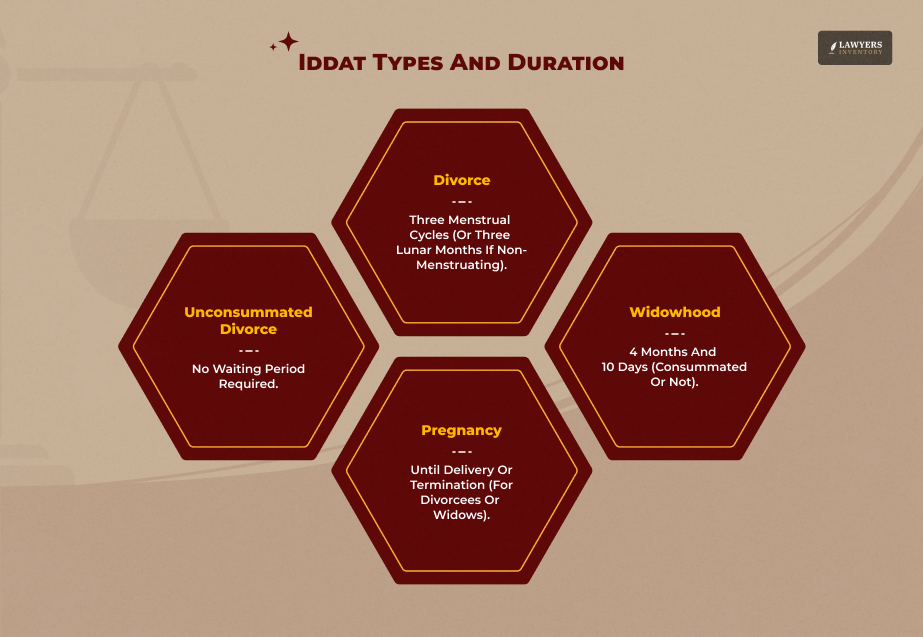
The timeline for Iddat is not a one-size-fits-all rule. Based on my review of statutory guides on iPleaders Legal Blog, the exact duration changes depending on the specific situation:
Iddat For Divorce (Talaq):
If a woman experiences a regular menstrual cycle, her waiting period lasts for three menstrual courses. For women who do not menstruate, the legal framework mandates a period of three lunar months.
Iddat For Widowhood:
Secondly, in case the marriage ends because of the death of the husband, then the mandatory iddat period becomes 4 months and 10 days. Irrespective of whether the marriage was consummate or not, this rule is legally binding.
Iddat During Pregnancy:
Third, if the marriage dissolves while the woman is pregnant, there will be a shift in the timeline of the iddat period.
In such cases, the iddat period will continue until the delivery or the termination of pregnancy. This holds true irrespective of whether the woman is a divorcee or a widower.
The No-Iddat Scenario:
If a marriage is legally dissolved via divorce before consummation, no waiting period is required. The woman is free to remarry immediately.
Legal Rights And Obligations During Iddat
Many people mistakenly view Iddat purely as a restriction. However, my legal research highlights that it triggers substantial statutory obligations for the husband and concrete rights for the woman.
Right To Maintenance (Nafaqah)
Traditionally, a husband must provide his wife with financial support during Iddat. This includes food, clothing, and overall upkeep.
Under statutory personal law, such as Section 3 of the Muslim Women (Protection of Rights on Divorce) Act, this financial settlement must be fair and reasonable.
Shelter And Residence
A woman has a clear legal right to remain in her matrimonial home during this timeframe. The husband cannot evict her until the full period wraps up. This ensures she has immediate physical security during a major life disruption.
Beginning Of Iddat
The Iddat period begins immediately when the marriage is dissolved – either through divorce or death of the husband. As per Muslim law, even if the woman receives official notice of the event later, the period starts instantly. [Source: Legal Wires]
The Landmark Shift: Maintenance Beyond Iddat
This is where modern statutory law has evolved heavily. I analyzed the historic Supreme Court of India Ruling on Drishti IAS.
The court ruled that Section 125 of the Criminal Procedure Code (CrPC) – now updated to Section 144 of the Bharatiya Nagarik Suraksha Sanhita (BNSS) – applies universally to all women.
The court explicitly confirmed that a divorced Muslim woman can claim maintenance from her ex-husband even after the Iddat period ends, provided she has not remarried and cannot support herself.
The apex court made it clear that secular laws protect vulnerable citizens and cannot be overridden by personal law codes.
| Marriage Dissolution Scenario | Standard Legal Duration | Post-Iddat Maintenance Status |
| Divorce (Normal Lifecycle) | 3 Menstrual Courses (or 3 Lunar Months) | Extended post-Iddat via Section 144 of the BNSS if she cannot self-support. |
| Widowhood (Death of Husband) | 4 Months and 10 Days | Maintenance shift; funded directly via the deceased husband’s estate or legal heirs. |
| Dissolution During Pregnancy | Until childbirth or termination | Covered until delivery, regardless of standard timelines for divorce or widowhood. |
Statutory Restrictions And Practical Legal Applications
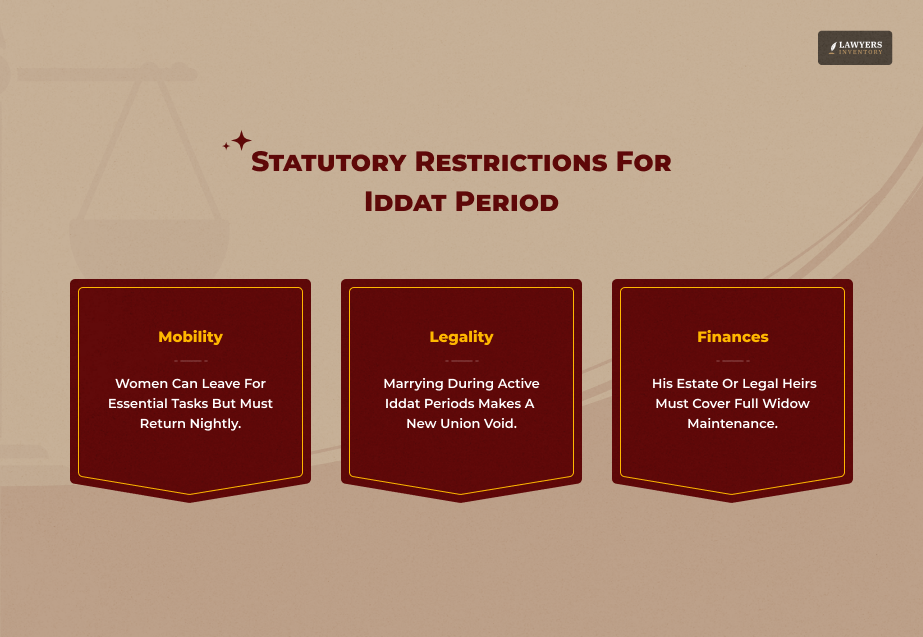
In practice, a breach of the waiting timeline leads to serious statutory consequences. Let’s look at how these elements play out in modern judicial systems.
Mobility And Residency Constraints
A common point of confusion is whether a woman can leave her house during Iddat. According to contemporary legal experts, old customary restrictions have eased.
Today’s legal systems recognize that a woman may leave her home for essential reasons. These include employment, medical emergencies, or gathering daily necessities, provided she returns to her primary residence at night.
Legal Consequences Of Remarriage During Iddat
If a woman contracts a new marriage before her Iddat ends, that new union faces severe legal trouble.
Under prevailing personal laws, a marriage performed during an ongoing Iddat period is classified as irregular (fasid) or completely void.
Any children born from such an irregular marriage could face complex legal battles regarding their legitimacy.
Maintenance Shifting In Widowhood
When a husband passes away, the dynamic changes. The obligation to provide maintenance can no longer fall directly on him.
In this scenario, the financial responsibility shifts cleanly to the deceased husband’s estate. Alternatively, the responsibility falls upon his legal heirs or relatives who stand to inherit his assets.
Modern Secular Interventions And Jurisprudential Differences
Here are a few things that you need to know when it comes to modern intervention with the tradition Iddat period under Muslim law.
The Uniform Civil Code (UCC) Impact
I have closely monitored state-level updates on this topic. According to reports from The Times of India, the state of Uttarakhand officially enforced its Uniform Civil Code. This civil code explicitly invalidates the practices of Iddat and Nikah Halala within state borders.
The state government treats these as extrajudicial divorce practices that conflict with gender equality. The police have even logged FIRs under the new code. This shows how regional, secular laws are beginning to erase personal law timelines altogether.
Jurisprudential Distinctions: Sunni vs. Shia Frameworks
Through my analysis of jurist opinions, I noted subtle differences between Islamic schools of thought.
While Hanafi (Sunni) jurisprudence strictly enforces the durations listed above, Shia frameworks evaluate certain areas differently.
For example, in a temporary marriage (Muta), the waiting period is shorter. It usually lasts for only two menstrual cycles instead of three.
High-Profile Case Studies: The Imran Khan And Bushra Bibi Trial
To see how these abstract rules create real-world legal crises, look at neighboring jurisdictions. A prominent example is the highly publicized Imran Khan and Bushra Bibi Iddat Case. [Source: The Guardian]
The state-level trial court initially handed down a seven-year prison sentence to the couple. The lawsuit, filed by Bushra Bibi’s ex-husband, alleged that the couple signed their marriage contract before her mandatory divorce waiting period had fully cleared.
While a higher District and Sessions court eventually acquitted both individuals after reviewing the medical timelines and testimonies, the trial shows how stringently state courts can audit the exact days of an Iddat calendar.
Leave A Reply






What Is Grand Larceny? Felony Thresholds, Penalties, And Your Legal Options
Read More
Larceny vs. Theft: What’s The Real Legal Difference?
Read More
Is AI Ruining Your Legal Case? How To Detect And Correct Fabricated Law
Read More
Can You Get A DUI On A Bike? How Vehicle Codes Impact Impaired Cycling
Read More
Reasonable Suspicion vs. Probable Cause Explained: The Fourth Amendment Standards That Determine Your Rights
Read More
0 Reply
No comments yet.