Quick Answer: What Is A Mistrial?

A mistrial is a trial that is terminated before the jury reaches a verdict - or before a judge renders a decision in a bench trial - due to circumstances that prevent a fair and lawful outcome. It occurs when a jury is unable to reach a verdict, and there must be a new trial with a new jury, or there is a serious procedural error or misconduct that would result in an unfair trial, and the judge adjourns the case without a decision on the merits. A mistrial does not produce a verdict of guilty or not guilty. It resets the case. The prosecution retains the option to retry.
When I started researching this topic, I expected a simple definition and a short list of reasons. Instead, I found that a mistrial is a major legal event. It connects deeply with three major things:
- Constitutional rights.
- How prosecutors use their power.
- The rights of the accused person.
Understanding what is a mistrial is very important.
When a criminal case suddenly ends without a final verdict, it changes everything for the defendants, victims, and their families. It changes the timeline, increases the costs, forces new strategies, and can even change the final outcome.
What Is A Mistrial? Understanding The Legal Definition
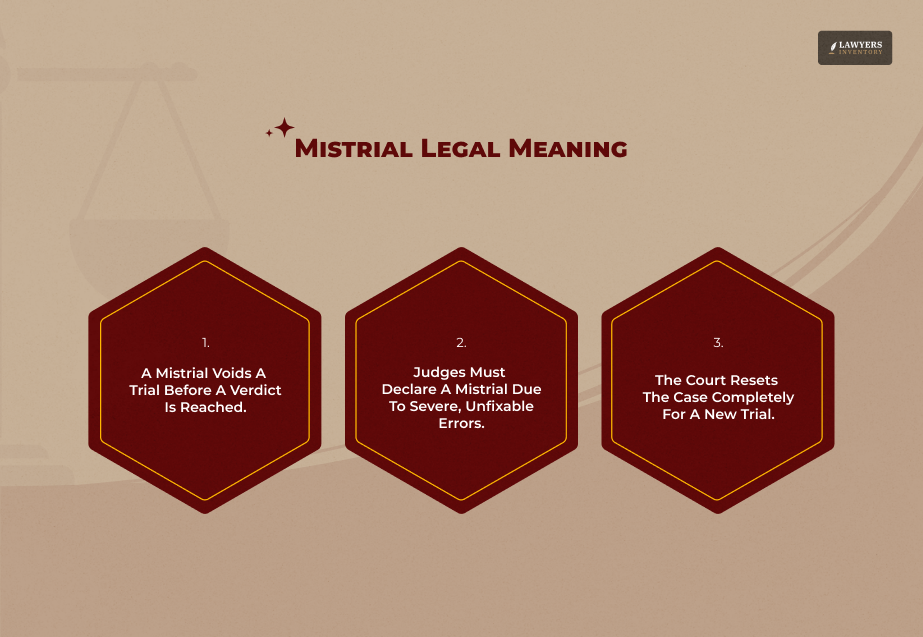
A mistrial is a trial that terminates and becomes void before a jury returns a verdict or a judge renders a decision [Source: American Bar Association].
Declared due to fundamental defects that prevent a fair and legal judgment, a mistrial serves as a critical safeguard. It protects the rights of all parties and ensures the unbiased application of the law [Source: Neal Davis Law, LegalClarity].
Once a judge orders a mistrial, all preceding actions become a legal nullity. The court enters no judgment, records no conviction or acquittal, and resets the case to its pre-trial status. However, a court never makes this decision lightly.
Judges first evaluate whether they can cure the problem, such as by issuing new jury instructions, or if the prejudice requires an entirely new trial.
In federal courts, Federal Rule of Criminal Procedure 26.3 mandates that judges give both the defense and the government a chance to comment, object, or suggest alternatives before halting the trial.
This rule reflects the extreme gravity of erasing weeks or months of legal proceedings instantly. While a deadlocked or hung jury remains the most common cause of a mistrial, numerous other procedural and evidentiary errors can trigger this reset.
The Seven Main Causes Of A Mistrial
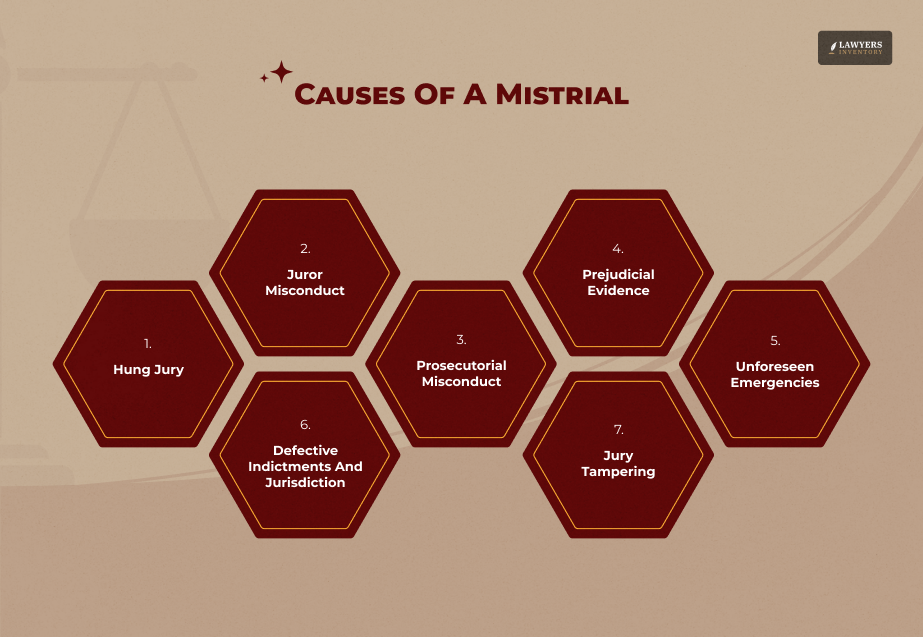
In my research, I identified seven distinct categories of events that can cause what is a mistrial. Each carries different legal consequences for what comes next.
1. Hung Jury
Under the Sixth Amendment, criminal convictions require a unanimous verdict. If jurors deadlock after thorough deliberation, the foreperson reports the stalemate [Source: Neal Davis Law].
While the judge may issue an Allen charge urging reconsideration, persistent deadlocks force the judge to declare a mistrial. Notably, a hung jury is a specific cause of a mistrial, not a synonym for it.
2. Juror Misconduct
Jurors are responsible for impartial and fair decision making which should strictly be done based on the information presented in the courtroom.
Misconduct would mean if a juror looks up online information relevant to the case, goes to the crime scene, or fails to follow the rules for isolation from others, that is sequestration.
Such a contamination can bring an impartial verdict only in which case a mistrial will have to be declared.
3. Prosecutorial Misconduct
If a prosecutor cites the evidence that has been disallowed or breaches the Brady law by withholding beneficial evidence from the opposite side, the court might halt the trial.
Some of the remarks are so devastating in nature that no matter how many instructions the judge gives the jury to forget them, the damage is already done.
4. Prejudicial Evidence
If a witness or a party either intentionally or accidentally discloses in a trial inadmissible, extremely prejudicial information, the judge would determine whether the disclosure would have the ability to make the trial unfair. In that such case is possible for the court not to declare a mistrial.
5. Unforeseen Emergencies
The serious illness or death of a judge, attorney, or juror can end proceedings. If the court exhausts all alternate jurors and cannot maintain the required panel size, it must declare a mistrial.
6. Defective Indictments And Jurisdiction
Procedural flaws, such as a court lacking jurisdiction or a fatally defective indictment, bar the entry of a valid judgment, according to Josh Johnson Law.
7. Jury Tampering
If outside parties threaten, bribe, or intimidate jurors, the entire trial’s integrity fails, forcing an immediate mistrial for safety and justice.
What Happens In A Mistrial: The Step-by-Step Process
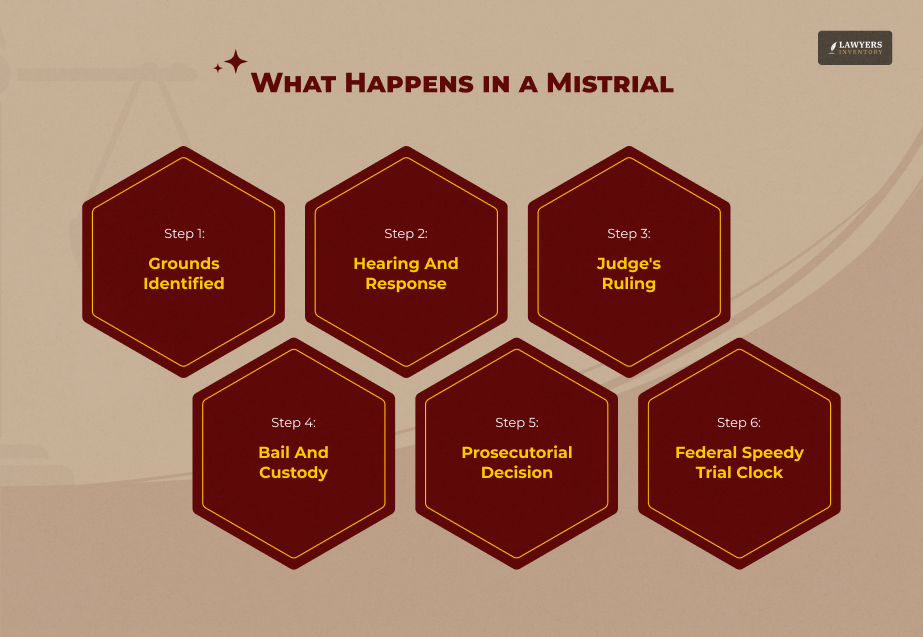
Understanding what happens in a mistrial requires following the procedural sequence from the moment the grounds arise to the final disposition of the case.
Step 1: Grounds Identified
Either a party moves for a mistrial, or the judge identifies the issue independently. Either attorney can file a motion. The judge may also act sua sponte – on their own initiative – if the problem is severe enough.
Step 2: Hearing And Response
Under Federal Rule of Criminal Procedure 26.3, both parties must be given the opportunity to comment, state their position, and suggest alternatives before the judge rules.
Step 3: Judge’s Ruling
The judge formally announces in open court that the trial is terminated. The jury is dismissed; jurors are released from service. The previous trial’s proceedings are treated as void; no verdict of guilty or not guilty is recorded. At that point, the case returns to its pre-trial status.
Step 4: Bail And Custody
A mistrial doesn’t automatically release a defendant from custody or cancel their bail. The judge has discretion to keep existing bail conditions in place, modify them, or set new ones entirely.
Step 5: Prosecutorial Decision
The prosecution must decide whether to retry the case, negotiate a plea, or drop the charges. This is often the most consequential decision that follows what is a mistrial – and it is made without any formal deadline in most state courts.
Step 6: Federal Speedy Trial Clock
In federal cases, the Speedy Trial Act puts a clock on the prosecution. A retrial must begin within 70 days of the date the mistrial becomes final.
If the 70-day deadline passes without a retrial, the defendant can move to have the charges dismissed. State courts have their own rules, and deadlines vary considerably.
Does A Mistrial Mean The Defendant Goes Free?
This is the most persistent misconception I encountered while researching this topic. The answer is almost always no.
A mistrial stops the trial before it concludes and declares it invalid. The decision does not clear or convict the defendant; it resets the case. After a mistrial, prosecutors usually decide whether to retry the case. [Source: Bryan Fagan]
Double jeopardy – the constitutional principle most people instinctively apply here – does not bar retrial after a mistrial in most circumstances.
Jeopardy terminates only upon a final verdict or a dismissal with prejudice. A mistrial produces neither. The retrial is treated as a continuation of the original proceeding, not a new and separate trial.
The exception arises when a mistrial results from intentional prosecutorial misconduct designed to provoke the defense into requesting it.
Under Oregon v. Kennedy (1982), if a prosecutor deliberately “goads” the defense into seeking a mistrial, double jeopardy may bar retrial. This standard is extremely high and rarely met. [Source: Justia]
The Karen Read Case: What Happens When A Mistrial Leads To Retrial
No recent case illustrated the real-world stakes of what is a mistrial more vividly than the Karen Read murder trial in Massachusetts – a case I found myself reading extensively during this research.
Karen Read was found not guilty of the most serious charges in her high-profile Massachusetts murder retrial in June 2025.
In their fourth day of deliberations, jurors acquitted Read of second-degree murder and manslaughter in the death of her boyfriend, Boston police officer John O’Keefe.
She was convicted of driving under the influence of alcohol. Read’s first trial, which started in April 2024 at Norfolk Superior Court in Dedham, ended months later in a mistrial due to a “starkly divided” hung jury. [Source: Yahoo!]
The Karen Read case illustrated something crucial about what is a mistrial that most coverage missed: a mistrial is not a conclusion. It is a reset.
Karen Read’s defense team fought aggressively after the first mistrial to prevent retrial, arguing double jeopardy should apply to charges the jury had allegedly unanimously agreed to acquit on.
Read’s lawyers filed multiple appeals – all the way to the Supreme Court – arguing that double jeopardy should prevent Read from being retried on the charges the jury had allegedly agreed on. According to CBS News, their efforts were unsuccessful, paving the way for Read’s retrial.
The outcome of the retrial – acquittal on the most serious charges – demonstrates why defendants sometimes prefer to push through to a second trial rather than accept a plea.
But it also demonstrates why what happens if a jury is hung twice is one of the most consequential questions in criminal law: the second proceeding can go in an entirely different direction from the first.
Mistrial vs. Related Legal Concepts
In my research, I found that what is a mistrial is most clearly understood in contrast to the legal concepts that surround it.
Mistrial vs. Acquittal:
An acquittal is a formal finding of not guilty. It permanently bars retrial on the same charges under double jeopardy. A mistrial produces no such finding and creates no such bar.
Mistrial vs. Appeal:
An appeal challenges a conviction after verdict. A mistrial terminates the trial before any verdict exists. The two operate at entirely different stages of the process.
Mistrial vs. Dismissal:
A dismissal with prejudice ends the case permanently – the prosecution cannot refile. A dismissal without prejudice allows refiling. A mistrial, by contrast, does not dismiss the charges at all. It simply terminates the current trial proceeding.
Mistrial vs. Hung Jury:
The hung jury vs mistrial relationship is cause and effect. A hung jury is one specific reason a mistrial is declared. Other reasons – misconduct, evidentiary errors, emergencies – also produce mistrials without any jury deadlock.
The difference between indicted vs charged is essentially an issue of language. Both expressions refer to a specific stage in the process of a criminal matter. Merging the two terms would only blur the lines and give us a wrong idea of what has or hasn’t happened from a legal point of view.
What Defendants Should Know After A Mistrial
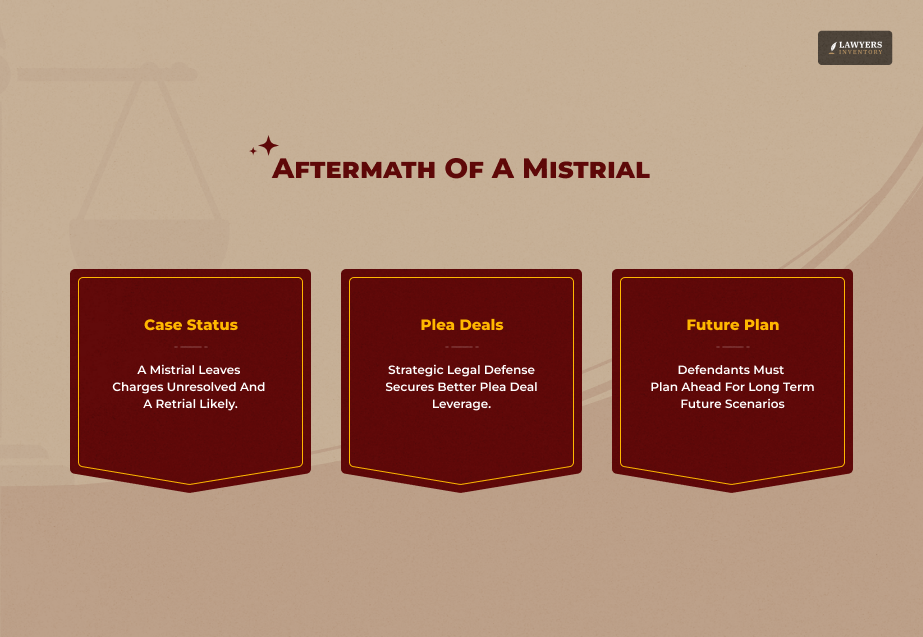
After what is a mistrial is declared, the defendant faces a period of significant uncertainty. The case is not resolved. The threat of retrial remains. Here is what I found matters most in the aftermath.
Legal Representation Is Immediately Critical.
The period between a mistrial and the prosecution’s decision about retrial is often when the most important strategic decisions are made. A qualified legal representative who understands both trial advocacy and plea negotiation can significantly affect the outcome at this stage.
Plea Negotiations May Become More Favorable.
A mistrial – particularly one caused by a hung jury – signals that the prosecution’s case has weaknesses. That leverage can be used in plea discussions.
Post-Conviction Planning Begins Here.
Even before any retrial, defendants and their families often begin researching post-conviction options.
Understanding what does it mean to commute a sentence – and the distinction between commute vs pardon – helps defendants think clearly about the full range of possible outcomes down the line.
These are not immediate considerations, but the period following a mistrial is exactly when long-term legal planning becomes most valuable.
Notable Historical Mistrials
Examining real cases helped me understand what is a mistrial not just as a definition but as a living procedural reality.
The O.J. Simpson Civil Trial Misconduct Concerns:
Simpson’s 1995 criminal trial did not itself produce a mistrial, but it generated extensive discussion about juror conduct, sequestration, and the boundaries between fair process and media saturation that inform modern mistrial jurisprudence.
Harvey Weinstein:
A mistrial was declared in Weinstein’s New York case in 2020 on certain counts after jurors could not reach unanimity on two of the charges.
The case proceeded to verdicts on the remaining counts. It was a vivid example of a partial hung jury – and of what is a mistrial applied to specific counts while verdicts are entered on others.
Aaron Hernandez:
The high-profile murder prosecution of the former NFL player involved multiple proceedings, juror issues, and procedural complexity that tested the boundaries of what courts can do to preserve fair process before and after declaring what is a mistrial.
Some of the most unusual applications of mistrial law appear in cases that might seem at first glance to belong among the weirdest lawsuits in legal history – cases where the grounds for terminating proceedings were so unusual or unforeseen that they tested the outer edges of the doctrine.
But what connects all mistrial cases, however unusual their facts, is the same constitutional principle: a trial that cannot be fair should not continue.
The Systemic Impact Of Mistrials
What is a mistrial costs everyone involved – and the legal system itself.
Repeated trials consume judicial resources, attorney time, and public funds. Witnesses must relive their testimony. Victims and their families endure prolonged uncertainty. Defendants face extended pretrial conditions – bail restrictions, travel limitations, reputational harm – without the finality that only a verdict can provide.
As mistrial frequency increases due to juror exposure to digital content, debates continue regarding safeguards that reduce such occurrences. Procedural reforms now address longstanding loopholes in jury instructions and evidence handling. [Source: EBSCO]
The criminal justice system is actively grappling with the question of how to reduce mistrial rates – particularly hung jury mistrials driven by social media exposure – without compromising the constitutional rights that mistrials exist to protect. That tension is unlikely to be fully resolved anytime soon.
Legal precedent on what is a mistrial continues to evolve as courts confront new challenges: jurors who research cases on smartphones overnight, social media exposure during short breaks in sequestration, and witnesses whose public statements reach jurors through indirect channels no cautionary instruction can fully address.
Sources:
- Legal Information Institute, Cornell Law School – Mistrial (law.cornell.edu/wex/mistrial)
- American Bar Association – How Courts Work: Mistrials (americanbar.org)
- LegalClarity – What Is a Mistrial in Court? Causes and What Comes Next (April 2026)
- Josh Johnson Law – What Happens in a Mistrial? Legal Process Explained (February 2026)
- Bryan Fagan Law – What Is a Mistrial and How Does a Mistrial Work? (April 2026)
- The Legal Guide – What Happens When a Case Is a Mistrial (2026)
- EBSCO Research Starters – Mistrials (October 2025)
- Federal Rules of Criminal Procedure, Rule 26.3 – Mistrial
- Federal Rules of Criminal Procedure, Rule 31(b)(3) – Partial Verdicts
- Ramos v. Louisiana, 590 U.S. 83 (2020)
- Oregon v. Kennedy, 456 U.S. 667 (1982)
- United States v. Perez, 22 U.S. 579 (1824)
- NPR – Karen Read Acquitted in 2nd Murder Trial (June 18, 2025)
- CBS Boston – Karen Read Trial: Full Timeline (June 2025)
18 U.S.C. § 3161 – Speedy Trial Act: Time Limits and Exclusions
Leave A Reply






Hung Jury vs. Mistrial: What Is The Difference And Why It Matters
Read More
NarodniyDimUkraina: An Overview Of The Kyiv-Based Brand Preserving Ukrainian Craftsmanship
Read More
What Is A Sequestered Jury? Legal Definition, Process, And Everything You Need To Know
Read More
What Is A Hung Jury? Legal Definition, Causes, And What Happens Next
Read More
Commute Vs. Pardon: What Is The Difference And Which One Do You Need?
Read More
0 Reply
No comments yet.