Quick Answer

In the hung jury vs mistrial comparison, the core distinction is this: a hung jury is one specific cause of a mistrial, while a mistrial is the broader legal result. A hung jury occurs when jurors cannot reach a unanimous verdict after extensive deliberation. A mistrial is the formal termination of a trial without a verdict - and it can result from a hung jury, but also from juror misconduct, prosecutorial error, prejudicial evidence, or other procedural failures. Every hung jury produces a mistrial. Not every mistrial involves a hung jury.
Initially, when I started researching this topic – hung jury vs mistrial distinction – I expected to find a clean, widely understood line between the two concepts.
However, I found one of the most consistently conflated distinctions in American criminal law. One that legal commentators, journalists, and even some attorneys use interchangeably, despite the fact that they describe fundamentally different things.
The confusion is understandable.
The two concepts are closely connected. But treating them as synonyms leads to real misunderstanding – of what rights a defendant has, what the prosecution can do next, and what actually happened in a courtroom.
The Core Distinctions At A Glance
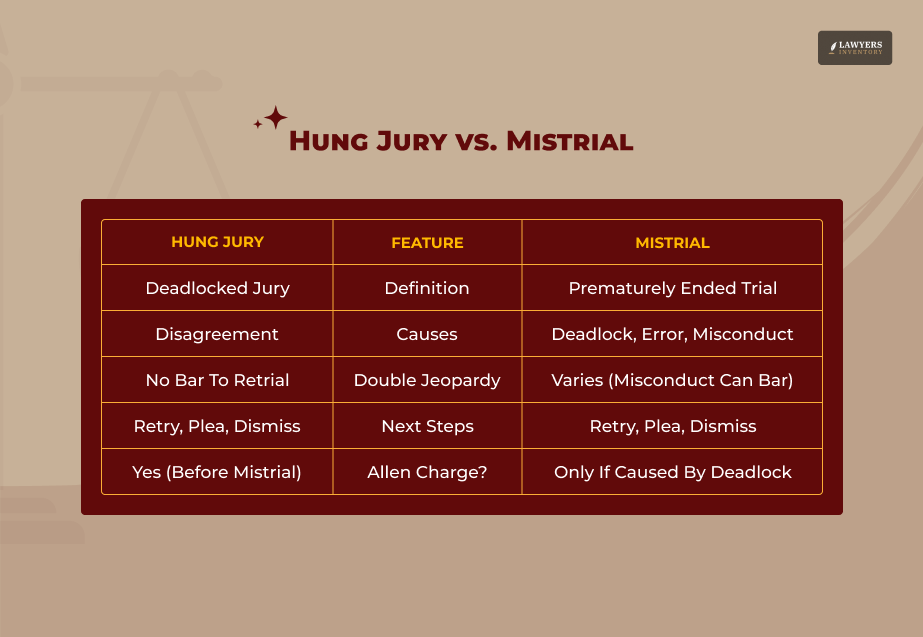
| Scope | Hung Jury | Mistrial |
| Definition | Jury cannot reach a unanimous verdict | Trial terminated without a verdict |
| Cause | Juror deadlock | Hung jury, misconduct, error, emergency |
| Result | Always produces a mistrial | May or may not involve a hung jury |
| Double jeopardy? | Generally does not bar retrial | Depends on cause – misconduct may bar retrial |
| Prosecution options | Retry, plea, dismiss | Retry, plea, dismiss – subject to double jeopardy analysis |
| Allen charge used? | Yes – before mistrial declared | Not applicable to non-deadlock mistrials |
What Is A Hung Jury?
A hung jury is also called a deadlocked jury. This happens when jurors cannot agree on a verdict. Every single juror must agree on guilt or innocence.
The Supreme Court confirmed this rule in Ramos v. Louisiana (2020). Today, all U.S. jurisdictions require a unanimous decision for criminal convictions. Just one dissenting juror stops the entire process.
A hung jury does not acquit the defendant. It does not convict the defendant either. It simply means the jurors reached an impasse.
Jurors disagree for several reasons. They debate the credibility of witnesses. They interpret the law differently. Most often, they disagree about the evidence.
The National Center for State Courts researched this issue. They found that evidence problems cause 71% of hung juries. Poor evidence quality drives these deadlocks. When a jury cannot agree, the judge declares a mistrial.
What Is A Mistrial?
A mistrial ends a trial early. The judge declares the trial void before anyone delivers a final verdict.
A hung jury is just one cause of a mistrial. Other problems also stop a trial. Judges declare mistrials for procedural errors. They stop trials for juror or attorney misconduct.
Severe illness of a key participant also causes a mistrial. Any major error that ruins trial fairness can trigger this ruling.
A hung jury always leads to a mistrial. However, other errors cause mistrials too.
The next legal steps depend on the cause of the mistrial. Usually, the prosecution retries the defendant after a hung jury.
But sometimes prosecutors commit severe misconduct. If that happens, the court bars a retrial to protect the defendant from double jeopardy.
Hung Jury vs Mistrial: The Hung Jury Mistrial Overlap
The most common cause of a mistrial is a hung jury.
When jurors cannot reach unanimity after extensive deliberation, the judge typically issues an Allen charge – sometimes called a “dynamite charge” – urging further deliberation. If the jury remains deadlocked, the judge declares a mistrial.
When a hung jury results in a mistrial, the procedural sequence is well-established. The jurors are discharged from any further deliberations or jury service in the case. All proceedings are treated as void. The case returns to its pre-trial status.
The prosecution then has three options:
- retry the case with a new jury,
- negotiate a plea agreement,
- drop the charges entirely.
This point in the hung jury vs. mistrial dynamic is where most people’s legal knowledge focuses – and understandably so, since the hung jury mistrial is the most publicly visible type.
High-profile cases like the Karen Read murder trial – where the first trial in 2024 ended in a hung jury, producing a mistrial, before a second trial resulted in acquittal on the most serious charges in 2025 – demonstrate both how common this sequence is and how different the second trial’s outcome can be from the first.
Mistrials Without Hung Juries: Hung Jury vs Mistrial Difference
This is the part of the hung jury vs mistrial distinction that most people miss entirely. Mistrials can – and do – occur for reasons that have nothing to do with jury deadlock.
Juror Misconduct
A judge can stop a trial if a juror acts improperly. This misconduct ruins the chance for a fair trial.
Jurors cannot research the case outside of court. They cannot discuss the trial with outsiders. They must also follow sequestration rules when the judge isolates the jury.
A single juror can ruin the whole panel. They do this by visiting a news website about the case. They also ruin it by contacting one of the parties. This improper behavior damages the integrity of the trial.
Prosecutorial Misconduct
Prosecutors must follow strict rules during a trial. A judge might throw out a case if a prosecutor breaks these rules.
For instance, prosecutors cannot mention inadmissible evidence. They cannot make improper remarks that prejudice the jury.
The Brady decision creates a specific duty for prosecutors. It forces them to share all helpful evidence with the defense. A defense lawyer might expose a Brady violation during trial.
The judge will try to fix the problem with instructions. If instructions fail, the judge must declare a mistrial to ensure fairness.
Prejudicial Evidence
Sometimes the jury sees forbidden evidence. This happens by accident or on purpose. When it happens, the judge must evaluate the damage. The judge decides if a simple warning to ignore the evidence will fix the issue.
Some statements cause extreme harm. A simple instruction cannot wipe out their negative effect.
High levels of bias ruin the trial’s fairness. In these severe cases, the judge has only one option. The judge declares a mistrial.
Unforeseen Emergencies
The death or serious illness of a juror, attorney, or judge can also produce a mistrial – particularly when all alternates have been used.
A natural disaster, a courthouse emergency, or any other extraordinary event that makes continuation impossible falls into the same category.
Jurisdictional Defects
Mistrials may also be declared for legal reasons, such as lack of jurisdiction. If a court determines mid-trial that it lacks authority over the parties or the subject matter, a mistrial is entered in place of judgment.
A fatally defective indictment that would guarantee reversal on appeal may also prompt termination of proceedings.
This connects to the broader question of indicted vs charged – the legal sufficiency of the charging document is not merely a starting-gun issue. Its adequacy matters throughout the proceedings.
The Critical Legal Difference: Double Jeopardy
The hung jury vs. mistrial distinction carries its most significant practical consequences in the double jeopardy analysis – and this is where the difference in types of mistrial matters most.
The Double Jeopardy Clause of the Fifth Amendment protects individuals from being tried twice for the same offense after a final verdict.
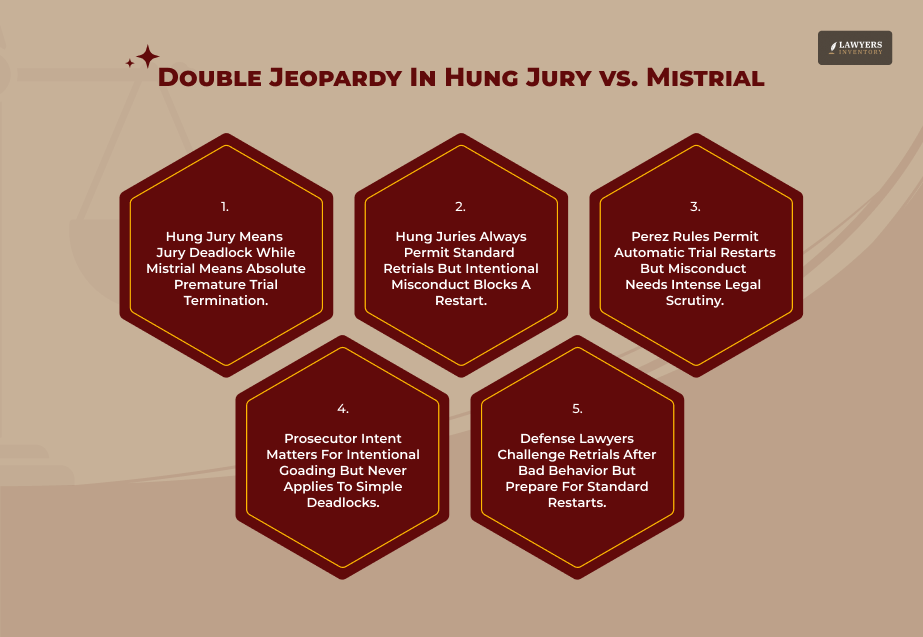
When a mistrial is declared due to a hung jury, double jeopardy generally does not apply. A mistrial due to a hung jury does not terminate jeopardy, so a prosecutor can choose to try the case again without violating the prohibition against double jeopardy.
Since 1824 – when the Supreme Court decided United States v. Perez – retrial after a hung jury has been considered constitutionally permissible under the doctrine of manifest necessity.
But when a mistrial is declared due to prosecutorial misconduct, the double jeopardy analysis changes significantly.
If the judge or the prosecution contributed to the mistrial, the prosecution cannot simply choose to re-prosecute the defendant.
Under Oregon v. Kennedy (1982), if a prosecutor deliberately “goads” the defense into seeking a mistrial, double jeopardy may bar retrial entirely.
This exception is narrow and requires clear evidence of intentional prosecutorial manipulation – but it represents a fundamental difference in legal outcome depending on which type of mistrial occurred.
Understanding this distinction is one reason that working with a qualified legal representative after a mistrial is so important.
The defense’s ability to challenge retrial – and the grounds on which it can do so – depends entirely on why the mistrial was declared in the first place.
Hung Jury Vs Mistrial: What Happens After Each Type?
The aftermath of a mistrial varies significantly depending on its cause – and this is where the hung jury vs. mistrial distinction becomes most practically relevant for defendants and their families.
After A Hung Jury Mistrial:
The prosecution retains full discretion to retry. The decision depends on the jury split, the strength of the evidence, and the seriousness of the charges.
A hung jury split 11-1 for conviction suggests a strong case worth retrying. A split 7-5 for acquittal tells a very different story.
This analysis directly feeds into what happens if a jury is hung twice. And that’s because a second consecutive deadlock significantly weakens the prosecution’s position and often prompts dismissal or plea negotiations.
After A Juror Misconduct Mistrial:
Retrial is generally permitted, since the misconduct was not attributable to the prosecution. The defense may, however, argue for dismissal if the misconduct was severe and prejudicial enough.
After A Prosecutorial Misconduct Mistrial:
This scenario creates the strongest opportunity for the defense to challenge a retrial. The defense must show that the prosecutor acted intentionally.
They must prove the prosecutor deliberately provoked the mistrial. If the defense proves this intent, double jeopardy bars a new prosecution entirely.
After An Emergency Mistrial:
Retrial is typically permitted without complication. The termination was beyond anyone’s control, and no constitutional rights were implicated by the emergency itself.
In all cases following what is a mistrial, the legal system treats the prior proceedings as void. The prosecution begins fresh – new jury selection, new opening statements, new presentation of evidence.
Anything that happened in the previous trial is treated as legally irrelevant to the subsequent one, though the parties obviously carry knowledge of the prior proceedings into the new trial.
The Role Of The Allen Charge
Before any hung jury reaches the stage of producing a mistrial, most judges attempt one critical intervention: the Allen charge.
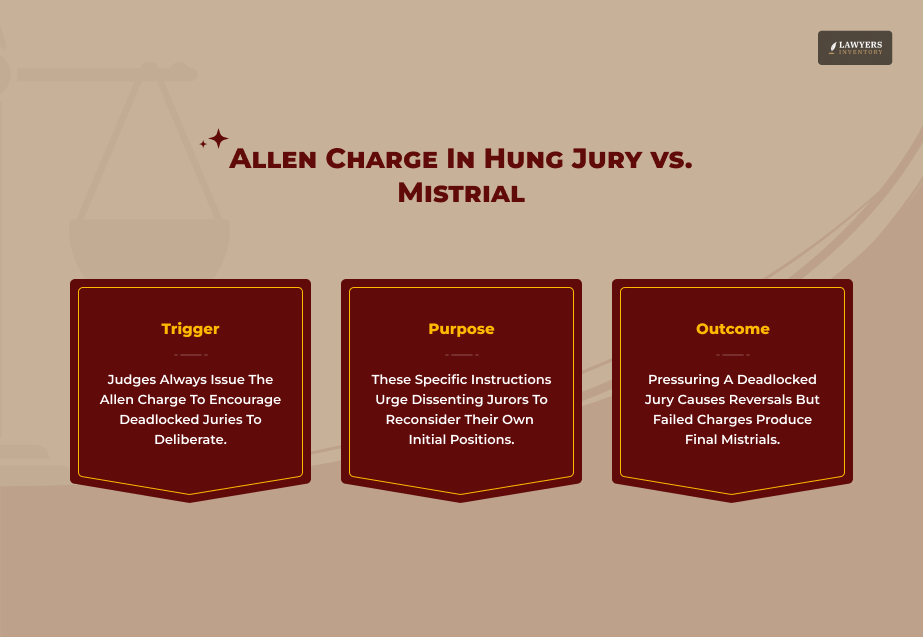
When a jury first reports deadlock, most judges respond with supplemental instructions to the jurors to resume deliberations.
The Allen charge specifically encourages dissenting jurors to reconsider their positions in light of the majority’s view – while making clear that no juror should abandon a genuinely held conviction simply to reach a verdict.
Courts walk a careful line here: an instruction that pressures jurors to capitulate on genuine reasonable doubt can itself be grounds for reversal.
If the Allen charge fails and the deadlock persists, the judge has no alternative but to declare a mistrial.
This procedural sequence – deadlock, Allen charge, mistrial – is the standard path from a hung jury to a formal termination of proceedings.
Read Also: What Is A Sequestered Jury? Legal Definition, Process, And Everything You Need To Know
Hung Jury vs Mistrial In High-Profile Cases
The Karen Read case brought the hung jury vs. mistrial distinction into unusually sharp public focus.
Her first trial in 2024 ended in a hung jury – a deadlock among jurors that produced a mistrial – before her second trial in 2025 resulted in acquittal on the most serious charges.
What made the Karen Read case legally significant beyond its facts was the defense’s attempt to use the first mistrial to block retrial on double jeopardy grounds.
The defense argued that the hung jury reflected partial acquittals on certain counts – a theory that, if accepted, would have transformed a hung jury mistrial into something more like an acquittal.
The Supreme Court declined to accept that argument, and the retrial proceeded. The outcome – acquittal on the most serious charges – vindicated the defense’s decision to push through rather than accept a plea.
This case also illustrated why the hung jury vs. mistrial distinction matters for legal precedent. Courts have consistently held that hung jury mistrials permit retrial.
But the legal arguments Karen Read’s team raised – about when a hung jury may implicitly contain acquittal verdicts on specific counts – represent a live and unresolved area of law that may produce new precedent in the years ahead.
The criminal justice system has produced other notable examples of this dynamic.
The O.J. Simpson civil trial, the Harvey Weinstein proceedings, and various organized crime prosecutions have all involved mistrials of different types – each illustrating how the specific cause of the mistrial shapes what comes next.
Even some of the weirdest lawsuits in legal history have produced mistrials, demonstrating that the doctrine applies across the full range of civil and criminal proceedings.
Hung Jury Vs Mistrial: Practical Implications For Defendants
A hung jury mistrial changes legal strategy immediately. Defendants manage retrials better when they understand this deadlock. They also improve their plea negotiation tactics.
A second hung jury alters the prosecutor’s plan. This repeat deadlock shifts their perspective. It often prompts prosecutors to drop the charges completely. Other times, it forces them to offer a better plea deal. [Source: NYC Criminal Attorneys]
Defendants cannot ignore long-term consequences after a mistrial. They must still prepare for a potential conviction. This preparation requires learning about post-conviction options. Defendants must study commutations and pardons.
A commutation reduces a sentence’s severity. It shortens the punishment. However, it keeps the underlying conviction on the record. A pardon works differently. It wipes out the conviction entirely. It also restores the person’s civil rights.
The government only grants these options after sentencing. Even so, the post-mistrial phase is the perfect time to review them. This knowledge helps families build solid legal strategies for the future.
Disclaimer: This article is for general informational and educational purposes only. It does not constitute legal advice. If you are involved in a case where a hung jury or mistrial has occurred, consult a qualified criminal defense attorney immediately to understand your rights and the legal options available in your specific jurisdiction.
Sources:
- Legal Information Institute, Cornell Law School – Hung Jury (law.cornell.edu/wex/hung_jury)
- Legal Information Institute, Cornell Law School – Mistrial (law.cornell.edu/wex/mistrial)
- Vista Criminal Law – Mistrials and Hung Juries (August 2024)
- SmartRules Blog – Understanding the Legal Distinctions: Hung Jury vs. Mistrial (March 2025)
- CDH Law PLLC – What Happens If There Is a Mistrial Due to a Hung Jury? (2025)
- Calcagni Law – Mistrial by Hung Jury (February 2025)
- Cron, Israels & Stark – Hung Jury in California: What It Means and What Happens Next (April 2026)
- Law Office of David D. White – What Happens When There Is a Mistrial (May 2026)
- Ramos v. Louisiana, 590 U.S. 83 (2020)
- Oregon v. Kennedy, 456 U.S. 667 (1982)
- United States v. Perez, 22 U.S. 579 (1824)
- National Center for State Courts – Hung Jury Deliberations Research
- Federal Rule of Criminal Procedure, Rule 31(b)(3) – Partial Verdicts
- NPR – Karen Read Acquitted in 2nd Murder Trial (June 18, 2025)
Leave A Reply






NarodniyDimUkraina: An Overview Of The Kyiv-Based Brand Preserving Ukrainian Craftsmanship
Read More
What Is A Mistrial? Legal Definition, Causes, And What Happens Next
Read More
What Is A Sequestered Jury? Legal Definition, Process, And Everything You Need To Know
Read More
What Is A Hung Jury? Legal Definition, Causes, And What Happens Next
Read More
Commute Vs. Pardon: What Is The Difference And Which One Do You Need?
Read More
0 Reply
No comments yet.