Quick Answer:

Nolle prosequi (often abbreviated as “nol. pros.” or “nolle prosed”) is a, “to be unwilling to pursue” or “will no longer prosecute.” The prosecutor, or a plaintiff, in a civil lawsuit makes a formal statement that is entered into the court record that the charging or prosecution of a case has been withdrawn voluntarily by them.
The intersection of absolute executive authority and individual liberties is where we find nolle prosequi. It is a Latin legal maxim meaning “we shall no longer prosecute.”
It represents one of the most powerful tools in a prosecutor’s arsenal. Furthermore, it allows government attorneys to unilaterally halt criminal proceedings before a verdict.
I recently watched this power play out in high-profile arenas. For instance, consider the decision by prosecutors to drop charges against four individuals accused of vandalizing the National Mall Reflecting Pool.
They filed a nolle prosequi to officially end the case.
I see this as an ideal case study. It shows how the mechanism alters the course of justice in an instant. While a legal assistant drafts the formal motions, the decision itself rests entirely on strategic prosecutorial discretion.
What Is Nolle Prosequi?
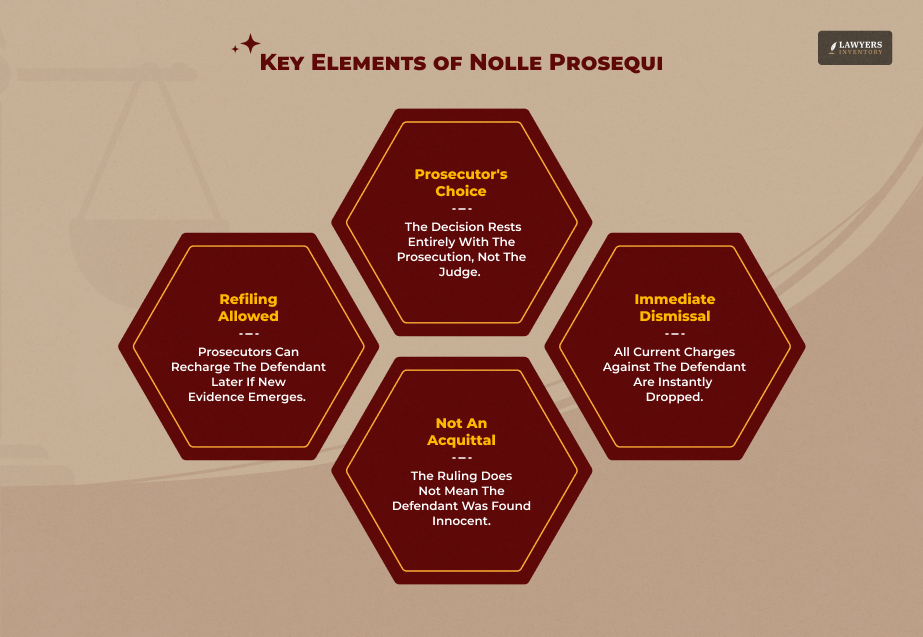
Nolle prosequi is a Latin legal term that literally means “not to wish to prosecute.” It is a formal notice that a prosecutor enters into the court record to voluntarily drop criminal charges. [Source: Legal Information Institute]
Prosecutors normally use such a power when they think a case has become too weak to keep fighting.
One instance would be that the state’s evidence had been destroyed, or, for example, a material witness could have gone missing.
Conversely, the prosecutor could drop the charges if the defendant turns out to have an unusually solid defense.
After the prosecutor issues the notice of discontinuation of prosecution, the case is over immediately, and the defendant is released by the court.
But remember that the dismissal of the case by the prosecutor is not the same thing as an acquittal. Since the verdict has not been reached by the court, the jury cannot declare the defendant “not guilty.”
Also, as a result of this, double jeopardy does not apply to this situation. This means the state can theoretically file the exact same charges again in the future. To do this, they simply need to present new evidence and act before the statute of limitations expires.
Apart from that, the original arrest will still show up on the defendant’s criminal record. The only way to remove it is if the defendant actively requests an expungement through the legal system.
Key Reasons For Nolle Prosequi
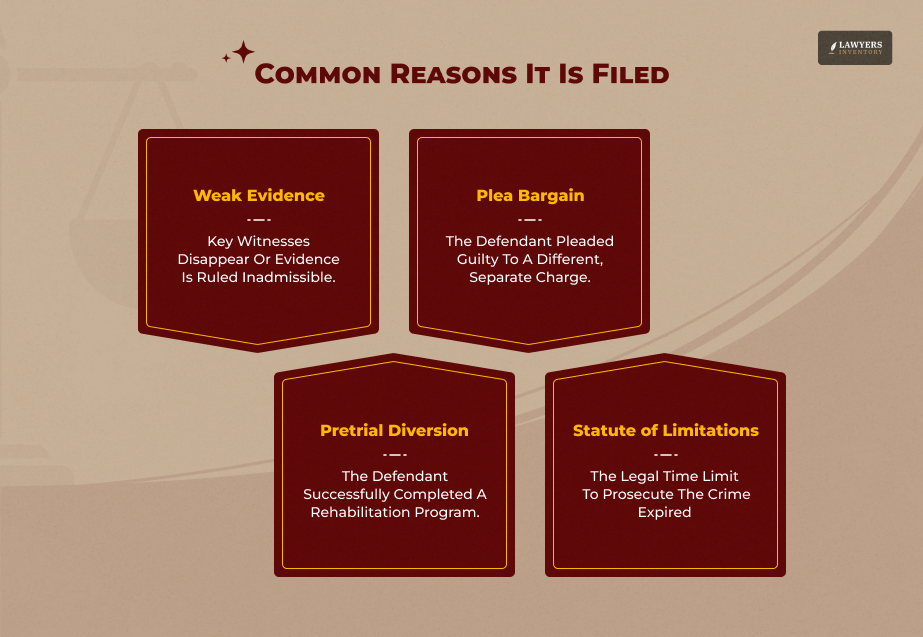
Prosecutors do not walk away from cases without structural reasons. The most common reasons for nolle prosequi involve evidentiary failures or systemic shifts.
A vital witness might disappear. Forensic data could be thoroughly discredited. Sometimes, new evidence entirely refutes the original claim of the state.
| Factor | Impact on the Prosecution |
| Witness Unavailability | Destroys the testimonial foundation of the case. |
| New Exculpatory Evidence | Introduces reasonable doubt or proves innocence. |
| Interests of Justice | Allows diversion programs for first-time offenders. |
I have closely followed the global legal landscape, observing unique applications of this rule. For example, recent proceedings in Bermuda highlighted how the Director of Public Prosecutions can bring criminal matters to an immediate halt [Source: Bernews].
In these moments, the state explicitly acknowledges that continuing the case would violate the standards of fair justice.
To understand how law firms highlight these defense victories, look at modern criminal defense marketing. It heavily focuses on showcasing dropped charges as a primary measure of success.
Does Nolle Prosequi Mean Dismissed?
A common point of confusion is whether the term equates to a complete case dismissal. The short answer is no – they are structurally different. A dismissal is often a permanent, court-ordered termination of charges.
Meanwhile, a nolle prosequi is a voluntary declaration by the state. It signals a decision to stop the current prosecution – frequently leaving the door open for future action.
I often notice how everyday people confuse this process with acquittal. An acquittal means a jury or judge found you not guilty. This mechanism simply means the state is pausing or abandoning the current indictment.
If you are a client seeking relief, your legal representative will tell you that the distinction matters immensely. It directly affects whether the state can rewrite your charges later on.
Will I Have A Criminal Record If My Case Was Nolle Prosequi?
One major concern for defendants is the lingering impact on their backgrounds. A constant thought that appears is: Will I have a criminal record if my case was nolle prosequi?
Yes, the initial arrest record remains visible to employers, landlords, and lenders. The case will show as dropped, but it does not vanish automatically.
Here’s how the process exactly happens, step-by-step:
- Arrest occurs.
- Charges filed.
- Nolle prosequi entered.
- Arrest record lingers.
- Expungement required.
Fortunately, progressive legal updates are actively addressing this issue. As of March 2026, jurisdictions like Shelby County, Tennessee, began automatically expunging cases carrying a nolle prosequi status without charging court fees.
This prevents individuals from carrying a legacy of unproven guilt. I view this as a massive step forward. It eliminates the systemic trap where innocent people are penalized by background checks.
The Statistical Black Hole: Behind The Hidden Data Of Dropped Charges
I find that the deepest flaw in public legal discourse is the total lack of transparency surrounding dropped cases.
In most courtrooms, a prosecutor stands up and enters a nolle prosequi without offering any detailed public explanation. This creates a massive data vacuum that leaves communities entirely in the dark.
Investigative journalists are forced to use open records laws to uncover the real motivations behind these decisions.
I have tracked data showing that high rates of dropped charges often mask deeper systemic failures.
Within state offices, these include:
- Illegal police searches.
- Unreliable forensics.
- Severe budget constraints.
When the government hides behind a Latin phrase without publishing its rationale, true institutional accountability becomes impossible. This lack of clear record-keeping turns the process into a statistical black hole that undermines public confidence.
The legal system must demand open documentation to ensure this power is never abused to hide prosecutorial mistakes or establish an unfair legal precedent.
Can A Nolle Prosequi Case Be Reopened?
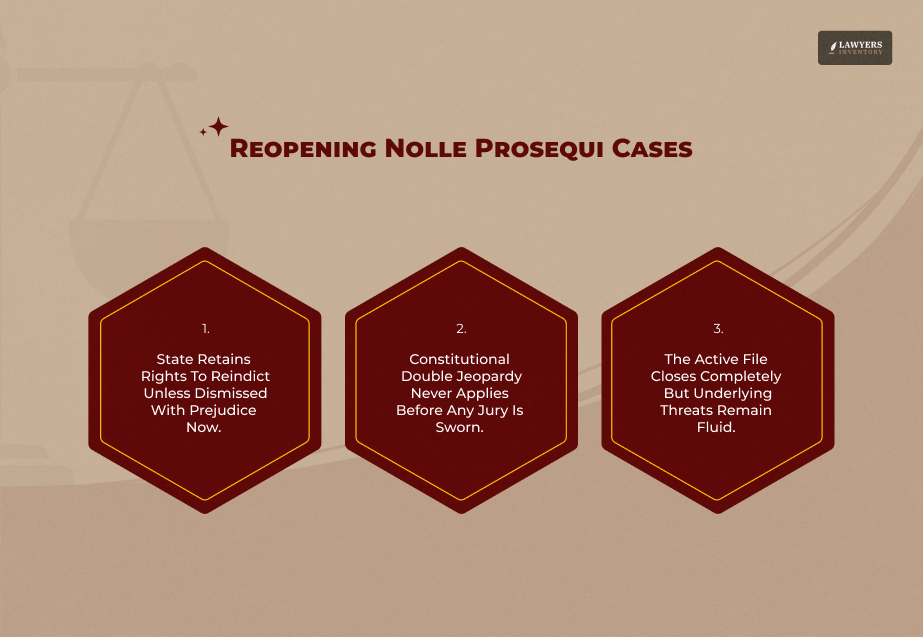
The question of finality often keeps defendants awake at night. Can a nolle prosequi case be reopened?
Unless a judge specifically attaches the phrase “with prejudice” to the order, the state generally retains the right to re-indict a person if new evidence emerges.
I analyze this through the lens of constitutional protections. Double jeopardy only applies once a jury is sworn or a plea is entered. Because a nolle prosequi occurs before this point, it does not bar future prosecution.
The phrase is inherently tied to the nolle prosequi past tense or “nolle-prossed” action. This means the specific active files are dead.
However, the state can technically revive the underlying threat. This is not like a civil writ of possession that finalizes property transfers – it remains fluid.
Global Legal Context And The Fight Against Abuse
The absolute nature of this power has triggered intense global debates. I find the evolving situation in Ghana particularly striking. Scholars are openly asking if the Attorney General’s exercise of nolle prosequi can be legally challenged in Ghanaian courts [Source: B&FT].
The Supreme Court of Ghana ruled that the Attorney General can discontinue cases brought by the Office of the Special Prosecutor (OSP).
This decision has raised serious concerns regarding accountability. It makes people ask how independent an anti-corruption body can be if an AG can stop a trial with a single pen stroke.
If the executive branch can kill any case without providing public reasons, the risk of political interference skyrockets. I believe this conversation is breaking new ground. It challenges the traditional concept of unreviewable prosecutorial power.
The Human And Systemic Impact Of Legal Limbo
I believe we must look at the immense psychological toll this mechanism takes on human beings.
From the institutional perspective of a prosecutor, entering this motion is an ethical necessity when a case falls apart. It prevents the state from unethically pursuing a conviction on weak grounds.
However, defense attorneys rightly view this open-ended resolution as a permanent “Sword of Damocles” hanging over their clients.
Technically, since the state might bring up the case again, the person finds themselves stuck in a legal limbo situation.
It is hard for them to forget the incident. On top of that, they might not be able to get jobs or be free to pursue their happiness while knowing they are free from charges and being able to move on.
Such a situation gives the state huge powers without ever being held accountable for it. This is because they would never have to prove the defendant’s guilt at a trial, like in the case of People v Beggs. [Source: CaseMine]
This also shows a serious injustice in the system – one where the idea of freedom is a farce, and the wrongdoer goes free without being proven innocent first.
Immediate Next Steps: An Actionable Guide After A Nolle Prosequi Case
If a prosecutor has dropped your charges using this motion, you cannot afford to sit back and assume your troubles are over.
I highly recommend taking immediate, proactive steps to secure your legal standing and clear your name.
- Secure the Certified Minute Order: Do not rely on verbal promises from the courtroom. Have your attorney obtain a certified copy of the official court order showing the entry of the drop.
- Determine Your Local Expungement Timeline: Research the specific rules in your state code. Figure out if authorities will wipe out your arrest record immediately or if a formal waiting period applies.
- Demand the Discharge of Bail Bonds: Contact your bail bondsman immediately to ensure your bond is formally discharged and any collateral is returned to you safely.
Is Nolle Prosequi A Good Thing?
Evaluating whether nolle prosequi is a good thing depends entirely on your position in the courtroom.
For an innocent defendant, it is an absolute lifeline that provides immediate freedom. For the legal system, it offers a pragmatic escape valve to drop weak cases without wasting public funds.
However, it can leave victims feeling entirely abandoned by the state. From a historical perspective, this mechanism acts as an important structural check within the separation of powers.
It is like the weirdest lawsuits on one side and the most fundamental statutes on the other – a constant evidence that the law is all about the principle of adaptability and flexibility.
It turns out that when we flip to a nolle prosequi statute of that state that has a separate chapter on statutory nolle prosequi, the section is really a collection of rules whose purpose is to stop the initiation of prosecutions with evil intent.Ultimately, it keeps the scales of justice balanced, even if it leaves some questions permanently unanswered.
Leave A Reply






What Is An Operating Agreement? LLC Requirements, Key Provisions, And Why You Need One
Read More
Intentional Infliction Of Emotional Distress Explained: Elements, Evidence, And What Makes A Claim Win
Read More
What Is A Preliminary Hearing? Core Procedures, Timeline, And What To Expect
Read More
What Is Grand Larceny? Felony Thresholds, Penalties, And Your Legal Options
Read More
Larceny vs. Theft: What’s The Real Legal Difference?
Read More
0 Reply
No comments yet.