
Quick Answer

A writ of possession is a legal court order that signals one of the final steps in an eviction process. It allows a landlord to regain control of their property by removing tenants. A court issues it after a landlord successfully wins an eviction lawsuit. It informs the tenant that they must leave the rental property by a specific time or otherwise face forcible removal by law enforcement officers. A writ of possession is not the same as an eviction. It is the enforcement document that follows an eviction judgment - and only becomes necessary when a tenant has not voluntarily vacated after losing in court.
Throughout my research, I consistently find that the writ of possession is the step most people misunderstand. Tenants confuse it with the eviction lawsuit itself. Landlords assume it guarantees instant removal.
Neither is correct.
A writ of possession is not the beginning of an eviction. It is the end of one – specifically the enforcement mechanism that follows a court judgment.
What Is A Writ Of Possession?
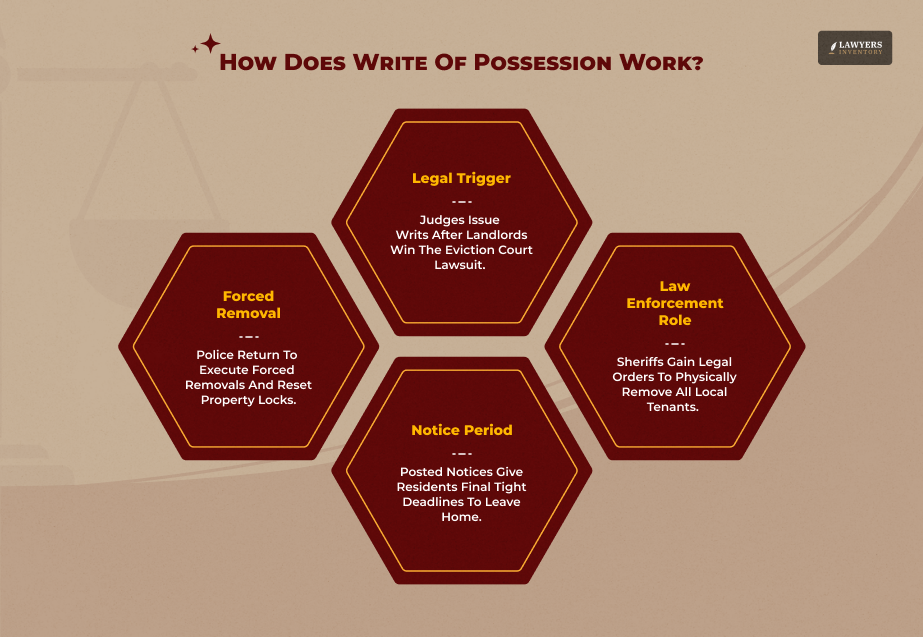
A writ of possession is a legally binding court order with the effect of a law that enables the property owner or the landlord to regain possession of their physical property or real estate from the tenant or person who is refusing to vacate the property.
According to Law District, “It informs the tenant that they must leave the rental property by a specific time or otherwise face forcible removal by law officers.”
It is, in fact, the last step in the eviction or mortgage termination, with the legal consequence of allowing police officers to physically remove those individuals and their property from the premises.
Writ Of Possession Vs. Eviction: Is A Writ Of Possession The Same As An Eviction?
Most people use “eviction” and “writ of possession” interchangeably. They are related – but they are not the same thing.
The terms writ of possession and eviction are often used interchangeably, but they describe different stages in a landlord-tenant dispute.
In most jurisdictions, eviction is the overall legal action to remove a tenant. A writ of possession is a court-issued order that authorizes a landlord or property owner to regain physical control of a rental unit.
It is not itself a new eviction action – it is a post-judgment enforcement tool used after a court has ruled in favor of the landlord.
The eviction process moves through several distinct stages.
- First, the landlord serves a formal eviction notice.
- Second, if the tenant does not comply, the landlord files an unlawful detainer lawsuit.
- Third, the court holds a hearing and issues a judgment.
If the landlord prevails and the tenant still does not leave, the court then issues a writ of possession.
A landlord will not need to file a writ of possession if they legally notify a tenant of eviction and the tenant leaves voluntarily.
A court-granted writ of possession means the landlord won an eviction court hearing, but the tenant has not left the rental property yet.
That distinction is critical for both parties. For tenants, it means the writ is not a surprise – it follows a court proceeding you had the opportunity to attend.
For landlords, it means you cannot skip the legal process and proceed directly to physical removal.
How A Writ Of Possession Is Obtained
The process leading to a writ of possession is sequential and non-negotiable. No valid writ exists without a completed court proceeding.
The property owner first files a lawsuit, commonly called an unlawful detainer or eviction action, asking a court to declare that the occupant’s right to stay has ended.
The court schedules a hearing. Both parties can attend and present evidence. If the landlord prevails, the court issues a judgment of possession.
Only after that judgment – and only if the tenant has not vacated voluntarily – does the landlord request a writ of possession.
After the court rules in favor of the landlord in an eviction lawsuit, an officer of the law serves the writ of possession to the tenant.
The writ is then delivered by the sheriff or constable – not by the landlord. This procedural requirement exists for a reason.
It ensures that physical removal happens through official channels, under law enforcement supervision, rather than through self-help action by the property owner.
Landlords must follow procedural rules to avoid challenges to the eviction and writ process. Notice compliance – accurate and timely notices – is essential.
Proper filing, service, and hearings are required at every stage. A writ issued after a defective proceeding can be challenged and potentially overturned.
Grounds For A Writ Of Possession: When Can You File?
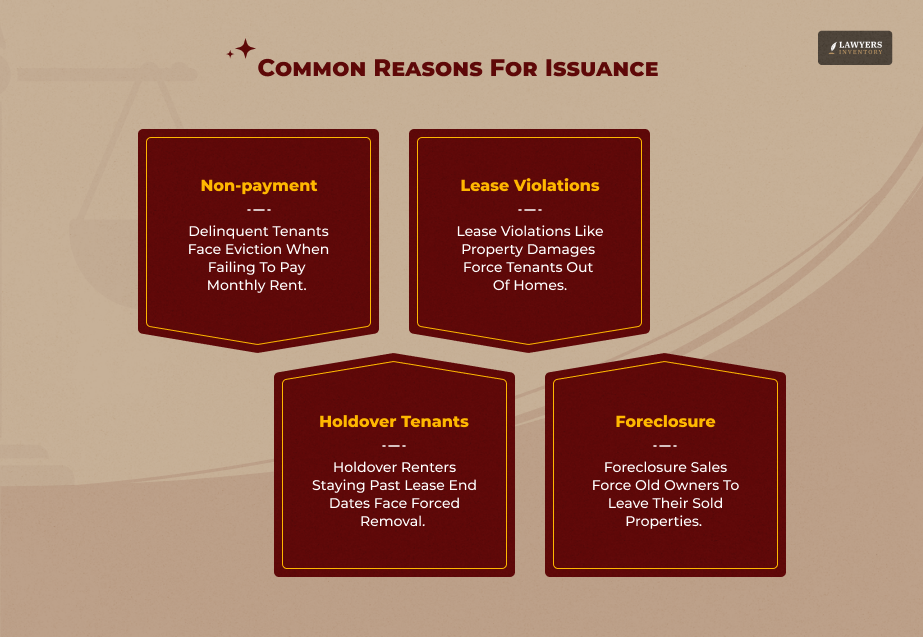
Although non-payment of rent is the most common reason for eviction, landlords can evict tenants for other lease agreement violations.
Court-approved reasons for eviction – and therefore for a writ of possession – include unpaid rent, property damage, unauthorized occupants, illegal activity, and other lease violations.
Specifically, the following violations frequently result in eviction proceedings that lead to a writ:
- Allowing unlisted occupants to reside in the unit
- Pet violations in a no-pet property
- Misuse, abuse, or illegal activity on the premises
- Material lease violations beyond nonpayment
In some situations, writs of possession can also be issued to homeowners when their property has been foreclosed.
This is an important extension of the writ’s application beyond the standard landlord-tenant context – and one that affects both tenants living in foreclosed properties and former homeowners who have lost title.
What Happens When The Writ Is Served?
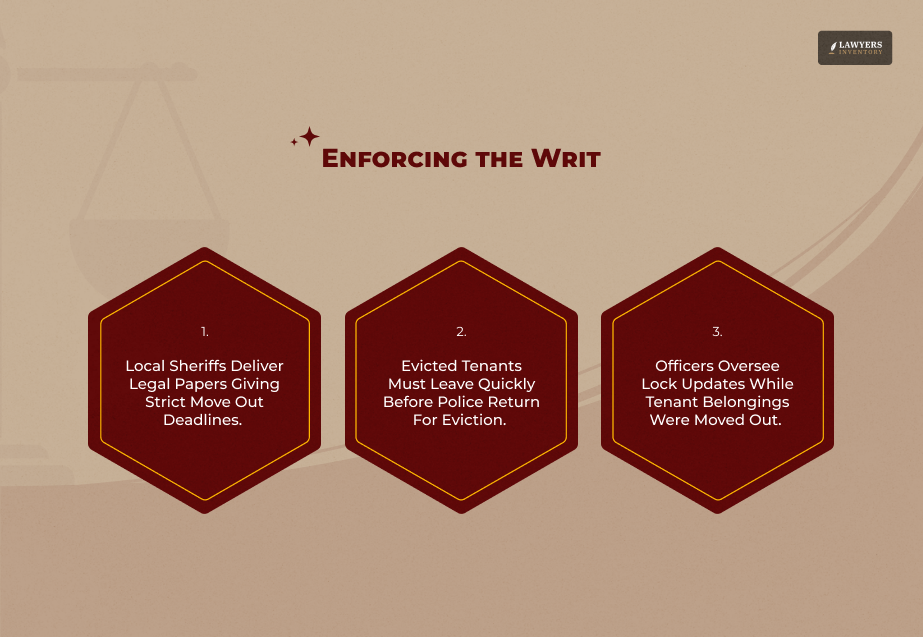
A writ of possession is served to the tenant by the sheriff, informing them that they must vacate the rental property by a specified deadline. If the tenant does not leave by that time, the sheriff is authorized to remove the tenant from the premises.
The timeline between service and enforcement varies significantly by state. In some jurisdictions, tenants have as few as 24 to 48 hours after service to vacate. In others, the window extends to five days or more.
A qualified legal representative can advise on the specific timeline in your jurisdiction – which is essential information for both planning a voluntary move and assessing appeal options.
To get a better idea about this, check out my previous articles on:
- How long after eviction court date do you have to move?
- How long does an eviction stay on your record?
When the deadline passes, and the tenant has not vacated, the sheriff or constable arrives at the property.
They supervise the removal of all occupants. The landlord or their agent then changes the locks in the sheriff’s presence.
The tenant’s belongings present at the time of removal are handled according to state-specific rules – in some states, belongings must be left in the unit for a defined period before disposal; in others, they may be moved to the curb immediately.
This moment – the physical enforcement of the writ – is one of the most stressful and legally consequential in the entire eviction process. Planning for it in advance, rather than waiting until it arrives, is the most important thing either party can do.
Special Protections That Can Delay Or Stop A Writ
Not every writ of possession proceeds to enforcement unchallenged. Several legal frameworks can delay or prevent enforcement even after a writ has been issued.
Bankruptcy Filing
A tenant who files for bankruptcy immediately triggers an automatic stay under federal law – which temporarily halts most debt collection and eviction enforcement, including writ execution.
If the landlord disputes the tenant’s bankruptcy certification, the bankruptcy court must hold a hearing within 10 days. If the tenant’s certification does not hold up, the eviction resumes immediately.
Bankruptcy is not a permanent solution to a writ of possession, but it can buy critical time for relocation or negotiation.
Servicemember Protections
The Servicemembers Civil Relief Act grants special eviction relief protections for active-duty members of the military and their family members. [Source: Consumer Financial Protection Bureau]
If a landlord tries to evict an active-duty member of the military from the main living quarters and the amount of monthly rent is lower than the level set each year for this threshold, then the landlord must go before a judge and obtain a court order first.
By 2025, $10,000 a month threshold had been passed by the adjusted threshold. This implies that the protection is in effect for almost all rental housing.
A service person receiving a warrant of possession by the court should, without delay, get in contact with the command officer and get advice from a military law support attorney. The SCRA offers strong but frequently ignored legal safeguards to both landlords and tenants.
Appeal And Stay Of Execution
Tenants may seek temporary reliefs, like stays or appeals, to delay enforcement. An appeal challenges the underlying eviction judgment.
A stay of execution asks the court to pause enforcement of the writ while the appeal is pending.
Both require prompt action – appeal deadlines are typically short, ranging from five to thirty days after the judgment depending on the jurisdiction.
In order to win an appeal, a tenant must be prepared to present scrupulous records to the court, including receipts, photos, witness statements, and copies of all correspondence between landlord and tenant.
An appeal can be time-consuming and expensive, and rent continues to accrue as long as the tenant remains in the rental residence.
Paying Arrears
If the issue is unpaid rent, a tenant may be able to stop the eviction by paying the landlord everything they owe, including court fees.
If the landlord’s case is not about unpaid rent, then a tenant usually cannot stop the eviction by paying what they owe.
This option is most viable in the period before the writ is executed. Once physical enforcement begins, payment of arrears does not automatically stop the process in most jurisdictions. The time to negotiate a payment arrangement is before the sheriff arrives – not after.
What Landlords Cannot Do: Self-Help Remains Illegal
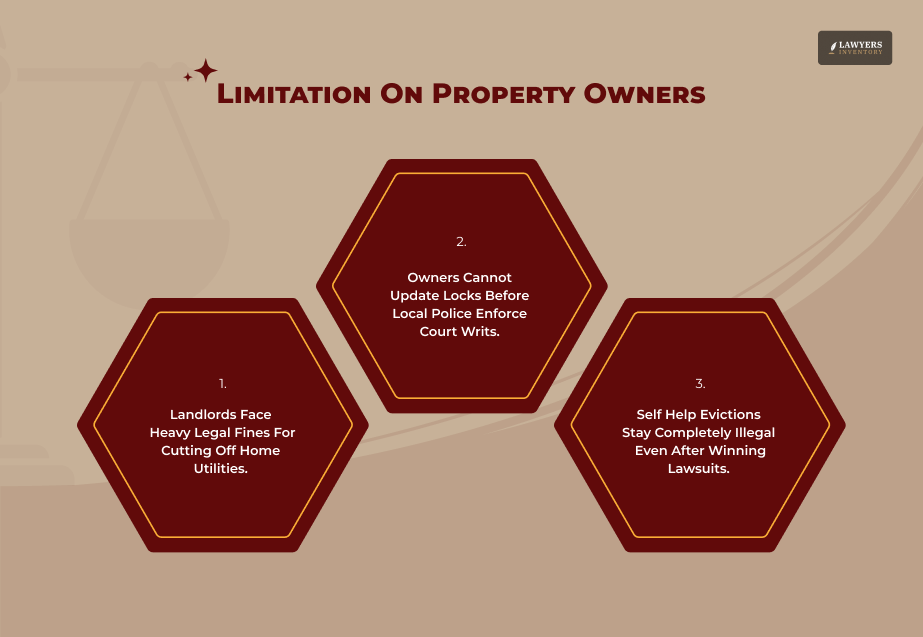
A valid court judgment does not allow self-help evictions. A landlord cannot take physical possession outside the formal writ process.
Landlords cannot change locks before the sheriff executes the writ. They cannot remove a tenant’s belongings without sheriff supervision. They cannot cut off utilities or physically block access. These actions remain illegal even after winning an eviction lawsuit.
Courts classify these illegal actions as constructive eviction. Landlords face significant financial liability for these acts. Having a valid judgment in hand does not protect them from these penalties.
Legal precedent remains consistent and severe across all jurisdictions. Courts repeatedly rule that the formal writ process is the sole lawful enforcement mechanism. [Source: EBSCO]
Judges do not make this rule out of sympathy for non-paying tenants. Instead, they enforce it because unauthorized self-help creates dangerous physical confrontations.
Furthermore, self-help evictions violate the constitutional principle of due process, reports Respicio. The law requires that parties enforce their property rights exclusively through state-sanctioned processes.
Even some of the weirdest lawsuits in landlord-tenant law history have arisen from landlords who believed a valid judgment authorized self-help removal. It does not.
The Writ Of Possession And Eviction Moratoriums
A writ of possession and an eviction moratorium occupy opposite ends of the same legal process.
A moratorium pauses the eviction proceedings that lead to a writ. A writ is what the process produces when those proceedings are completed without moratorium protection.
The intersection of the two creates important questions for tenants who received notices during an active moratorium. A notice issued during an eviction moratorium does not disappear when the freeze ends.
Landlords who issued notices during protected periods can resume proceedings – and ultimately obtain writs – once the moratorium expires.
Many tenants assumed a moratorium provided permanent protection. This false assumption trapped them in courts across the country after 2021.
Both parties must understand the entire legal timeline. You cannot look at the final enforcement step in isolation.
Instead, you must track the initial notice. Then, you must monitor the court judgment. Finally, you must understand the writ service. [Source: Martinez Law Center]
State-by-State Variation: Why Jurisdiction Matters
Local and state laws change the process for getting a writ of possession. These regulations vary heavily by area.
Because of this, landlords must understand their specific local rules. Tenants must also study these exact area guidelines. Both parties need this regional knowledge to navigate the eviction process properly. [Source: US Legal Forms]
The variations are significant and practically consequential:
- Notice periods before filing range from 3 days in some states to 30 days or more in others.
- Time between judgment and writ issuance varies from immediate in some jurisdictions to several weeks in others.
- Enforcement timelines after service range from 24 hours in Texas to 14 days or more in California and New York.
- Belongings after enforcement – in some states, landlords must leave belongings in the unit for up to seven days. In others, immediate removal to the curb is permitted.
- Redemption rights – some states allow tenants to pay all arrears up until the moment of physical enforcement to stop the writ. Others cut off this right at the judgment stage.
These variations mean that the practical experience of a writ of possession in Texas bears little resemblance to the same process in New York or California.
Jurisdiction-specific legal advice – from a housing attorney familiar with your local courts – is the only reliable guide to your specific rights and timeline.
Disclaimer: This article is for general informational and educational purposes only. It does not constitute legal advice. Writ of possession procedures vary significantly by state and locality. If you have received a writ of possession or are seeking to enforce one, consult a qualified housing attorney in your jurisdiction immediately.
Sources:
- LawDistrict – What Is a Writ of Possession? Definition and Process (May 2026) – lawdistrict.com
- US Legal Forms – Writ of Possession: Understanding Its Legal Definition – legal-resources.uslegalforms.com
- LegalClarity – What Is a Writ of Possession and How Does It Work? (May 2026) – legalclarity.org
- Redfin – What Is a Writ of Possession, and What Does It Mean for Tenants? (May 2025) – redfin.com
- The Legal Guide – Writ of Possession vs Eviction: Understanding the Difference and Process – thelegalguide.org
- Tenant-Rights.com – Request for Writ of Possession: Texas (March 2026) – tenant-rights.com
- Tenant-Rights.com – Writ of Possession: Arkansas (June 2026) – tenant-rights.com
- Servicemembers Civil Relief Act – 50 U.S.C. § 3951 – Eviction Protections for Military Members
11 U.S.C. § 362 – Automatic Stay in Bankruptcy
Leave A Reply







What Is An Operating Agreement? LLC Requirements, Key Provisions, And Why You Need One
Read More
Intentional Infliction Of Emotional Distress Explained: Elements, Evidence, And What Makes A Claim Win
Read More
What Is A Preliminary Hearing? Core Procedures, Timeline, And What To Expect
Read More
What Is Grand Larceny? Felony Thresholds, Penalties, And Your Legal Options
Read More
Larceny vs. Theft: What’s The Real Legal Difference?
Read More
0 Reply
No comments yet.