Quick Answer

An eviction moratorium is a temporary, government-mandated suspension of a landlord's legal right to remove tenants from a residential or commercial property during a period of public crisis. Eviction moratoriums block landlords from filing to remove tenants, usually during a public health emergency or economic crisis. These protections prevent eviction filings for nonpayment of rent but do not eliminate the underlying rent debt. Your obligation to pay rent continues. The moratorium only pauses enforcement - it does not forgive what you owe.
When I first started tracking eviction moratorium law closely, most legal analysts were treating it as a closed chapter – a COVID-era relic that ended with the Supreme Court’s August 2021 ruling.
Then the Los Angeles wildfires hit in early 2025, and within weeks the LA County Board of Supervisors voted 4-0 to reinstate a new moratorium for affected tenants. The chapter was not closed at all.
Eviction moratoriums are not a pandemic anomaly. They are a recurring legal tool that governments reach for during crises – economic, environmental, or otherwise.
Understanding how they work, what they protect, and critically, what they do not protect, is essential knowledge for any tenant or landlord navigating today’s housing market.
Here is everything I found.
What Is An Eviction Moratorium?
An eviction moratorium is a legally mandated, temporary suspension of a landlord’s right to remove tenants from a residential or commercial property.
Government executives, legislative bodies, or health departments enact these freezes during periods of acute public distress.
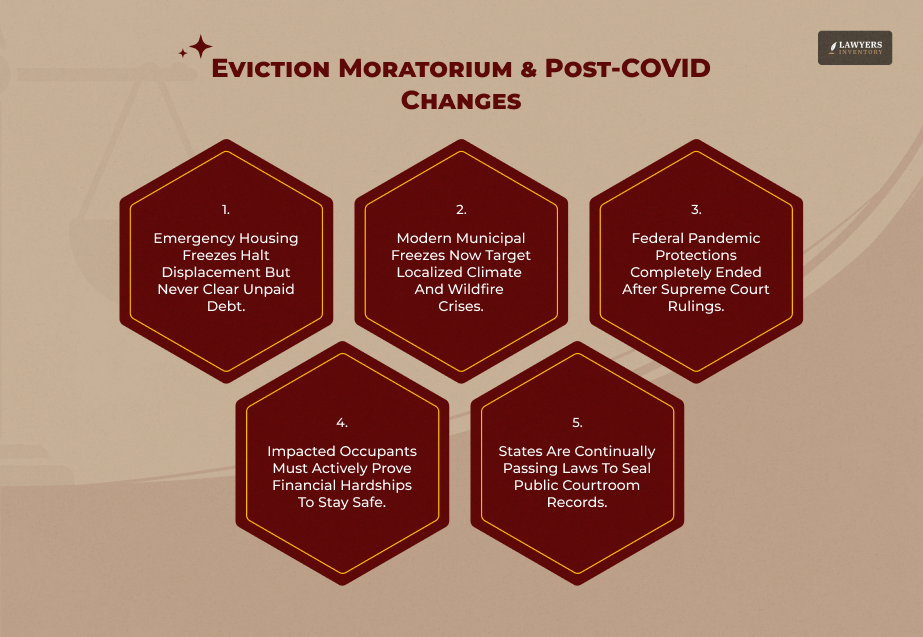
Economic collapses, natural disasters, and widespread public health emergencies are the most common triggers.
The critical distinction that I want you to keep in mind: a moratorium pauses displacement. It does not eliminate your financial obligations. Moratoriums delayed evictions but did not cancel rent or late fees. Tenants remain responsible for unpaid amounts.
This distinction has caused enormous confusion – and real legal harm – for tenants who assumed that a government freeze meant their rent was forgiven. It was not then, and it is not now.
The Federal COVID Moratorium: What Actually Happened
The most significant eviction moratorium in modern American history unfolded between 2020 and 2021. Understanding its arc is essential context for understanding how moratoriums operate today.
The CARES Act of 2020 set up the federal eviction moratorium for tenants who lease homes owned by landlords that have federally guaranteed mortgages, or the tenants who are living in federally aided housing.
Later, the CDC came up with one which was a far-reaching moratorium. This provided almost all the residential tenants with the rights to the rental homes, irrespective of the mortgage type of their landlords.
Eligibility under the federal moratorium was not automatic. Tenants needed to demonstrate income limits, document income loss, and show good-faith efforts to pay – including applying for rental assistance and making partial payments where possible. Simply living in a rental property did not automatically protect you.
The federal eviction moratorium ended on August 26, 2021, when the Supreme Court ruled to terminate it, leaving decisions to state and local authorities.
What most people do not adequately address is what happened after.
Local trial courts spent years unpacking back-rent cases compiled during that unique era. State legislatures are still actively dealing with bills addressing lingering pandemic-era notice requirements.
The legal precedents set during that period continue to shape how courts view tenant protections and emergency executive authority – years after the original orders expired.
Eviction Moratoriums Are Not Gone – They Evolved
As of 2024, all U.S. states have ended eviction moratoriums except Washington D.C., which maintains limited protections. However, that national picture obscures significant local activity.
Pandemic eviction moratoriums ended three years ago in New York, but a new one was approved in early 2025 by the Los Angeles County Board of Supervisors.
The vote, resulting from a post-wildfire campaign by tenant activists, was 4-0 with one abstention. Several similar measures were under consideration by other Southern California governments.
The LA County moratorium began on February 1, 2025, and applied to all renters in Los Angeles County, including incorporated cities. It was enacted in response to the Palisades, Eaton, Hurst, and Kenneth wildfires.
Tenants were required to demonstrate financial hardship and provide timely notice to the landlord of their inability to pay rent.
Tenants were not excused from their rental obligations – they had 12 months, until July 31, 2026, to repay any unpaid rent. [Source: LawDistrict]
Simultaneously, New York State legislators introduced the Extreme Weather Tenant Protection Act in 2025.
This bill halts residential evictions during severe weather. It notes that over 7,500 New York City households faced eviction on days exceeding 90°F over four years. This crisis heavily impacts financially unstable and heat-vulnerable communities.
The pattern is clear.
In the post-COVID era, after any economic disruption, governments in left-leaning jurisdictions are likely to push to pause rent payments. This poses ongoing risks and obligations for both landlords and renters. [Source: LegalClarity]
Beyond temporary moratoria, 21 states have adopted laws to seal or expunge eviction records, with 14 state representatives proposing new or enhanced protections during the 2025 legislative session [Source: New York State Senate].
What An Eviction Moratorium Does And Does Not Do
The gap between public perception and legal reality on this question has caused genuine harm to tenants who misunderstood their protections.
What a moratorium does:
- Temporarily suspends a landlord’s right to file eviction proceedings for nonpayment
- Pauses the court process that leads to physical removal
- Protects covered tenants from immediate displacement during the covered period
- In some jurisdictions, pauses late fee accrual during the protected period
What a moratorium does not do:
- Cancel, forgive, or reduce rent owed
- Prevent landlords from issuing notices for lease violations, property damage, or criminal activity
- Protect tenants who do not qualify under the specific eligibility criteria
- Prevent eviction proceedings after the moratorium expires
- Remove cases from court dockets – unresolved filings remain active
That last point deserves particular attention. A notice issued during a moratorium does not disappear when the moratorium ends. Landlords who issued notices during the protected period can proceed with eviction proceedings once the freeze lifts – and they frequently do.
Working with a legal representative immediately upon receiving any notice – even during an active moratorium – is the most important step a tenant can take. Missing procedural deadlines by even hours can result in an automatic default judgment.
What Happens To Back Rent When A Moratorium Ends?
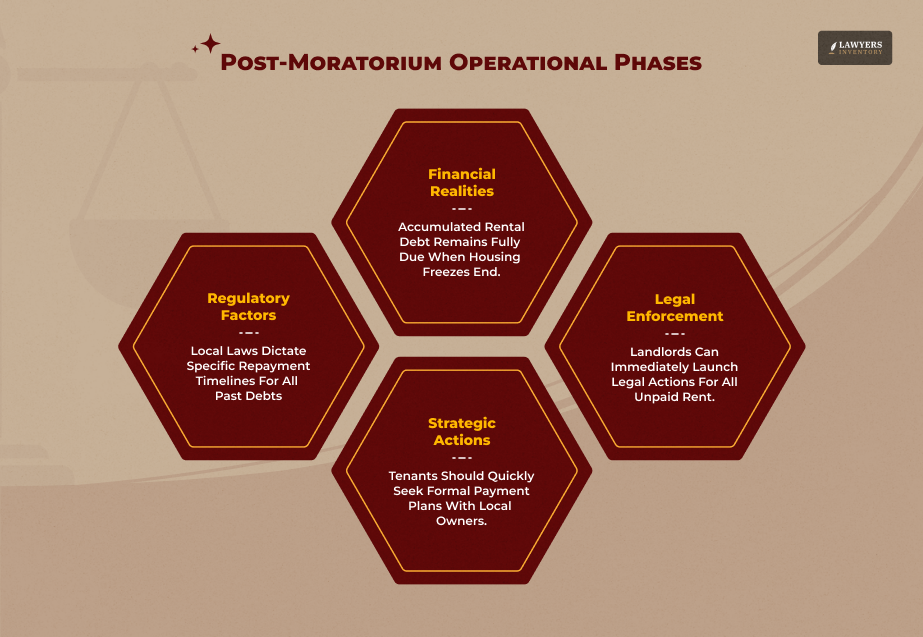
A moratorium protects you from displacement. It does not protect you from the debt you accumulated while it was active. When the freeze lifts, that accumulated rent becomes immediately collectible.
Moratoriums delayed evictions but did not cancel rent or late fees. Tenants remain responsible for unpaid amounts. [Source: LegalShield]
The specific repayment frameworks vary by jurisdiction. In Washington State, if a tenant has remaining unpaid rent that accrued during the moratorium period, the landlord must offer the tenant a reasonable repayment schedule not exceeding monthly payments equal to one-third of the monthly rental charges during the period of accrued debt.
In Los Angeles County’s 2025 wildfire moratorium, tenants were given 12 months – until July 31, 2026 – to repay any unpaid rent accrued during the protection period. [Source: Quora]
In other jurisdictions, no structured repayment framework exists. When the freeze ends, the full amount becomes due.
Landlords who do not receive payment can immediately begin eviction proceedings for nonpayment – proceedings that can now also include the accumulated arrears.
The practical implication: if you are currently protected by any moratorium, start planning for repayment now.
Document every interaction with your landlord. Apply for every available rental assistance program.
Proactive communication with your housing provider before the moratorium ends is far more likely to produce a workable repayment arrangement than waiting until proceedings begin.
Tenants should stay proactive – communicating with landlords, researching available assistance, and understanding their rights.
If an eviction notice is issued, it is important that both parties understand their obligations under the specific notice framework governing their jurisdiction.
Navigating Notices During An Active Moratorium
Key Points:

• Active housing freezes never stop landlords from serving official notices.
• Severe property damage fully allows owners to initiate immediate removals.
• Changing residential locks remains an entirely illegal self help practice.
• Failing to meet strict legal deadlines triggers bizarre default judgments.
A common and dangerous misconception: an active moratorium means you cannot be served with an eviction notice. That is incorrect.
In spite of a current ban on evictions, landlords are still within their rights to give eviction warnings at the first stage.
The usual reasons that permit landlords to do so are major property damage, illegal activities on the rented premises, and behaviors that are disturbingly aggressive and are putting the safety of other neighbors in danger.
A landlord almost never has the right to remove you themselves: changing locks, removing your belongings, or cutting utilities – known as self-help eviction – is illegal in most states and often carries penalties. [Source: The Real Deal]
However, the right to issue a formal notice through proper legal channels generally survives even during a moratorium.
If a notice appears at your door, do not assume a general freeze grants you total immunity. Inspect it carefully. Determine whether it falls within an exception to the moratorium’s protections.
Consult a qualified legal assistant or housing attorney immediately to assess the document for technical defects and construct a response before any administrative deadlines pass.
The procedural path following an initial notice is strict. Missing a deadline by even a few hours can result in an automatic default judgment – regardless of whether a moratorium is technically in effect.
Constructive Eviction: What Landlords Cannot Do
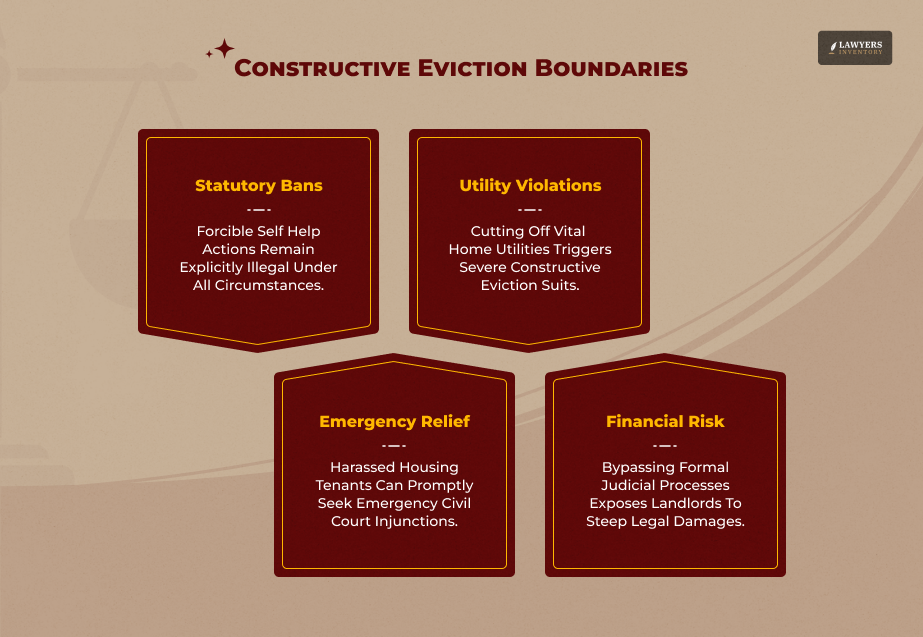
During any active eviction moratorium – and outside of one – landlords are prohibited from taking matters into their own hands to force tenants out.
When a landlord intentionally degrades living conditions or cuts off basic utilities to force departure without a court order, they commit what the law recognizes as constructive eviction.
This conduct is explicitly illegal under all circumstances. During an active moratorium, courts view it with heightened severity.
Some specific unlawful activities are:
- Changing the locks without the court’s approval, removing doors or windows.
- Preventing access to the building by cutting off the supply of water, gas, or electric.
- Taking away home appliances or fixtures.
- Causing a nuisance in the property which is so persistent that it is virtually a form of harassment.
The tenants who are subject to these kinds of behaviors can immediately ask the court for an emergency injunction ordering the landlords to restore the situation as it was – re-entering the premises and bringing back utilities without delay.
Courts across the country have consistently reinforced this principle through cases establishing lasting legal precedent – including some of the weirdest lawsuits in landlord-tenant history, involving everything from targeted utility disruptions to deliberate structural sabotage.
These cases serve a systemic purpose: they establish that no financial dispute justifies bypassing the formal legal process.
Landlords who engage in constructive eviction expose themselves to punitive damages, statutory fines, and mandatory attorney fee awards – costs that frequently exceed the back rent they were trying to recover.
Eviction Moratoriums Vs. Rent Control: The Distinction That Matters
| Eviction Moratorium | Feature | Rent Control |
| Pauses physical displacement | Purpose | Caps annual price increases |
| Temporary emergency measure | Duration | Permanent legal framework |
| Active crisis or disaster | Trigger | Local ordinance or statute |
| Delays payment collection | Relief | Restricts ongoing pricing |
| Halts court filings | Scope | Regulates long-term affordability |
These two tenant protections are frequently confused. They are fundamentally different legal instruments.
An eviction moratorium is temporary. It applies during a defined crisis period. It pauses displacement but does not regulate the amount of rent a landlord can charge.
Rent control is a permanent or semi-permanent regulatory framework that limits the amount landlords can increase rent within a defined period.
It applies continuously – not only during crises – and typically requires a formal local ordinance or state statute to implement.
A property can be subject to rent control without any active eviction moratorium in place. A moratorium can protect a tenant from displacement in a city with no rent control ordinance.
And in some jurisdictions – notably parts of California and New York – a tenant may be protected by both simultaneously.
Understanding which protection applies to your specific property, in your specific jurisdiction, requires either direct research into local ordinances or consultation with a housing attorney familiar with your area.
Assuming one protection provides coverage that only the other delivers is one of the most common – and costly – mistakes tenants make.
How Long After An Eviction Court Date Do You Have To Move?
When a moratorium expires, a housing judge hears the disputed case. The court carefully examines the evidence submitted by both sides. [Source: NY Times]
If the landlord wins the case against the tenant, the judge grants possession of the property to the landlord.
This is a very brief summary of the usual legal process. Most tenants are never informed about these steps.
So, how long after eviction court date do you have to move?
The exact window depends on your state statutes and local county enforcement codes. In most jurisdictions, tenants have between 72 hours and approximately two weeks after the formal writ is delivered to local law enforcement to vacate.
The trial day is just the starting point of losing possession. From that exact moment, a legal clock begins to tick.
Once the final day of that timeline passes, authorities will take action. The county sheriff or a deputy U.S. marshal will show up.
They have the lawful authority to assist in removing people and possessions. They will also change the building locks.
Figuring out this timeline early lets you make emergency relocation arrangements. You must act before enforcement officially begins. Do not wait for the final notice to start making your plans.
How Long Does An Eviction Stay On Your Record?
A formal eviction process affects a tenant long after losing an apartment. The judge’s court decision remains on your record for years.
This eviction record will show up during future rental application processes. It also appears in public court records for anyone to see.
Additionally, according to Law Info, the filing impacts your financial record. It can stay on your credit report for seven years from the first filing date.
As of 2025, 21 states have active eviction record sealing or expungement laws. During the 2025 legislative year, 14 states introduced laws to either strengthen existing sealing or expungement protections or create new ones. [Source: New York State Senate]
Even if a past moratorium protected your family from immediate displacement, any unresolved judgment or civil financial claim that follows will limit your future ability to secure housing.
Property management firms use background check algorithms that flag prior landlord-tenant disputes immediately. A record of forced removal can result in automatic denials even when your credit score is strong.
Resolving disputes through formal settlements, structured payment arrangements, or legal sealing options – where available in your state – is the most important step you can take to protect your long-term housing mobility.
Disclaimer: This article is for general informational and educational purposes only. It does not constitute legal advice. Eviction moratorium laws vary significantly by state, county, and city and change frequently. If you have received an eviction notice or are facing housing court proceedings, consult a qualified housing attorney in your jurisdiction immediately.
Sources
- LawDistrict – Eviction Moratoriums by State – lawdistrict.com
- LegalClarity – What Does a Moratorium Mean and How Does It Work? (April 2026) – legalclarity.org
- The Real Deal – Eviction Moratoriums Are Back (March 2025) – therealdeal.com
- Bell Properties – Understanding Eviction Moratoriums and Tenant Rights in California (October 2025) – bellprop.com
- National Low Income Housing Coalition – State and Local Tenant Protections Database – nlihc.org
- National Low Income Housing Coalition – State Legislators Introduce New Tenant Protection Policies During 2025 Legislative Sessions (October 2025) – nlihc.org
- New York State Senate Bill 2025-S8960A – Extreme Weather Tenant Protection Act – nysenate.gov
- Washington State Legislature – RCW 59.18.630 – Eviction Moratorium Repayment Requirements – app.leg.wa.gov
- Commoner Law – Eviction Laws by State (2026) – commoner-law.com
- Advanced Collection Bureau – Understanding the Eviction Moratorium: What It Means for Landlords and Tenants – advancedcb.com
- LeadingAge – Supreme Court Ends Eviction Moratorium – leadingage.org
- California Apartment Association – State’s Eviction Moratorium Ends, But Some Metros Keep Limits Alive – caanet.org
- CARES Act, 15 U.S.C. § 9058 – Temporary Moratorium on Eviction Filings
- Alabama Association of Realtors v. Department of Health and Human Services, 594 U.S. (2021) – Supreme Court ruling ending federal eviction moratorium
Leave A Reply






What Is An Operating Agreement? LLC Requirements, Key Provisions, And Why You Need One
Read More
Intentional Infliction Of Emotional Distress Explained: Elements, Evidence, And What Makes A Claim Win
Read More
What Is A Preliminary Hearing? Core Procedures, Timeline, And What To Expect
Read More
What Is Grand Larceny? Felony Thresholds, Penalties, And Your Legal Options
Read More
Larceny vs. Theft: What’s The Real Legal Difference?
Read More
0 Reply
No comments yet.