Summarize using AI





Prompt copied. Paste it into Gemini.
Quick Answer: Is Gerrymandering Legal?

It depends on the type. At the federal level, lawmakers can legally redraw voting districts to gain a partisan advantage. In contrast, redrawing districts to discriminate against a specific racial group is illegal. This practice directly violates the Constitution's Equal Protection Clause. However, the U.S. Supreme Court issued a watershed decision in Louisiana v. Callais. This ruling made it much harder for civil rights plaintiffs to prove racial gerrymandering. The decision created an incredibly high bar for plaintiffs trying to win fair representation.
I’ve been following redistricting fights closely. And when reading on is gerrymandering legal or not, I don’t think I’ve seen the legal ground shift this fast in years.
If you’re trying to understand your rights, or just what’s actually happening to your district, here’s where things stand right now.
What The Supreme Court Just Changed
The Supreme Court issued a major ruling in Louisiana v. Callais on April 29, 2026. [Source: Justia]
The justices split 6-3 on the decision. The majority struck down Louisiana’s congressional map. This map contained two Black-majority districts. The Court labeled the map an unconstitutional racial gerrymander.
Justice Samuel Alito authored the majority opinion. He argued that the Voting Rights Act “was designed to enforce the Constitution – not collide with it.” [Source: US Supreme Court]
He then criticized lower courts for forcing districts to have majority-Black voting groups. Alito asserted that these court orders create race-based discrimination. He concluded that the Constitution explicitly forbids this practice.
Most of the judges voted in his favor. However, Justice Elena Kagan wrote a strong dissent. She fiercely criticized the decision and its future impacts. [Source: Truthout]
Kagan stated the ruling would destroy Section 2 of the Voting Rights Act of 1965. This critical law protects equal voting opportunities for everyone. She warned that the decision makes the law a dead letter. [Source: The Conversation]
Before this ruling, states often drew majority-minority districts. They did this to comply with Section 2. The law prevents states from diluting minority voting power.
Now, the legal standards are different. Helping minority voters gain representation is no longer enough. It does not justify race-based map-drawing by itself.
Instead, courts require strong evidence of intentional discrimination. Plaintiffs must prove that lawmakers used race to deny minorities equal opportunities.
As for the states, this is what the overview looks like:
- The ruling directly affects Louisiana, where a majority-Black district is expected to be redrawn
- Alabama, Tennessee, and Mississippi have signaled they may redraw their own maps in response
Besides, legal experts widely agree it will make future Section 2 challenges much harder to win.
Is Gerrymandering Legal? Two Very Different Answers For Legality Status
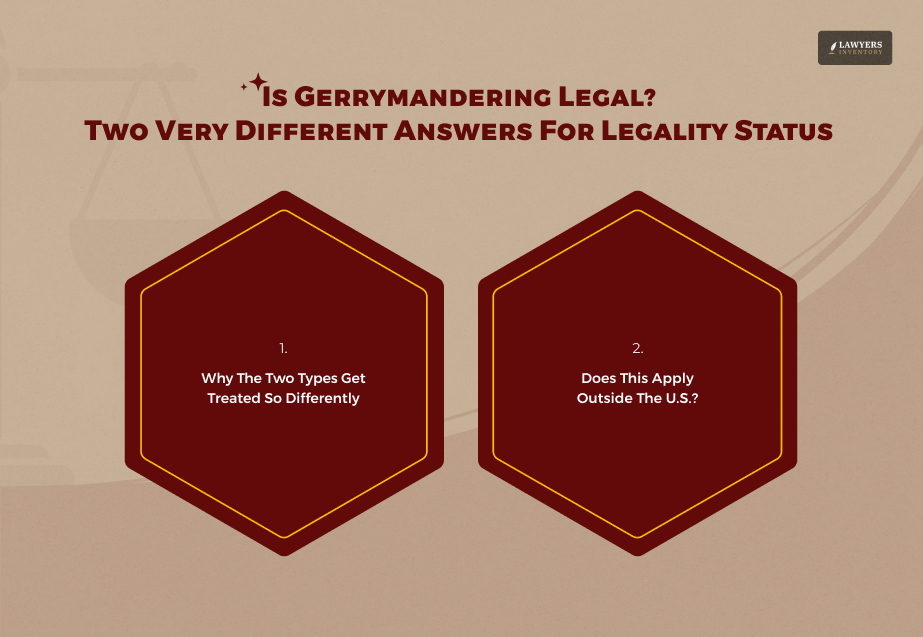
Here’s the part most people don’t talk about: the gerrymandering legal question really splits into two separate tracks, and they don’t follow the same rules at all.
Partisan gerrymandering happens when a party draws districts purely to gain seats, regardless of race. It’s legal under federal law.
Chief Justice John Roberts delivered the verdict in Rucho v. Common Cause (2019). He ruled that federal judges cannot referee political power struggles between parties.
As a result, the nation’s top court completely shut down federal partisan gerrymandering claims. [Source: Supreme Court of the United States]
Racial gerrymandering happens when lawmakers use race as the main factor to draw district lines. This practice remains unconstitutional. It directly violates the 14th Amendment’s Equal Protection Clause. [Source: Virginia Mercury]
But Callais narrowed the circumstances where a map can even use race to comply with the Voting Rights Act, making these claims much harder for courts to sort out either way.
That gap between what’s politically controversial and what’s legally allowed is exactly why the gerrymandering legal question doesn’t have a one-word answer.
Why The Two Types Get Treated So Differently
This split goes back further than most people realize.
The Supreme Court issued a landmark ruling in Baker v. Carr (1962). This decision gave federal courts jurisdiction over redistricting for the first time.
The Court used the 14th Amendment’s Equal Protection Clause to review voting maps. Consequently, this case established the legal basis for the “one person, one vote” rule.
Soon after, Congress took action. Lawmakers passed the Voting Rights Act of 1965. This law explicitly banned racial discrimination in voting. Crucially, the Act regulated how states design their electoral districts.
Partisan advantage was never treated the same way. That is because the Constitution gives states, not federal courts, primary authority over how they draw their own maps.
However, race is different because the 14th and 15th Amendments explicitly bar racial discrimination, giving courts a constitutional hook that simply doesn’t exist for ordinary political favoritism.
Does This Apply Outside The U.S.?
Gerrymandering is mostly a U.S.-specific issue. The concept relies on unique U.S. court cases. It connects directly to the U.S. Constitution and the Voting Rights Act. As per Cambridge, other nations reshape their districts using entirely different rules.
In India, officials call this equivalent process delimitation. The Delimitation Commission oversees the boundary changes. The commission follows the Delimitation Act of 2002. It also follows Articles 82 and 170 of the Indian Constitution. [Source: Indian Kanoon]
Indian courts allow very limited judicial review of these orders. Judges only intervene if evidence shows the commission acted in bad faith. Furthermore, Indian courts do not recognize claims like Section 2 of the U.S. Voting Rights Act. India does not resolve boundary manipulation through heavy litigation.
The UK, Canada, and Australia handle districts differently. These countries rely heavily on independent boundary commissions. They also use public hearings to set lines fairly. This system explains why they see far less gerrymandering litigation than the U.S. [Source: Electoral Reform Society]
Read Also: The Reality of Our Right to Vote and How Nothing Makes Sense
What Can You Actually Do If You Think Your District Was Gerrymandered?
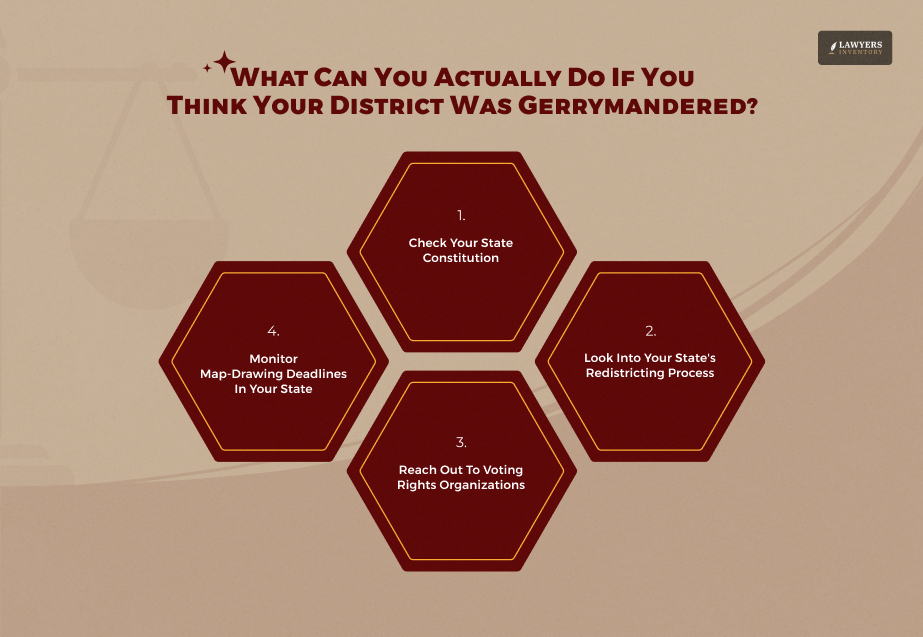
If you’re wondering whether you have any recourse, your options depend heavily on where you live.
Check Your State Constitution:
Firstly, some state supreme courts, including Pennsylvania’s and Ohio’s in past cycles, have struck down partisan gerrymanders under state constitutional provisions, even though federal courts won’t hear partisan claims.
Look Into Your State’s Redistricting Process:
Secondly, states like California and Michigan that have independent redistricting commissions allow their citizens to have a direct say in what future maps will look like via ballot initiatives.
Reach Out To Voting Rights Organizations:
Several advocacy groups consistently support local residents. These groups include the Brennan Center for Justice and the Campaign Legal Center. They help residents who face the impacts of voting district changes. [Source: Common Cause]
Monitor Map-Drawing Deadlines In Your State:
Finally, voice your concerns through public comment periods that occur when a legislature is about to pass new maps. Such periods are often one of the few times that you can do so.
Note: None of these guarantee a specific outcome, and the legal landscape around gerrymandering is unusually unsettled right now. But knowing which door to knock on makes a real difference.
So, Is Gerrymandering Legal?
In conclusion, partisan gerrymandering is legal under federal law, at least for now. On the other hand, racial gerrymandering is illegal. However, proving it just got considerably harder after Callais.
I would expect more states to test these new limits before the 2026 midterms, and I would expect more litigation to follow.
So, if your district changes shape before your next election, you’re not imagining things. And you’re not without options.
Leave A Reply






Do You Pay Taxes On Lawsuit Settlements? IRC Section 104 Explained
Read More
Non-Disparagement Clause Explained: Requirements, Enforceability, And What Changed Recently
Read More
Best Practices For Successful Trademark Registration
Read More
Understanding Your Rights: A Guide To The Legal Process
Read More
How To Clear A Bench Warrant Without Going To Jail: A Legal Guide
Read More
1 Reply
Gerrymandering Meaning, History, And Why It Matters Now
August 27, 2026 at 5:55 am
[…] the word describes a political practice rather than a permanent legal status. I have covered the legality of gerrymandering in my previous blog – do check that out for an in-depth […]
Reply