Summarize using AI





Prompt copied. Paste it into Gemini.
Quick Answer:

A court appoints a legal guardian to make decisions for another person. This person cannot fully make decisions for themselves. The ward is usually a minor child or an incapacitated adult. A court order grants this authority. Family relationships alone do not grant these rights. The court strictly limits the guardian's power. The guardian manages daily care, medical treatment, or finances based on the judge's order.
People use the term “legal guardian” loosely in everyday conversation. However, the law defines this role very specifically. This guide covers the definition, eligibility rules, and the limits of a guardian’s power.
What Does Legal Guardian Mean?
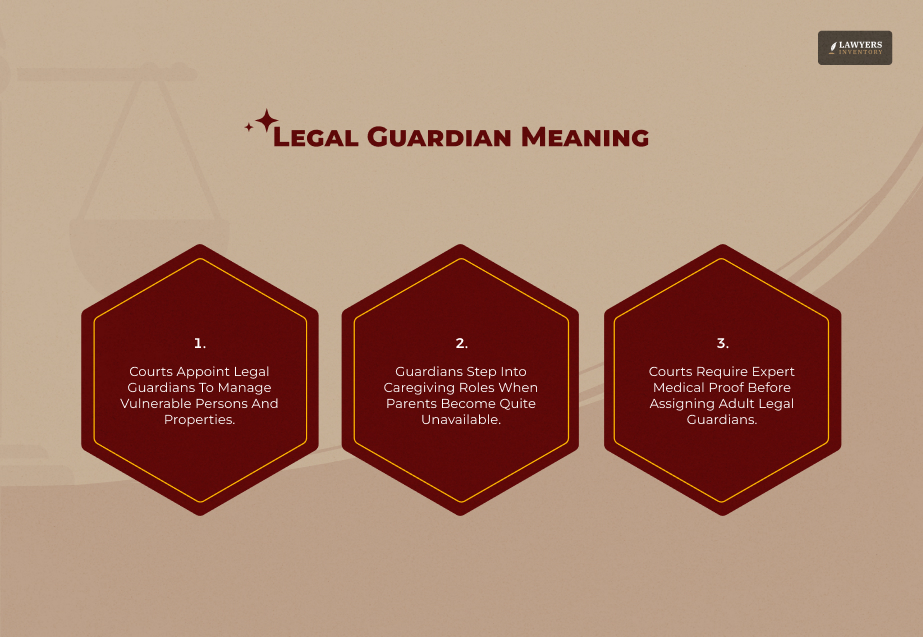
A court formally authorizes a legal guardian to make decisions for a ward. The ward cannot reliably make these choices alone.
Black’s Law Dictionary describes a guardian as a manager of a person and their property. This definition applies to individuals who cannot legally manage their own affairs. This classic definition remains highly accurate today.
Two major groups make up most guardianship cases. The first group includes minors whose parents cannot care for them. The second group includes adults whom age, illness, disability, or injury incapacitates.
The legal mechanics differ for each group. However, the underlying concept remains identical. The guardian must always act in the ward’s best interests.
Guardian Of A Minor: How It Works
A court appoints a legal guardian when parents die or become unavailable. The guardian steps directly into the caregiving role. This arrangement differs significantly from adoption.
A guardian does not become the child’s legal parent. Furthermore, the court can review or end the setup at any time.
State laws and probate courts govern minor guardianship in the United States. The U.S. Administration for Children and Families states that guardianship allows parents to name a caregiver.
This process grants specific legal rights to the caregiver. In many cases, the court does not terminate parental rights. The parents simply cannot exercise their rights at the current time.
Courts consider several consistent factors before appointing a guardian:
- Existing bond between the proposed guardian and the child.
- Guardian’s ability to provide a safe and stable home.
- Child’s preference, if they have reached an appropriate age.
- Overall welfare of the child, which serves as the deciding factor.
Guardian Of An Incapacitated Adult: How It Works
The second major category involves adult guardianship. Some U.S. states call this arrangement a conservatorship.
This setup applies when an adult cannot manage personal care or finances. Conditions like advanced dementia, severe brain injuries, or developmental disabilities cause this incapacity.
Courts are typically very cautious about appointing adult guardians. The laws of most U.S. states clearly state that a court is not allowed to appoint a guardian of an adult person without first having reliable evidence from either psychological or medical experts of the person’s incapacity.
Now many states prefer less intrusive methods of help instead of full legal guardianship. Among these are supported decision-making agreements or durable powers of attorney.
In these, the person has most of his or her decision-making abilities intact while getting the needed assistance.
Comparing Key Legal Terms: Guardianship vs. Custody vs. Power Of Attorney vs. Conservatorship
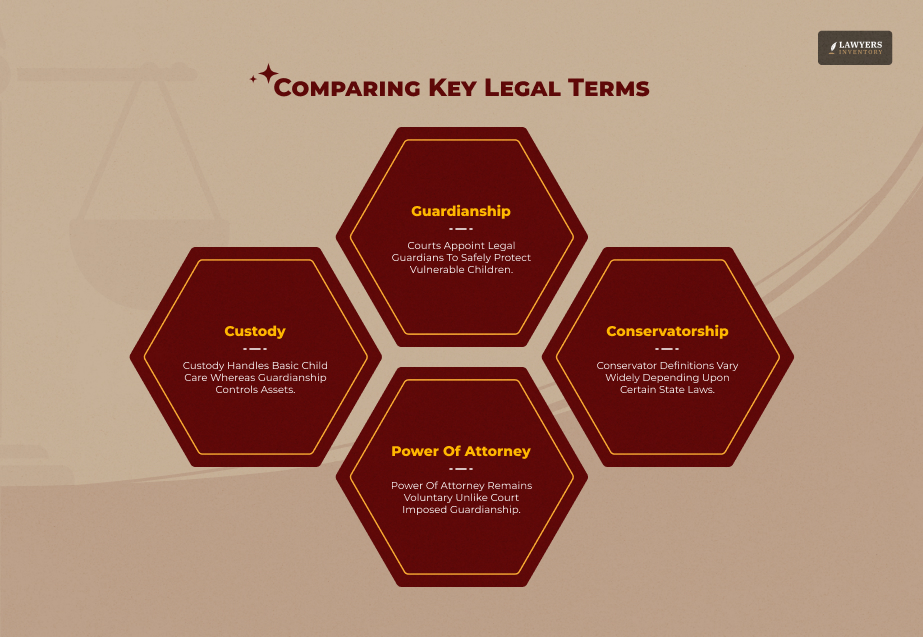
People constantly confuse guardianship, custody, power of attorney, and conservatorship. This confusion causes real problems for families seeking the right option.
Guardianship is a much more comprehensive concept.
While custody refers basically to how and under what conditions a child is looked after each day by the custodial parent, guardianship also empowers the guardian of a child to manage his or her assets and to sign legally binding documents, i.e., wills, contracts, etc.
The rights of a custodial parent do not include such matters; they are confined to what they are authorized to do, and that is raising and physically controlling the child.
Power of attorney differs because the arrangement is voluntary. A competent adult chooses a representative to manage finances or healthcare. The adult can revoke this authority at any time. In contrast, a court imposes guardianship because the person can no longer make that choice.
“Conservator” is a U.S. state-law term with inconsistent meanings. Some states use “conservator” only for financial decisions. These same states reserve “guardian” for personal and medical choices. Other states use the terms interchangeably. You must check your specific state laws to understand these terms locally.
The Different Types Of Legal Guardianship
Different types of guardianships determine the extent and nature of the guardian’s authority. A person guardian oversees and makes decisions for daily living – like providing care, medical treatment, schooling, and housing.
One who is a guardian of the person and a guardian of the estate, also called a combined guardian, can be appointed or different persons for these two functions according to the court’s decision.
A parent names a testamentary guardian in a will to protect their children after the parent’s death. A parent authorizes a standby guardian in advance for emergencies like serious illness.
The parent retains full authority until a specific event triggers the standby guardian’s role. Finally, a court appoints a guardian ad litem strictly to represent a minor’s interests during a specific lawsuit.
How This Works Outside The U.S.
India lacks a single uniform guardianship code. Instead, the law varies based on the ward’s religion. The Hindu Minority and Guardianship Act, 1956 primarily governs Hindu families.
Muslim, Christian, and Parsi guardianships rely on personal laws and the older Guardians and Wards Act, 1890. This older act applies across all communities when no specific personal law exists.
India also maintains a dedicated framework for adults with specific disabilities. The National Trust Act, 1999 allows a Local Level Committee to appoint a legal guardian.
This act covers individuals with autism, cerebral palsy, intellectual disabilities, or multiple disabilities.
This system applies regardless of age, which creates a meaningful difference from Western models.
Read Also: Wendy Williams’ Guardianship Issue And What We Learn From Her Legal Battle
What Can (And Can’t) A Legal Guardian Actually Do?
A court order defines the guardian’s exact authority.
Guardians cannot rely on assumptions. Depending on the judge’s orders, a guardian consents to medical treatment and enrolls a ward in school. They also manage bank accounts, handle property, and represent the ward in administrative matters.
Guardians cannot act outside their court-authorized scope. A personal care guardian cannot sell the ward’s property without separate court approval.
Most jurisdictions require guardians to file periodic reports with the court. Judges will promptly remove and replace any guardian who mismanages funds or neglects their duties.
How Do You Actually Become A Legal Guardian?
The guardianship process varies by jurisdiction, but it follows the same basic shape everywhere. A petitioner files a formal application with the appropriate court.
In the United States, people usually file in family or probate court. In India, people file with the relevant authority under their applicable personal law.
The petitioner must demonstrate exactly why the ward needs a guardian. They must also provide their own personal background information to the court.
In adult guardianship cases, the petitioner must submit clear medical evidence. This evidence must fully support the claim of the adult’s incapacity.
Before finalizing a decision, the court thoroughly examines each petition that comes their way.
Quite often, a judge will delegate an independent investigator to verify facts independently. After reviewing the petition, the court will organize a formal session to examine the collected.
If the judge approves the request, the new guardian receives a formal court order. This order explicitly defines the scope of their decision-making authority. From that exact point forward, the guardian remains strictly accountable to the court.
Guardianship exists entirely to protect people who genuinely cannot protect themselves. However, the arrangement also creates a massive transfer of personal decision-making power.
This major shift in legal rights explains why courts require such a strict, detailed process before granting approval.
Sources:
- U.S. Administration for Children and Families
- Black’s Law Dictionary
- Hindu Minority and Guardianship Act, 1956
- Guardians and Wards Act, 1890
- National Trust Act, 1999 (India).
Leave A Reply






Do You Pay Taxes On Lawsuit Settlements? IRC Section 104 Explained
Read More
Non-Disparagement Clause Explained: Requirements, Enforceability, And What Changed Recently
Read More
Best Practices For Successful Trademark Registration
Read More
Understanding Your Rights: A Guide To The Legal Process
Read More
How To Clear A Bench Warrant Without Going To Jail: A Legal Guide
Read More
0 Reply
No comments yet.