Summarize using AI





Prompt copied. Paste it into Gemini.
Quick Answer: What Is Public Policy

Public policy is the system of laws, regulatory measures, courses of action, and funding priorities concerning a given topic promulgated by a governmental entity or its representatives. In simple terms, it is the guide or "rulebook" that governments create to address public issues, maintain order, and improve the lives of citizens.
When I hear the term public policy, I do not treat it as a synonym for a law. The distinction matters, especially when someone is trying to understand a legal dispute, challenge a government decision, or assess whether an agreement can be enforced.
In simple terms, I would define public policy as the principles, priorities, decisions, rules, and government actions used to address issues affecting the public.
Governments use public policy to decide what problems require attention, what objectives they want to pursue, and what legal or administrative measures they will use.
But what is public policy? Especially in law?
The concept also has a distinct meaning in legal disputes. Courts may consider public policy when deciding whether a contract, transaction, award, or other legal arrangement is compatible with the public interest. The precise test depends on the jurisdiction and the legal issue involved.
What Is Public Policy?
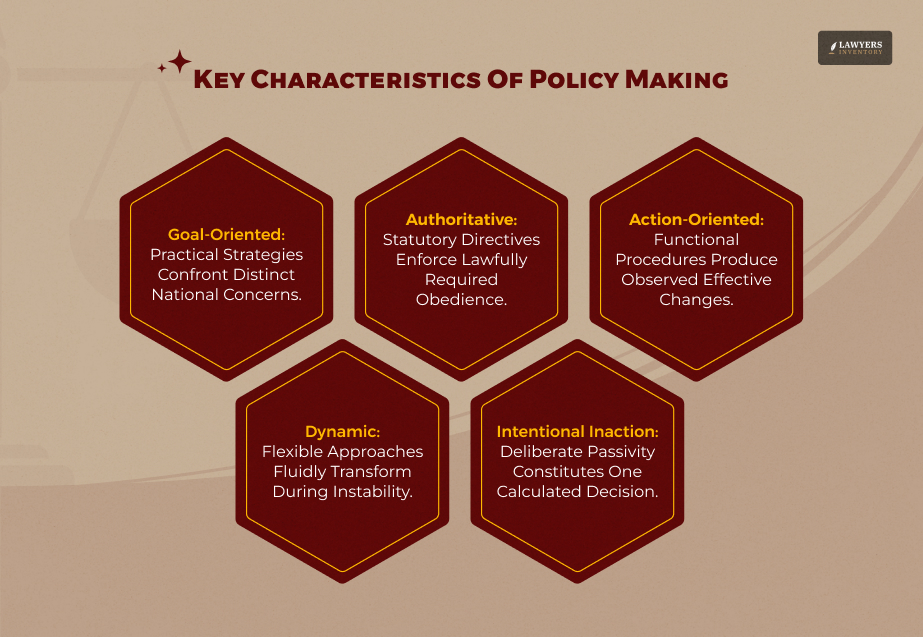
I find it useful to separate policy, law, and government administration.
A policy states a government’s intent or commitment to the public. Governments often announce policies before a legislative body passes a law. In contrast, a law confers legally binding rights, obligations, prohibitions, or powers.
A government creates a law only after completing all constitutional and legislative steps. Administration defines the exact way government departments carry out these laws and programs.
An environmental scenario illustrates this entire process.
A government first identifies cutting air pollution as a major goal. This policy decision then drives the creation of specific laws. These laws set strict environmental standards and allocate public funds. Finally, the administration determines the licensing process and enforces the rules.
This differentiation creates a crucial legal boundary. The mere possession of a policy document does not grant you a private legal right. Policies do not carry legal weight on their own.
You must look to other sources to bring a successful legal challenge. The constitution, laws, regulations, and administrative rules govern your legal standing. Case law also determines whether you can seek a benefit or secure a legal remedy.
Georgetown’s McCourt School describes public policy as rules, regulations, and programs used by governments at local, sub-national, and national levels to address real-world problems.
American University’s School of Public Affairs similarly describes it through government decisions, laws, and actions directed at public issues.
How Public Policy Becomes Government Action
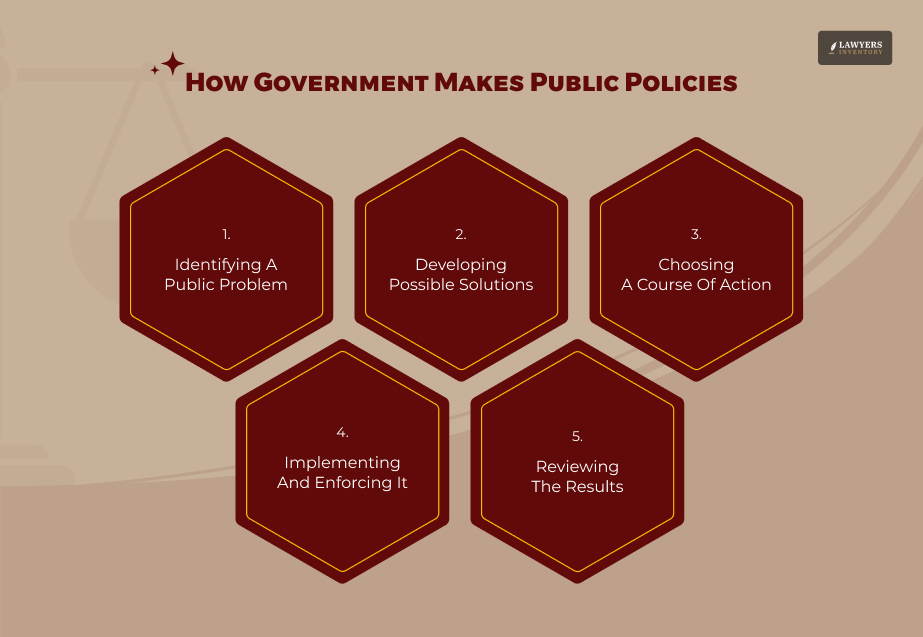
I would not describe policymaking as a single event. It is usually a process.
1. Identifying A Public Problem
A problem first gains governmental attention. It may involve public health, taxation, housing, employment, crime, environmental protection, education, technology, or national security.
2. Developing Possible Solutions
Officials, legislators, researchers, affected communities, businesses, and advocacy groups may contribute evidence and competing proposals. Policymakers consider factors such as cost, effectiveness, legal authority, public impact, and unintended consequences.
3. Choosing A Course Of Action
The government then decides what response to pursue. Depending on the legal system, that response might involve legislation, regulation, executive action, public spending, administrative programs, or a combination of measures.
4. Implementing And Enforcing It
A policy has little practical value if it cannot be implemented. Government agencies may issue rules, administer programs, allocate funds, investigate violations, or impose penalties.
5. Reviewing The Results
Good policymaking does not stop at implementation. Governments must check if the policy made a difference. They need to see who gained and who lost. They must also look for unforeseen effects.
Georgetown University considers evaluation crucial. It helps everyone understand policy effectiveness. It also reveals the actual changes a policy brings about.
What Are The Main Types Of Public Policy?
There is no single classification that applies in every jurisdiction. However, I commonly see four broad categories used in public-policy literature.
Substantive policies address a particular public problem. Healthcare, education, environmental protection, and criminal justice are common examples.
Regulatory policies establish standards or restrictions governing conduct. Environmental standards, workplace requirements, and consumer-protection rules can fall within this category.
Distributive policies allocate public resources or benefits. Infrastructure spending and certain public programmes are examples.
Redistributive policies seek to change how resources or economic burdens are distributed. Taxation and social-support programs may serve redistributive objectives.
These categories help explain what a policy is trying to accomplish. They do not, by themselves, determine whether a particular government measure is lawful. That question requires analysis of the governing legal framework.
What Does Public Policy Mean In Law?
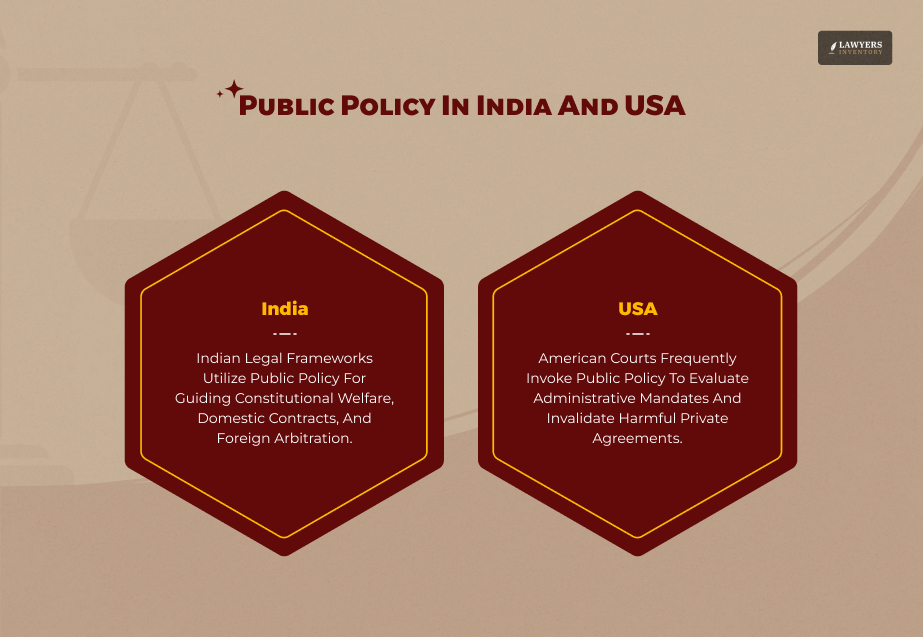
This is where the term becomes more important for someone seeking legal help.
In U.S. legal terminology, Cornell Law School’s Legal Information Institute notes that public policy can refer to principles underlying social rules.
It further states that these are “frequently unwritten and implemented through programs as a course of action established and/or legislated, generally by a government or non-profit organization, in response to social challenges.” [Source: Legal Information Institute]
In a legal context, it can also provide a basis for refusing legitimacy or enforcement to a contract or transaction that is harmful to the public interest.
I would therefore avoid saying that a court can reject any agreement simply because a judge dislikes it. Public-policy doctrines operate within established legal rules and vary by jurisdiction.
For example, U.S. courts have recognized circumstances in which contracts or contractual provisions will not be enforced because they conflict with public policy. The U.S. Supreme Court has discussed this principle in the context of arbitration agreements and exculpatory provisions.
The same phrase also carries important legal consequences in India, but the context matters.
How Public Policy Works In India
India is actually a very good example to support why I would never give a universal definition of public policy without first identifying the legal context.
Article 37 of India’s Constitution states a key rule. The Directive Principles of State Policy cannot be enforced by any court. Yet, the same article calls them the basis of governance. The government must consider them when making laws. [Source: Indian Kanoon]
Article 38 gives another specific instruction. The State must focus on the welfare of the people. It must also take steps to reduce inequalities.
Public policy applies to Indian contract law as well.
Section 23 of the Indian Contract Act, 1872 is crucial. It covers agreements against public policy. Here, public policy means the public good and public interest. It does not mean the policy of a specific government.
The Supreme Court of India, through cases like Central Inland Water Transport Corp. v. Brojo Nath Ganguly, clarified this section.
Arbitration serves as a further significant example. The Arbitration and Conciliation Act, 1996 uses this concept. Public policy is a ground for refusing foreign arbitral awards. The law lists specific situations. [Source: India Code]
These include a party being misled or bribed. They also include the main policy of Indian law. Finally, they include the fundamental principles of morality or justice.
These differences matter a lot. “Public policy” has different meanings across these fields. Constitutional governance, contract law, and arbitration require three different legal tests.
What About The United States And Other Countries?
In the United States, public policy operates through a federal and state legal system. A policy objective may become law through Congress or a state legislature, while agencies may implement statutory mandates through regulations and administrative action.
Courts can then review government action or resolve disputes under the applicable constitutional, statutory, regulatory, and common-law rules.
Other countries use different constitutional structures and administrative systems. The same policy objective may therefore produce different legal consequences.
I would also distinguish public policy as government policy from public policy as a legal doctrine. The first concerns what governments choose to do. The second concerns principles that courts and legal systems may use when resolving particular disputes.
That distinction is one of the most important gaps I see in many introductory explanations of the subject.
Articles often explain policymaking but do not tell a person facing a legal problem why the phrase “against public policy” may matter differently from a government policy announcement.
Why Public Policy Matters If I Have A Legal Problem
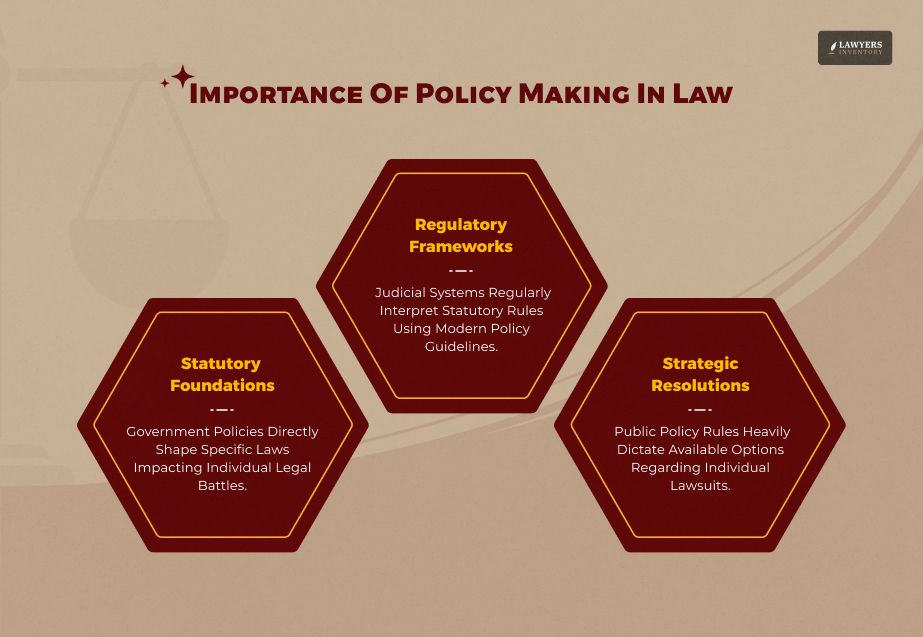
I would pay attention to public policy whenever a dispute involves government action, regulatory compliance, contracts, licensing, public benefits, employment rules, environmental restrictions, consumer protection, constitutional rights, or arbitration.
But I would not assume that mentioning “public policy” is enough to win a case.
A lawyer must identify the relevant jurisdiction, legal provision, government authority, contractual term, judicial precedent, and available remedy.
The question is not merely whether something appears unfair or undesirable. The legal question is whether an applicable rule recognizes the relevant public-policy principle and gives the court authority to act on it.
That is also why I would avoid relying on a general online definition when the issue concerns an active dispute. Public policy can be highly fact-specific and jurisdiction-specific.
What I Would Check Before Relying On A Public-Policy Argument
Before treating public policy as a legal argument, I would ask four basic questions.
First, which jurisdiction applies? A rule in India may differ substantially from one in a U.S. state or another country.
Second, what area of law is involved? Contract law, constitutional law, administrative law, arbitration, employment law, and criminal law can apply different tests.
Third, what is the actual legal source? I would look for the relevant statute, regulation, constitutional provision, or binding judicial decision rather than relying only on a policy statement.
Fourth, what remedy is available? Even where a public-policy concern exists, the available remedy may depend on the governing law and procedural rules.
For someone seeking legal help, these questions are more useful than memorizing a single definition.
Public Policy Is Not A Universal Rule
When I explain what public policy is, I describe it as the framework of government choices and actions used to address public problems. It can influence legislation, regulations, spending, administration, and public programs.
In law, however, the phrase has an additional and more precise role. Courts may use public-policy principles in specific legal contexts, including questions about enforceability and the validity or recognition of certain transactions or awards.The safest conclusion is therefore simple: public policy is not one universal legal rule. Its meaning and legal effect depend on the jurisdiction, the subject matter, and the specific legal provision or doctrine being applied.
Leave A Reply






Do You Pay Taxes On Lawsuit Settlements? IRC Section 104 Explained
Read More
Non-Disparagement Clause Explained: Requirements, Enforceability, And What Changed Recently
Read More
Best Practices For Successful Trademark Registration
Read More
Understanding Your Rights: A Guide To The Legal Process
Read More
How To Clear A Bench Warrant Without Going To Jail: A Legal Guide
Read More
0 Reply
No comments yet.