Summarize using AI





Prompt copied. Paste it into Gemini.
Quick Answer

Adopted on March 11, 1861, the Confederate Constitution was the governing document of the seceded Southern states through the American Civil War. Although it followed the 1787 U.S Constitution outline, it brought about changes that were quite open about their purpose. These amendments were made to shift powers to the central government and to make the practice of racial slavery legal.
The Provisional Congress adopted the Confederate Constitution on March 11, 1861. It met in Montgomery, Alabama. Eleven seceding Southern states used it as their supreme law during the Civil War.
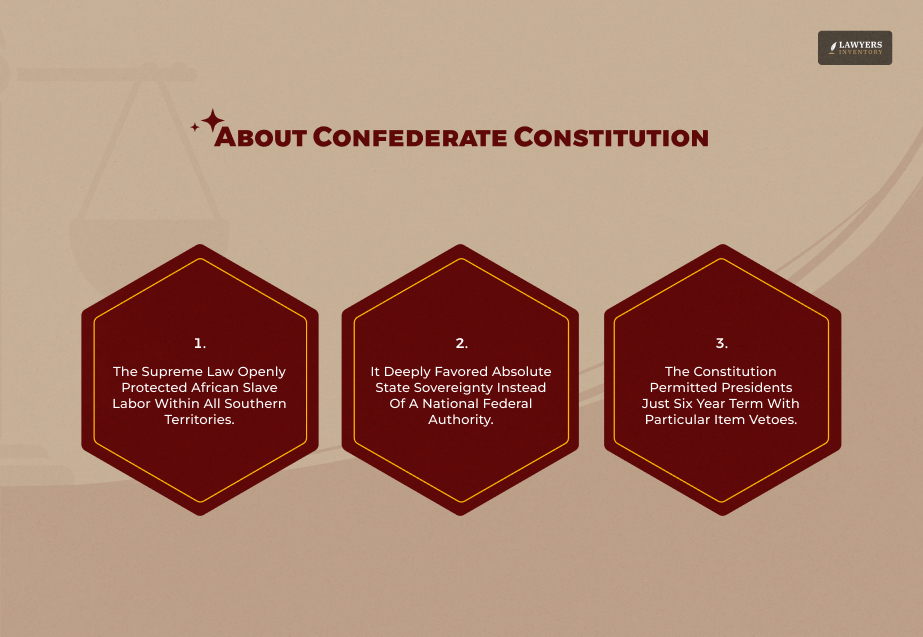
The drafters copied much of the 1787 U.S. Constitution’s structure. But they made deliberate changes. They named slavery directly. They barred any future law from restricting it. [Source: Article I, Section 9(4) and Article IV, Section 2(1) and Section 3(3).]
They gave the president a single six-year term. He could not seek re-election. [Source: Article II, Section 1(1).] They introduced a line-item veto over appropriations. [Source: Article I, Section 7(2).]
They banned protective tariffs. They blocked most federal infrastructure spending. [Source: Article I, Section 8(1) and 8(3).] They let just three states trigger a constitutional convention. [Source: Article V, Section 1(1).]
I treat this document as a primary source. It shows how structural choices shape governance outcomes, separate from what a document claims about itself. [Source: Avalon Project, Yale Law School]
What Is The Confederate Constitution?
I read this document as a founding charter first, and a political statement second. The provisional congress ratified it on March 11, 1861. That was about a month before the war began at Fort Sumter.
The structure looks familiar.
- Sets up a bicameral Congress.
- Creates a single executive.
- Anchors the judiciary in one Supreme Court. [Source: Article III, Section 1(1).]
But I found specific, deliberate departures once I compared clauses side by side.
It Named And Protected Slavery Explicitly
The drafters used the phrases “negro slaves” and “the institution of negro slavery.” I did not find the term “chattel slavery” anywhere in the text. This matters because several existing articles online get this detail wrong.
It Dropped General Welfare Language Tied To Tariffs
Congress could not use import duties “to promote or foster any branch of industry.” [Source: Article I, Section 8(1).] I read this as a direct rejection of protective tariff policy.
It Barred Federal Funding For Internal Improvements
Roads and canals lost federal support under this document. Congress kept a narrow exception for river and harbor navigation aids. [Source: Article I, Section 8(3).]
It Lowered The Bar For Amendments
Three states could force a constitutional convention. They did not need Congress to start the process. [Source: Article V, Section 1(1).] Compare this to the higher bar in the U.S. Constitution’s Article V.
I see this pattern clearly: the drafters borrowed 1787 language, then rebuilt the incentive structure underneath it.
Confederate Constitution vs. U.S. Constitution: Key Structural Differences
I built this table by comparing the original texts clause by clause. Here’s what you need to know:
| Legal Parameter | 1787 U.S. Constitution | 1861 Confederate Constitution |
| Executive Term | Four years, eligible for re-election | Single six-year term, no re-election (Art. II §1.1) |
| Budget Veto | Approve or reject entire bill | Line-item veto on individual appropriations (Art. I §7.2) |
| Slavery Language | No direct use of “slave” | Names “negro slaves” directly; protects the right of property in them (Art. I §9.4; Art. IV §2.1) |
| State Sovereignty | “We the People” forms a permanent union | States act “in its sovereign and independent character” (Preamble) |
| Judicial Wording | “Cases in Law and Equity” (Art. III §2.1) | Drops “Equity”; extends only to “all cases arising under this Constitution” (Art. III §2.1) |
| Diversity Jurisdiction | Covers suits between citizens of different states | Narrows to land-grant disputes only; bars suits against states by out-of-state or foreign citizens (Art. III §2.1) |
| Tariffs | Congress may lay duties for general welfare | Explicitly bars protective tariffs (Art. I §8.1) |
| Amendment Trigger | Congress or two-thirds of state legislatures | Any three states can summon a convention (Art. V §1.1) |
Note: I sourced the U.S. Constitution language from Article III, Section 2, Clause 1, per the National Archives and Cornell Law School’s Constitution Annotated.
Executive Power: The Single-Term Presidency And The Line-Item Veto
I want to separate two executive innovations here, because practitioners often conflate them.
- The first is the single term.
- The second is the budget veto.
They solve different problems. Here’s what you should know:
The Six-Year, Single-Term Presidency
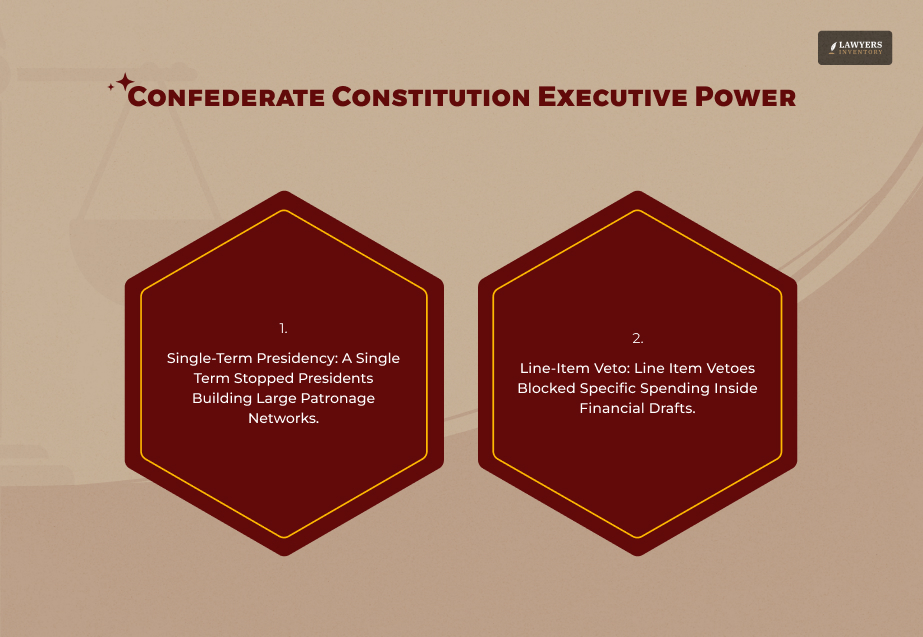
Article II, Section 1(1) set the term at six years. It added: “the President shall not be re-eligible.” I read this as a direct reaction to a specific fear.
Southern drafters worried that re-election incentives let presidents build patronage networks. Removing that option cut one risk.
But it also removed any accountability mechanism during the term itself.
The Constitutional Line-Item Veto
Article I, Section 7(2) matters more for modern practice. It lets the president “approve any appropriation and disapprove any other appropriation in the same bill.” Most legal experts call this a true line-item veto.
The U.S. president has never held this power constitutionally. Congress passed a statutory version in 1996. The Supreme Court struck it down two years later. The Court found it violated separation of powers. [Source: Clinton v. City of New York, 524 U.S. 417 (1998).]
The Confederate version avoided that problem. It sat directly in the constitutional text. It was not granted by ordinary statute. I see this as the reason the mechanism still comes up in comparative constitutional design discussions today.
Read Also: What Is A Constitutional Crisis And Are We In One Right Now?
The States’ Rights Paradox: Sovereignty Claims vs. Wartime Centralization
I found a real tension here, and I want to walk through it plainly.
The Preamble says each state acts “in its sovereign and independent character.” Article VI reserves undelegated powers to the states. That is the stated principle.
The government in Richmond did the opposite once the war started.
What The Central Government Actually Did
It enacted the Confederacy’s first national conscription law in April 1862. This was a wartime statute. It was not part of the constitutional text itself. It suspended habeas corpus in specific theaters and used the authority in Article I, Section 9(3).
That clause permits suspension “when in cases of rebellion or invasion the public safety may require it.” I note this language is nearly identical to the U.S. Constitution’s own Article I, Section 9. It impressed private property, including enslaved laborers, for military use.
How Governors Responded
Georgia’s Joseph Brown pushed back hard. So did North Carolina’s Zebulon Vance. Both argued these measures violated the sovereignty the Constitution promised them. I found no clean resolution to this dispute before the Confederacy collapsed in 1865.
I read this as a concrete lesson for practitioners: constitutional text favoring decentralization tends to give way under sustained emergency conditions. This holds true regardless of what the document says on paper.
Comparative Federalism: How This Fits Broader Constitutional Design
I place the Confederate model next to other federal systems to see what residual-power placement actually does to national stability.
India’s Centralized Residual Power
India runs a quasi-federal system. Residual legislative power sits with the central government. [Source: Article 248 of the Indian Constitution.] This is the opposite design choice from the Confederacy.
The U.S. Middle Ground
The 1787 Constitution sits between these two poles. It reserves residual power to the states or the people under the Tenth Amendment. But it grants a stronger central taxing and commerce power than the CSA ever adopted.
I treat the Confederate experiment as a useful data point precisely because it failed. A system that pushed residual authority almost entirely to the state level collapsed within four years.
External pressure forced it to override its own founding principles – conscription, impressment, martial law – just to function as a wartime state.
I don’t take this as proof that decentralization always fails. I take it as one documented case where an extreme version of it did, under the specific pressure of prolonged conflict.
Questions Practitioners Ask About The Confederate Constitution
I get the same handful of questions whenever this document comes up in comparative federalism discussions. I’ll answer each one directly, with citations.
Did The Confederate Constitution Actually Protect States’ Rights?
Only in a limited way. It gave states more autonomy in some areas. But it removed their freedom to abolish or restrict slavery within their own borders. Article I, Section 9(4) bars any law “denying or impairing the right of property in negro slaves.”
Article IV, Section 2(1) guarantees slaveholders the right to bring enslaved people into any state of the Confederacy without impairment.
I read this as clear evidence: on the question of slavery, state sovereignty stayed subordinate to protecting the institution.
Did The Confederacy Ever Establish Its Supreme Court?
No, it did not. Article III, Section 1 authorized “one Supreme Court, and such Inferior Courts as the Congress may from time to time ordain and establish.”
Congress created inferior district courts. It never passed the legislation needed to organize the Supreme Court itself. State-sovereignty objections blocked it.
Legislators feared a federal appellate body reviewing state court decisions. State supreme courts filled the gap in practice. I found this produced inconsistent interpretation of Confederate law across different states.
What Happened To The Diversity Jurisdiction Clause?
The drafters narrowed it. The U.S. Constitution’s Article III grants federal courts jurisdiction over “controversies… between citizens of different states.”
I compared this against Article III, Section 2(1) of the Confederate text. The Confederate version removed that general grant.
It limited citizen-vs-citizen federal jurisdiction to land-grant disputes only. It specified that “no state shall be sued by a citizen or subject of any foreign state.”
I see this as consistent with the missing “equity” language in the same clause. Both reflect the same anti-centralization instinct: narrower federal judicial reach, by design.
Which Features Of The Document Had Lasting Influence?
I found one clear survivor: the constitutional line-item veto under Article I, Section 7(2). It remains the most frequently cited example in modern discussions of executive budget power.
The U.S. never adopted it at the federal level in constitutional form, though. Beyond that single feature, I did not find evidence that the document’s other distinctive provisions survived Confederate defeat in any direct legal sense.I treat its significance today as a comparative case study, not a source of surviving legal doctrine.
Leave A Reply






Do You Pay Taxes On Lawsuit Settlements? IRC Section 104 Explained
Read More
Non-Disparagement Clause Explained: Requirements, Enforceability, And What Changed Recently
Read More
Best Practices For Successful Trademark Registration
Read More
Understanding Your Rights: A Guide To The Legal Process
Read More
How To Clear A Bench Warrant Without Going To Jail: A Legal Guide
Read More
0 Reply
No comments yet.