Quick Answer

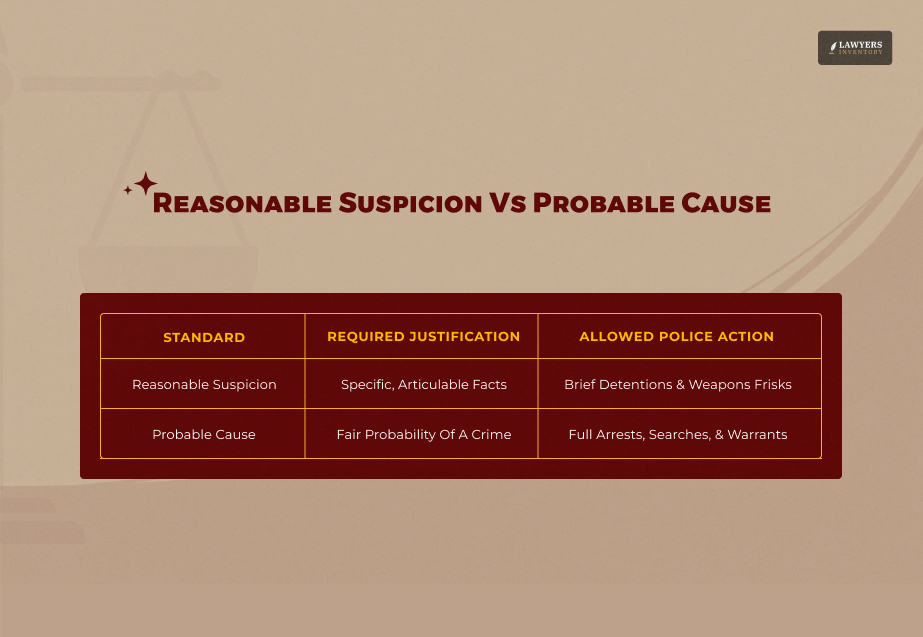
Reasonable suspicion is the lower of two legal standards under the Fourth Amendment. It allows police to briefly stop and detain someone based on specific, articulable facts suggesting criminal activity - but not to arrest or conduct a full search. Probable cause is the higher standard. It requires sufficient facts that a reasonable person would believe a crime has been committed, and it authorizes arrests, full searches, and search warrants. If either standard is not met, evidence obtained as a result may be suppressed - and charges can be reduced or dismissed entirely.
Most people learn about reasonable suspicion vs probable cause the hard way – during a traffic stop, a street encounter, or when they are trying to understand why evidence in a criminal case was thrown out.
These are not abstract legal technicalities. They are the constitutional standards that determine when police can legally stop you, search you, and arrest you. Getting them wrong – on either side of the encounter – has real consequences.
The gap between these two standards is exactly where most Fourth Amendment violations happen. Understanding where one ends and the other begins tells you what police can and cannot do at every stage of an encounter with law enforcement.
The Fourth Amendment: Where Both Standards Come From
Both reasonable suspicion and probable cause flow from the same constitutional source.
The Fourth Amendment to the United States Constitution provides that the right of the people to be secure in their persons, houses, papers, and effects against unreasonable searches and seizures shall not be violated.
No warrants shall issue but upon probable cause.
The Fourth Amendment does not give police unlimited authority to stop, search, or arrest anyone they want. It requires law enforcement to meet a specific legal standard depending on what they are trying to do.
Courts have spent decades defining what “unreasonable” means in practical terms. The result is a tiered system where different police actions require different levels of justification.
Reasonable suspicion and probable cause are the two main tiers in that system. They are not equivalent, interchangeable, or simply different words for the same concept.
Each authorizes a distinct category of law enforcement action – and each carries distinct legal consequences when it is not met.
The Legal Burden Of Proof In Reasonable Suspicion Vs Probable Cause
Most people know that criminal conviction requires proof beyond a reasonable doubt. Fewer understand where reasonable suspicion and probable cause sit relative to that standard – or relative to each other.
The spectrum runs from no standard at all through increasing levels of certainty:
- Mere suspicion or hunch – Not enough to justify any police action. A gut feeling alone has no legal weight.
- Reasonable suspicion – Specific, articulable facts suggesting possible criminal activity. Justifies a brief investigative stop and pat-down for weapons.
- Probable cause – Sufficient facts that a reasonable person would believe a crime has been committed. Required for arrest, full search, and search warrants.
- Preponderance of evidence – More likely than not. The standard for civil cases.
- Clear and convincing evidence – A higher civil standard used for serious matters like fraud.
- Beyond a reasonable doubt – The highest standard. Required for criminal conviction.
Probable cause sits well above reasonable suspicion but well below what a jury needs to convict. It is commonly described as a “fair probability” that a crime occurred – not certainty, but meaningfully more than a guess.
Reasonable Suspicion: The Lower Standard
Reasonable suspicion is the legal threshold that permits police to briefly stop and detain a person for investigative purposes without making an arrest or conducting a full search.
It is narrow and purpose-driven. The stop must be brief, and its scope must be limited to investigating the specific suspicion that justified it.
The standard requires specific and articulable facts – not a hunch, a feeling, or a general sense that something seems off.
The officer must be able to point to concrete, observable facts that, combined with rational inferences from those facts, suggest that criminal activity is occurring, has occurred, or is about to occur.
Terry v. Ohio: The Case That Defined the Standard
The practical legacy of Terry v. Ohio (1968) is the creation of the “Terry stop,” an investigative tool that allows police to briefly detain individuals without making a formal arrest.
The case arose after a detective observed men repeatedly walking past a store window, suspected they were “casing” it for a robbery, and stopped them. He conducted a limited pat-down of their outer clothing, discovering concealed guns on two of the suspects.
The Supreme Court ruled this conduct constitutional, establishing a two-part framework for law enforcement:
- The Stop: Officers may briefly detain someone based on reasonable suspicion of criminal activity.
- The Frisk: Officers may conduct a limited pat-down for weapons if they reasonably believe the suspect is armed and dangerous.
Crucially, the Court ruled that this suspicion must rely on specific, articulable facts rather than a mere gut feeling or hunch.
What Reasonable Suspicion Allows – And Does Not Allow
Reasonable suspicion authorizes a brief investigative stop – typically no longer than necessary to confirm or dispel the suspicion. It also authorizes a limited pat-down of outer clothing for weapons if the officer has specific reason to believe the person may be armed.
Here’s what it does not authorize:
- A full search of pockets, bags, or a vehicle
- An arrest.
- Handcuffing someone and placing them in a patrol car unless circumstances escalate independently to justify that level of restraint.
The moment a stop extends beyond its investigative purpose – or escalates without a corresponding increase in legal justification – the constitutional analysis changes.
What Happens If Police Had No Legal Basis To Stop Me?

Your attorney can file a motion to suppress evidence if the police stopped you without reasonable suspicion or searched your property without probable cause. This motion asks the judge to prohibit the prosecution from using that illegally obtained evidence against you.

If the judge approves your motion, the court bars that evidence from your trial. The loss of this principal evidence frequently forces the prosecutor to lower your charges or drop the case entirely.

Your defense team handles this process through a formal suppression hearing. This legal proceeding takes place in court before your trial begins.
Probable Cause: The Higher Standard
Probable cause is a significantly higher bar. It is the standard required before an officer can make an arrest, conduct a full search, apply for a search warrant, or obtain an arrest warrant.
The Supreme Court has described probable cause as existing when the facts and circumstances within the officer’s knowledge are sufficient to warrant a person of reasonable caution in the belief that a crime has been committed.
The standard is objective – it does not depend on what the individual officer believed, but on what a reasonable person with the same information would conclude. Hunches, even experienced ones, do not establish probable cause. Evidence, observations, and reliable information do.
Illinois v. Gates: The Totality Of The Circumstances Test
The U.S. Supreme Court clarified the standard for determining probable cause in Illinois v. Gates (1983). This landmark decision fundamentally changed how courts evaluate information provided by confidential informants. [Source: South Carolina Fraternal Order of Police]
Before this ruling, judges applied a rigid, two-pronged legal test to evaluate police informer tips. This older framework forced courts to analyze an informant’s reliability and their basis of knowledge as two entirely separate, strict requirements.
With its decision, the Supreme Court dropped that rigid test completely. Instead, the Court established a more flexible “totality of the circumstances” standard. Judges must now weigh all the facts and surrounding circumstances together to decide if probable cause exists.
Courts must look at the whole picture – every fact, observation, tip, and inference. Now, they assess whether they collectively establish a fair probability that contraband or evidence of a crime will be found, or that the suspect committed the offense.
This totality approach gives officers and courts flexibility to evaluate complex situations. It also means that no single factor is automatically decisive.
A tip from an unknown informant may be insufficient alone but sufficient when combined with police corroboration of the tip’s details.
What Probable Cause Authorizes
Probable cause authorizes arrest without a warrant if the officer personally witnesses an offense or has probable cause to believe a felony has been committed and the suspect committed it.
Here’s what it authorizes:
- A full search of a person incident to that arrest.
- Application for a search warrant.
The latter requires presenting a sworn affidavit to a magistrate establishing that probable cause exists to believe evidence will be found in the location to be searched.
Several exceptions to the warrant requirement exist, but probable cause remains the governing standard in each of them.
The automobile exception – allowing warrantless searches of vehicles – still requires probable cause.
Exigent circumstances searches – conducted without a warrant when an emergency makes obtaining one impractical – still require probable cause.
The warrant requirement can be bypassed in some circumstances. The probable cause requirement cannot.
Does Probable Cause Guarantee A Conviction?

No. Probable cause only justifies an arrest or charge, requiring far less evidence than the "beyond a reasonable doubt" standard needed to convict. Cases frequently collapse before trial if the state lacks trial-ready evidence, new exonerating facts emerge, or defense lawyers successfully suppress illegally obtained evidence using the exclusionary rule.
The Exclusionary Rule In Reasonable Suspicion Vs Probable Cause: What Happens When The Standards Are Not Met
Police misconduct triggers the exclusionary rule. The landmark case Mapp v. Ohio (1961) confirmed this rule. It strictly forbids prosecutors from using primary evidence gathered without reasonable suspicion or probable cause. [Source: Legal Information Institute]
Reasonable suspicion exists when an officer spots suspicious behavior without a clear explanation or alibi. Probable cause requires enough evidence to convince a fair-minded person that a specific individual committed a crime.
The “fruit of the poisonous tree” doctrine extends this constitutional protection even further. Silverthorne Lumber Co. v. United States (1920) established this legal principle. It excludes all secondary or derivative evidence stemming from the original illegal action.
For example, the court will throw out a weapon found during an unlawful search. It will also reject any confession that follows that illegal search. [Source: Justia]
Ultimately, the consequence is direct and dramatic. The loss of key evidence often destroys the government’s case completely. Prosecutors cannot secure a guilty verdict.
An illegal stop or an improper search can easily ruin a criminal prosecution. This remains true even if the suspect is actually guilty, and even if other evidence links them to the crime.
Where These Standards Apply: Common Scenarios For Reasonable Suspicion Vs Probable Cause
Reasonable suspicion and probable cause do not exist in the abstract. They arise in specific, recurring situations that anyone who interacts with law enforcement may encounter.
Traffic Stops
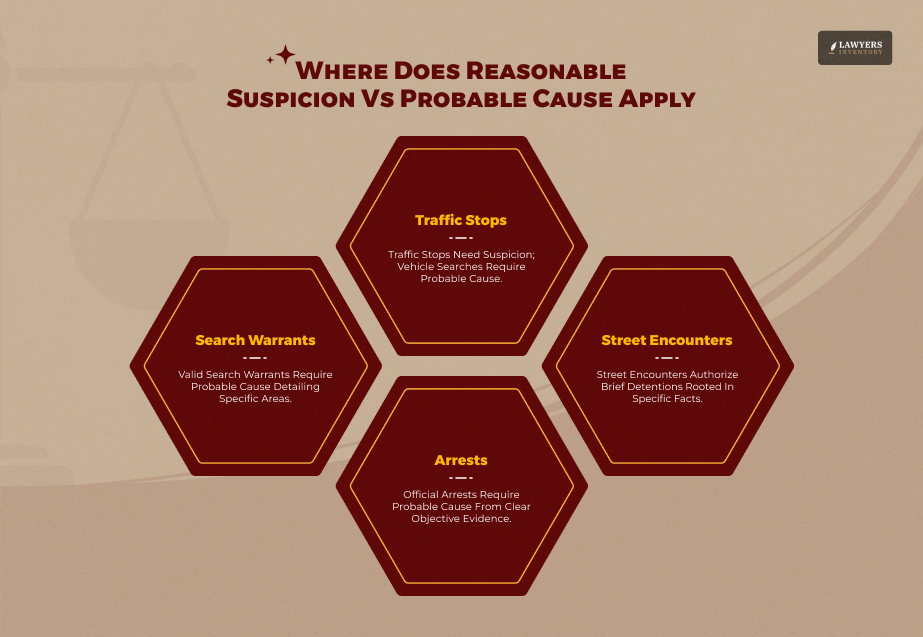
A traffic stop requires reasonable suspicion at minimum – a specific, articulable reason to believe a traffic violation occurred or that criminal activity is afoot.
An observed lane change without a signal, a broken taillight, or erratic driving satisfies this standard.
A vague sense that the driver looks suspicious, or a desire to investigate based on neighborhood or demographics alone, does not.
Once stopped, escalating to a search of the vehicle requires probable cause – the plain smell of marijuana, a weapon in plain view, or other specific, objective indicators of criminal activity.
Street Encounters And Terry Stops
An officer who observes behavior consistent with criminal activity – specific conduct, not merely presence in a high-crime area – may initiate a brief investigative detention.
The stop must be brief. The officer may conduct a pat-down for weapons if they have specific, articulable reason to believe the person is armed.
Presence in a high-crime area alone does not establish reasonable suspicion. Some of the things that alone do not establish reasonable suspicion include:
- Race.
- Ethnicity.
- Generalized nervousness.
The facts must be specific to this person, this behavior, at this time.
Arrests
An arrest requires probable cause. Officers must be able to point to specific facts establishing a fair probability that the person committed a crime.
Some of the things that can establish probable cause include the following:
- Witness identification.
- Direct observation of an offense.
- Combination of circumstantial evidence that a reasonable person would find convincing.
An arrest made without probable cause is an unlawful arrest.
Evidence obtained as a result – including statements made after an unlawful arrest – may be suppressed under the exclusionary rule.
Search Warrants
Generally, there must be probable cause supported by an affidavit that a magistrate can review and sign a warrant based on. The contents of the affidavit should specify the location under search and the objects to which legal process attaches.
In general, warrants which permit investigators from searching everything that an individual holds are considered to be invalid due to violation of the Fourth Amendment’s specificity requirement.
Digital Devices And The Border: A Developing Area In Reasonable Suspicion Vs Probable Cause
When talking about these standards, most often ignore an area that is both practically significant and legally unsettled in 2026: searches of cell phones and digital devices, particularly at the border.
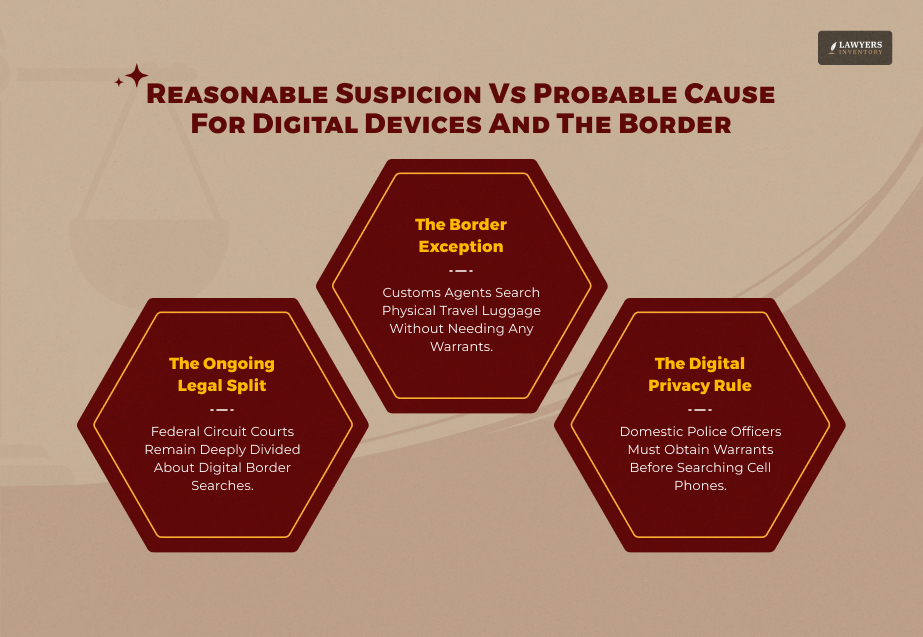
U.S. Customs and Border Protection agents can search travelers, their luggage, and their vehicles at ports of entry without any individualized suspicion. This is the border search exception to the Fourth Amendment.
However, the law governing digital device searches at the border is actively developing. Some federal circuits require reasonable suspicion for a forensic search of a phone’s contents, even at the border.
Intimate body cavity searches require a heightened level of suspicion. This standard closely approaches probable cause due to the highly intrusive nature of the search.
Digital privacy follows stricter rules. In Riley v. California (2014), the Supreme Court ruled that the traditional “search incident to arrest” exception excludes digital data. Police must obtain a warrant before they can search an arrestee’s cell phone. [Source: Justia]
However, the border search exception governs international transit under a separate standard. The Supreme Court has not yet decided how Riley applies to international travel.
Consequently, U.S. circuit courts remain deeply divided. Judges disagree on whether border agents need a warrant, individualized suspicion, or no suspicion at all to perform a forensic search on a traveler’s electronic devices.
For anyone crossing international borders with digital devices containing sensitive information, understanding that the usual probable cause requirement for digital searches may not apply at the border is practically important knowledge in 2026.
State Constitutions: Where Protections Can Go Further
Federal Fourth Amendment standards establish a floor – the minimum protection every American receives. State constitutions can and do provide broader protections. This is one of the most consistently underexplored aspects of these standards.
Several states interpret their own constitutions to require more than the federal minimum. Some states require a higher level of justification for certain stops or searches than federal law demands.
Some state courts have interpreted their constitutions to limit the automobile exception or to require a warrant for searches that federal law permits without one.
The practical consequence for anyone involved in a criminal case is significant. A challenge that would fail under federal Fourth Amendment doctrine might succeed under state constitutional law.
An experienced criminal defense attorney familiar with your state’s constitutional jurisprudence – not merely federal Fourth Amendment standards – is positioned to identify arguments that generalist analysis would miss.
Reasonable Suspicion Vs Probable Cause: What These Standards Mean During A Police Encounter
These principles have immediate practical applications if you are ever stopped by police. Understanding them before an encounter is far more useful than learning them afterward.
You have the right to remain silent during any police stop. Provide identification if required by your state’s stop-and-identify statute. Beyond that, you are not required to answer questions, consent to a search, or explain yourself.
Do not physically resist a stop or a search even if you believe it is unlawful. Resistance creates independent legal exposure and does not preserve your constitutional challenge.
Assert your rights verbally and clearly – “I do not consent to this search” – then raise the constitutional issue through your attorney and the suppression motion process. That is where these standards are tested and enforced.
If you are arrested, ask for an attorney immediately and do not speak without one present. A stop or search that lacked the required legal justification can be challenged – but that challenge happens in court, not on the street.
Disclaimer: This article is for general informational and educational purposes only. It does not constitute legal advice. If you believe your Fourth Amendment rights were violated during a police encounter, consult a qualified criminal defense attorney in your jurisdiction immediately.
Sources:
- U.S. Constitution, Amendment IV – Fourth Amendment Text and Clause
- Terry v. Ohio, 392 U.S. 1 (1968) – Reasonable suspicion standard for investigative stops
- Illinois v. Gates, 462 U.S. 213 (1983) – Totality of circumstances test for probable cause
- Mapp v. Ohio, 367 U.S. 643 (1961) – Exclusionary rule applied to states
- Riley v. California, 573 U.S. 373 (2014) – Warrant requirement for cell phone searches incident to arrest
- Illinois v. Wardlow, 528 U.S. 119 (2000) – Flight from police and reasonable suspicion
- United States v. Montoya de Hernandez, 473 U.S. 531 (1985) – Border search and reasonable suspicion for extended detentions
- Silverthorne Lumber Co. v. United States, 251 U.S. 385 (1920) – Fruit of the poisonous tree doctrine
- FindLaw – What’s the Difference Between Reasonable Suspicion and Probable Cause? (May 2026)
- Legal Synopsis – Probable Cause vs Reasonable Suspicion: 2026 Guide
- Eisner Gorin LLP – Reasonable Suspicion vs. Probable Cause Explained (March 2026)
- GovFacts – Your Rights: Reasonable Suspicion, Probable Cause (December 2025)
- Legal Information Institute, Cornell Law School – Fourth Amendment
Leave A Reply






Can You Get A DUI On A Bike? How Vehicle Codes Impact Impaired Cycling
Read More
What Is Malicious Prosecution? How To Know If You Have A Claim
Read More
What Is Malicious Compliance? Can It Get You Fired, Sued, Or Legally Protected?
Read More
What Is Litigation? A Complete Guide To The Legal Process, Costs, And When You Need It
Read More
What Does Pro Bono Mean – And Does It Actually Mean Free?
Read More
0 Reply
No comments yet.