Quick Answer

The Restatement (Second) of Torts first introduced the concept of Intentional Infliction of Emotional Distress (IIED) in 1964. Recently, the American Law Institute updated this framework. The most current version is the Restatement (Third) of Torts: Liability for Physical and Emotional Harm. Courts consider Section 46 of this modern text to be a highly reliable legal source. The rule states that a wrongdoer is liable if their extreme and outrageous conduct causes severe emotional harm to another person. To trigger this legal liability, the wrongdoer must act with specific intent or recklessness. Ultimately, they face legal accountability for the serious psychological hurt they cause.
Emotional harm is real harm. Courts have recognized this for decades – and the tort of intentional infliction of emotional distress exists specifically to provide a legal remedy when someone’s deliberate or reckless conduct causes severe psychological injury.
But the bar is deliberately high. Hurt feelings, rudeness, and even deliberate unkindness generally do not qualify. Understanding precisely what the law requires – and what evidence actually supports a winning claim – is essential before pursuing this cause of action.
What Is Intentional Infliction Of Emotional Distress?
Intentional infliction of emotional distress is a tort that occurs when one acts in a manner that intentionally or recklessly causes another to suffer severe emotional distress.
It is a standalone civil claim – meaning a plaintiff can pursue it even without accompanying physical injury. [Source: Legal Information Institute]
The tort was not always recognized. For most of legal history, emotional harm without physical injury was not independently compensable.
Courts gradually accepted that psychological damage could be genuine, measurable, and caused directly by another’s conduct.
The Restatement (Second) of Torts formalized IIED in 1965. The Restatement (Third) of Torts: Physical and Emotional Harm, § 46 provides the modern authoritative framework, stating that a person who intentionally or recklessly causes severe emotional harm to another by extreme and outrageous conduct is liable for that emotional harm.
Some jurisdictions call this tort “outrage” or “the tort of outrage.” The name varies by state. The underlying elements do not.
The Four Elements Of An IIED Claim
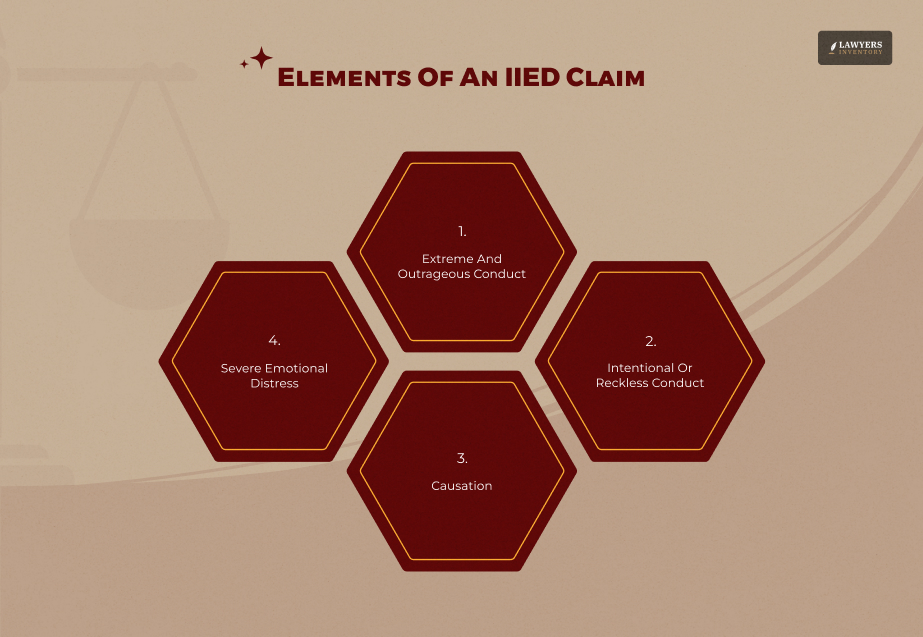
Every IIED claim rests on four elements. The plaintiff must establish all of them by a preponderance of the evidence – meaning it is more likely than not that each element is satisfied.
Element One: Extreme And Outrageous Conduct
This is the most demanding element and the one on which most IIED claims fail. The defendant’s conduct must go beyond all possible bounds of decency and be regarded as atrocious and utterly intolerable in a civilized community. Courts apply this standard strictly.
Conduct that qualifies is genuinely extreme. Examples courts have found sufficient include:
- A debt collector making repeated threatening phone calls to a person’s home at all hours claiming false legal consequences. [Source: Sherman v. Field Clinic (Illinois)]
- An employer systematically targeting an employee with a calculated campaign of humiliation designed to force resignation.
- A hospital worker falsely telling a patient that a family member had died. [Source: Wilkinson v. Downton (1897)]
- A person repeatedly showing up at another’s home to make graphic threats.
What does not qualify is equally important. Mere insults, indignities, threats, annoyances, or petty oppressions do not meet the threshold.
Courts have consistently refused IIED claims based on rude workplace behavior, offensive remarks, ordinary employment disputes, and interpersonal conflicts – even when those interactions were genuinely distressing. [Source: Slocum v. Food Fair Stores of Florida (1958)]
The standard is not what the plaintiff found unbearable. It is what a reasonable person in a civilized society should not be expected to endure.
Element Two: Intentional Or Reckless Conduct
The defendant must have either intended to cause severe emotional distress or acted with reckless disregard of the high probability that severe distress would result. This element is broader than it appears.
The plaintiff does not need to prove that the defendant specifically intended emotional harm. Reckless disregard of an obvious risk of severe distress is sufficient.
This distinction matters in cases where the defendant claims their conduct was thoughtless rather than malicious.
A defendant who creates an obvious risk of severe psychological harm – and proceeds anyway – satisfies this element even without proof of deliberate cruelty.
Element Three: Causation
To win an emotional distress claim, the plaintiff bears the initial burden of proof. They must establish a direct, unbroken chain of causation.
Specifically, they must prove that the defendant’s outrageous or negligent conduct directly generated the psychological trauma.
Consequently, defense attorneys aggressively exploit pre-existing conditions. If a plaintiff already struggled with depression, anxiety, or unrelated life stressors, the defense will use those facts.
They will argue that the defendant’s actions did not cause the current mental state. Instead, they will claim the distress stems entirely from independent, external life events.
To defeat this defense strategy, plaintiffs must build a rigorous evidence trail. They map out a strict chronological timeline. This timeline connects the precise date of the misconduct directly to the sudden onset of psychological symptoms.
Furthermore, they hire mental health experts, psychiatrists, and psychologists to write comprehensive medical evaluations. These expert reports legally link the clinical diagnosis directly to the defendant’s specific actions.
Element Four: Severe Emotional Distress
The distress must be severe. Temporary upset, embarrassment, grief, and anxiety – even genuine and understandable – do not meet the threshold.
Severe emotional distress is distress of such substantial quantity or enduring quality that no reasonable person in a civilized society should be expected to endure it.
Courts look for distress that is clinically significant and documented.
Psychiatric diagnoses of post-traumatic stress disorder, major depressive disorder, generalized anxiety disorder, and similar conditions – tied to the defendant’s conduct by a treating or evaluating mental health professional – provide the strongest foundation for this element.
Physical manifestations of psychological harm – insomnia, weight loss, inability to work, and physical illness caused by stress – also support the severity element.
Intentional Infliction Of Emotional Distress vs. Negligent Infliction Of Emotional Distress
| Feature | Intentional (IIED) | Negligent (NIED) |
| Blame | Intentional or reckless. | Careless or accidental. |
| Conduct | Extreme and outrageous. | Breach of standard care. |
| Physical | Purely mental harm. | Requires physical impact. |
| Bystander | Present at the event. | Inside the zone of danger. |
| Focus | Punishing bad behavior. | Fixing careless errors. |
This distinction determines which claim a plaintiff should pursue. Intentional infliction requires intentional or reckless conduct.
Negligent infliction of emotional distress – NIED – applies when the defendant’s careless conduct, rather than deliberate or reckless behavior, causes severe emotional harm. The conduct threshold for NIED is typically lower – negligence rather than outrageousness.
However, NIED carries its own restrictions, including a physical impact requirement in some states and a bystander limitation in others. [Source: Legal Information Institute]
The practical question is: was the defendant’s conduct deliberate and extreme, or merely careless? If the conduct was extreme and targeted, IIED is typically the stronger claim and carries higher damage potential.
If the defendant was careless rather than deliberately harmful – a medical provider who fails to notify a patient about a serious diagnosis, for example – NIED may be the more appropriate cause of action.
Some plaintiffs pursue both claims in the alternative. A skilled personal injury attorney can assess which claim the facts best support and whether pleading both creates strategic advantage.
IIED In The Workplace
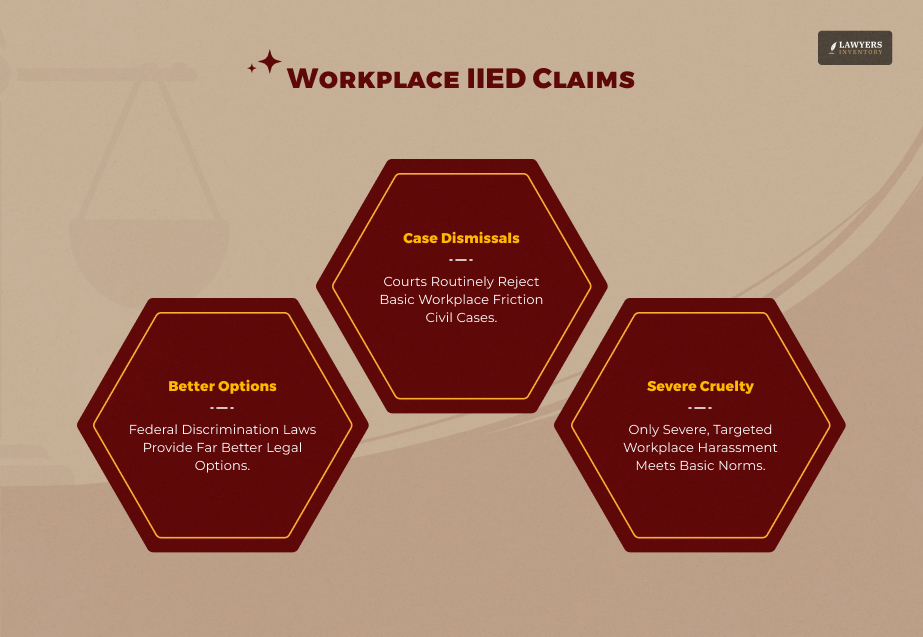
Workplace IIED claims are among the most commonly filed – and the most commonly dismissed. Courts apply the outrageous conduct standard with particular strictness in employment contexts.
The reason courts are more skeptical of workplace IIED claims is that employment relationships inherently involve conduct that employees may find distressing – criticism of performance, assignment changes, termination decisions, and management conflict.
Courts have consistently held that personality conflicts, harsh criticism, unfair treatment, and even deliberate unkindness in the workplace do not meet the outrageous conduct threshold.
What does meet the threshold in employment cases is conduct that goes well beyond ordinary workplace friction. This can be:
- A calculated campaign of humiliation.
- Sustained targeting designed to cause psychological breakdown.
- Deliberate exposure of an employee’s private medical information to coworkers.
- Systematic retaliation combining multiple forms of harassment over time.
Many workplace IIED claims are better pursued alongside – or instead of – claims under anti-discrimination statutes.
Title VII of the Civil Rights Act, the Americans with Disabilities Act, and state employment discrimination laws often provide more accessible remedies for workplace misconduct than IIED’s demanding common-law standard.
Third-Party Bystander Claims
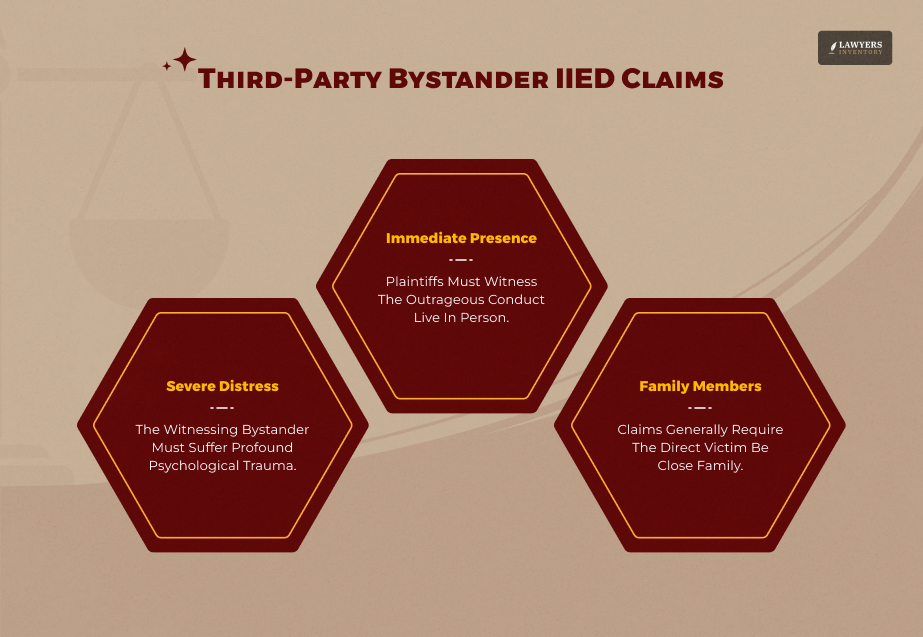
IIED can extend beyond the person directly targeted by the defendant’s conduct. When extreme and outrageous conduct is directed at a third party – typically a family member – and the plaintiff witnesses it, a bystander IIED claim may be available.
The requirements for bystander claims are more restrictive.
The conduct must occur while the family member or close person is present. The plaintiff must be present at the time of the conduct.
And the distress suffered by the bystander must itself be severe and directly caused by witnessing the event. Courts are reluctant to extend IIED liability too broadly. The requirement of presence at the time of the conduct is a hard limit in most jurisdictions.
This claim arises most commonly in situations where a plaintiff witnesses extreme abuse or harassment directed at a child, spouse, or other immediate family member.
The underlying conduct must still meet the outrageous standard – and the bystander’s distress must be severe, not merely sympathetic.
The First Amendment Limit
One aspect of IIED law that most people overlook entirely is its constitutional boundary. When the defendant’s conduct involves speech on matters of public concern – particularly involving public figures – the First Amendment imposes limits on IIED liability.
The Supreme Court established this boundary in Hustler Magazine v. Falwell, 485 U.S. 46 (1988). [Source: Justia]
The Court held that a public figure cannot recover for IIED based on speech regarding a matter of public concern unless the speech contains a false statement of fact made with actual malice.
Satire, parody, and offensive commentary on public figures receive First Amendment protection that defeats an IIED claim. No matter how distressing it is to the subject.
This limitation applies primarily to public figures and matters of genuine public concern. Private individuals in private disputes are not affected by this constraint.
But in any case involving media defendants, online publication, or commentary on matters of public interest, the First Amendment analysis must be part of the claim assessment.
Damages And What Courts Actually Award
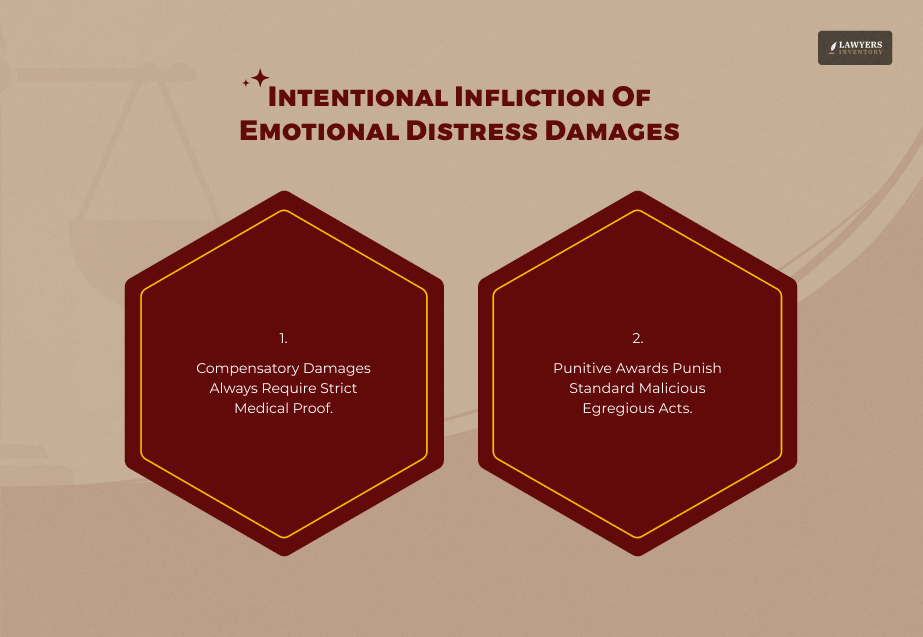
IIED damages fall into two categories: compensatory damages and punitive damages.
Compensatory damages cover the actual harm caused – therapy costs, psychiatric treatment, lost wages from inability to work, and compensation for pain and suffering.
These require documentation. Courts expect plaintiffs to produce medical and mental health records, employment records showing impact on work performance, and expert testimony connecting the diagnosis to the defendant’s conduct.
Punitive damages may be available in cases involving particularly egregious conduct. It involves cases where the defendant’s behavior was malicious, oppressive, or carried out with conscious disregard for the plaintiff’s rights. [Source: Steinger, Greene & Feiner]
Punitive damages are not available in every state and are subject to constitutional proportionality limits established by the Supreme Court.
Courts have awarded six-figure damages in well-documented IIED cases. But documentation is the operative word.
A claim supported by a treating psychiatrist’s testimony, contemporaneous records of the defendant’s conduct, a clear diagnosis tied to those events, and evidence of ongoing impact is far stronger than a claim that relies primarily on the plaintiff’s own account of their suffering.
What Evidence Actually Wins An IIED Claim
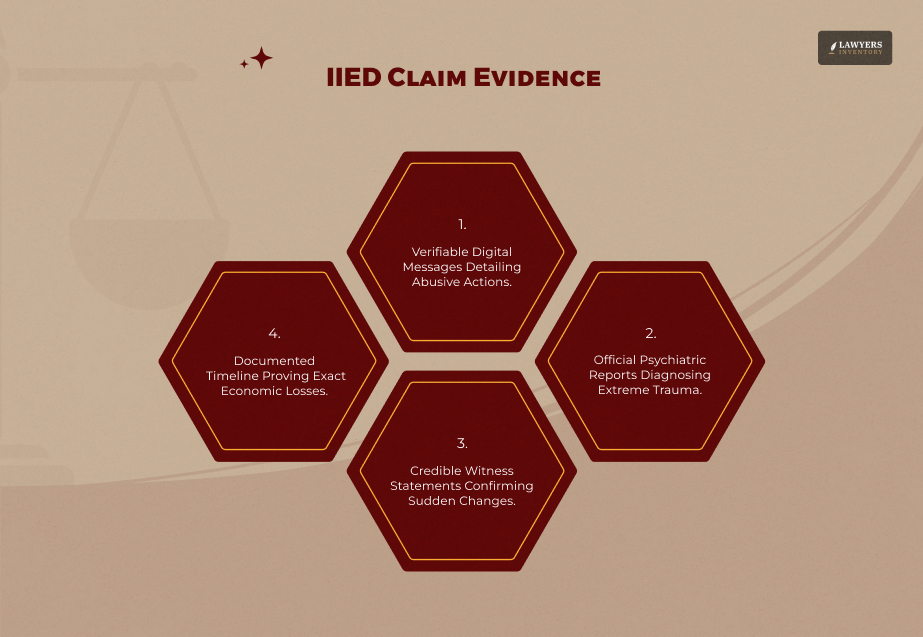
Across all four elements, evidence quality is what separates successful IIED claims from dismissed ones. Plaintiffs who pursue this tort without building a strong evidentiary record rarely prevail.
The most important categories of evidence include:
- Contemporaneous records of the defendant’s conduct. This includes text messages, emails, voicemails, social media posts, and witness accounts created at the time events occurred
- Mental health treatment records that document the diagnosis, its onset, and its connection to the defendant’s conduct.
- Testimony from a treating or evaluating mental health professional who can speak to both severity and causation.
- Evidence of the conduct’s impact on daily functioning – employment records, school records, testimony from family members who observed changes in behavior.
- Timeline that clearly connects the defendant’s conduct to the onset and progression of the distress.
Evidence created or preserved at the time of the events is significantly more persuasive than retrospective accounts assembled after litigation begins.
Anyone who believes they may have an IIED claim should document the defendant’s conduct contemporaneously. Rather than waiting until litigation is underway, they should:
- Preserve every communication.
- Record every incident in writing with dates.
- Seek mental health treatment promptly.
Defenses To Intentional Infliction Of Emotional Distress Claims
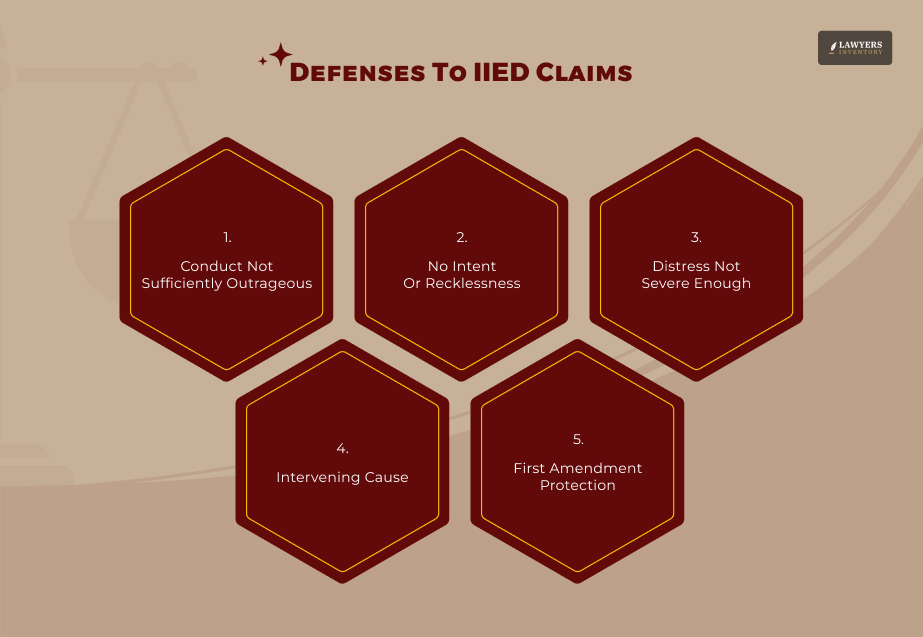
Understanding the defenses a defendant will raise helps plaintiffs anticipate the challenges their claim faces.
Conduct Not Sufficiently Outrageous:
This is the most common defense. The defendant argues their behavior, while perhaps inappropriate, did not meet the extreme standard. Courts agree more often than plaintiffs expect.
No Intent Or Recklessness:
The defendant argues their conduct was thoughtless rather than deliberate – attempting to shift the claim to negligence, where different and sometimes more restrictive rules apply.
Distress Not Severe Enough:
The defendant challenges whether the plaintiff’s emotional response meets the legal threshold for severity. This defense directly attacks the fourth element. It is particularly effective when the plaintiff has not sought professional mental health treatment.
Intervening Cause:
The defendant argues that the plaintiff’s distress results from other life circumstances – pre-existing conditions, unrelated stressors, or other events – rather than the defendant’s conduct.
First Amendment Protection:
In cases involving speech, the defendant may argue constitutional protection defeats the claim – particularly when the plaintiff is a public figure or the subject matter involves public concern.
Disclaimer: This article is for general informational and educational purposes only. It does not constitute legal advice. IIED law varies by state, and the strength of any claim depends on the specific facts and applicable jurisdiction. If you believe you have been subjected to extreme and outrageous conduct that caused severe emotional harm, consult a qualified personal injury attorney in your jurisdiction as soon as possible.
Sources:
- Restatement (Third) of Torts: Physical and Emotional Harm, § 46 – American Law Institute
- Restatement (Second) of Torts § 46 – American Law Institute (1965)
- Legal Information Institute, Cornell Law School – Intentional Infliction of Emotional Distress – law.cornell.edu/wex/intentional_infliction_of_emotional_distress
- Hustler Magazine, Inc. v. Falwell, 485 U.S. 46 (1988) – First Amendment limit on IIED claims
- FindLaw – Intentional Infliction of Emotional Distress (updated September 2025) – findlaw.com/injury/torts-and-personal-injuries/intentional-infliction-of-emotional-distress.html
- Bloomberg Law – Intentional Infliction of Emotional Distress Overview – bloomberglaw.com
- Justia – CACI No. 1600: Intentional Infliction of Emotional Distress – California Civil Jury Instructions (2026) – justia.com
- USLegal – Intentional Infliction of Emotional Distress Law and Legal Definition – definitions.uslegal.com
- Neurolaunch – Intentional Infliction of Mental Distress: Legal Implications and Emotional Impact (updated August 2026) – neurolaunch.com
- Saeedian Law Group – Intentional Infliction of Emotional Distress in California (updated September 2026) – saeedianlawgroup.com
- Viehweg v. Vic Tanny International of Missouri, Inc., 732 S.W.2d 212 (Mo. App. 1987) – Outrageous conduct standard
- Title VII of the Civil Rights Act of 1964, 42 U.S.C. § 2000e – Federal employment discrimination law
- Americans with Disabilities Act of 1990, 42 U.S.C. § 12101 – Employment protections for disabled workers
Leave A Reply






What Is A Preliminary Hearing? Core Procedures, Timeline, And What To Expect
Read More
What Is Grand Larceny? Felony Thresholds, Penalties, And Your Legal Options
Read More
Larceny vs. Theft: What’s The Real Legal Difference?
Read More
Is AI Ruining Your Legal Case? How To Detect And Correct Fabricated Law
Read More
Can You Get A DUI On A Bike? How Vehicle Codes Impact Impaired Cycling
Read More
0 Reply
No comments yet.