Summarize using AI





Prompt copied. Paste it into Gemini.
Listen to this article
Quick Answer: Law Schools That Don't Require LSAT
No ABA-accredited law schools have done away with testing completely. There is still a requirement to take an admissions test (ABA Standard 503). However, the ABA allows schools to request a variance so they can admit up to 100% of their class without requiring an LSAT or other test. This builds on a previous rule allowing up to 10% of a class to be admitted without an LSAT score (Interpretation 503-3).
Finding law schools that don’t require LSAT scores is now a top goal for many applicants seeking a legal education.
The American Bar Association (ABA) historically required a valid standardized test score for all accredited schools under its strict Standard 503 rules.
However, the rules for law school admissions changed rapidly over the past few years, creating brand new options for students. Admissions offices now look at applicants using alternative tests, university exemption paths, and total portfolio reviews.
To understand the various applications available, it is important to understand your overall goals. Many people will ask – how long does it take to get a law degree in the United States?
A standard Juris Doctor (JD) degree is 3 years of full-time study. You’ll learn core rules, short case studies, and develop your legal writing skills. Once you have obtained your Law degree, there are many different things that you can go into.
Beyond working in a courtroom, graduates can go into areas such as corporate compliance, government policy, real estate management, and business leadership.
The Evolution Of Standardized Testing In Legal Admissions
This shift in testing methods has been a huge change in American law education. For many years, the LSAC had full control over entry into the legal profession.
Many educators have argued that having only one test does not show students’ actual capabilities as well as those from lower-income backgrounds or non-traditional career routes.
Using alternative tests helps to improve equity issues in this area while still maintaining high academic standards.
Shift In The Law School Testing Timeline
- Before 2021: The ABA strictly enforced Standard 503, making the LSAT a mandatory requirement for almost every applicant.
- November 2021: The ABA officially approved the GRE as a valid alternative to the LSAT for law school admissions.
- 2023–2026: The ABA began granting individual variances for a new class-based test called JD-Next.
- Present Day: Over 100 accredited law schools now accept alternative scores or offer true test-optional pathways.
Applicants evaluating these options must look closely at how hard is the LSAT compared to newer tests.
The traditional exam requires absolute mastery of formal logic and strict reading comprehension under a very tight timer.
To get ready, students spend months learning how to study for the LSAT, often buying expensive books and taking dozens of timed practice tests.
Because traditional test prep takes so much time and money, both students and universities have pushed for simpler ways to measure academic ability.
ABA-Accredited Schools With A No-Test Variance
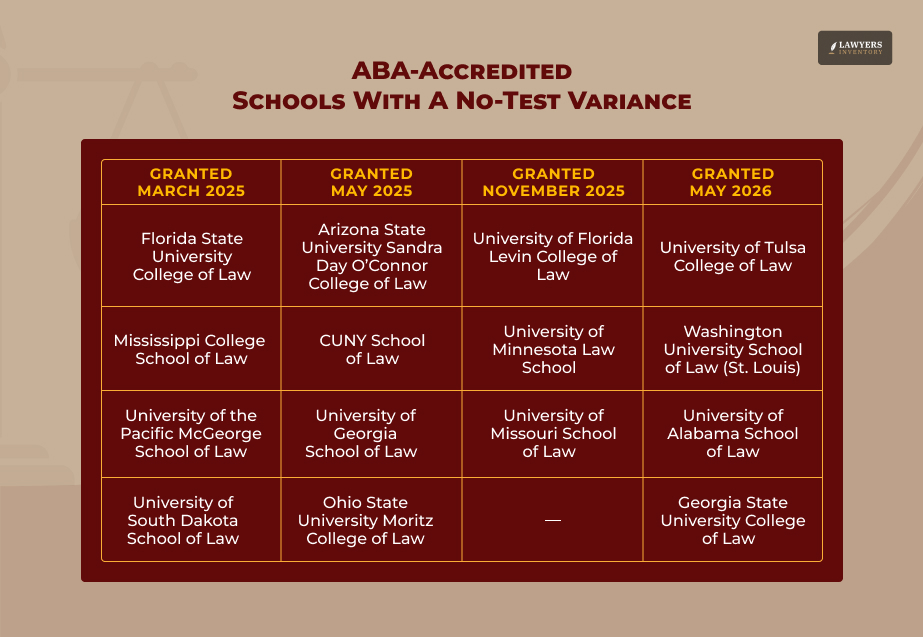
This list comes from the ABA’s own page of granted Standard 503 variances. It includes the schools granted a variance that is not the JD-Next-only kind.
Granted March 2025
- Florida State University College of Law
- George Mason University Antonin Scalia Law School
- Indiana University–Bloomington Maurer School of Law
- Mississippi College School of Law
- University of the Pacific McGeorge School of Law
- University of South Dakota School of Law
- Syracuse University College of Law
- Texas A&M University School of Law
- University of Utah S.J. Quinney College of Law
- University of Washington School of Law
Granted May 2025
- Arizona State University Sandra Day O’Connor College of Law
- CUNY School of Law
- University of Georgia School of Law
- Ohio State University Moritz College of Law
Granted November 2025
- University of Florida Levin College of Law
- University of Minnesota Law School
- University of Missouri School of Law
Granted May 2026
- University of Tulsa College of Law
- Washington University School of Law (St. Louis)
- University of Alabama School of Law
- Georgia State University College of Law
Law Schools That Don’t Require LSAT Metrics: The Current Landscape

Finding a complete list of law schools that don’t require LSAT or GRE scores requires checking the specific rules of each university. Most ABA-accredited schools still want at least one standardized test score to satisfy national rules.
However, over 100 top-tier and regional law schools updated their basic rules to accept other types of tests. This systemic change gives multiple options to students who want to avoid the traditional exam.
There are unique situations where you can find law schools that don’t require LSAT or GRE scores at all.
Some schools use high undergraduate GPAs to exempt their own college graduates, while others participate in experimental pilot programs approved by the ABA.
Applicants must check the rules for each university carefully, because policies can change between early application deadlines and regular application pools.
The GRE And GMAT Multi-Program Track
The most common alternative path is submitting Graduate Record Examination (GRE) scores. After data proved that GRE scores successfully predict a student’s first-year law grades, elite programs – like Harvard, Yale, and Stanford – began accepting it.
The Graduate Management Admission Test (GMAT) is another option, though schools usually limit GMAT scores to students applying for joint JD/MBA business degrees.
The Emergence Of JD-Next As An Approved Alternative
A highly significant update is the growth of the JD-Next path. Created by the University of Arizona and managed by Aspen Publishing, JD-Next is an 8-week online course covering basic contract law, followed by a final test.
The ABA has given official permission to dozens of law schools to accept JD-Next scores instead of a traditional entrance exam. This program tests your actual ability to learn law school work rather than testing abstract logic games.
Institutional Exceptions And True Test-Optional Frameworks
True test-optional admissions – where you do not submit any test score at all – are still rare but growing.
The ABA allows law schools to accept a small percentage of their class without scores under strict exemption rules.
These application tracks place all the focus on college transcripts, professional writing samples, and letters of recommendation. As a result, finding premier law schools that don’t require LSAT points involves evaluating these specific institutional programs.
Elite candidates often wonder how high they need to get on their LSAT to get into an elite university like Harvard. For traditional applicants, this is usually going to be between 170-176.
However, if you are taking the GRE route, you will completely avoid this scoring system. The admissions committee will look at your academic results from undergrad and personal achievements.
In some cases, skipping the LSAT could affect your financial aid. As you won’t have a merit-based scholarship to law school, you will need to prove your excellence through other means, such as having an extremely high GPA in college.
Direct Admissions For Internal Undergraduates
Many large state universities use the ABA’s undergraduate exemption rules to keep their top college talent.
For example, the University of Iowa College of Law runs the Kinnick Law Program, which allows top Iowa undergraduates with high GPAs to skip the LSAT entirely.
Similarly, the University of Florida Levin College of Law offers a true test-optional path for its own top-performing seniors through the Gator Scholars Program.
Holistic Programs For Experienced Professionals
Certain schools have special ABA permissions to conduct expanded test-optional pilots. WashU Law (Washington University in St. Louis) offers an extremely pure holistic admissions process by allowing all applicants to decide if they wish to submit their test scores.
George Washington University Law School also has a test-optional option for those with 4 or more years of full-time professional experience or military service, or an obtained doctoral degree.
Financial And Career Implications Of Bypassing The LSAT
There are obvious financial implications of skipping entrance scores.
To become a lawyer is an expensive undertaking, and so students will want to know how much it will actually cost them to go to law school.
Annual fees for top private law schools can be in excess of $70,000, bringing the total three-year cost well past $250,000, including accommodation and books.
Many law schools will offer the best scholarships and discounted fees based on your traditional entrance scores.
Therefore, those applying without these scores may not receive as much merit aid unless they have a higher-than-average grade at university.
Financial And Career Trade-Offs
| Admission Path | Financial Impact | School Availability | Primary Benefit |
| Alternative Metrics (GRE / JD-Next) | May limit access to certain merit scholarships at specific schools. | Available at over 100 ABA-approved law programs. | Bypasses heavy test prep costs and logic-game stress. |
| Traditional Track (LSAT) | Maximizes eligibility for automatic institutional merit aid. | Universally accepted at all 199 ABA law schools. | Clear, predictable path to secure funding packages. |
Despite potentially higher student debt, graduates from these courses are able to go into a variety of different areas.
Those who have graduated using holistic admissions often use their qualification to work in non-traditional law careers.
This could include roles such as:
- Corporate Consulting
- Sports Agency Management
- Financial Fraud Analysis
- Executive Leadership roles in large non-profit organizations.
Legal employers nowadays often look for practical skills, writing skills, and hands-on experience, so by finding progressive law schools that do not require LSAT scores, your studies will be tailored to these current industry trends.
Admissions Metrics And Bar Exam Performance
In the admissions world, an often ignored aspect is the correlation between entrance exams and licensing standards.
The ABA is vigilant in monitoring consumer protection through Standard 316, which requires schools to maintain a minimum pass rate of 75% on the Bar exam within 2 years of graduation.
In the past, the legal industry utilized the multi-state UBE Bar exam to ensure standardized legal principles are understood between states.
Admissions committees are also particularly careful with alternative testing groups to ensure non-traditional testing methods do not negatively affect their strict accreditation criteria.
The testing environment is shifting toward the comprehensive NextGen Bar exam, which emphasizes practical skills, client counseling, and legal research over rote memorization.
This evolution aligns neatly with the philosophy behind alternative admissions tools like JD-Next, which evaluate procedural skills rather than abstract logic.
As a result, many progressive law schools that don’t require LSAT scores view this shift as a validation of their holistic frameworks.
They anticipate that students evaluated on classroom performance and core legal analysis will perform exceptionally well on a modernized, practice-focused licensing exam.
The Judicial Career Path Without Traditional Metrics
A long-term goal for many legal academics is to become part of the judiciary.
Many new students will ask if you need a law degree to become a judge in the United States. This largely depends on the jurisdiction you want to work in.
All federal judges and state appellate justices will have law degrees. However, there are some local jurisdictions that employ magistrates or justices of the peace who aren’t legally qualified to adjudicate on minor offenses and small claims courts.
To get onto a court of record, you will need a legal education and knowledge of complex legal principles.
Requirements For Different Judicial Levels
- Courts of Record (Federal and State Appellate Courts): A formal Juris Doctor degree is strictly required, state bar licensure is mandatory, and judges must have a deep background in legal brief writing.
- Local and Magistrate Courts (Select Jurisdictions): A law degree is optional in specific states, the courts have limited case jurisdiction, and laypersons can sometimes be appointed or elected.
Writing is developed from the first stage of application. LSAC has recently updated its writing test to the LSAT argumentative writing task, which gives candidates more realistic writing tasks, similar to the essays they will be asked to complete at law school.
Candidates will be given a large amount of facts to analyze and must write a well-structured, persuasive piece of writing within a time limit.
Some holistic admissions will require candidates to submit a different piece of writing, such as their undergraduate thesis or work from a professional setting. Writing is a vital skill for progression in the legal sector.
Overview Of Assessment Methods
Navigating the details of law schools that don’t require LSAT scores involves comparing the entry parameters of different test structures.
The following table provides a direct comparison of the primary assessment tools accepted across the United States.
| Metric Type | Primary Focus | Best Suited For | Key Limitation |
| Traditional LSAT | Analytical and Logical Reasoning | Universal Applicants | High Prep Cost & Stress |
| GRE General | Verbal, Quant, & Essay Writing | STEM & Joint-Degree Applicants | Variable School Acceptance |
| JD-Next Course | Contract Law Class Performance | Practical & Non-Traditional Learners | Requires 8-Week Time Investment |
| True Test-Optional | Undergraduate GPA & Experience | Internal Alumni & Mid-Career Pros | Capped Percentage of Class Size |
Ultimately, deciding to skip traditional entry requirements comes down to being brutally honest about the make-up of your personal portfolio.
As more law schools that don’t require the LSAT become available, selecting the right score for you will ensure you protect your finances, understand the rules of the institution, and create a fulfilling career in law.
Disclaimer:
This article is for informational purposes only. Always visit official sources before applying.
Sources:
- American Bar Association (ABA): Standard 503: Admission Test
- American Bar Association (ABA): Standard 316: Bar Passage Outcomes
- LSAT Argumentative Writing Overview: Law School Admission Council (LSAC)
- JD-Next: A Validated Alternative Law School Admission Test: JD-Next (Aspen Publishing)
- List of Law Schools Accepting the GRE General Test: Educational Testing Service (ETS)
- J.D. Application Requirements and Holistic Review Policies: Washington University School of Law (WashU Law)
- J.D. Admissions Test-Optional Pathway for Experienced Professionals: George Washington University Law School (GW Law)
- The Kinnick Law Program Rules and Merit Scholarship Limitations: University of Iowa College of Law
- Gator Scholars Program Direct Admission Requirements: University of Florida Levin College of Law
- The NextGen Bar Exam: Testing Practical Skills and Legal Research: National Conference of Bar Examiners (NCBE)
Leave A Reply






How To Structure The New LSAT Writing Sample Under Time Constraints
Read More
Skills vs. Memorization: Why The LSAT Fails Rote Learners And How The Curve Works
Read More
How To Study For The LSAT? The Exact Study Protocol Used By Top LSAT Test-Takers
Read More
The Complete Law School Timeline: Traditional, Accelerated, And Part-Time Pathways Compared
Read More
What Is The True Cost Of A JD: Tuition Sticker Price Vs. Hidden Living And Interest Traps
Read More
0 Reply
No comments yet.