Summarize using AI





Prompt copied. Paste it into Gemini.
Today’s hot topic: Hawthorne Residential Partners lawsuit
For several years, residents living in Hawthorne Residential Partners-operated apartments have complained about excessive rent increases, discriminatory treatment of security deposits, and a lack of response to repair requests.
The beginning of 2025 witnessed these complaints becoming a real legal battle that might end up redefining tenant protection laws in multiple states.
Moreover, for renters, this particular case is so much more than statistics and insights on a piece of court document. It has more to do with families who felt trapped due to the escalating residential expenses. And not just that – property managers repeatedly ignored these families.
To corporate property managers and landlords, the lawsuit is a reminder that transparency and accountability aren’t just a choice anymore. Rather, they happen to be at the core of survival – especially in the present housing landscape.
This article breaks down the lawsuit:
- Who are Hawthorne Residential Partners?
- Why did the Hawthorne Residential Partners lawsuit happen? Timeline.
- A complete breakdown of the lawsuit.
- The specific claims made by both parties.
- Eligibility for filing the lawsuit.
- Potential grounds for filing a lawsuit.
- Expected compensation and settlements.
- Real-life tenant anecdotes.
Stay tuned.
Who Are Hawthorne Residential Partners?
Launched in 2009 in North Carolina’s Greensboro, Hawthorne Residential Partners started as a property management company. Initially, operating locally, the firm expanded and grew into one of Southeast’s biggest apartment operators.
With over 175 communities as of 2025, Hawthorne Residential Partners operates in multiple states, including Virginia, Tennessee, Georgia, North Carolina, and South Carolina.
Business Model:
Hawthorne Residential Partners (HRP) positions itself less like a property management firm and more like offering “modern living with a sense of community.”
The firm’s carefully curated communities usually feature:
Hawthorne positions itself as providing “modern living with a sense of community.” Its communities typically feature:
- Pools,
- Fitness centers,
- Pet-friendly amenities like dog parks,
- Business centers,
- Clubhouses, and more.
The company’s branding attracts expanding families, retirees, and young professionals seeking community and convenience at an affordable price.
But under all that glorified branding, several tenants claim a different reality. Instead of quality service and stability, they are dealing with:
- Unexpected increases in rent.
- Poor maintenance.
- Inconsistent follow-throughs.
- Combative approaches with zero cooperation from property managers.
Why Did The Hawthorne Residential Partners Lawsuit Happen? Timeline
The Hawthorne Residential Partners lawsuit didn’t happen over a month – it took years to ferment and grow into a conflict. It’s the result of a tenant’s frustration growing over the years.
Disjointed complaints related to maintenance delays and rent hikes might not be alarming when seen as isolated incidents. But collectively, these issues revealed a negative pattern.
On that note, here’s a complete timeline breakdown of the lawsuit:
| Year | Description (What Happened?) |
| 2018 – 2021 | Tenant forums and online complaint websites started displaying the same kinds of complaints – disputes over security deposits, rent hikes, and inattentive management. |
| 2022 | Tennessee and North Carolina legal aid organizations talked about observing a hike in complaints by tenants about HRP. |
| 2023 | Lawyers began to collect cases, monitoring evidence of various discriminatory practices in multiple states. |
| 2024 | Several tenants sued. Then, the lawsuits were all consolidated into a single class-action case. |
| 2025 | Courts are considering the certification of the class action, potentially covering hundreds of tenants. |
The fact that a class action has escalated from individual complaints highlights how structural and prevalent the supposed issue could be.
Hawthorne Residential Partners Lawsuit: A Complete Breakdown
Over time, Hawthorne Residential Partners has gotten tangled up in several legal messes. Most of them involve tenant complaints and property issues, everything from negligence claims to accusations of ignoring fair housing laws.
These kinds of lawsuits don’t just hit a company’s image—they also send a strong message to other property managers about what not to do. I reviewed some of the public court records, and here are some of the things that I found out about the ongoing.
Let’s break down some of the bigger cases that’ve been turning heads:
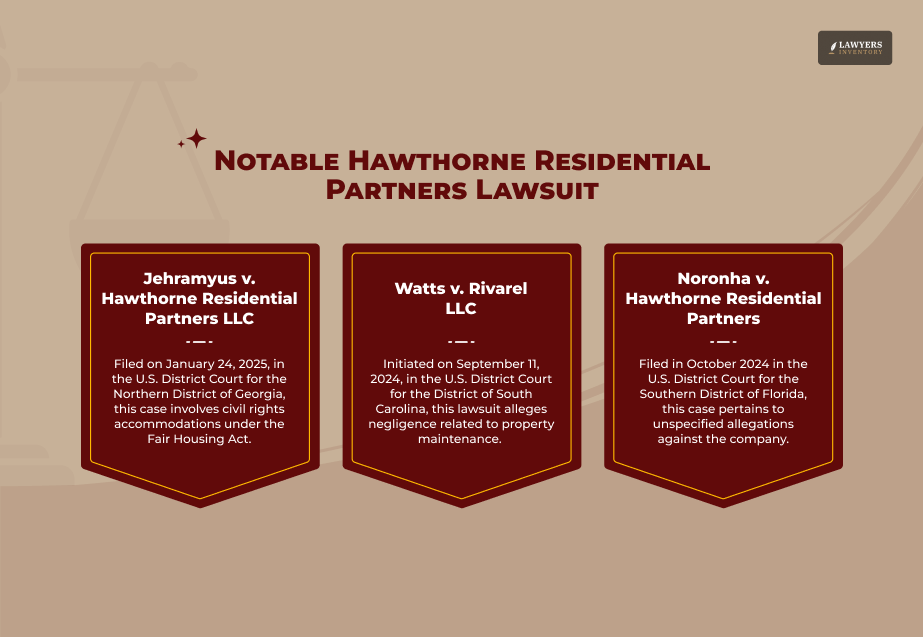
Jehramyus v. Hawthorne Residential Partners LLC
According to Justia, Jehramyus v. Hawthorne Residential Partners LLC (No. 1:2025cv00304) was filed January 24, 2025, in the U.S. District Court for the Northern District of Georgia, alleging violations of the Fair Housing Act for failure to provide disability accommodations.
Although the case is still unfolding, it’s a reminder that companies can’t cut corners when it comes to accessibility.
Watts v. Rivarel LLC
This one came up on September 11, 2024, in South Carolina. Rivarel LLC—tied to Hawthorne—was accused of letting hazardous conditions slide at one of their properties. According to the lawsuit, that neglect led to someone getting hurt.
Claims like these highlight just how vital maintenance is. Ignoring safety issues isn’t just bad business—it can land you in court.
Noronha v. Hawthorne Residential Partners
Filed in October 2024 in Florida, this lawsuit is another reminder that legal troubles can hit anytime when tenant complaints go unresolved.
According to Law360, Noronha v. Hawthorne Residential Partners is a federal court case filed against HRP, alleging the violation of civil rights. Additionally, they also filed complaints about breach of contract by the residential company.
Keosha Johnson v. Hawthorne Residential Partners
In 2023, in Keosha Johnson v. Hawthorne Residential Partners, LLC (Wake County, NC), the court approved a class-action settlement over allegedly unlawful fees tied to eviction processes.
According to the official court records, Johnson alleged that the company “violated N.C.G.S. §§ 42-46 and 75-50 et seg. by automatically assessing tenants three fees incurred in filing an eviction lawsuit based on tenants’ failure to pay rent or other amounts owed in a timely manner.”
What Are The Major Legal Allegations In The Hawthorne Residential Partners Lawsuit?
As I have already mentioned above, BBB data shows 130 complaints over the past three years, with many involving service/repair issues and delayed maintenance requests. On top of these, Hawthorne’s legal battles shine a light on deeper problems in the rental world.
From what’s been shared publicly, several themes keep popping up:
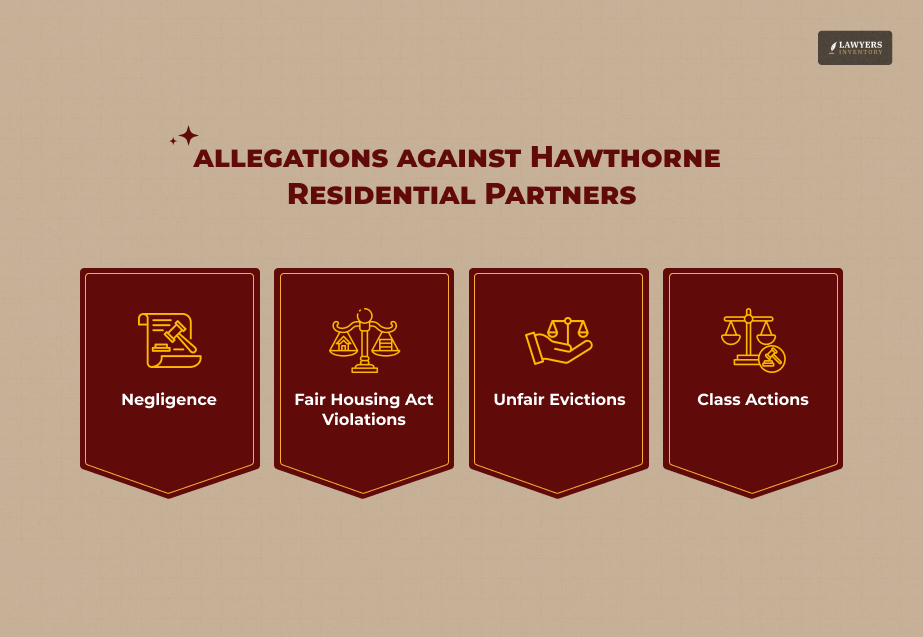
- Negligence: One of the biggest complaints? Hawthorne allegedly ignored repair and safety issues. We’re talking mold, broken appliances, dangerous living conditions… and tenants claim their concerns fell on deaf ears.
- Fair Housing Act Violations: Some lawsuits argue that the company didn’t accommodate people with disabilities or discriminated based on protected traits. That’s a serious breach of federal law.
- Unfair Evictions: A few tenants have said they were kicked out without a valid reason or without proper legal procedures. That’s not just shady—it’s often illegal.
- Class Actions: Multiple people have come together in some cases, filing class action lawsuits. They pointed to widespread issues like systemic neglect or broken lease agreements.
These cases aren’t just about money. They’re about holding companies accountable and reminding landlords everywhere that tenant rights matter.
Eligibility for Filing a Hawthorne Residential Partners Lawsuit
Thinking about taking legal action? Here’s what you’ll need to consider:
- You’re a current or past tenant: You’ve got to have lived in one of their managed properties.
- You’ve been harmed somehow: This could mean financial losses, health issues from bad living conditions, unfair treatment, breach of contract—you name it.
- You tried to resolve it: Courts want to see that you at least tried to fix the issue before jumping into a lawsuit.
You’re within the time limit: Each state has its own rules for how long you have to file a claim—don’t wait too long.
Potential Grounds for Filing a Lawsuit
Here’s a quick rundown of reasons people have used in similar lawsuits:
- Breach of contract: like when the landlord promises working appliances or pest control and then ghosts you.
- Discrimination: especially if they denied you reasonable accommodations or treated you unfairly because of your race, religion, or disability.
- Illegal evictions: tossing tenants out without a legal reason or skipping the proper notice process.
- Negligence: failing to fix stuff that could cause harm (like broken stairs or exposed wiring).
If any of that sounds familiar, it’s probably time to speak with a lawyer. Experts like a landlord-tenant attorney are probably the best ones who can help you in such cases.
Additionally, with their legal assistance, you will be able to understand your rights much better!
Compensation You Can Expect: Hawthorne Residential Partners Lawsuit Settlement Amounts
So what kind of payout are we talking about?
The short answer: it depends. Every case is different, and the final amount depends on the specifics—what went wrong, what proof you have, and how bad the damage was. But here’s the kind of stuff tenants could be compensated for:
Types of Compensation
If you are trying to understand the amount of money you can get out of a settlement in the lawsuit, there’s something more important that you need to know.
And what’s that? Well, TBH, it’s the type of compensation that you might be eligible for in the case!
“There’s type?”
Yes, my friend! There are types of compensation. Here are some of them that you should know if you are planning to be a part of the Hawthorne Residential Partners lawsuit:
- Repair and Maintenance Costs: If you had to cover repairs out of pocket because management didn’t step up, you might be reimbursed.
- Rent Refunds or Security Deposit: Paid rent for an apartment you couldn’t even live in properly? You might get some of that back. Same for deposits that were unfairly withheld.
- Emotional Distress: Stress, anxiety, and frustration from living in unsafe or discriminatory conditions? In some cases, you can be compensated for that too.
- Legal Fees: If you win, you may get back the money you spent hiring a lawyer.
- Punitive Damages: If the company acted especially recklessly, courts might add extra penalties to make sure they don’t pull the same stunt again.
What Is The Settlement Amount In The Lawsuit?
Exact figures from the Hawthorne cases haven’t all been made public.
But if we look at similar lawsuits against other management companies, settlements can range from a few thousand bucks to six-figure sums—especially in class actions or when serious injuries were involved.
Your final amount depends on how strong your case is and how well it’s documented.
Hawthorne Residential Partners Lawsuit: Real-life Tenant Stories
The actual tenant stories show how high the stakes really are:
1. “My rent increased $400 in a year. I couldn’t afford to relocate, so I felt trapped.” – A tenant living in Charlotte currently.
2. “I requested accommodation due to my disability, but they denied it. It was humiliating.” – A tenant from Tennessee.
3. “When I left, they charged $1,000 to install a carpet that was five years old.” – A tenant living in Raleigh.
4. “We sent more than 10 maintenance requests for mold. They checked them off as ‘completed’ every time, but nobody ever showed up.” – A former tenant from Atlanta.(Source: lawsuitzone.com)
Hawthorne Residential Partners Lawsuit: Who Can Help You in Similar Cases?
It is extremely exhausting to deal with a housing lawsuit. But guess what? You don’t really need to solve all the problems on your own. Here are some people who can actually help you:
- Landlord-Tenant Lawyers: These are the guys who know all the details of rental laws. They will explain to you your rights, assist in preparing a good case, and if it goes to court, they will be there for you.
- Fair Housing Advocates: Such parties as the National Fair Housing Alliance and local non-profits can become your strongest allies when it comes to the fight against discrimination. They will even be the ones to report to HUD on your behalf.
- Legal Aid Services: In case you have no money to pay for a lawyer, you can still try to reach legal aid organizations. Those groups, in large part, are open to providing the renters free or reasonably paid assistance.
If you were searching for information on the Hawthorne Residential Partners lawsuit, I hope this blog cleared a few things up. Got questions? Drop them in the comments—I’ll do my best to help you figure it out.
Frequently Asked Questions:
Check out the most frequently asked questions about the Hawthorne Residential Partners Lawsuit:
In 2009, Hawthorne Residential Partners was launched by Shoff Allison, Ed Harrington, and Samantha Davenport.
Generally, housing lawsuits take 1 to 3 years to settle – this is specifically true for class actions. And the HRP lawsuit is no different.
Yes. The decisions that can come out of this could go on to establish a legal precedent that can impact rental housing across the United States.
Read Also:
- Generational Equity Reviews- An Honest Guide (2025)
- An Understanding Of The Home Depot Damage Protection Class Action
- Direct Fairways Lawsuit- Allegations, Legal Implications, And Consumer Impact
Leave A Reply







Understanding The Lady Bird Deed: What Is It & How Is It Better?
Read More
Understanding What Does Under Contract Mean In Real Estate
Read More
Is Section 8 Getting Cut Off: Answering The Most Asked!
Read More
Texas Built Construction Lawsuit Explained: Rights, Remedies, And Legal Truths
Read More
0 Reply
No comments yet.